What is a Blog and Why Does Your Business Need One


A blog is a section of a website with regular publications (articles, case studies, guides) that serves two business objectives simultaneously: it drives organic traffic from Google and converts visitors into customers. In this guide, we will break down what a blog is, why businesses need one, how a blog impacts SEO promotion, how it helps attract clients, and which are the best platforms for creating a blog in 2026.
The article is structured according to the Spilno Agency analysis principle: sequential numbered sections, comparative data, and a final conclusion with concrete steps for businesses.
1. What is a Blog
A blog is a section of a corporate website where a company regularly publishes materials for its audience: articles, instructions, case studies, analytics, and industry news. The word originates from the English blog (short for weblog — ‘a journal on the web’). Today, a blog is not a single author’s diary but a business’s primary content asset.
A blog differs from a business card website in three ways:
- Regularity of Publications. A business card website is static — a blog is updated weekly with new materials.
- Focus on Search Queries. Each blog article is written for a specific user query in Google.
- Expert Value, Not Advertising. A blog answers customer questions — the product is mentioned secondarily.
Blog formats in 2026 go beyond text: vlogs (YouTube + transcript on the site), podcasts with text versions, microblogs on LinkedIn with full articles on the site. The basic format — a text article on your own domain — remains the foundation because only it is indexed by search engines and cited by LLM models.
2. Why Businesses Need a Blog: 4 Functions
A business blog simultaneously performs four marketing functions:
- SEO Channel. Each article is a separate entry point from search. 100 articles = 100 potential Google rankings for various queries.
- Proof of Expertise (E-E-A-T). In-depth texts show Google and the client that you understand the topic. This affects both ranking and trust.
- Lead Generation. An article + the right CTA = a consultation request. A blog works 24/7, without paid traffic costs.
- Audience Retention. Newsletters with new articles bring customers back to the site. Subscribers buy 3-5 times more often than random visitors.
3. How a Blog Impacts SEO Promotion
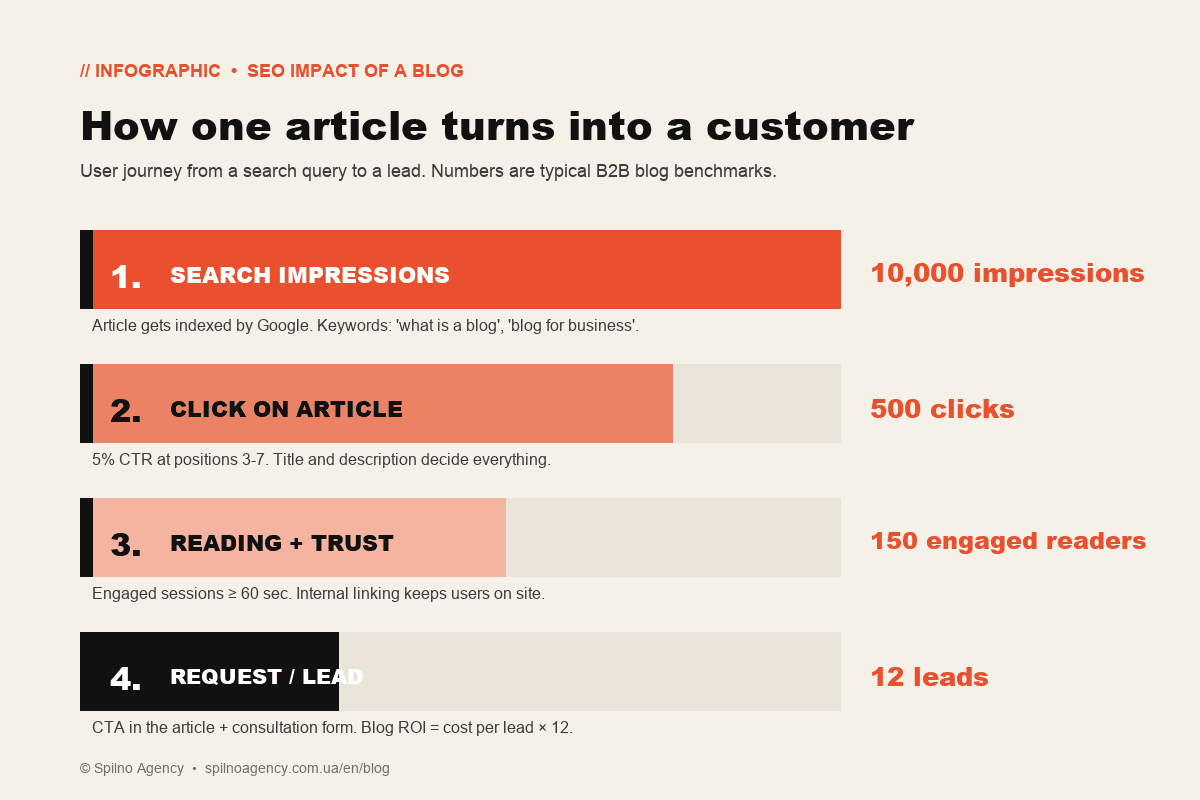
This is a key section. A blog is the cheapest and most sustainable channel for organic traffic. An article written once brings visitors for years, unlike advertising, which stops when payment ceases.
3.1. Expanding the Semantic Core
A website without a blog ranks for 50–100 keywords (service names + brand). A blog with 50 quality articles easily adds 1500–3000 additional queries to the search results. Each blog article covers a cluster of 10–30 related queries: the main one + LSI variations + question forms.
3.2. Internal Linking and Page Authority
A blog allows for proper internal PageRank distribution. A blog article links to a commercial service page, transferring its weight. Without a blog, commercial pages lack internal links and rank worse than competitors.
3.3. E-E-A-T and Authorship
Google officially considers Experience, Expertise, Authoritativeness, and Trustworthiness. A blog is the primary tool to demonstrate these. Author bylines with photos, regular updates, and source citations are all quality signals that boost a site’s ranking.
3.4. GEO — Optimization for AI Search
In 2026, SEO is complemented by GEO (Generative Engine Optimization) — optimization for ChatGPT, Perplexity, Google AI Overview, and Claude. GEO principles include clear definitions at the beginning of an article, factual data with numbers, structured lists, and FAQ sections. A blog is the only website format that meets these requirements. A brand cited by LLMs receives traffic even without clicks from Google.
Learn more about the technical side of SEO in our article Google Search Console Secrets.
4. How a Blog Helps Attract Clients
SEO traffic alone doesn’t pay the bills. The blog’s task is to guide the reader through the funnel: problem awareness → solution selection → request. This follows the TOFU → MOFU → BOFU model.
- TOFU (top of funnel) — ‘What is’ articles. The user is just getting acquainted with the topic. Example queries: ‘what is a blog’, ‘why is analytics needed’. The goal is to capture attention, add the reader to remarketing, and offer a subscription.
- MOFU (middle of funnel) — ‘How to do’ articles. Instructions, guides, checklists. The user is already looking for solutions. CTAs: free audit, template, consultation.
- BOFU (bottom of funnel) — case studies and comparisons. ‘How we did X’, ‘WordPress vs Webflow’. The reader is ready to buy — final proof is needed. CTA: direct service request.
A blog without a CTA is a library. A blog with a CTA is a sales department working 24/7.
Specific CTA patterns that work on the Spilno Blog:
- Inline-CTA — a banner after the first section: ‘Need help with SEO? Order a free audit’.
- Sticky-CTA — a small bar at the bottom of the screen on mobile.
- End-CTA — a large form at the end of the article with a specific service.
- Internal Linking — a link to a related case study or service directly within the text.
5. Best Platforms for Creating a Blog
Platforms for creating a blog differ in four parameters: SEO capabilities, price, ease of launch, and code control. Here’s an objective comparison of the top 5 solutions as of 2026:
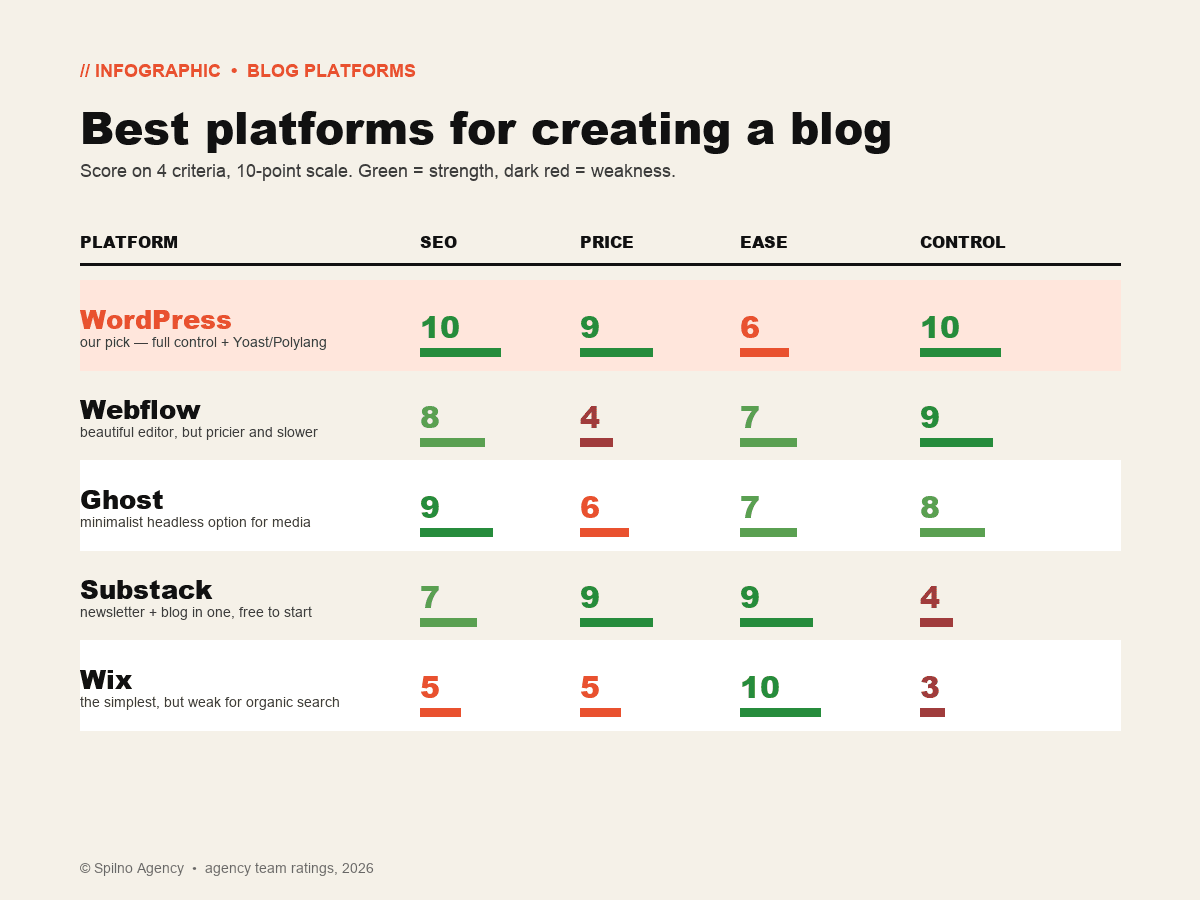
- WordPress — the leader for business blogs. Free core, full control, best SEO plugins (Yoast, RankMath), multilingual support via Polylang. This blog is also built on WordPress.
- Webflow — beautiful visual editor and clean templates, but more expensive (from $23/month) and slower to index.
- Ghost — a minimalist headless option for media and newsletters. Strong SEO, but limited e-commerce functionality.
- Substack — the simplest option for a newsletter-first blog. Free to start, but limited design control.
- Wix — the simplest option for small businesses. Weak for serious organic traffic.
Platform Conclusion: If a blog is a strategic channel, choose WordPress. If you need a quick landing page with a few posts, opt for Webflow or Squarespace.
6. What Articles to Write: A Content Plan for Your Blog
Blog articles are not written randomly. The ‘3-3-3’ formula works:
- 3 Clusters — core topics around which brand expertise is built. For a marketing agency, these are SEO, analytics, and content.
- 3 Formats within each cluster — guide (TOFU), instruction (MOFU), case study (BOFU).
- 3 Publications per month minimum. Lower frequency does not provide a cumulative effect: Google does not perceive the site as active.
The minimum length for a quality blog article is 1500 words. Top 1 articles in Google usually have 2500-3500 words. An article shorter than 800 words has almost no chance of organic traffic in a competitive niche.
Conclusion
What the analysis showed:
- A blog is not a ‘trendy thing’ but a tool with measurable ROI: 10,000 search impressions → 12 leads.
- A blog simultaneously strengthens SEO (by expanding semantics, internal linking, and E-E-A-T) and attracts clients through the TOFU/MOFU/BOFU funnel.
- Among blog creation platforms, WordPress remains the undisputed choice for businesses focused on organic traffic.
What businesses need to do:
- Launch a blog on WordPress — even with 5 initial articles.
- Create a content plan using the ‘3-3-3’ formula and stick to 3 publications per month.
- By the end of the first quarter, set up analytics, evaluate traffic, and adjust topics based on real queries from Google Search Console.
If you need help launching a business blog — leave a request at Spilno Agency, we’ll consult you for free.
FAQ: Frequently Asked Questions About Blogs
What is a blog in simple terms?
A blog is a section of a website with regular publications on one or more topics. For businesses, a blog is a tool for attracting organic traffic and leads.
How much does it cost to launch a business blog?
Technical launch on WordPress ranges from $0 (free hosting) to $30/month. The main cost is content: one quality blog article costs $80-300 including preparation, SEO optimization, and editing.
How long does it take for a blog to generate traffic?
First Google rankings appear 2-4 months after publication. Stable organic traffic comes in 6-9 months with regular publications (at least 3 articles/month).
What are the best platforms for creating a blog in 2026?
For businesses — WordPress (full control, SEO). For media — Ghost. For a quick start — Substack. For a small business card blog — Wix.

Read also
Best CMS for an Online Store: Cloud vs Self-Hosted Platforms in 2026
Compare Shopify, WooCommerce, PrestaShop, OpenCart and Magento for your online store. Pros, cons, and a step-by-step CMS selection…
LinkedIn Ads Library: How to Find Your Competitors’ LinkedIn Ads (2026 Guide)
How to use the LinkedIn Ads Library to see any competitor's sponsored content for free — step by…
Meta Ads Library: How to Find Your Competitors’ Facebook & Instagram Ads (2026)
How to use the Meta Ads Library to see any competitor's Facebook, Instagram and Threads ads for free…