Why There Are No Guarantees in SEO: An Honest Guide from Spilno Agency

TL;DR. No honest SEO agency in 2026 can guarantee a specific Google position or traffic volume – and this is precisely what signifies their professionalism. Google’s algorithms update over 600 times a year, competitors act in parallel with you, AI-generated answers take clicks, and seasonality along with client actions on the website also influence the results. What can be guaranteed is the scope of work, methodology, and transparent reporting. If there are no results after a year of promotion, a diagnosis is performed using the checklist below, and in 80% of cases, the problem isn’t with “bad SEO” but with one of the 7 factors that need to be systematically addressed.
In this guide, we will cover: why guarantees in SEO are technically impossible, why some agencies still juggle them, what a reputable contractor actually guarantees, and a step-by-step analysis algorithm – what to do if you don’t see growth after 12 months of promotion.

What “Guarantee” Means in the Context of SEO
The word “guarantee” in SEO is used in three different meanings, and it’s important to distinguish them:
- Position Guarantee – “We’ll get you to the TOP-3 for keyword X.” Technically impossible, as the position is determined by Google’s algorithm, not the agency.
- Traffic Guarantee – “We’ll provide 10,000 organic visits.” Possible only as a forecast with a range, as traffic depends on search query frequency and user behavior.
- Work and Methodology Guarantee – “We will perform an audit, optimize 50 pages, and build 20 quality backlinks.” This is the only type of guarantee that can be given honestly – because here, the agency controls 100% of the process.
When a commercial proposal states “we guarantee TOP-10,” in 9 out of 10 cases, it’s a marketing hook that is either legally meaningless or hidden behind a list of keywords with zero competition.
7 Factors an SEO Agency Cannot Control
To guarantee a position, one must control all factors influencing it. An SEO team controls a maximum of 30–40% of them. The rest are beyond their influence.
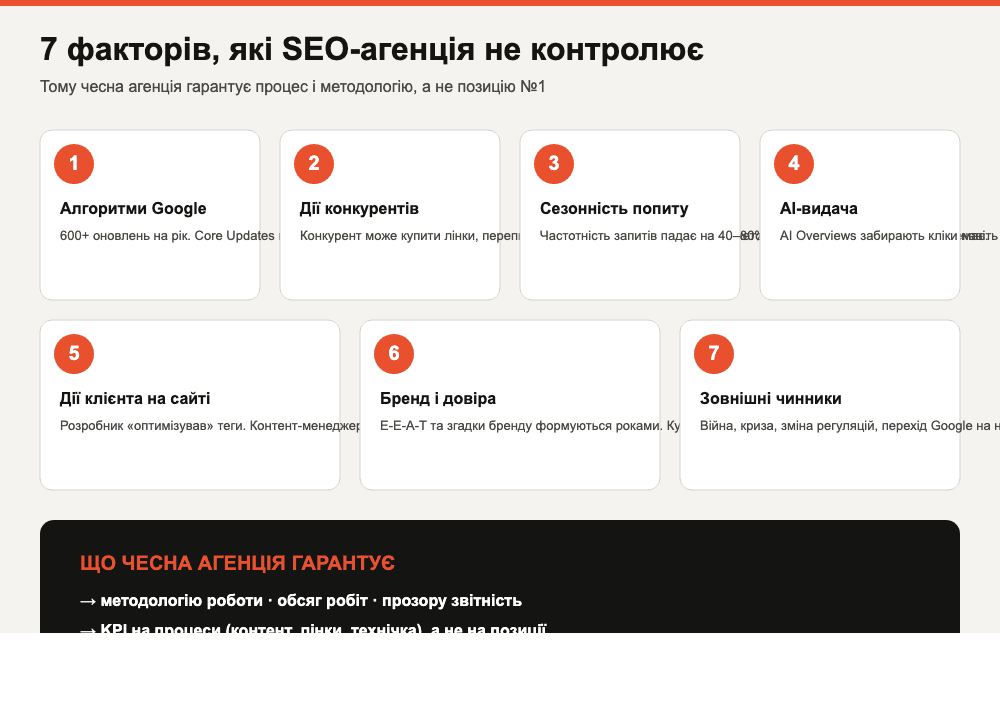
1. Google Algorithms
According to Google itself, over 4,600 changes were released to search in 2024 – that’s more than 12 updates daily. Among these are 4–5 major Core Updates per year, each of which can shift positions by 10–50 points in a day. No SEO specialist has prior access to these updates, nor a guarantee of how they will specifically affect a particular niche.
2. Competitor Actions
SEO is not a competition with Google, but a competition with other sites in the SERP. While you are optimizing content, a competitor might: buy 200 backlinks, rewrite their pages for the same semantics, launch a parallel PPC campaign (which indirectly boosts organic through branded searches), or enter the niche with thrice the budget. Guaranteeing “what a competitor will do” is impossible.
3. Demand Seasonality
Many niches experience query frequency fluctuations of 2–10 times between peak and off-peak seasons (tourism, education, repairs, BFCM products). A website might hold TOP-3 positions all year, but traffic in January simply won’t come – because there are physically fewer people searching for “summer camp for children” in January. This is not the agency’s fault – it’s market behavior.
4. AI Overviews (AI Overviews, ChatGPT, Perplexity)
With the launch of Google AI Overviews and the mass migration of users to ChatGPT/Perplexity, even the #1 position in classic SERPs no longer guarantees a click. According to industry research in 2026, CTR for top-1 positions in queries with an AI block has dropped by 30–40%. A website can be perfectly optimized – but the user gets the answer in the chat and doesn’t click through.
5. Client Actions on the Website
The most frequent reason for position regression is changes on the client’s side: a developer “optimized” tags, a marketer deleted a page, a new advertising agency rewrote titles without approval, a designer closed critical content blocks in JS. An SEO agency cannot physically prevent you from breaking your own website – it can only warn you.
6. Brand and Trust (E-E-A-T)
Google increasingly considers brand signals: recognition, mentions, reviews, real expertise of authors. This cannot be bought in 3 months – it accumulates over years through PR, content, and reputation. A young brand without a history objectively cannot outrank a company that has been in the market for 10 years in a single season.
7. External Factors
War, sanctions, regulatory changes (e.g., bans on certain content formats), global crises, Google’s transition to new SERP formats, the emergence of new types of rich snippets – all these affect search results. No forecast from 2021 could have predicted what SERPs would look like in 2026.
Why Some Agencies Still Talk About “Guarantees”
If guarantees are technically impossible, why do about 30% of SEO agency websites in Ukraine still write “We guarantee TOP-10” on their homepage? Let’s examine 5 typical tactics that allow this promise to exist:
Tactic 1. Low-frequency “junk” queries
The agency takes semantics with a monthly frequency of 0–10 queries and queries where there are simply no real competitors (e.g., “buy juniper doors in Kropyvnytskyi cheap”). Getting such a query to TOP-3 is not difficult. The “guaranteed TOP” certificate is formally fulfilled – but the client receives no traffic or sales.
Tactic 2. Guarantee only for branded queries
In the contract, in small print – a list of keywords, 80% of which are branded (“company name,” “company name reviews”). A brand, by definition, ranks for its own name. The “guarantee” is met – the client understood nothing.
Tactic 3. “Or we’ll refund your money”
Legally, such a guarantee is limited either to the amount of the last month, or to “transferring the budget to the next month,” or to conditions that are almost impossible to prove (e.g., the client is obliged to implement 100% of the corrections perfectly on time). In reality, almost no one manages to get the full amount back for a year of work.
Tactic 4. Focus on short-term effect
The agency uses aggressive methods (artificial traffic manipulation, PBN networks, spam backlinks) that can provide rapid growth in 2–3 months. The “guarantee” contract is for 3–6 months. After 6–9 months, Google imposes sanctions – but the guarantee has been formally met, and the client is left with a damaged website.
Tactic 5. Market Psychology
The client wants to hear “guarantees” – and the market sells it. Reputable agencies lose tenders to companies that promise more than they can deliver. This is a systemic problem that can only be fought with one thing – client education. That’s why we’re writing this guide.
What a Reputable SEO Agency Actually Guarantees
Spilno Agency’s contract does not include position guarantees – and here’s what we guarantee instead:
| What We Guarantee | How It Looks in the Contract |
|---|---|
| Scope of Work | Specific figures: “50 pages optimized per month,” “20 quality backlinks per quarter,” “technical audit once every 6 months” |
| Methodology | Documented process: audit checklist, content plan template, revision approval procedure |
| Transparent Reporting | Monthly report with positions, traffic, completed work, budget, and plan for the next month |
| Forecast with Ranges | “Optimistic / baseline / conservative” scenarios with specific figures and risks |
| Response Speed | SLA: response to inquiry – up to 4 hours during business hours, critical error correction – on the day of discovery |
| Competence Guarantee | Team of certified specialists with open profiles and real case studies |
This is an approach that stands the test of time: the client knows exactly what they are paying for, even if the market conditions have changed.
Spilno Agency’s Analysis Principle: Why There’s No Result After a Year
If you’ve been paying for SEO for a year and don’t see growth – before changing agencies, a systematic analysis is needed. At Spilno Agency, we use a 7-block checklist: by going through it, in 80% of cases, we find the real reason for stagnation without changing contractors. You can go through each block yourself or with us.
Block 1. Technical Audit
Check this first – because technical errors can nullify any content and links.
- Are all target pages open for indexing (robots.txt, meta robots, X-Robots-Tag)?
- How many pages are in Google’s index versus sitemap.xml? If the difference is more than 20%, there’s a problem.
- Are Core Web Vitals (LCP, INP, CLS) in the “green” zone? Check in PageSpeed Insights and CrUX.
- Are there mass 404 / 500 / 301 chains? Check in Screaming Frog and Search Console.
- Is the mobile version served correctly (Mobile-First Index)?
- Is Schema.org present and valid (Article, FAQ, Product, Organization)?
- HTTPS, HSTS, updated certificates – without errors?
Block 2. Keyword and Semantics Analysis
- Is the semantics collected correctly? Often the reason is focusing on keywords that do not carry commercial intent.
- Are there keywords for which you rank in positions 11–30 (close to the top)? These are “low-hanging fruit” – easier to boost than to break through from scratch.
- Does the site cover the full thematic clustering? Google prefers sites that cover a topic, not just individual pages.
- Is there cannibalization – where 2–3 pages compete with each other for the same query?
Block 3. Content Quality and Relevance
- Is the content written by an expert or a copywriter “on the topic”? Google distinguishes this well by vocabulary and facts.
- Does the page contain unique data – your statistics, case studies, numbers? Or is it a retelling of Wikipedia?
- Does the content provide a comprehensive answer to the query, or does it force the user to click further (a bad behavioral signal)?
- Are the pages updated? An old article, to which no fresh data has been added for 18+ months, loses positions.
- Is there clear E-E-A-T: author with photo, bio, expertise; sources; update date?
Block 4. External Link Profile
- Backlink dynamics: growing, stagnant, falling? If falling – Google reduces trust.
- Donor quality: thematic, with traffic, without penalties – or spam directories and PBNs?
- Is the anchor profile natural (60–70% branded and unanchored) – or over-optimized with commercial anchors?
- Are there toxic links that should have been disavowed?
Block 5. Competitor Analysis
- Who is actually in the TOP-10 for your main semantics – and how are they stronger?
- How does their content differ: depth, format, presence of video, infographics, original data?
- How many backlinks do they have and from which donors? (Ahrefs, Semrush)
- How long has the domain been in the top? If 5+ years – it’s a trust factor that needs to be compensated in another way (e.g., through news triggers).
Block 6. Business Metrics, Not Just Positions
- It’s possible that positions exist, traffic exists – but the website conversion is low. This is a UX/CRO problem, not SEO.
- It’s possible that the traffic is not targeted – users come for informational queries and don’t buy. This is a strategy problem.
- Check micro-conversions: page depth, time on site, return from search. If they are falling – Google sees this and cuts positions.
Block 7. Agency Performance
- What work was done over the year? If reports mention “page optimization” without a list of URLs and access rights – that’s already a red flag.
- Are the approved process KPIs being met (content, links, technical)?
- Is there a connection between the work done and positions/traffic? A reputable agency shows this connection monthly.
- Is communication transparent – or do you have a single point of contact who explains nothing?
What to Do If There’s No Result After 1 Year of Promotion – Step-by-Step Instruction
Algorithm for a client who has been paying for SEO for a year and doesn’t see traffic or position growth:
Step 1. Define “What Exactly” Isn’t Working (1 day)
Before drawing conclusions – specify the problem. “No result” is too broad.
- Positions haven’t grown for which specific semantics? Create an Excel sheet: 30–50 keywords × months × current position.
- Traffic hasn’t increased? Check GSC: Performance → Compare year over year. If clicks have fallen but impressions have grown – it’s a CTR problem, not an SEO problem.
- Positions have grown, but traffic hasn’t? This is seasonality or AI Overviews taking clicks.
- Traffic is present, but no sales? This is not SEO, but conversion.
Step 2. Request Detailed Reporting from the Agency (3–5 days)
- A list of ALL work performed over 12 months with dates and URLs.
- A list of all backlinks built: domain, date, placement type.
- A list of updated pages: before/after title, description, H1, content volume.
- Current technical status: when the last audit was conducted, which errors were fixed.
- Current strategy for the next quarter.
If the agency cannot provide this within 5 business days – you already have the answer as to why there’s no result.
Step 3. Order an Independent Audit from Another Agency (1–2 weeks)
This doesn’t mean changing contractors – it means getting a second opinion. An honest audit:
- Follows the 7-block checklist (as above).
- Provides a written conclusion with evidence: screenshots, logs, graphs.
- Doesn’t push a contract immediately – first shows the problem, then offers a solution.
- Costs $500–$2,000 depending on the scope – this is a reasonable investment to understand the situation.
Step 4. Make a Data-Driven Decision (1 week)
After an independent audit, you will have three possible scenarios:
| Scenario | What It Means | What to Do |
|---|---|---|
| A. The agency is doing well, the market has changed | Seasonality, Core Update, AI Overviews, competition with an X10 budget competitor | Adjust the strategy with the agency: strengthen GEO, add news triggers, enter related niches |
| B. The agency is doing little or nothing | Imitation of vigorous activity: reports of “optimization” without real results on the site | Provide a 60-day correction plan with specific KPIs. If not met – change contractors |
| C. The site cannot rank in principle | Young domain in a hyper-competitive niche; historically damaged site; incorrect architecture | Talk to the agency about realistic expectations. Possibly – add paid channels as primary, SEO as strategic |
Step 5. Rewrite the Contract with New Rules (1 week)
Regardless of whether you stay with your current contractor or not – switch to a new type of contract:
- KPIs for processes (not positions): scope of work, number of pages, links, audits.
- SLA: response speed, format and date of monthly report.
- Transparent rates for individual tasks: so you understand what you’re paying for.
- Clear responsibility for site changes: any change on the client’s side must be agreed upon with SEO.
- Right to a quarterly independent audit: you can bring in an external auditor, the agency must provide access.
Step 6. Work with Realistic Expectations (Ongoing)
SEO is an investment with a 12–24 month horizon, not PPC. Instead of “when will I be in the TOP?” – ask “what’s the trend over the last 6 months and what’s the speed of movement?” If the trend is positive – continue. If it’s flat – diagnose using the checklist. If it’s negative – urgently perform Step 3.
Frequently Asked Questions About SEO Guarantees
Can you demand a TOP-10 guarantee from an agency in the contract?
You can demand it, and some agencies will give it – but it’s either a legally empty promise or it will apply to “convenient” queries with zero competition. Instead of a position guarantee, demand a guarantee of scope of work and transparent methodology – this truly protects your interests.
How long does it take to see the first results in SEO?
For a new domain – 6–9 months for the first significant movements. For an existing site – 2–4 months for technical and content changes. For a highly competitive niche – 12–18 months for stable positions. If there’s absolutely no progress after 12 months – it’s a signal for diagnosis, but not a verdict.
Is it worth paying an agency for results, not for the process?
“Performance-based SEO” (payment for positions/traffic) sounds attractive but has a downside: the agency is motivated to choose only low-risk, easy keywords, ignoring strategically important ones. As a result, you get “good SEO on paper” without any real impact on the business. A hybrid model (fixed fee for process + bonus for achieved KPIs) is the most balanced.
How to understand if an agency is doing “pseudo-work”?
Red flags: vague reports without specific URLs, no list of links built, the same “optimizations” every month, refusal to show technical briefs to copywriters, no access to GSC/GA4 from your side, absence of an annual plan.
Should you switch to another agency if there are no results after a year?
Not immediately. First – diagnosis using the 7-block checklist and an independent audit. In 30–40% of cases, the problem is not with the agency, but with factors it doesn’t control (seasonality, AI Overviews, client actions on the site, overestimated expectations). Changing contractors without diagnosis in such a case will only reset progress – the new contractor will start from scratch.
What KPIs to set instead of “TOP-10”?
Realistic process KPIs: number of pages optimized per month, number of quality backlinks per quarter, volume of expert content written, regularity of technical audits, % of pages with “Good” Core Web Vitals, trend of impressions in GSC, trend of clicks quarter-over-quarter, share of branded traffic.
Conclusions
- There are no position guarantees in SEO – and this is not a flaw of the industry, but a consequence of the fact that the position is determined by Google’s algorithm, not the agency.
- An agency controls a maximum of 30–40% of factors. The rest – algorithms, competitors, seasonality, AI-generated answers, client actions, brand, external factors – are beyond its influence.
- “TOP-10 guarantees” found on the market are marketing hooks hidden behind low-frequency semantics, branded queries, or legally void “refunds.”
- A reputable agency guarantees scope of work, methodology, transparent reporting, SLA, and forecasts with ranges – what it actually controls.
- If there are no results after a year – don’t blindly change contractors. Go through the diagnosis using the 7-block checklist, order an independent audit, and make a decision based on data.
- SEO is an investment with a 12–24 month horizon. It only works when the client and agency have the same realistic expectations and measure the process, not magic.
If you want an independent SEO audit or a contractor who works transparently without impossible promises – contact Spilno Agency. We will conduct a diagnosis using our 7-block checklist and show you the real picture.

Read also
Best CMS for an Online Store: Cloud vs Self-Hosted Platforms in 2026
Compare Shopify, WooCommerce, PrestaShop, OpenCart and Magento for your online store. Pros, cons, and a step-by-step CMS selection…
LinkedIn Ads Library: How to Find Your Competitors’ LinkedIn Ads (2026 Guide)
How to use the LinkedIn Ads Library to see any competitor's sponsored content for free — step by…
Meta Ads Library: How to Find Your Competitors’ Facebook & Instagram Ads (2026)
How to use the Meta Ads Library to see any competitor's Facebook, Instagram and Threads ads for free…