E-commerce SEO Strategies: The Complete Guide

Every online store aiming for sustainable growth needs a clear, multi-channel SEO strategy. Unlike corporate websites, e-commerce platforms have thousands of pages, complex category structures, and constantly changing inventories — making ecommerce SEO a uniquely challenging discipline.
60–70% of organic traffic for most online stores comes from category pages — not product cards, not blog posts.
What Is Ecommerce SEO
Ecommerce SEO is the practice of optimizing an online store to rank higher in organic search results and attract targeted traffic without paid advertising. The key difference from regular website SEO lies in scale: hundreds of categories, thousands of product pages, complex faceted navigation, and persistent duplicate content challenges.
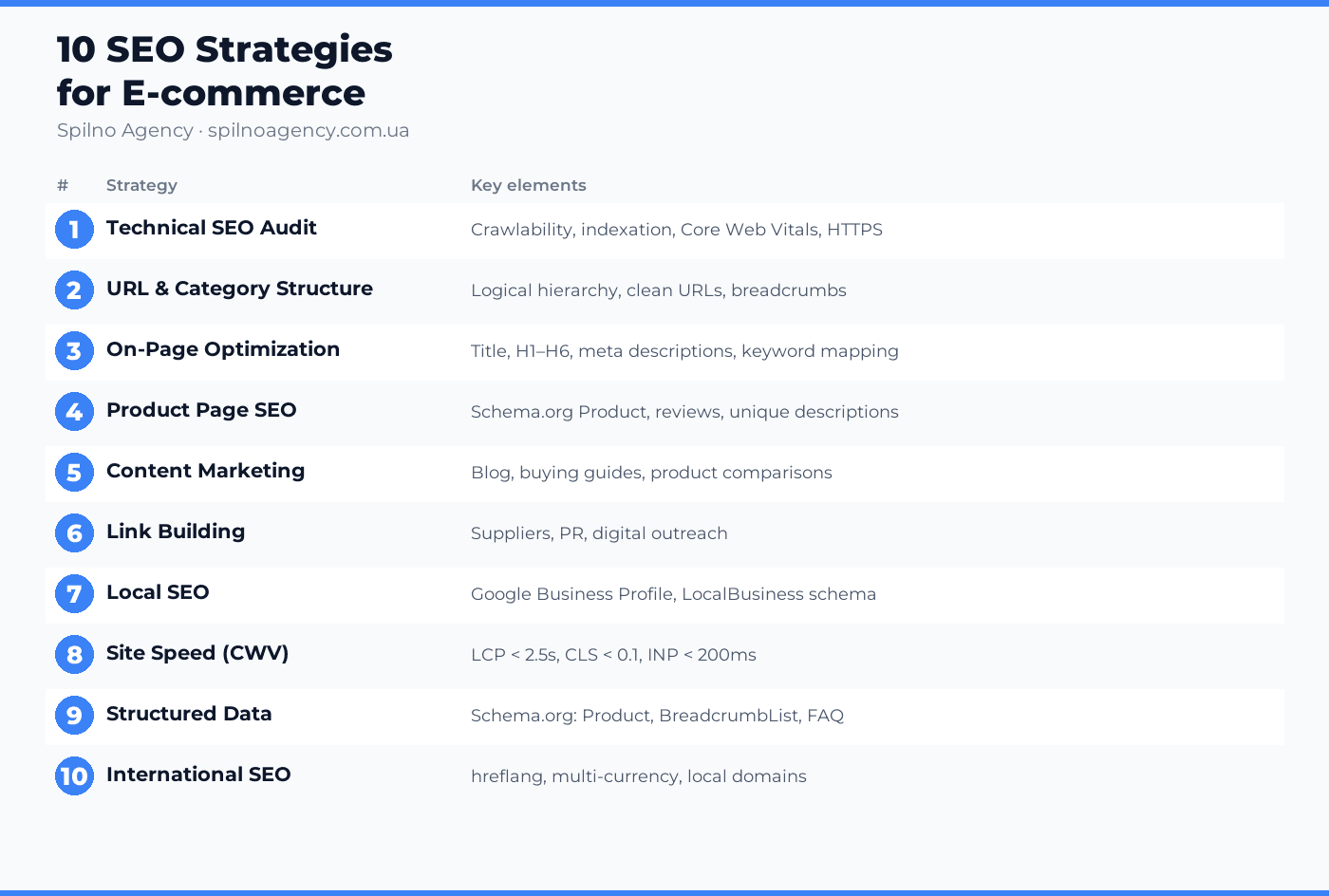
A successful ecommerce SEO strategy spans 10 core disciplines — from technical foundations to international expansion.
Strategy 1: Technical SEO
Technical SEO is the foundation of every ecommerce growth effort. Without a solid technical base, all other optimizations have limited impact.
Core technical tasks for online stores:
- Crawl budget management: for large stores, configure robots.txt and XML sitemaps to prioritize key pages for crawler access.
- Core Web Vitals: LCP < 2.5s, CLS < 0.1, INP < 200ms — required for ranking in Google.
- Mobile-first indexation: Google indexes the mobile version first. Every page must be fully responsive.
- HTTPS: a basic security signal. All pages must be SSL-protected.
- Canonical tags: prevent duplicate content caused by faceted navigation and URL parameters.
- Structured data: Schema.org Product, BreadcrumbList, FAQPage — improves CTR via rich snippets.
Strategy 2: URL & Category Structure
A logical site architecture benefits both usability and SEO. A clear category hierarchy helps Google distribute link equity and understand the topical relevance of each section.
Architecture principles for online stores:
- Keep depth to 3–4 levels maximum: homepage → category → subcategory → product.
- Use clean, readable URLs:
/electronics/smartphones/over/cat?id=12&sub=45. - Add breadcrumbs with BreadcrumbList schema markup on every page.
- Avoid listing the same product in multiple categories without canonical tags.
Strategy 3: On-Page Optimization
On-page SEO for ecommerce means optimizing every page for a specific target keyword — with no overlap between pages.
Keyword mapping — the foundation of on-page strategy:
Every category page and every product card should have one clear target keyword. Avoid cannibalization: never optimize two pages for the same phrase.
- Title tag: unique per page, under 60 characters, target keyword near the start.
- Meta description: under 160 characters, CTA included, target keyword present.
- H1: one per page, matches the user’s search intent.
- H2–H3: logical hierarchy, secondary keywords in subheadings.
- Internal links: connect categories to products, blog posts to categories.
Strategy 4: Category Page Optimization
Category pages are the revenue engine of ecommerce SEO. They rank for high-volume, high-intent commercial queries and drive the majority of organic traffic.
What to optimize on a category page:
- Unique descriptive text (minimum 200–300 words) with target keywords.
- Filters and sorting — block from indexation or use canonical tags to prevent duplicate pages.
- Pagination: use rel=”next/prev” or a single scrollable page with sufficient products.
- Aggregate ratings and reviews: star ratings in search results boost CTR significantly.
Strategy 5: Product Page SEO
Product pages rank for long-tail queries: “buy iPhone 15 Pro 256GB blue.” These queries have lower volume but high purchase intent — and high conversion rates.
Product page optimization checklist:
- Unique descriptions: never copy manufacturer text — it creates duplicate content and risks filters.
- Schema.org Product: markup with price, availability, and ratings generates rich snippets that dramatically improve CTR.
- User reviews: UGC improves page semantics and keeps content fresh for Google.
- Images: descriptive alt text, compressed WebP/AVIF format, proper lazy loading.
- Canonical: required for products in multiple categories or with variants (color, size).
Strategy 6: Content Marketing
Blog content and buying guides aren’t just “useful content” — they capture informational traffic at the top of the funnel and convert readers into buyers.
High-impact content types for online stores:
- Buying guides: “How to Choose a Laptop for Work in 2025” — captures top-of-funnel traffic.
- Product comparisons: “iPhone 15 vs Samsung S24” — commercial intent with internal links to both products.
- Reviews and tests: improve E-E-A-T signals and attract backlinks from industry sites.
- FAQ pages: target “how to,” “what is,” “how much” queries — win featured snippets.
Strategy 7: Link Building
Backlinks remain one of Google’s strongest ranking signals. Ecommerce sites have access to unique, high-quality link sources that other site types don’t.
Effective link building methods for online stores:
- Supplier and manufacturer pages: request a backlink as an authorized retailer — these carry high topical authority.
- Digital PR: press releases about unique products or market research earn media coverage with backlinks.
- Bloggers and reviewers: send a product for review, earn a contextual link from a relevant niche site.
- Broken link building: find broken links pointing to competitors and offer your page as a replacement.
- Industry directories: curated, niche-specific and regional directories add relevant link signals.
Strategy 8: Local SEO
If your store has physical retail locations or delivers to specific cities, local SEO is a high-priority strategy.
- Google Business Profile: complete your profile fully, add photos, respond to every review.
- LocalBusiness Schema: structured data with address, phone number, and business hours.
- Local landing pages: “Delivery to New York,” “Store in Chicago” — optimize for geo-specific queries.
- NAP consistency: business name, address, and phone number must be identical across all platforms.
Strategy 9: Site Speed & Core Web Vitals
Core Web Vitals became an official Google ranking factor in 2021. For image-heavy ecommerce sites with complex JavaScript, performance is a significant challenge.
Practical performance improvements:
- Optimize images: convert to WebP/AVIF, implement lazy loading for below-the-fold images.
- Use a CDN for static assets — reduces TTFB and improves LCP significantly.
- Minimize JavaScript and CSS, defer loading of non-critical scripts.
- Server-level caching (Redis, Varnish) for high-traffic category and product pages.
Strategy 10: International SEO
If your store sells across multiple countries or languages, international SEO ensures proper market targeting and prevents cannibalization between versions.
- hreflang: correctly declare language and region for every page version.
- URL structure: subdomains, subdirectories, or ccTLDs — each approach has trade-offs worth evaluating.
- Localized content: translation alone is insufficient — adapt content to each market’s cultural context.
- Local link building: build backlink profiles in each target market separately.
Ecommerce SEO Strategy Checklist
- ✓ Technical SEO audit completed, critical errors fixed
- ✓ Core Web Vitals: LCP < 2.5s, CLS < 0.1, INP < 200ms
- ✓ XML sitemap created and submitted to Google Search Console
- ✓ Robots.txt configured (facets, cart, search blocked)
- ✓ Category structure is logical, depth ≤ 4 levels
- ✓ Keyword mapping for all categories and key products
- ✓ Unique title, H1, meta description per category page
- ✓ Category descriptions: 200–300+ words, keywords included
- ✓ Product cards: unique descriptions, Schema.org Product, reviews
- ✓ Canonical tags for product variants and faceted navigation
- ✓ Internal linking: blog → categories → products
- ✓ Link building plan developed and in progress
- ✓ Google Business Profile complete (for stores with physical locations)
- ✓ hreflang configured (for multilingual/multi-regional stores)
SEO and GEO Orientation for E-commerce
With the rise of AI-powered search (Google AI Overviews, Perplexity, ChatGPT Search), online stores face a new dimension of visibility — Generative Engine Optimization (GEO).
To ensure your store is cited by AI systems when users ask about products and purchases:
- Structure content in Q&A format (FAQ, how-to guides) — the primary format AI systems pull from.
- Use complete Schema.org Product markup: price, availability, ratings, brand.
- Publish authoritative comparison content — AI systems frequently cite detailed product reviews.
- Maintain strong E-E-A-T: credit authors, show update dates, link to authoritative sources.
Frequently Asked Questions
What is ecommerce SEO?
Ecommerce SEO is the process of optimizing an online store to rank higher in organic search results. It covers technical optimization, on-page elements, category and product page SEO, content strategy, and link building — all aimed at driving targeted traffic and increasing sales without paid advertising.
Where should I start with SEO for a new online store?
Start with a technical audit: check crawlability, page speed, HTTPS, and mobile optimization. Then build a solid category structure and keyword mapping. Only after that should you move to content strategy and link building.
How long does ecommerce SEO take to show results?
New sites typically see initial results in 3–6 months. For already-indexed stores, technical fixes can show impact within 4–8 weeks. Competitive commercial keywords usually require 6–12 months of consistent effort.
How is ecommerce SEO different from regular website SEO?
Online stores have thousands of product and category pages, making indexation management and duplicate content more complex. Key differences include optimizing faceted navigation, managing thin product pages, implementing Schema.org Product markup, and leveraging user-generated reviews for SEO.
Which ecommerce SEO strategies deliver the best ROI?
The highest ROI comes from the combination: technical SEO + category page optimization (drives 60–70% of organic traffic) + content marketing (buying guides, comparisons) + link building. Local SEO is critical for stores with physical locations.
Need a tailored SEO strategy for your online store? Spilno Agency builds comprehensive ecommerce SEO plans and delivers consistent organic traffic growth.

Read also
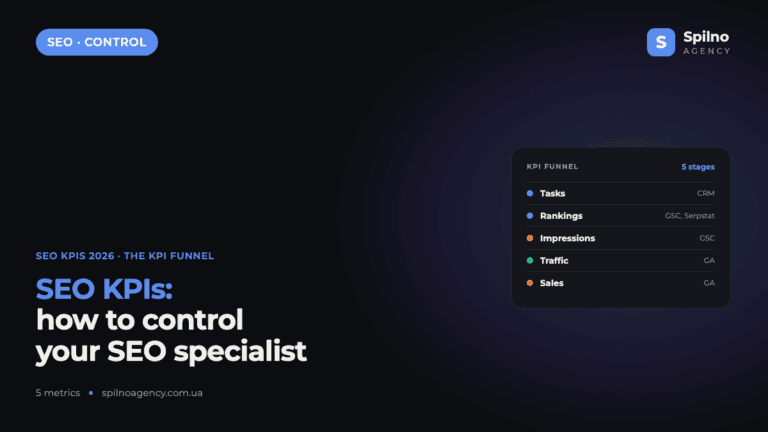
How to Control an SEO Specialist: The 5-Stage SEO KPI Funnel
SEO KPIs form a chain of five metrics that show, step by step, whether your SEO is actually…
Best CMS for an Online Store: Cloud vs Self-Hosted Platforms in 2026
Compare Shopify, WooCommerce, PrestaShop, OpenCart and Magento for your online store. Pros, cons, and a step-by-step CMS selection…
LinkedIn Ads Library: How to Find Your Competitors’ LinkedIn Ads (2026 Guide)
How to use the LinkedIn Ads Library to see any competitor's sponsored content for free — step by…