SEO Promotion: What It Is and What Stages It Consists Of in 2026

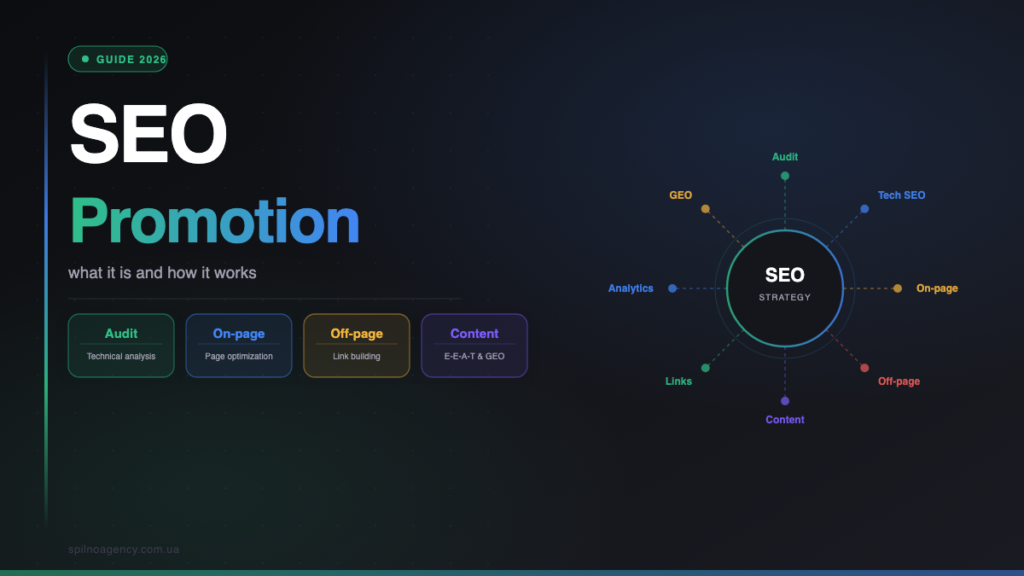
SEO promotion is a set of technical and content measures that drive your website to the top of Google’s organic results. This 2026 guide covers the full definition, 7 stages from audit to link building, ranking factors, and GEO & AI Overviews trends.
SEO promotion in 2026 is not magic — it’s a system that works around the clock, placing your website at the top of Google, attracting targeted traffic, and generating sales without paying per click. In this guide, we cover what SEO is, the 7 stages of the process, and what Google ranking factors actually matter.
What Is SEO Promotion: Definition 2026
SEO promotion (Search Engine Optimization) is a set of technical, content, and link-building activities that help a website achieve higher positions in the organic search results of search engines for targeted user queries.
The key difference between SEO and paid advertising (Google Ads): you don’t pay for each click. Effort is invested once — and the site continues to generate traffic for months and years. That’s why SEO is one of the highest-ROI channels in digital marketing for European businesses.
Why SEO promotion matters for your business:
- rank your website in Google’s top 10 for commercial and informational queries;
- receive consistent organic traffic without advertising spend;
- increase brand awareness and audience trust;
- reduce cost per lead (CPL) compared to PPC over time;
- build a stable long-term sales channel.
How Search Engines Rank Websites: The Fundamentals
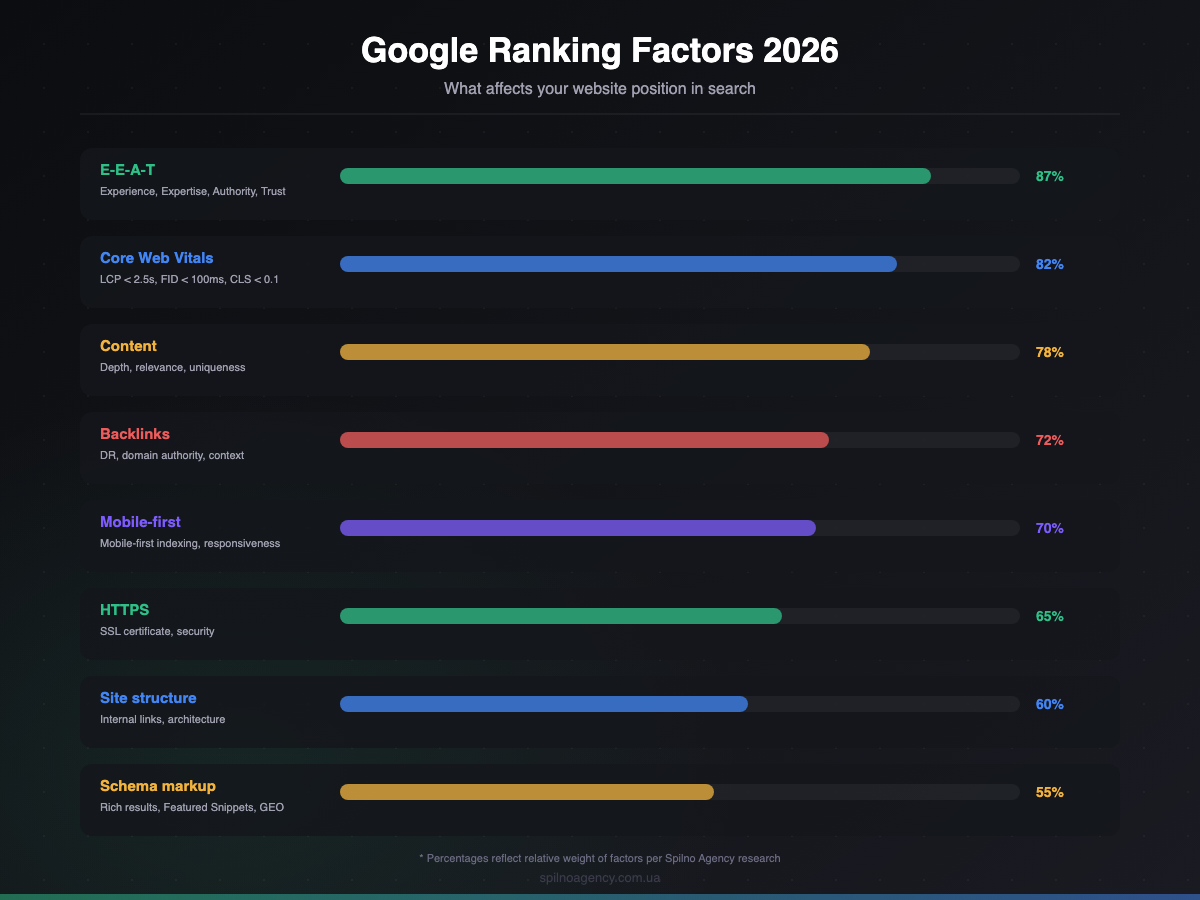
To understand SEO, you need to know how Google decides which website to show first. Google’s algorithm uses over 200 ranking factors, but they all come down to three core elements:
- Technical accessibility — the site must be properly indexed: no errors, HTTPS, fast loading, and responsive design.
- Content relevance — pages must precisely answer user queries, contain keywords in the right places, and have clear structure.
- Domain authority — the site must have backlinks from authoritative resources confirming its trustworthiness.
In 2026, two additional key factors have emerged: E-E-A-T (Experience, Expertise, Authoritativeness, Trustworthiness) and GEO (optimisation for generative AI search responses from Google and ChatGPT).
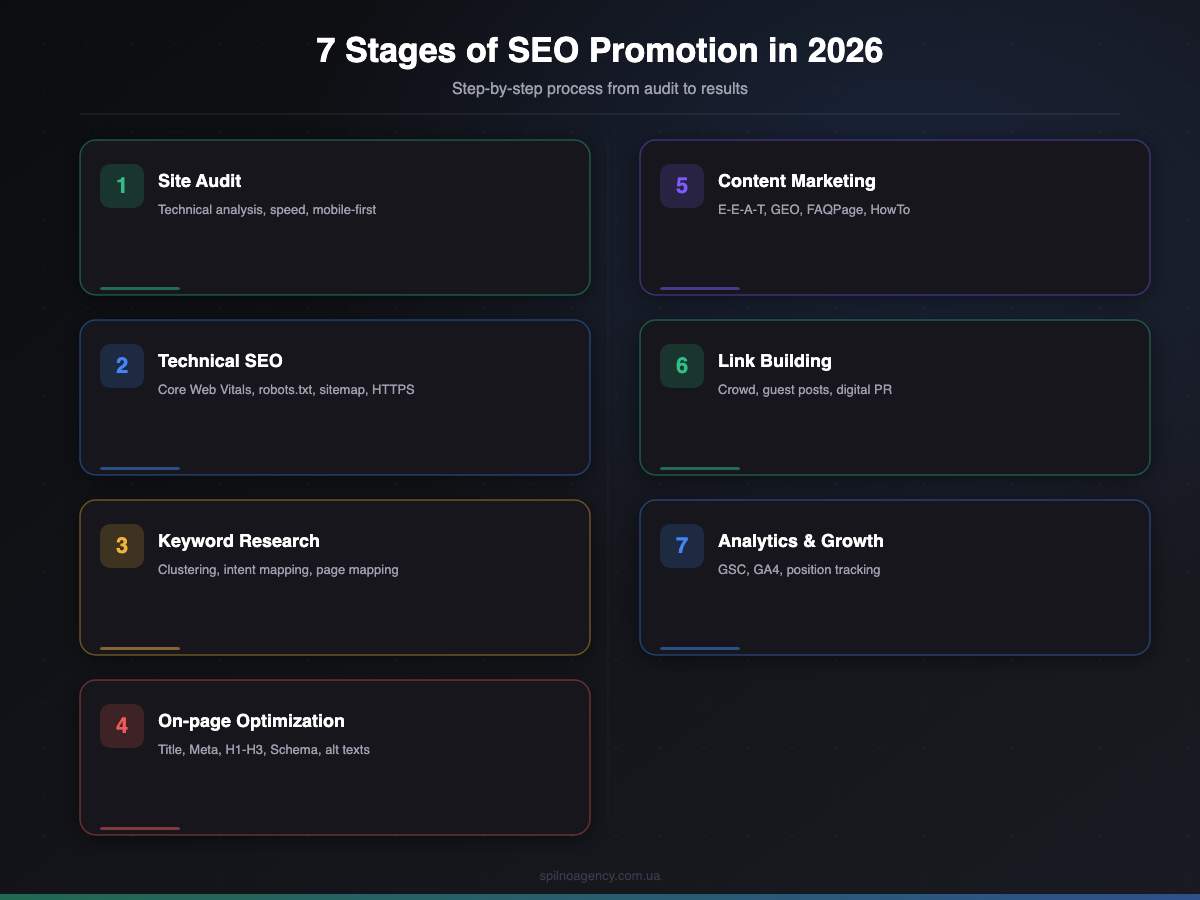
7 Stages of SEO Promotion: A Step-by-Step Process
Professional SEO promotion follows a structured sequence — not a random collection of tasks. Here are the 7 stages used by experienced SEO specialists and agencies across Europe.
Stage 1: Technical Site Audit
The first step is diagnosing the current state of the website. An audit identifies issues that prevent Google from properly indexing and ranking your pages.
What a technical audit covers:
- loading speed (Core Web Vitals: LCP, CLS, INP);
- indexation errors (4xx, 5xx, duplicate pages, thin content);
- URL structure and breadcrumbs;
- HTTPS and SSL certificate presence;
robots.txtfile and XML sitemap;- mobile version and responsiveness;
- internal linking and site architecture.
Tools for auditing: Google Search Console, Screaming Frog, Serpstat Site Audit, PageSpeed Insights, Ahrefs.
Stage 2: Technical SEO Optimisation
After the audit — fixing the identified issues. This is the technical foundation without which all other efforts are ineffective.
- Core Web Vitals optimisation (LCP < 2.5s, CLS < 0.1, INP < 200ms);
robots.txtand XML Sitemap configuration;- HTTPS implementation, Mixed Content removal;
- 404 error fixing and redirect setup;
- image optimisation (WebP format,
altattributes, lazy load); - Schema markup implementation (Organization, BreadcrumbList, FAQPage);
- canonical and hreflang configuration for multilingual sites.
Stage 3: Keyword Research & Semantic Core
The semantic core is a structured list of target keywords reflecting your audience’s interests. Without it, you can’t determine which queries to optimise each page for.
Keyword research principles for 2026:
- Search intent — understand the query purpose (informational, commercial, navigational, transactional);
- Clustering — grouping related queries into a single page;
- Long-tail keywords — low-competition phrases with specific intent (lower competition, higher conversion);
- LSI keywords — semantically related terms to enrich content;
- Question queries — for Featured Snippets and AI Overviews.
Stage 4: On-Page Optimisation
On-page SEO is the optimisation of elements directly on the page. Properly structured meta tags and content give Google a clear signal about the page’s topic.
Essential on-page optimisation elements:
- Title tag — unique, up to 60 characters, primary keyword at the beginning;
- Meta description — up to 160 characters, with CTA and target keyword;
- H1 — one per page, precisely reflects the topic, contains primary keyword;
- H2–H3 — structure the content, contain LSI keywords and question queries;
- URL slug — short, readable, with keyword;
- Images —
altattributes with descriptions, compression for speed; - Internal linking — links to related pages on your site;
- Schema markup — FAQPage, HowTo, Article for rich results.
Stage 5: Content Marketing & E-E-A-T
Content is the foundation of SEO. Google doesn’t just analyse keywords — it assesses information quality, the author’s experience, and user value. In 2026, the key standard is E-E-A-T (Experience, Expertise, Authoritativeness, Trustworthiness).
- Depth — thoroughly cover the topic, address related questions;
- Uniqueness — original perspective, personal experience, case studies;
- Relevance — regularly update content to reflect market changes;
- Structure — clear H2/H3 headings, lists, tables, FAQ sections;
- GEO optimisation — structured content with facts for AI search engine citation;
- Multimedia — infographics, videos, diagrams that increase time on site.
Stage 6: Link Building (Off-Page SEO)
Link building is acquiring backlinks from authoritative external websites pointing to yours. Google treats links as trust votes: more quality backlinks mean higher domain authority (DR).
Effective link building methods in 2026:
- Guest publications — writing useful articles for industry resources;
- Digital PR — earning media links through your own research and statistics;
- Crowd links — organic mentions in relevant forums and Q&A sites;
- Link recovery — finding and reclaiming broken competitor links;
- Skyscraper technique — improved version of popular content to attract links;
- Directories and aggregators — registration in industry resources.
Stage 7: Analytics & Strategy Adjustment
SEO is an iterative process. Without regular monitoring, it’s impossible to understand what’s working and what needs refinement.
- Rankings — average position for target queries (Google Search Console);
- Organic traffic — number of users from search (GA4);
- CTR — click-through rate in search results (GSC);
- Core Web Vitals — speed and UX (PageSpeed Insights, GSC);
- Domain Rating — domain authority (Ahrefs, Serpstat);
- Conversions — sales and leads from organic traffic (GA4).
Types of SEO Promotion: Which Suits Your Business
- Local SEO — for businesses with a physical location (cafes, service centres, clinics): Google Business Profile optimisation, local queries “[service] + [city]”, Local Pack;
- E-commerce SEO — for online shops: category optimisation, product pages, filters, faceted navigation, Product Schema;
- International SEO — for businesses in multiple countries: hreflang, ccTLD vs subdirectories, multilingual content;
- Enterprise SEO — for large sites with thousands of pages: automation, log-file analysis, crawl budget management.
White Hat vs Black Hat SEO: What to Choose
- White Hat SEO — methods compliant with Google’s guidelines: quality content, organic links, technical optimisation. Delivers stable long-term results.
- Black Hat SEO — manipulative techniques: purchased links, content farms, hidden text, cloaking. May produce short-term gains but inevitably leads to Google penalties (Manual Action or algorithmic filters: Penguin, Panda).
Our conclusion: for businesses building a reputation and planning long-term growth across European markets, White Hat SEO is the only right choice.
How Long Does SEO Take: Realistic Expectations
- 1–2 months — technical audit, critical error fixes, initial indexation of new pages;
- 3–4 months — first ranking changes, impressions growth in GSC, early traffic;
- 6 months — noticeable organic traffic growth, top 10 for low-competition queries;
- 12 months — stable traffic, top 3 for priority queries, measurable impact on sales.
SEO Trends 2026: What to Prepare For
- AI Overviews (SGE) — Google shows AI-generated answers above organic results. To appear there, content must be structured, contain specific facts and Schema markup.
- GEO (Generative Engine Optimisation) — optimisation for ChatGPT Search, Perplexity, Gemini. These AI systems cite authoritative sources — your site must be one.
- E-E-A-T & Author Authority — Google evaluates the content author’s experience. Named authors with verified expertise are increasingly important.
- Core Web Vitals & INP — FID was replaced by INP (Interaction to Next Paint) in 2024. Sites with INP < 200ms gain ranking advantage.
- Zero-click Search — some queries are resolved directly in search results (Featured Snippets, Knowledge Graph). Optimise content for rich results.
- Multimodal Search — image search (Google Lens), voice queries, video content. Media assets are becoming part of the SEO strategy.
How to Start SEO Promotion: 5 First Steps
- Connect Google Search Console and check for critical indexation errors.
- Test Core Web Vitals via PageSpeed Insights — fix critical speed issues.
- Build a keyword semantic core for your priority pages (Serpstat, Google Keyword Planner).
- Optimise Title and Meta description for your 5–10 most important pages.
- Connect Google Analytics 4 to track traffic and conversions.
If you need help with SEO promotion for your European business — Spilno Agency is ready to conduct a free audit and develop a strategy tailored to your market.
FAQ: Frequently Asked Questions About SEO Promotion
What is SEO promotion in simple terms?
SEO promotion is a set of activities that help your website rank higher in Google’s organic search results without paying per click. The goal is to attract users actively searching for your product or service.
How long does SEO promotion take?
First results: 2–3 months. Stable organic traffic: 4–6 months. Top 3 for competitive keywords: 8–12 months. Exact timeline depends on niche and the site’s starting condition.
What is the difference between on-page and off-page SEO?
On-page SEO is optimisation within your website (Title, content, structure, Schema). Off-page SEO covers external factors (backlinks, brand mentions). Both are necessary for stable results.
What is GEO in SEO 2026?
GEO (Generative Engine Optimisation) is the optimisation of content for AI search engines: Google AI Overviews, ChatGPT Search, Perplexity. It requires structured content, Schema markup, and E-E-A-T compliance.
