Google’s official statements on what affects ranking: a 1998–2026 deep dive

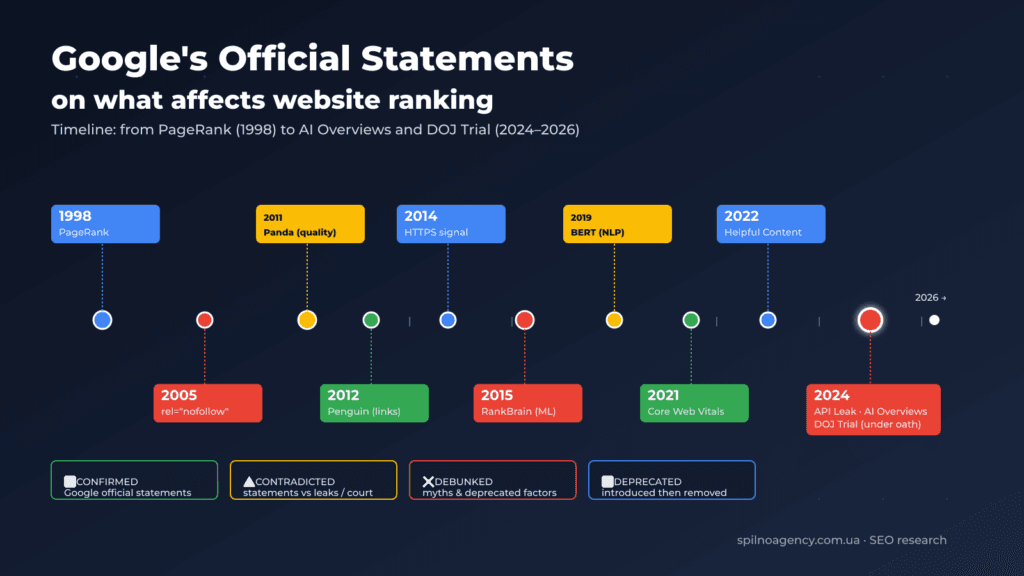
Every SEO professional has at some point heard a client say: “I was told Google counts behavioral signals.” Or: “I read in a blog that an aged domain ranks better.” Or the classic: “And in the 2024 leak…” The problem is that the history of Google’s public statements is 25+ years of constant contradictions: the same claim could in five years be debunked, confirmed, deprecated, then partially confirmed again — this time under oath in an antitrust trial.
This is a research piece. We’ve gathered in one place a chronological timeline of every key public statement Google has made about ranking factors — from the 1998 PageRank patent to AI Overviews, the Content Warehouse API leak, and sworn testimony in the DOJ antitrust trial. Official statements (Search Central blog, employee X/Twitter, conferences) are separated from industry rumors, which are separated from confirmed document leaks. At the end — a large summary table: what’s been confirmed, what’s been debunked, and what was officially deprecated after becoming standard.
The length is deliberate — this is a reference you’ll want to come back to. Keep it bookmarked. Under each subsection, a collapsible “📚 Sources” block gives direct links to the official materials so you can verify any claim.
Contents
- How Google communicates: 8 official channels
- Era 1 (1998–2009): Foundation — PageRank, first updates, nofollow
- Era 2 (2010–2014): The Zoo — Panda, Penguin, Hummingbird, HTTPS
- Era 3 (2015–2019): Machine Learning — RankBrain, Mobile-First, BERT
- Era 4 (2020–2023): UX, Core Web Vitals, E-E-A-T, Helpful Content
- Era 5 (2024–2026): Leak, AI Overviews, antitrust trial
- Separately: Industry rumors Google never confirmed
- Separately: Document leaks — what we learned despite Google
- Separately: What Google officially deprecated after launch
- Summary table: confirmed / debunked / deprecated
- Takeaways: how to read Google’s statements in 2026
1. How Google communicates: 8 official channels
Before diving into the timeline, it’s worth understanding where the information actually comes from. Google’s statements on ranking carry different weight — from a rank-and-file engineer’s tweet to an official documentation update. Here are eight channels through which the company talks to the SEO community:
- Google Search Central Blog (formerly Webmaster Central Blog) — the most official channel. Core Updates, new systems (Helpful Content, Page Experience), documentation changes — all announced here.
- Google Search Central documentation (developers.google.com/search) — what the company is willing to commit to in writing as a recommendation. Not always ranking factors, more often best practices.
- Employee X/Twitter: Google Search Liaison (Danny Sullivan), John Mueller, Gary Illyes, Martin Splitt. The most “hot takes” come from here — and also the most contradictory framings.
- Search Off the Record — the official Search team podcast. Less formal, but employees speak on behalf of Google.
- Google Office Hours / SEO Office Hours — regular Q&A on YouTube. Verbatim quotes are then dissected in industry blogs.
- Conferences: Google I/O, Search Central Live, SMX, BrightonSEO. The loudest announcements (BERT, MUM, SGE) were made here.
- Patents — formally not “statements,” but published Google patents on algorithms (PageRank, Hummingbird, Panda) hint at the direction.
- Sworn testimony — the newest channel. The United States v. Google antitrust trial (DOJ, 2023–2024) forced top executives to testify under oath. Things Google denied in tweets for years turned out to be true in court.
The trust hierarchy for an SEO professional is roughly: court → blog → documentation → podcast/Office Hours → employee tweets → conference talks. The last three are the most common source of “legends” that then wander the industry for years.
📚 Sources
- Google Search Central Blog: developers.google.com/search/blog
- Search Central documentation: developers.google.com/search
- X accounts: @searchliaison (Danny Sullivan), @JohnMu (John Mueller), @methode (Gary Illyes), @g33konaut (Martin Splitt)
- Search Off the Record podcast: developers.google.com/search/podcasts
- Antitrust case: United States v. Google LLC (Case No. 1:20-cv-03010, US District Court for the District of Columbia, 2023–2024)
- Judge Amit Mehta’s “Memorandum Opinion,” August 5, 2024
2. Era 1 (1998–2009): Foundation — PageRank, first updates, nofollow
1998 — PageRank patent (Stanford)
Sergey Brin and Larry Page publish “The Anatomy of a Large-Scale Hypertextual Web Search Engine” and file the PageRank patent (US6285999B1, granted 2001). This is the first and most foundational official statement of the principle that links are votes of trust, with the vote’s weight depending on the weight of the page that casts it. The public PageRank score (Toolbar PageRank, 0–10) lasted until 2016, when Google removed it from the Toolbar for good. The algorithm itself still lives inside the search system — Gary Illyes confirmed this in 2017: “PageRank is still used; we just stopped showing it publicly.”
📚 Sources
- Brin S., Page L. “The Anatomy of a Large-Scale Hypertextual Web Search Engine,” Stanford (1998): infolab.stanford.edu/~backrub/google.html
- US patent US6285999B1 “Method for node ranking in a linked database” — granted September 4, 2001 (USPTO)
- Gary Illyes confirming PageRank still in core: @methode tweet, February 2017
2003 — Florida Update
The first major algorithm update — it gutted mass keyword stuffing and hidden text. Google did not officially announce Florida — the name came from the industry (WebmasterWorld forums). This set a precedent: major shakeups happen, and Google stays silent. Technically not a “ranking factors statement,” but Florida was the moment the industry understood that Google actively penalizes spam tactics.
📚 Sources
- Florida update discussion: WebmasterWorld forum, “Update Florida” thread, November–December 2003
- Overview: Danny Sullivan, Search Engine Watch, “Search Engine Forums Spotlight: Florida Update,” December 2003
- No official Google announcement exists
2004 — Brandy Update and LSI
Google officially (via Webmaster Central) hinted at semantic work — Latent Semantic Indexing (LSI). The SEO community ran with the term “LSI keywords,” and it stuck around for over a decade. Important caveat: in 2019, John Mueller stated bluntly on Twitter that “no such thing as LSI keywords — anyone telling you otherwise is mistaken.” A term that supposedly came from Google in 2004 was officially debunked by Google itself fifteen years later.
📚 Sources
- Brandy Update: Matt Cutts comments on WebmasterRadio interview, February 2004
- Industry overview: Search Engine Journal “Google Brandy Update Analysis,” February 2004
- Debunking “LSI keywords”: John Mueller @JohnMu, Twitter, July 30, 2019 — “There’s no such thing as LSI keywords”
2005 — Nofollow (joint Google, Yahoo, MSN announcement)
On January 18, 2005, Matt Cutts publishes “Preventing comment spam” on Google’s official blog — the announcement of the rel="nofollow" attribute. This is one of the earliest unambiguously formal Google statements on a ranking factor: nofollow links do not pass PageRank. Google, Yahoo, and MSN adopted it at the same time — that triggered industry-wide unification. In 2019, Google expanded the attribute family: nofollow became a “hint,” and rel="sponsored" and rel="ugc" were added.
📚 Sources
- Nofollow announcement: Matt Cutts & Jason Shellen, Google Webmaster Central Blog, “Preventing comment spam,” January 18, 2005
- Parallel announcements: Yahoo Search Blog and MSN Search Blog, January 2005
- “Evolving ‘nofollow’ — new ways to identify the nature of links”: Webmaster Central Blog, September 10, 2019 (introduction of sponsored and ugc)
2009 — “Meta keywords aren’t used”
On September 21, 2009, Matt Cutts publishes a video statement: Google does not use the meta keywords tag for ranking in web search. A classic example of a clear official rejection of a factor that had appeared in SEO books for a decade. The statement has been repeatedly reaffirmed by John Mueller and Danny Sullivan — a steady “no” for 16 years.
📚 Sources
- Video “Google does not use the keywords meta tag in web ranking”: Matt Cutts, Google Webmaster Help YouTube, September 21, 2009
- Accompanying post: Webmaster Central Blog, “Google does not use the keywords meta tag in web ranking,” September 21, 2009
- Reaffirmations: John Mueller on Twitter, repeatedly 2018–2023
2009 — Caffeine announced, Vince (rumor)
In August 2009 Google announces a new search infrastructure — Caffeine (full launch June 2010). Not directly about ranking factors, but about indexing speed. The same year, the industry observes an update it names “Vince” — supposedly brands started ranking better. Google never officially confirmed Vince as an update; Matt Cutts later said “it was a minor change for trust,” without clearly defining “brand authority.”
📚 Sources
- Caffeine announcement: “A new web indexing system,” Webmaster Central Blog, August 10, 2009; full launch — June 8, 2010
- Vince update explanation by Matt Cutts: Google Webmaster Help video, March 2009
- Industry overview: Search Engine Land, “Google Vince Update: An In-Depth Look,” March 2009
3. Era 2 (2010–2014): The Zoo — Panda, Penguin, Hummingbird, HTTPS
2010 — Site speed officially becomes a factor (April)
On April 9, 2010, Webmaster Central Blog publishes a post co-signed by Amit Singhal and Matt Cutts: “Using site speed in web search ranking.” This is the first written, on-the-record Google statement that site speed is a ranking factor in desktop search. The impact, according to Google, was minimal — “fewer than 1% of queries.” In 2018, the “Speed Update” would land for mobile search.
📚 Sources
- “Using site speed in web search ranking”: Amit Singhal & Matt Cutts, Google Webmaster Central Blog, April 9, 2010
- Technical commentary: Matt Cutts video, April 2010
2011 — Panda (February 24)
Official blog announcement: “Finding more high-quality sites in search.” The first update targeting content quality rather than link spam. Panda gutted the content farms (eHow, Suite101). Initially it was a separate algorithm running periodically; in 2016 Google officially announced that Panda “is now part of our core ranking algorithm” — fully integrated.
📚 Sources
- Panda announcement: Amit Singhal, “Finding more high-quality sites in search,” Webmaster Central Blog, February 24, 2011
- Singhal & Cutts interview: Wired, “TED 2011: The ‘Panda’ That Hates Farms,” March 2011
- Core integration: Gary Illyes confirmation to Search Engine Land, January 2016
2011 — Schema.org (June)
Google, Bing, and Yahoo jointly announce Schema.org — a unified vocabulary for structured data. This is an official channel for conveying semantics, which Google has expanded over 15 years. The line Google has repeated dozens of times: structured data is not a direct ranking factor, but it affects rich results and content understanding. John Mueller and Gary Illyes still repeat this formula.
📚 Sources
- Schema.org launch: joint Google/Bing/Yahoo statement, blog.schema.org “Introducing Schema.org,” June 2, 2011
- Documentation: developers.google.com/search/docs/appearance/structured-data
- “Schema not a direct ranking factor”: John Mueller tweets, 2017–2022; Gary Illyes confirmation on Search Off the Record, 2021
2012 — Penguin (April 24)
Official announcement: “Another step to reward high-quality sites.” Penguin is aimed directly at link manipulation — anchor spam, link networks, PBNs. It ran periodically until 2016, when Google announced “Penguin 4.0” in real time and integrated it into the core. Penguin spawned an entire industry — link audits and disavows.
📚 Sources
- Penguin announcement: Matt Cutts, “Another step to reward high-quality sites,” Webmaster Central Blog, April 24, 2012
- Penguin 4.0 (real-time, in core): Webmaster Central Blog, September 23, 2016
2012 — Exact Match Domain (EMD), Pirate, Disavow Tool
Same year: an official EMD update against domains like buy-cheap-viagra-online.com that ranked purely on the keyword in the name. Pirate update — against pirated content. In October 2012 Google launches the Disavow Tool in Search Console — itself an official statement: “we acknowledge that artificial links are a real problem, and we’re giving you a tool to disclaim them.”
📚 Sources
- EMD update: Matt Cutts tweet @mattcutts, September 28, 2012
- Pirate update: “An update to our search algorithms,” Webmaster Central Blog, August 10, 2012
- Disavow Tool: Matt Cutts, Pubcon Las Vegas keynote, October 16, 2012; accompanying Webmaster Central Blog post
2013 — Hummingbird (September)
At a press conference in the garage where Google began, Amit Singhal announces Hummingbird — a new “architecture” of the algorithm focused on semantic and voice queries. Not an update on top — a replacement of the core. Notably, Hummingbird had been running for a month before the official announcement, and the industry hadn’t noticed.
📚 Sources
- Google press conference: September 26, 2013, Menlo Park (Susan Wojcicki’s garage)
- Overview: Danny Sullivan, Search Engine Land, “FAQ: All About The New Google ‘Hummingbird’ Algorithm,” September 26, 2013
- Amit Singhal interview: USA Today, September 2013
2014 — HTTPS officially becomes a factor (August 6)
Webmaster Central Blog post: “HTTPS as a ranking signal.” Google states outright: HTTPS sites get a small ranking boost. At the time — fewer than 1% of queries, with a promise to strengthen the signal later. One of the clearest official statements about a specific technical factor.
📚 Sources
- “HTTPS as a ranking signal”: Zineb Ait Bahajji & Gary Illyes, Google Webmaster Central Blog, August 6, 2014
- Documentation: developers.google.com/search/docs/advanced/security/https
2014 — Authorship deprecated (August 28)
Ironically — the same month HTTPS became a factor, Google officially fully retired Authorship — the rel=author system tied to Google+. John Mueller writes: “We’ve made the difficult decision to stop showing authorship in search results.” The “AuthorRank” concept that SEO bloggers had been pushing for four years died, never confirmed as a factor. A textbook example of an officially launched technology being officially shut down.
📚 Sources
- Authorship retirement: John Mueller, Google+ post, August 28, 2014
- Overview: Search Engine Land, “It’s Over: The Rise & Fall of Google Authorship for Search Results,” August 29, 2014
- Original launch announcement (for context): Othar Hansson, Webmaster Central Blog, June 2011
2014 — Pigeon (local search)
A local search update that brought local and organic signals closer together. Search Engine Land named it; Google confirmed the change but never used the term “Pigeon.” The typical pattern: the industry names it, Google confirms the substance.
📚 Sources
- Pigeon launch: Search Engine Land, “Pigeon: Google’s New Local Search Algorithm,” July 24, 2014
- Google comment to SEL: change confirmed without using the name, July 24, 2014
4. Era 3 (2015–2019): Machine Learning — RankBrain, Mobile-First, BERT
2015 — Mobilegeddon (April 21)
Google officially (on the blog two months before launch!) announces: mobile-friendliness will become a strong ranking factor in mobile search. The first time Google had publicly warned the industry about a major update well in advance. The actual impact was milder than expected — hence the “Mobilegeddon” meme.
📚 Sources
- Announcement: “Finding more mobile-friendly search results,” Google Webmaster Central Blog, February 26, 2015
- Launch: April 21, 2015
2015 — RankBrain (October 26)
Bloomberg interview with Greg Corrado: RankBrain is the third most important ranking factor after content and links. The loudest statement about a specific factor in a decade. RankBrain is an ML system for processing queries, especially new ones. No internal document has since ranked the top three factors so plainly, which is why this statement still lives in SEO folklore.
📚 Sources
- Jack Clark, “Google Turning Its Lucrative Web Search Over to AI Machines,” Bloomberg, October 26, 2015 — interview with Greg Corrado (Senior Research Scientist)
- Reconfirmed in DOJ Trial 2024: Pandu Nayak testimony on RankBrain’s role
2016 — Possum, AMP, Penguin 4.0
Possum — a local search update (never officially confirmed by name). AMP — Accelerated Mobile Pages, a separate technology for fast mobile pages; Google officially gave AMP priority in the Top Stories carousel. Penguin 4.0 — real-time integration.
📚 Sources
- Possum: Search Engine Land overview, September 1, 2016 (Google never used the name)
- AMP in Top Stories: “AMP’ing up your mobile search results,” AMP Project Blog, February 24, 2016
- Penguin 4.0: “Penguin is now part of our core algorithm,” Webmaster Central Blog, September 23, 2016
2017 — Fred (March)
A classic case: the SEO industry names something, Google ironically refuses to confirm. Gary Illyes joked: “You can call every update Fred.” There is no official “Fred” update — there were several undisclosed changes in March 2017 that the industry bundled into a single meme.
📚 Sources
- Gary Illyes joke @methode: Twitter, March 9, 2017
- Overview: Search Engine Roundtable, Barry Schwartz, “Google Fred Update,” March 2017
2017 — Intrusive Interstitials
Starting January 10, 2017, Google officially demotes mobile pages with intrusive popups that block content right after the user lands. A clean, formally announced factor.
📚 Sources
- Announcement: Doantam Phan, “Helping users easily access content on mobile,” Webmaster Central Blog, August 23, 2016
- Launch: January 10, 2017
2018 — Mobile-First Indexing, Speed Update, Medic
Three major official announcements in one year. Mobile-First Indexing: Google gradually shifts to indexing the mobile version as primary. Speed Update (July): speed becomes a factor in mobile search. Medic Update (August 1): an unnamed core update that hit YMYL sites hard (medical, financial). After Medic, Google began talking actively about E-A-T (Expertise, Authoritativeness, Trustworthiness) as a quality concept — referring to Search Quality Rater Guidelines.
The key formula Google has repeated since 2018: E-A-T is not a direct metric the algorithm computes. It’s a concept Quality Raters (human assessors) use, and their ratings then train the algorithms. This matters: you can’t “optimize for E-A-T” the way you optimize for speed.
📚 Sources
- Mobile-First Indexing: “Rolling out mobile-first indexing,” Webmaster Central Blog, March 26, 2018; first announcement — November 4, 2016
- Speed Update: “Using page speed in mobile search ranking,” Webmaster Central Blog, January 17, 2018; launch — July 2018
- Medic Update: Danny Sullivan confirmation on Twitter @searchliaison, August 1, 2018
- E-A-T: Search Quality Rater Guidelines version 2018; developers.google.com/search/blog/2019/08/core-updates
2019 — BERT (October), Diversity, nofollow as hint
BERT (Bidirectional Encoder Representations from Transformers): the biggest leap in language understanding in five years, affecting ~10% of all queries. Officially announced by Pandu Nayak on the blog. Site owners don’t “optimize for BERT,” but it fundamentally changed how Google processes long, natural-language queries.
Site Diversity Update (June): no more than 2 results from the same domain per query. Nofollow as hint (September): the attribute stops being a hard instruction — Google may now ignore it. Added: sponsored and ugc.
📚 Sources
- BERT announcement: Pandu Nayak, “Understanding searches better than ever before,” Google Blog, October 25, 2019
- Site Diversity: @searchliaison tweet, June 6, 2019
- Nofollow as hint, sponsored, ugc: “Evolving ‘nofollow’ — new ways to identify the nature of links,” Webmaster Central Blog, September 10, 2019
5. Era 4 (2020–2023): UX, Core Web Vitals, E-E-A-T, Helpful Content
2020 — Passage Indexing announced, December Core Update
At Search On 2020 Google announces Passage Indexing: the ability for an individual passage on a page to rank for a relevant query, even if the whole page isn’t optimized for it. Launch — February 2021. This is not a change to indexing (a common misreading) — it’s a change to ranking at the fragment level.
📚 Sources
- Passage Indexing announcement: Prabhakar Raghavan, Search On 2020 keynote, October 15, 2020
- Clarification of terminology: @searchliaison tweet, November 11, 2020 (passage ranking, not indexing)
- Launch: February 2021 (confirmed by @searchliaison)
2021 — Page Experience (LCP/FID/CLS) and Core Web Vitals
Announced back in May 2020, launched June–August 2021. Core Web Vitals become a ranking factor for mobile search: LCP (Largest Contentful Paint), FID (First Input Delay), CLS (Cumulative Layout Shift). In 2022 — desktop too. For the first time Google gave concrete metrics with threshold values — the most measurable set of factors in history.
It’s worth noting that in April 2023 Google officially “downgraded” Page Experience: it’s no longer a “ranking system,” just a “concept.” And in March 2024, FID was replaced by INP (Interaction to Next Paint). Classic arc: introduce → standardize → revise.
📚 Sources
- Page Experience announcement: “Evaluating page experience for a better web,” Google Search Central Blog, May 28, 2020
- Launch: June–August 2021 (mobile); February–March 2022 (desktop)
- Downgrade to “concept”: “Google Search ranking systems” page update, April 2023
- FID → INP: “Introducing INP to Core Web Vitals,” web.dev blog, May 10, 2023; final replacement — March 12, 2024
- Documentation: web.dev/vitals
2021 — MUM (Google I/O, May)
Multitask Unified Model — a new multimodal model, 1000× more powerful than BERT (per Google). Announced as a breakthrough, but MUM never saw broad use in ranking: mostly “about this result,” vaccine info, a few verticals. A textbook example of a loud announcement with no clear consequences for classic SEO.
📚 Sources
- MUM announcement: Pandu Nayak, “MUM: A new AI milestone for understanding information,” Google Blog, May 18, 2021 (Google I/O 2021)
- First applied use (vaccine information): Google Blog, June 2021
2021–2023 — Product Reviews Updates
A series of updates (April 2021, December 2021, March 2022, July 2022, February 2023, April 2023, November 2023) targeting product review quality. Google officially published a criteria checklist: expert evaluation, photos from the author’s own experience, pros and cons, comparison to alternatives. In November 2023 the system was integrated into the core as Reviews System (no longer products-only — any reviews).
📚 Sources
- First Product Reviews Update: “What site owners should know about Google’s April 2021 product reviews update,” Search Central Blog, April 8, 2021
- Criteria checklist: developers.google.com/search/blog/2021/04/product-reviews-update
- Reviews System integration: Search Central Blog, November 16, 2023
2022 — Helpful Content Update (August)
August 25, 2022 — the official HCU announcement. The first site-wide classifier: if a significant share of the site is “unhelpful” (written for search engines, not people), the ENTIRE site is demoted, not just individual pages. Google publishes a big checklist of self-assessment questions (“Was this created for people, or for search engines?”). In September 2023 — the largest HCU in two years, which gutted many affiliate sites. In March 2024 the system was integrated into the core algorithm — no more standalone HCU announcements.
📚 Sources
- HCU announcement: “More content by people, for people in Search,” Search Central Blog, August 18, 2022; launch — August 25, 2022
- “Creating helpful, reliable, people-first content” checklist: developers.google.com/search/docs/fundamentals/creating-helpful-content
- September 2023 HCU — Search Central Blog announcement, September 14, 2023
- Core integration: March 2024 Core Update announcement, March 5, 2024
2022 — SpamBrain, Link Spam Update (December)
Google officially names its AI spam-fighting system: SpamBrain. In December 2022, a SpamBrain-powered Link Spam Update neutralizes unnatural links (not by penalty, just by ceasing to count them).
📚 Sources
- First SpamBrain mention: “How we fought search spam on Google in 2020,” Webmaster Central Blog, June 28, 2021
- Link Spam Update: “Launching the December 2022 link spam update with SpamBrain,” Search Central Blog, December 14, 2022
2022 — “Site Authority doesn’t exist” (John Mueller, again)
Worth flagging separately. Throughout the 2010s and early 2020s Google repeatedly (Mueller, Illyes) stated: “Domain Authority doesn’t exist. We have no site-wide authority metric.” This was the long-standing “official position.” In 2024 the Content Warehouse leak will reveal the siteAuthority attribute does exist — and this statement will land in the “debunked by documentation” category.
📚 Sources
- John Mueller’s repeated denials: @JohnMu tweets — December 21, 2020; November 4, 2021; May 5, 2022
- Contradiction in 2024 leak: siteAuthority attribute in the CompressedQualitySignals module (Content Warehouse leak, May 2024)
2022 — Continuous Scroll, “Discussions and Forums”
SERP UI changes: infinite scroll on mobile (launched 2021, on desktop 2022, removed 2024). A dedicated “Discussions and Forums” block in the SERP, which sharply lifted Reddit and forums. Not directly a ranking factor, but an official signal of increased trust in UGC content on forums.
📚 Sources
- Continuous Scroll on desktop: Google Search Blog, December 5, 2022; removal — confirmed by Google to Search Engine Land, June 25, 2024
- Discussions and Forums in SERP: Google Search Blog announcement, November 2022
2022 — E-A-T becomes E-E-A-T (December)
Google updates Search Quality Rater Guidelines: adds the first “E” — Experience. The concept now reads as Experience, Expertise, Authoritativeness, Trustworthiness. The message: “We want content created by people who actually have experience with the topic.” This strengthened the value of first-person content and hurt AI-generated reviews.
📚 Sources
- SQRG update adding Experience: Search Central Blog, “An update to our raters guidelines: E-A-T gets an extra E for Experience,” December 15, 2022
- Search Quality Rater Guidelines (PDF): services.google.com/fh/files/misc/hsw-sqrg.pdf
2023 — SGE (Search Generative Experience), Perspectives, AI content
At Google I/O 2023 (May) — the SGE announcement: generative AI answers above organic results. In February 2023, a standalone statement from Danny Sullivan: “High-quality AI content is not a violation of our policies.” A revolutionary statement that officially flipped years of “auto-generated content is a violation” framing. Google reframed: what matters is quality and helpfulness, not origin.
Perspectives (June 2023) — a SERP filter that surfaces real human opinions from YouTube/Reddit/TikTok. Another official signal in favor of UGC.
📚 Sources
- SGE: “Supercharging Search with generative AI,” Liz Reid, Google Blog, May 10, 2023 (Google I/O 2023)
- AI content: “Google Search’s guidance about AI-generated content,” Search Central Blog (Danny Sullivan + Chris Nelson), February 8, 2023
- Perspectives: Google I/O 2023 announcement, June 2023
2023 — Hidden Gems, Topic Authority
Google officially talks about “Hidden Gems” — a boost for lesser-known but useful pages (especially forum content). And about Topic Authority for news search: expertise in a specific topic outweighs general site authority. This is a direct hint that site-wide authority is being evaluated (even as “Domain Authority” continues to be denied as a term).
📚 Sources
- Hidden Gems: Search Central Blog, August 23, 2023 — part of the “New ways to find just what you need on Search” series
- Topic Authority: “Understanding news topic authority,” Google News Initiative Blog, May 2023
6. Era 5 (2024–2026): Leak, AI Overviews, antitrust trial
March 2024 — The largest Core + Spam Update in history
On March 5, 2024 Google launches the March 2024 Core Update + Spam Update, which took 45 days to roll out — the longest ever. The message: “Reduce low-quality AI content by 40%.” At the same time, official announcement: the Helpful Content System has been integrated into the core algorithm. No more standalone HCU updates. Also at the same time, FID is officially replaced by INP in Core Web Vitals.
📚 Sources
- “What web creators should know about our March 2024 core update and new spam policies”: Search Central Blog, March 5, 2024
- Rollout completion — @googlesearchc tweet, April 19, 2024 (45 days)
- FID → INP: web.dev blog, “Interaction to Next Paint becomes a Core Web Vital,” March 12, 2024
May 14, 2024 — AI Overviews
At Google I/O 2024 SGE is renamed AI Overviews and rolled out to all US users. A fundamental shift in the SERP model: an AI block above organic results on ~13–18% of informational queries. The first weeks bring mass memes about wild advice (“eat rocks,” “glue on pizza”); Google quickly narrows the coverage.
Official position: sources for AI Overviews are selected using the same ranking signals, not a separate algorithm. So “optimizing for AI Overviews” is the same as optimizing for classic search, plus structuring content as direct answers and statements. This spawned an entire field — GEO (Generative Engine Optimization) — which we cover in dedicated articles.
📚 Sources
- Google I/O 2024 keynote: Sundar Pichai, May 14, 2024
- “Generative AI in Search: Let Google do the searching for you”: Liz Reid, Google Blog, May 14, 2024
- Narrowing AI Overviews after errors: “About last week,” Liz Reid, Google Blog, May 30, 2024
May 27–28, 2024 — The Content Warehouse API leak
The biggest event in SEO history. An anonymous researcher passed a document containing 2,596 modules and 14,014 attributes from Google’s internal Content Warehouse API to Rand Fishkin (SparkToro) and Mike King (iPullRank). The document is genuine — Google later confirmed it, noting that “some attributes are out of date or not used in ranking.”
Key findings that directly contradict Google’s public statements:
- NavBoost — a ranking system based on clicks from Chrome. Gary Illyes had said for years: “We don’t use clicks for ranking.” The leak revealed a detailed system: badClicks, goodClicks, lastLongestClicks, unsquashedClicks.
- siteAuthority — a site-wide authority metric. Denied for decades.
- hostAge — a host-age attribute, apparently used for “sandboxing” new sites. Google said “no sandbox.”
- isElectionAuthority, isCovidLocalAuthority, smallPersonalSite — whitelist flags for certain types of sites. Google had publicly denied any whitelist.
- chromeInTotal — click data from Chrome (not just from Search). The use of Chrome behavioral data had been denied.
- Twiddlers — post-ranking modules that re-rank results based on additional signals (freshness, brand, locality).
The leak is not an “official statement,” but after it, Google’s official position on many points shifted — from “we don’t use this” to “we don’t use this the way you think.” The most consequential event in SEO 2024.
📚 Sources
- Rand Fishkin (SparkToro), “An Anonymous Source Shared Thousands of Leaked Google Search API Documents,” May 27, 2024
- Mike King (iPullRank), “Secrets from the Algorithm: Google Search’s Internal Engineering Documentation Has Leaked,” May 28, 2024
- Google’s reaction: press comment to The Verge, May 29, 2024
- Recovered attribute list: hexdocs.pm/google_api_content_warehouse
September–October 2023 and 2024 — DOJ vs. Google (sworn testimony)
The United States v. Google antitrust trial. From the public documents and testimony:
- Pandu Nayak (VP Search) confirms that Google uses click signals for ranking. The NavBoost system (formerly Navboost), Glue (for non-web results), and the role of RankBrain are described.
- Internal slides by Eric Lehman state: “We do use clicks.” This undermines years of public denials.
- It’s confirmed that Google retains click data at a scale never publicly acknowledged before.
- In August 2024 Judge Mehta rules: Google is a monopolist in search. This opens the path to further structural changes.
Sworn testimony is a new, most powerful category of “Google statements.” We now have official, legally binding information that click signals are part of ranking. This closes one of the longest standoffs between Google and the SEO industry.
📚 Sources
- United States v. Google LLC, Case No. 1:20-cv-03010, US District Court for the District of Columbia
- DOJ public materials: justice.gov/atr/case/us-and-plaintiff-states-v-google-llc-2020
- Eric Lehman slides: published by Search Engine Land, October 13, 2023
- Pandu Nayak testimony (transcript): October 2023; coverage — The Verge, Bloomberg, Search Engine Roundtable
- Judge Amit Mehta’s “Memorandum Opinion,” August 5, 2024
August–November 2024 — Series of Core Updates and Site Reputation Abuse
Google launches the August 2024 Core Update, then the November 2024 Core Update. The message: “Partial correction for sites that were unfairly hit by the September 2023 HCU.” Separately, the Site Reputation Abuse Policy (from May 5, 2024) — against “parasite SEO,” where large brands rent out their domains for third-party affiliate content (coupons.cnn.com, forbes.com/advisor). Large sites responded by mass-closing such sections or marking them noindex.
📚 Sources
- August 2024 Core Update: “Our August 2024 core update,” Search Central Blog, August 15, 2024
- November 2024 Core Update: Search Central Blog, November 11, 2024
- Site Reputation Abuse policy: announced March 5, 2024 (Search Central Blog); manual actions from May 6, 2024
December 2024 — Spam Update and new Expired Domain Abuse policy
Another common pattern is now officially called out: buying aged domains to relaunch affiliate content on them. Google explicitly labels this a policy violation.
📚 Sources
- Expired Domain Abuse — Search Spam Policies update, March 2024; enforcement rollout — December 2024
- Documentation: developers.google.com/search/docs/essentials/spam-policies
March 2025 — Core Update
The first major update of 2025. Google states there is improved recognition of “topic-level authority” vs. “general site authority”. Many sites with established topic authority regained positions.
📚 Sources
- March 2025 Core Update: Search Central Blog, March 2025
- Industry analysis: Sistrix, Semrush reports, March 2025
2025 — AI Mode and AI Overviews expansion
At I/O 2025 Google announces AI Mode — a full chat-style search mode in its own tab. AI Overviews expands to new markets (EU countries, Ukraine) and new query categories. Google’s official line: “Sites that rank well in classic search are well-cited in AI Overviews.” No separate “AI factors,” but there are recommendations:
- Clear, direct answers in opening paragraphs.
- Structured data (Schema.org).
- Credible sources and E-E-A-T.
- Unique value (experience, data, expertise).
📚 Sources
- Google I/O 2025 keynote, May 2025
- AI Mode announcement: Liz Reid, Google Blog, May 2025
- AI Overviews recommendations — Search Central documentation update, 2025
2025–2026 — Ongoing Core Updates and new policies
Through 2025 and into early 2026, Google continues a series of smaller core updates (June 2025, November 2025, January 2026). The overall trend in official statements:
- Fewer “loud” updates of the Panda/Penguin kind.
- More “quiet” integration of systems into the core (HCU, Reviews, Spam — all already in the core).
- A stronger role for click behavior and topic authority.
- More transparency after the 2024 leak — Google has started describing individual systems in more detail in the documentation.
📚 Sources
- Search Central Blog announcement series, June 2025 — January 2026
- “Google Search ranking systems” documentation updates, 2025–2026
- Analytics: Sistrix, Semrush, Search Engine Land — quarterly reports 2025
7. Separately: Industry rumors Google never confirmed
A separate category — things the SEO community believes (often with good reason), but that Google either denied or simply ignored. Sorted out:
- Sandbox for new domains. A rumor since 2004: new sites struggle to rank for the first 6–12 months. Google denied it for decades. The 2024 leak revealed the hostAge attribute — effectively partly confirmed.
- Domain Authority as a metric. Google denied any site-wide authority. The leak revealed siteAuthority — debunked.
- CTR and clicks as a factor. Denied for years. NavBoost in DOJ and the leak — debunked.
- Brand bias (brands rank better). Hinted at since 2009 (Vince), never officially confirmed. The leak shows attributes like isAuthoritativeBrand. Probably true.
- AuthorRank. A hypothetical “author authority” metric. Never existed as a separate system, though heavily discussed 2011–2014.
- Bounce rate as a factor. Google’s stance: “We don’t use bounce rate from GA.” Likely true — but indirect behavior (dwell time, returns to SERP) is used via NavBoost.
- Social signals (likes/shares). Google officially: “Not used as a direct factor.” Probably true; influence is indirect, via links and traffic.
- LSI keywords. As we saw — Google first hinted at the idea, then debunked it. A textbook example of a rumor born from a fuzzy statement.
- Word count as a factor. For decades people said: “Longer is better.” Google: “Word count is not a factor.” Reality: long content is often deeper, but that’s a consequence, not a cause.
- Exact keyword density. Matt Cutts openly laughed at the idea of “4–6% density” back in 2011. Doesn’t exist and never did.
📚 Sources
- Sandbox denial: John Mueller @JohnMu tweets, 2018–2023; hostAge in the Content Warehouse leak (May 2024)
- Domain Authority denial: John Mueller tweet, December 21, 2020; siteAuthority in the leak — Mike King, iPullRank, May 2024
- CTR/clicks denial: Gary Illyes at SMX East 2016; NavBoost confirmed via Pandu Nayak DOJ testimony, October 2023; 2024 leak
- Brand bias: Vince update (Matt Cutts, March 2009); isAuthoritativeBrand in the Content Warehouse leak
- AuthorRank: term popularized by Eric Schmidt in “The New Digital Age” 2013; debunked by John Mueller tweets 2014–2018
- Bounce rate: Gary Illyes at Pubcon 2018; John Mueller on Twitter, August 2019
- Social signals: Matt Cutts video “Are pages from social media sites ranked differently?”, January 2014
- LSI keywords debunked: John Mueller, Twitter, July 30, 2019
- Word count: John Mueller, Twitter August 2019; Office Hours December 2020
- Keyword density: Matt Cutts, “What’s the ideal keyword density?”, November 17, 2011
8. Separately: Document leaks — what we learned despite Google
Leaks are not Google statements, but they fundamentally changed how we understand the official ones. The three key ones:
1. Search Quality Rater Guidelines leaks (recurring leaks 2008–2013)
Until 2015, Google didn’t publish the SQRG publicly. The document leaked several times; eventually Google made it official and now updates it yearly. The SQRG is not an algorithm — it’s instructions for human assessors. But it shows the quality parameters Google orients to (E-E-A-T, YMYL, beneficial purpose).
📚 Sources
- First SQRG leaks: PotPieGirl blog, 2008; expanded leak — AJ Kohn, Blind Five Year Old, 2011
- First official publication: Google, November 2015
- Current version (PDF): services.google.com/fh/files/misc/hsw-sqrg.pdf
2. DOJ Trial Documents (September 2023 – August 2024)
Hundreds of slides, presentations, and internal emails. The key bits:
- Eric Lehman’s NavBoost slide: “PageRanks of pages can be amplified or attenuated based on clicks.”
- A slide describing Glue — the ranking system for non-web blocks (video, news).
- Pandu Nayak confirms under oath: “Clicks are an input.”
- A document on QualityScore — an internal metric Google does not discuss publicly.
📚 Sources
- DOJ public materials: justice.gov/atr/case/us-and-plaintiff-states-v-google-llc-2020
- Eric Lehman slides — published by Search Engine Land, Barry Schwartz, October 13, 2023
- Pandu Nayak testimony — October 2023 transcript (coverage: The Verge, Bloomberg, Ars Technica)
- Amit Mehta’s “Memorandum Opinion,” August 5, 2024
3. Content Warehouse API Leak (May 2024)
Described above. The largest internal documentation leak in Google’s history. The key number: 14,014 attributes, most of which describe handling and storage — but hundreds have direct or indirect relevance to ranking. Mike King wrote a deep teardown at iPullRank — a must-read for anyone trying to understand Google after 2024.
📚 Sources
- Rand Fishkin, SparkToro, “An Anonymous Source Shared Thousands of Leaked Google Search API Documents,” May 27, 2024
- Mike King, iPullRank, “Secrets from the Algorithm: Google Search’s Internal Engineering Documentation Has Leaked,” May 28, 2024
- Authenticity confirmation: Google Communications comment to The Verge, May 29, 2024
- Reverse-engineered module list: hexdocs.pm/google_api_content_warehouse
9. Separately: What Google officially deprecated after launch
A separate category for SEO professionals: factors Google officially introduced and then officially shut down. If you see an article recommending one of these optimizations, the article is outdated.
- Meta keywords. Stopped being used long before 2009; officially confirmed in 2009 (Matt Cutts).
- Authorship (rel=author, Google+ binding). Introduced 2011, deprecated August 2014. AuthorRank never existed.
- Toolbar PageRank (the public 0–10 number). Last update — December 2013; full shutdown — March 2016. Actual PageRank still runs internally.
- Google+ social signals (presumed). Google+ shut down in 2019. No social signal was ever officially a ranking factor.
- AMP as a Top Stories requirement. Introduced 2016, removed June 2021 with Page Experience.
- Mobile-friendly as a separate update (Mobilegeddon). Replaced entirely by the transition to Mobile-First Indexing in 2018–2023 (full transition completed in 2023).
- FID in Core Web Vitals. Introduced 2021, replaced by INP in March 2024.
- Page Experience as a “ranking system”. In 2023 reframed as a “concept,” no longer a standalone system.
- Helpful Content System as a standalone update. Integrated into the core in March 2024; no more standalone announcements.
- Continuous Scroll in SERPs. Launched 2021–2022, removed June 2024 — pagination is back.
- A separate “Reviews Update”. In November 2023 folded into the Reviews System (now any reviews, not just products).
- “Freshness” (Query Deserves Freshness) in its classic form. Kept for news queries, but removed from most informational queries after the 2022–2023 core updates.
📚 Sources
- Meta keywords: Matt Cutts video, September 21, 2009
- Authorship retired: John Mueller, Google+, August 28, 2014
- Toolbar PageRank shut down: Google to Search Engine Land, March 7, 2016
- Google+ closed: Google official blog, October 8, 2018; full shutdown April 2, 2019
- AMP as Top Stories requirement removed: Page Experience announcement, June 2021
- FID → INP: web.dev blog, March 12, 2024
- Page Experience removed from “systems”: “Google Search ranking systems” page update, April 2023
- HCU integrated into core: March 2024 Core Update announcement
- Continuous Scroll removed: Search Engine Land, June 25, 2024 (confirmed by Google)
- Reviews System consolidation: Search Central, November 16, 2023
- QDF: concept described by Amit Singhal on Twitter, 2007; scope narrowed in 2022–2023 core updates
10. Summary table: confirmed / debunked / deprecated
The big synthesis. Categories:
- ✅ Confirmed — a clear official statement, still valid in 2026.
- ❌ Debunked — Google denied it, or leak/court showed the opposite.
- ⏹️ Deprecated — introduced as a factor, officially removed.
- ⚠️ Contradicted — publicly denied, but leaks/court showed otherwise.
- ❓ Unknown — Google avoids direct statements.
| Factor / claim | Year | Status | Explanation | Source |
|---|---|---|---|---|
| PageRank as a concept | 1998 | ✅ Confirmed | Algorithm scoring authority through links. The public-facing score was removed in 2016, but the algorithm keeps running inside the search system — confirmed by Gary Illyes in a 2017 tweet. | Stanford paper 1998; Illyes confirmation 2017 |
| Toolbar PageRank (public 0–10) | 2000 | ⏹️ Deprecated (2016) | The public 0–10 score in the browser toolbar stopped updating in December 2013 and was fully removed in March 2016. Don’t confuse with PageRank itself — that stayed. | Google confirmation to Search Engine Land, March 2016 |
| Meta keywords | — | ❌ Debunked (2009) | The <meta name="keywords"> tag is not used for ranking in Google Web Search. Matt Cutts said so plainly in a 2009 video. A steady “no” for over 15 years. | Matt Cutts video, September 21, 2009 |
| nofollow as a ranking signal | 2005 | ✅ Confirmed; “hint” since 2019 | The rel="nofollow" attribute didn’t pass PageRank from 2005. Since September 2019 it’s a “hint” — Google may honor it or ignore it. sponsored and ugc added. | Webmaster Central Blog, January 18, 2005 and September 10, 2019 |
| Site speed (desktop) | 2010 | ✅ Confirmed | Site speed has been used in desktop ranking since April 2010. Google noted: it affects <1% of queries. First written statement about a specific technical factor. | Webmaster Central Blog, April 9, 2010 |
| Panda (content quality) | 2011 | ✅ Confirmed; in core (2016) | Algorithm filtering low-quality content and content farms. Originally periodic launches; in the core since 2016. No more standalone Panda announcements. | Webmaster Central Blog, February 24, 2011 |
| Penguin (link spam) | 2012 | ✅ Confirmed; in core (2016) | Algorithm against link manipulation (anchor spam, link networks, PBNs). Penguin 4.0 integrated into the core in 2016, runs in real time. | Webmaster Central Blog, April 24, 2012 |
| EMD (exact match domain) | 2012 | ✅ Confirmed as a dampener | Domains like buy-cheap-shoes-online.com used to rank purely on the keyword in the name. The EMD update removed this advantage for low-quality sites. Not a penalty — a reduced bonus. | Matt Cutts tweet, September 28, 2012 |
| Hummingbird (semantics) | 2013 | ✅ Confirmed; in core | Not an “add-on” update — a replacement of the search architecture for natural-language, voice, and long queries. Ran for a month before the official announcement. | Google press conference, September 26, 2013 |
| HTTPS | 2014 | ✅ Confirmed (light boost) | HTTPS has been an official ranking factor since August 2014. Impact stated as small (“tiebreaker” when all else is equal). | Webmaster Central Blog, August 6, 2014 |
| Authorship / AuthorRank | 2011 | ⏹️ Deprecated (2014) | The rel=author system tied to Google+ ran 2011–2014. “AuthorRank” (author reputation as a factor) — never confirmed. Functionality removed entirely in August 2014. | John Mueller’s Google+ post, August 28, 2014 |
| Mobile-friendly (Mobilegeddon) | 2015 | ⏹️ Replaced by Mobile-First Indexing | The standalone “mobile-friendly” badge and ranking boost in mobile search gradually lost meaning as Mobile-First Indexing took over (fully — end of 2023). | Announced February 26, 2015; transition completed October 31, 2023 |
| RankBrain (ML) | 2015 | ✅ Confirmed | ML system for processing new and ambiguous queries. Called the “third most important factor” in 2015 (Greg Corrado, Bloomberg). Reconfirmed in DOJ Trial 2024. | Bloomberg, October 26, 2015; DOJ 2024 |
| Fred (update) | 2017 | ❓ Google never recognized the name | The name is an industry joke. Gary Illyes said: “you can call every update Fred.” Actually — several undisclosed changes in March 2017 lumped under a meme. | Gary Illyes tweets, March 2017 |
| Intrusive Interstitials | 2017 | ✅ Confirmed (mobile) | Mobile pages with intrusive popups that block content right after landing get demoted. A clearly stated factor. | Webmaster Central Blog, August 23, 2016 |
| Mobile-First Indexing | 2018 | ✅ Confirmed; completed 2023 | Google indexes the mobile version of a site as primary (not desktop). The transition took five years and was fully completed October 31, 2023. | Search Central Blog, October 31, 2023 |
| Speed Update (mobile) | 2018 | ✅ Confirmed | Speed became a factor in mobile search in July 2018. Before that, speed affected only desktop. | Webmaster Central Blog, January 17, 2018 |
| E-A-T → E-E-A-T | 2018 / 2022 | ⚠️ Concept, not a direct metric | E-A-T (Experience, Expertise, Authoritativeness, Trustworthiness) is not an algorithmic factor — it’s a framework for human quality raters. You can’t “optimize E-A-T” the way you optimize speed. Experience was added in 2022. | Search Quality Rater Guidelines, December 15, 2022 version |
| BERT | 2019 | ✅ Confirmed | Natural-language understanding model. Affected ~10% of queries. The biggest leap in context understanding in five years. | Google Blog, Pandu Nayak, October 25, 2019 |
| Site Diversity (2 per domain) | 2019 | ✅ Confirmed | No more than 2 results from a single domain per query. Exceptions: subdomains for some queries. | SearchLiaison tweet, June 6, 2019 |
| Passage Indexing | 2020 / launch 2021 | ✅ Confirmed | Not a change to indexing (a common misreading) — it’s the ability to rank a single passage of a page even when the whole page isn’t optimized for the query. | Search On 2020; launch February 2021 |
| Page Experience as a “system” | 2021 | ⏹️ Downgraded to “concept” (2023) | Until 2023 Page Experience was a standalone “ranking system.” In April 2023 Google reframed it as a “concept,” not a system. Individual signals (CWV, HTTPS) remained. | “Google Search ranking systems” page update, April 2023 |
| LCP, CLS (Core Web Vitals) | 2021 | ✅ Confirmed | LCP (main content rendering speed) and CLS (layout stability) — real metrics with threshold values. A weak but direct factor on mobile (since 2021) and desktop (since 2022). | web.dev and Search Central docs |
| FID | 2021 | ⏹️ Replaced by INP (2024) | First Input Delay — the first-tap responsiveness metric — turned out to be too narrow. Fully replaced by INP on March 12, 2024, which measures all interactions. | web.dev announcement, March 2023; replacement March 2024 |
| INP | 2024 | ✅ Confirmed | Interaction to Next Paint — the new responsiveness metric. Replaces FID. “Good” threshold: <200 ms. | web.dev blog, March 12, 2024 |
| MUM | 2021 | ⚠️ Loud announcement, limited impact | Multitask Unified Model touted as “1000× more powerful than BERT.” In practice rarely used in classic ranking — mostly “about this result,” covid info, niche verticals. Textbook case of a loud announcement with no clear SEO consequence. | Google I/O 2021, May 18, 2021 |
| Product Reviews System | 2021 | ✅ Confirmed; in core (2023) | Series of product review quality updates (2021–2023). In November 2023 renamed Reviews System (now any reviews, not just products) and integrated into the core. | Integration announcement — Search Central, November 16, 2023 |
| Helpful Content System | 2022 | ⏹️ Integrated into core (2024) | The first site-wide “helpful / unhelpful for people” classifier. Standalone HCU updates ran 2022–2023. Fully dissolved into the core algorithm in March 2024 — no more standalone announcements. | Integration announcement — Search Central, March 2024 |
| SpamBrain | 2022 | ✅ Confirmed | Google’s AI spam-detection system. Doesn’t penalize — just stops counting unnatural links. Runs continuously, “refreshed” by Link Spam Updates. | Search Central Blog, December 14, 2022 |
| AI content per se as a violation | — | ❌ Debunked (2023) | Until February 2023 Google said for years that auto-generated content violates policies. In February 2023 it reframed: what matters is quality and helpfulness, not origin. High-quality AI content is not a violation. | Search Central Blog, Danny Sullivan, February 8, 2023 |
| SGE / AI Overviews | 2023 / 2024 | ✅ Confirmed (launched) | SGE announced May 2023; renamed AI Overviews and rolled out to all US users May 14, 2024. Appears on ~13–18% of informational queries. Sources are selected by the same ranking signals as classic search. | Google I/O 2024, May 14, 2024 |
| Site Reputation Abuse | 2024 | ✅ Confirmed | Policy against “parasite SEO” — large brands (forbes.com/advisor, coupons.cnn.com) renting their domains to third-party affiliate content. Large sites responded by mass-closing such sections. | Search Central, March 5, 2024; manual actions from May 6, 2024 |
| Clicks as a signal (NavBoost) | — | ⚠️ Denied → confirmed in court | Google said publicly for years: “We don’t use clicks for ranking.” In October 2023 at the DOJ Trial, Pandu Nayak under oath confirmed: NavBoost uses click signals (badClicks, goodClicks, lastLongestClicks). The 2024 leak added technical detail. | DOJ Trial, October 2023; Content Warehouse leak, May 2024 |
| Site Authority as a metric | — | ⚠️ Denied → found in the leak | Google said for years: “Domain Authority as a metric doesn’t exist.” The May 2024 Content Warehouse leak surfaced a siteAuthority attribute — a site-wide authority metric. Exact mechanics unknown, but its existence is now documented. | Content Warehouse leak (Mike King, iPullRank), May 2024 |
| Sandbox for new domains | — | ⚠️ Denied → hostAge attribute exists | Google said for years: “There’s no sandbox for new sites.” The 2024 leak surfaced a hostAge attribute whose documentation describes it as used for “sandboxing fresh spam in serving time.” So some form of restriction on new domains does exist. | Content Warehouse leak, PerDocData module description; May 2024 |
| Whitelist for sensitive topics | — | ⚠️ Denied → flags exist in the system | Google publicly denied any whitelist for manually boosting sites. The 2024 leak surfaced flags isElectionAuthority, isCovidLocalAuthority, smallPersonalSite. Not a classic “whitelist,” but topic-specific trust signals — yes. | Content Warehouse leak, May 2024 |
| Bounce rate from Google Analytics | — | ❌ Debunked (not used directly) | Google does not use “bounce rate from GA” directly. That’s true: the GA metric is private to the site owner. But search behavioral signals (return to SERP, dwell time) are used via NavBoost. | John Mueller statements 2017–2022 |
| Social signals (likes/shares) | — | ❌ Debunked as a direct factor | Raw like/share counts don’t affect ranking. Matt Cutts confirmed this back in 2014. Indirect impact is possible: social → traffic → visibility → natural links. | Matt Cutts video, January 2014 |
| LSI keywords | 2004 (hint) | ❌ Debunked (2019) | “LSI keywords” lived in SEO folklore for decades. In 2019 John Mueller stated outright: “No such thing as LSI keywords.” A textbook example of a rumor that grew out of a fuzzy Google statement. | John Mueller tweet, July 30, 2019 |
| Domain age as a direct factor | — | ❌ Debunked (age alone — no) | Domain age by itself is not a factor (John Mueller, repeatedly). But indirect signals (accumulated link history, established host, hostAge — see above) correlate with age. | John Mueller tweets, repeatedly 2018–2022 |
| Word count as a factor | — | ❌ Debunked | Word count is not a direct ranking metric. Long content is often better simply because it’s deeper — that’s a consequence, not a cause. | John Mueller Office Hours, December 2020 |
| Keyword density | — | ❌ Debunked | “Ideal density of 4–6%” doesn’t exist and never did. Matt Cutts ridiculed it back in 2011. | Matt Cutts video, November 17, 2011 |
| AMP as a Top Stories advantage | 2016 | ⏹️ Deprecated (2021) | From 2016 to 2021 AMP pages enjoyed an advantage in the mobile Top Stories block. With Page Experience launching in June 2021, AMP was no longer required — any fast page can appear in Top Stories. | Change announcement — Search Central, June 2021 |
| Google+ social signals | — | ⏹️ Platform shut down (2019) | Google+ closed for consumers in April 2019. No “+1,” shares, or other Google+ signals were ever officially a ranking factor. | Google official blog, October 8, 2018 |
| Continuous Scroll in SERPs | 2021 | ⏹️ Deprecated (2024) | Infinite scroll launched on mobile in 2021, desktop 2022. Fully removed in June 2024 — classic pagination is back. Not a ranking factor, but it changed CTR statistics. | Google confirmation to Search Engine Land, June 25, 2024 |
| QDF (Query Deserves Freshness) | 2007 | ⚠️ Narrowed to news and trends | “Freshness” as a boost for queries that deserve fresh results. In the 2010s it operated broadly (including informational queries). 2022–2023 core updates narrowed the scope — now mostly news and clearly “hot” topics. | Concept described by Amit Singhal, 2007; narrowed in 2022–2023 core updates |
| Topic Authority (news) | 2023 | ✅ Confirmed (news) | A dedicated ranking system for Google News: expertise in a specific topic outweighs general site authority. A small but topic-authoritative site can outrank big brands. | Google News Initiative Blog, May 2023 |
| Hidden Gems | 2023 | ✅ Confirmed | Boost for lesser-known but helpful pages — especially genuine human discussions from forums, Reddit, personal blogs. Drove Reddit’s SERP growth in 2023–2024. | Search Central Blog, August 23, 2023 |
| Reddit/forum boost in SERPs | 2023 | ⚠️ Observed, not separately called a factor | Reddit, Quora, and forums saw a sharp visibility lift from August 2023. Google didn’t call it a separate factor, but acknowledged: it follows from Hidden Gems + Discussions and Forums + a preference for UGC. | Sistrix, Semrush analytics, August 2023 — May 2024 |
| Twiddlers (post-ranking) | — | ⚠️ Found in the 2024 leak | “Twiddlers” are post-ranking modules that reorder already-ranked results based on additional signals (freshness, brand, locality, diversification). Google didn’t discuss them publicly, but the leak and DOJ documents describe the architecture in detail. | Content Warehouse leak + DOJ Trial documents, 2023–2024 |
| Chrome clickstream as a signal | — | ⚠️ chromeInTotal in the leak | Google publicly denied passing Chrome data into ranking. The leak surfaced a chromeInTotal attribute — aggregated page visit data from Chrome. So clicks and navigation from Chrome users are potentially used as a popularity signal. | Content Warehouse leak, May 2024 |
11. Takeaways: how to read Google’s statements in 2026
Summing up 25+ years of Google’s public communication, a few persistent patterns emerge:
- Categorical “no”s are the least reliable category of statements. Almost everything Google had denied for years (clicks, site authority, sandbox) turned out — partially, but really — to be true in 2024.
- Conceptual frameworks (E-E-A-T, Helpful Content) outlive specific updates. Updates (Panda, Penguin) get folded into the core; the concepts stay.
- “Folded into the core” is essentially the destination of every Google system. HCU, Panda, Penguin, Reviews — all end up in the core. Don’t wait for standalone announcements — respond to core updates.
- Documentation > tweet. Always check whether a claim is fixed in the documentation. What John Mueller says on Twitter doesn’t always make it into the official position.
- Watch the courts and the leaks. 2023–2024 produced more ground truth about Google than the preceding decade combined.
- “Not a ranking factor” ≠ “don’t bother”. Schema, AMP, Open Graph don’t drive ranking directly, but they drive visibility and CTR.
- Trend of the last three years: Google is moving from “secret updates” to more transparent checklists (HCU FAQ, Reviews criteria, Site Reputation policy). The 2024 leak only accelerated this.
If you boil it down to one line: read Google’s official statements skeptically, but read them systematically. Don’t trust any single tweet, but track the patterns. Don’t confuse “concept” with “factor.” And always remember that what Google denies today may be confirmed under oath five years from now.
This article is current as of May 2026. If you spot a statement that isn’t covered here — let us know and we’ll update it.

Read also
cPanel SEO: How to Optimize Your Hosting for Search in 2026 (Enable & Disable)
cPanel is a hosting control panel that packs dozens of features with a direct impact on SEO: HTTPS…

Cloudflare for SEO: How to Configure It to Improve Search Performance in 2026
Cloudflare works as a proxy and CDN between the visitor and your website, and it can noticeably affect…

How Spilno Agency Does On-Page SEO Optimization with Claude
Spilno Agency runs on-page SEO optimization together with the AI agent Claude — following one document standard that…