Semantic Core & Keyword Research: The Complete Guide

A semantic core is an organized list of keywords and phrases that represent the topics your website covers and the queries your target audience uses. Building a strong semantic core is the foundation of any SEO strategy — it defines your site structure, content topics, and ranking priorities. Without it, even a technically perfect website will struggle to attract organic traffic.
A semantic core is not just a list of words. It is a map of your audience’s needs that turns your website from a collection of pages into a systematic tool for attracting organic traffic.
What Is a Semantic Core in SEO
In plain terms: a semantic core is the full list of phrases your customers use to search for what you sell.
It sounds complicated, but it is really a spreadsheet. It gathers every formulation — from “buy X” to “X price” and “difference between X and Y”.
Why this matters to your business: without this list there is no way to know how many pages the site actually needs and what each of them should be about. This is where the structure of the future site is decided.
A semantic core (also called a keyword universe or keyword map) is an ordered collection of keywords, search phrases, and queries that describe your website’s topics and match what your target audience searches for. Simply put: it is the complete list of queries people should use to find your website on Google.
A semantic core serves several strategic functions:
- Site structure: sections, categories, and pages are built around keyword clusters
- Content plan: each cluster maps to one article or page
- Promotion priorities: identifies which pages to optimize first
- Competitor analysis: reveals which queries bring traffic to competitors
How a Semantic Core Looks
A semantic core looks like an ordinary spreadsheet: one row per phrase, with columns for how often it is searched and which page it should lead to.
There is no magic to it — it is a working document that content and site sections are later built from.
Why this matters to your business: when a contractor hands over a semantic core, you should receive exactly this kind of table — with volumes and page assignments — not merely a list of words in a document.
A semantic core is typically stored as a spreadsheet (Google Sheets or Excel). Each row represents one keyword; each column captures a characteristic of that query. Here is a typical structure:
| Keyword | Monthly Volume | Difficulty | Intent | Cluster | Target Page |
|---|---|---|---|---|---|
| keyword research | 301,000 | 70 | informational | SEO basics | /blog/keyword-research |
| keyword research guide | 260 | 1 | informational | SEO basics | /blog/keyword-research |
| seo services | 22,200 | 55 | commercial | SEO services | /seo-services |
| hire seo agency | 1,300 | 42 | transactional | SEO services | /seo-services |
The larger the site, the more detailed the table becomes. For an ecommerce store, there may be thousands of rows — but the logic remains the same: every query maps to a specific page.
Types of Keywords in a Semantic Core
Phrases in the core differ in two ways: how often they are searched, and what the person actually wants.
Some are searching to understand a topic, others to compare options, others again are ready to buy. These are different people at different stages, and they need different pages.
Why this matters to your business: a page that answers the wrong intent will not sell, even if it reaches the top. The classic mistake is pointing a “what is X” query straight at a pricing page.
Keywords are classified along two main dimensions: search volume and search intent.
By Search Volume
- Head keywords: short, generic queries (1–2 words), e.g. “seo optimization.” High volume but fierce competition.
- Mid-tail keywords: 2–3 words, “seo optimization services.” A balance of volume and competition.
- Long-tail keywords: specific multi-word phrases, “how to do seo optimization for a small business.” Lower volume but higher conversion rate.
By Search Intent
- Informational: “what is a semantic core” — the user wants to learn
- Commercial: “best seo agency” — comparing options
- Transactional: “hire seo agency” — ready to purchase
- Navigational: “Spilno Agency website” — looking for a specific brand
How to Build a Semantic Core: Step-by-Step Process
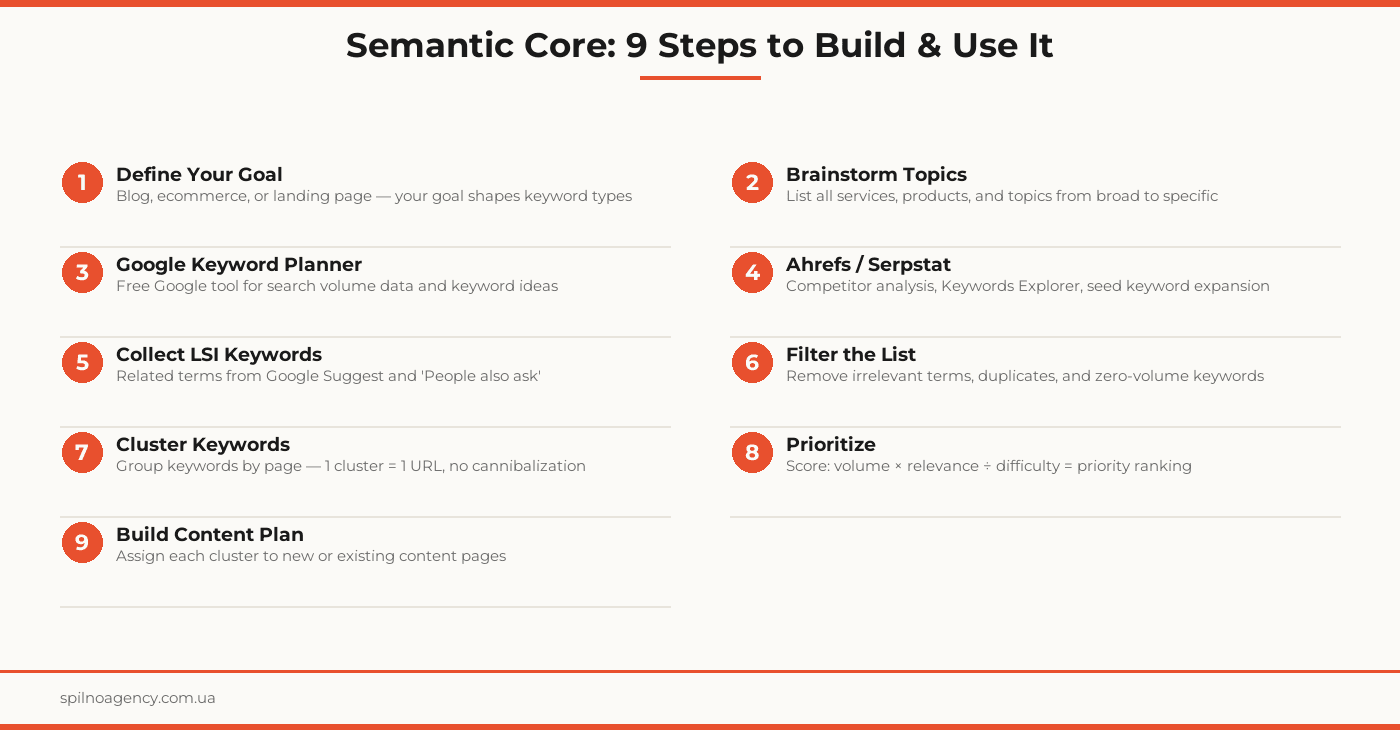
Step 1. Define Your Goal and Topic
Before opening any tool, answer these questions: What is the purpose of your website? What do you sell or write about? Who is your target audience and what language do they use in search? These answers set the boundaries for everything that follows.
Step 2. Brainstorm Seed Keywords
Create a list of “seed” keywords — the most general terms related to your topic. For an SEO agency: “seo,” “website promotion,” “optimization,” “pay per click.” These seeds become the starting point for expansion through tools.
Step 3. Expand Through Keyword Research Tools
Using your seed keywords, collect a full list of variations: synonyms, related phrases, question queries, and LSI terms. Use multiple sources to maximize coverage of actual search demand.
Step 4. Analyze Competitors
Check which keywords rank your competitors — especially those you may have missed. Ahrefs and Serpstat let you see the full organic keyword profile of any competing website.
Step 5. Filter and Clean
Remove irrelevant queries, duplicates, branded terms of competitors, zero-volume keywords, and anything outside your niche. Keep only what will realistically bring targeted traffic to your site.
Step 6. Cluster Keywords
Group keywords by topic and intent. Each cluster = one page. To validate clusters, check Google SERP: if the same competitor pages appear in the top results for two queries, those queries belong in the same cluster.
Tools to Build Your Semantic Core
Google Keyword Planner
Free. Google’s official tool for advertisers. Shows search volumes, seasonality, and related queries. Perfect for getting started — data comes directly from Google. Drawback: it aggregates volumes into ranges for non-active advertisers.
Ahrefs Keywords Explorer
Paid. One of the most powerful tools available: detailed keyword statistics, SERP analysis, “Also rank for,” and “Also talk about” features. Shows clickthrough rate, CPC, and keyword difficulty with high accuracy. Essential for deep research.
Serpstat
Paid (free tier available). Particularly strong for Ukrainian, Russian, and Eastern European markets. Combines keyword research, competitor analysis, clustering, and rank tracking in one platform. A strong choice for agencies operating in these markets.
Semrush
Paid. A comprehensive platform covering keyword research, competitor analysis, site audit, and social media. The largest keyword database for English-language and international markets.
Ubersuggest
Partially free. Neil Patel’s tool — simple and beginner-friendly. Shows volumes, keyword difficulty, and content ideas. Suited for small businesses and bloggers starting their SEO journey.
Google Search Console
Free. Once your site exists, GSC is an irreplaceable source of real queries your site already ranks for. Ideal for expanding and refreshing an existing semantic core with actual performance data.
Google Autocomplete and “Related Searches”
Free. The suggestions in Google’s search bar and the “Related searches” section at the bottom of the SERP are excellent sources of long-tail keywords and related topics that automated tools often miss.
Keyword Clustering
Clustering is the process of grouping keywords by relevance and intent so that each cluster is assigned to a single URL. It is one of the most critical stages of working with a semantic core.
The clustering rule: one page = one cluster. When two pages target similar queries, keyword cannibalization occurs and both pages underperform.
Clustering methods:
- SERP-based clustering: compare the top 10 results for each query. If 3+ URLs overlap, those queries belong in the same cluster.
- Semantic clustering: group by meaning and shared terms.
- Automated clustering: use tools like Serpstat’s clustering feature or KeyClusters.
What to Do After Collecting Your Semantic Core
A collected semantic core is not the end goal — it is the starting point for systematic work on your site.
1. Audit Existing Content
Compare your semantic core against the pages that already exist. Which clusters already have content? Where are the gaps? Which existing pages can be optimized for new queries?
2. Build a Content Plan
Based on your clusters, create a list of new content to publish. Prioritize by traffic potential and competitive difficulty. Assign deadlines and owners for each piece.
3. Optimize Existing Pages
For pages that already exist, update the title tag, H1, meta description, and body content to match the cluster. Add missing keywords and cover the topic more thoroughly.
4. Revise or Build Site Structure
New clusters may require new sections or categories. Review your navigation and internal linking to reflect the updated semantic map of your site.
5. Monitor and Update Regularly
Track your site’s rankings for the keywords in your semantic core using Google Search Console, Ahrefs, or Serpstat. Every 3–6 months, refresh the core: add new queries, remove obsolete ones, and adjust priorities.
Example Semantic Core for a Blog: 10 Pages
Below is a practical example of a semantic core for a digital marketing blog with 10 pages. Each page has its own keyword cluster with 5 terms. Total: 50 keywords across 10 URLs. This is exactly how a real semantic core should look in spreadsheet form.
Abbreviations: inf — informational intent, com — commercial, trans — transactional; KD — Keyword Difficulty (0–100)
| # | Keyword | Volume/mo | KD | Intent | Cluster | Target Page |
|---|---|---|---|---|---|---|
| 1 | digital marketing | 135,000 | 45 | inf | Homepage | / |
| 2 | digital marketing agency | 22,200 | 52 | com | Homepage | / |
| 3 | what is digital marketing | 18,100 | 38 | inf | Homepage | / |
| 4 | digital marketing for small business | 2,400 | 22 | com | Homepage | / |
| 5 | digital marketing strategy | 9,900 | 48 | inf | Homepage | / |
| 6 | seo services | 22,200 | 55 | com | SEO | /seo |
| 7 | search engine optimization | 40,500 | 61 | inf | SEO | /seo |
| 8 | how to do seo | 6,600 | 42 | inf | SEO | /seo |
| 9 | seo audit | 6,600 | 52 | com | SEO | /seo |
| 10 | on page seo | 5,400 | 44 | inf | SEO | /seo |
| 11 | content marketing | 27,100 | 53 | inf | Content | /content |
| 12 | content marketing strategy | 8,100 | 48 | inf | Content | /content |
| 13 | seo content writing | 4,400 | 41 | com | Content | /content |
| 14 | how to write seo articles | 1,600 | 28 | inf | Content | /content |
| 15 | content marketing for beginners | 880 | 22 | inf | Content | /content |
| 16 | social media marketing | 40,500 | 57 | inf | Social | /smm |
| 17 | instagram marketing | 18,100 | 50 | com | Social | /smm |
| 18 | facebook advertising | 22,200 | 55 | com | Social | /smm |
| 19 | social media strategy | 8,100 | 46 | inf | Social | /smm |
| 20 | smm marketing | 3,600 | 38 | inf | Social | /smm |
| 21 | email marketing | 33,100 | 54 | inf | ||
| 22 | email marketing for beginners | 2,400 | 29 | inf | ||
| 23 | email campaign | 5,400 | 42 | com | ||
| 24 | email marketing automation | 4,400 | 45 | com | ||
| 25 | email funnel | 1,300 | 24 | inf | ||
| 26 | google analytics 4 | 60,500 | 46 | inf | Analytics | /analytics |
| 27 | how to use google analytics | 5,400 | 36 | inf | Analytics | /analytics |
| 28 | ga4 reports | 3,600 | 28 | inf | Analytics | /analytics |
| 29 | website traffic analysis | 2,400 | 32 | com | Analytics | /analytics |
| 30 | google analytics metrics | 1,600 | 25 | inf | Analytics | /analytics |
| 31 | google ads | 40,500 | 62 | com | PPC | /ppc |
| 32 | ppc advertising | 18,100 | 54 | com | PPC | /ppc |
| 33 | google ads for beginners | 3,600 | 33 | inf | PPC | /ppc |
| 34 | how much does google ads cost | 2,900 | 27 | inf | PPC | /ppc |
| 35 | ppc campaign management | 1,600 | 38 | com | PPC | /ppc |
| 36 | link building | 18,100 | 52 | com | Links | /link-building |
| 37 | how to build backlinks | 4,400 | 38 | inf | Links | /link-building |
| 38 | backlink strategy | 2,900 | 35 | inf | Links | /link-building |
| 39 | link building outreach | 1,300 | 28 | com | Links | /link-building |
| 40 | quality backlinks | 1,000 | 22 | inf | Links | /link-building |
| 41 | technical seo | 22,200 | 50 | inf | Tech SEO | /technical-seo |
| 42 | page speed optimization | 8,100 | 44 | inf | Tech SEO | /technical-seo |
| 43 | core web vitals | 27,100 | 47 | inf | Tech SEO | /technical-seo |
| 44 | seo site audit | 6,600 | 48 | com | Tech SEO | /technical-seo |
| 45 | xml sitemap seo | 4,400 | 30 | inf | Tech SEO | /technical-seo |
| 46 | local seo | 14,800 | 46 | inf | Local | /local-seo |
| 47 | google my business optimization | 27,100 | 42 | com | Local | /local-seo |
| 48 | local seo for small business | 2,400 | 31 | com | Local | /local-seo |
| 49 | google maps seo | 3,600 | 35 | com | Local | /local-seo |
| 50 | google business profile | 5,400 | 38 | com | Local | /local-seo |
Key takeaways from this example:
- One cluster = one URL. All keywords in the “SEO” cluster point to /seo only, regardless of volume or difficulty.
- Mixed intents within one cluster are normal. “Email marketing” (inf) and “email campaign” (com) both belong to the Email cluster, covering different aspects of the same topic.
- KD 0–30 is a great entry point. For a new blog, start with low-competition queries (KD ≤ 30) and build authority before targeting harder terms.
- Low volume ≠ low value. “Local citations seo” (1,000/mo) with clear commercial intent can drive 5–10 qualified leads per month.
Download the Semantic Core Template
50 keywords · 10 clusters · PDF, Excel or Google Sheets
How Often Should You Update or Rebuild Your Semantic Core
A semantic core is not a static document — it is a living structure that requires regular review. Search behavior evolves, competitors publish new content, and Google updates its algorithms. There are two modes of working with your semantic core: regular updates and full rebuilds.
Regular Updates — Every 3–6 Months
A quarterly or biannual review is the standard for most sites. During an update you:
- Add new queries that appeared in Google Search Console with impressions but no matching page
- Remove keywords whose search volume has dropped to zero or near zero
- Move keywords between clusters if search intent has shifted
- Add seasonal queries at least 2 months before the peak season
- Refresh volume and difficulty metrics from up-to-date data pulls
Full Rebuild — When Is It Justified
A complete rebuild from scratch makes sense in these situations:
- Product or audience change. If you expanded your offer or shifted your target audience, the old core no longer reflects reality.
- Entering a new market or language. Translation is not a new semantic core — each locale has its own search behavior and competitive landscape.
- After a major Google Core Update. A significant algorithm change can rewrite ranking priorities: some queries gain value, others lose traffic overnight.
- Organic traffic dropped 30%+ without technical causes. The queries you were targeting may no longer match current user intent.
- Your core is older than 2 years. The SEO landscape changes fast — a core built in 2022 may not reflect the realities of 2025.
Unscheduled Review Triggers
- New queries appear in Search Console with clicks but no matching page — add them to the core immediately
- Rankings dropped sharply — check if the SERP changed (new competitors, AI Overviews, Featured Snippets)
- A competitor launched a new section and gained positions fast — analyze their keyword profile to close the gap
The rule: don’t wait for traffic to drop. A semantic core that is updated proactively is a competitive advantage, not a chore.
Keyword Research Checklist
- Defined the website’s goal and topic scope
- Created a seed keyword list (20–50 base terms)
- Collected queries via Google Keyword Planner
- Expanded the list using Ahrefs or Serpstat
- Analyzed competitors’ organic keyword profiles
- Collected LSI keywords and Google suggestions
- Removed irrelevant and duplicate queries
- Clustered keywords by topic and intent
- Assigned each cluster to a specific URL
- Audited existing pages against the core
- Created a content plan for 3–6 months
- Set up rank tracking for target keywords
Frequently Asked Questions About Semantic Core
What is a semantic core in SEO?
A semantic core is a structured list of keywords and phrases for which your website should rank in search engines. It covers all topics your site addresses and maps user queries to every stage of the sales funnel. Building one ensures your content strategy is driven by actual search demand.
How many keywords should a semantic core have?
For a small blog, 50–200 keywords is sufficient. For a corporate site or ecommerce store, it can run into thousands. What matters more than quantity is quality and relevance — every keyword should map to an existing or planned page on your site.
How often should I update my semantic core?
Review your semantic core every 3–6 months, or after significant changes to your products or services. Search trends shift, new queries emerge, and others become obsolete. Regular updates keep your strategy aligned with actual market demand.
Which tool is best for keyword research?
For beginners, Google Keyword Planner is free and reliable. For in-depth analysis, Ahrefs or Semrush offer the most complete data. Serpstat is strong for Eastern European markets. The best approach combines multiple tools to maximize keyword coverage across different data sources.
What is keyword clustering?
Keyword clustering is grouping keywords by topic and intent so each cluster is assigned to a single URL. The rule: one page = one cluster. This prevents keyword cannibalization, where multiple pages compete for the same query, and helps you distribute content efficiently across your site.
Work With Spilno Agency
Need help building your semantic core or developing an SEO strategy? The Spilno Agency team is ready to help your business grow in organic search.

Read also

Is an SEO specialist responsible for leads and sales? Our position
A LinkedIn discussion: should an SEO specialist be responsible for leads and sales from the SEO channel. Spilno…
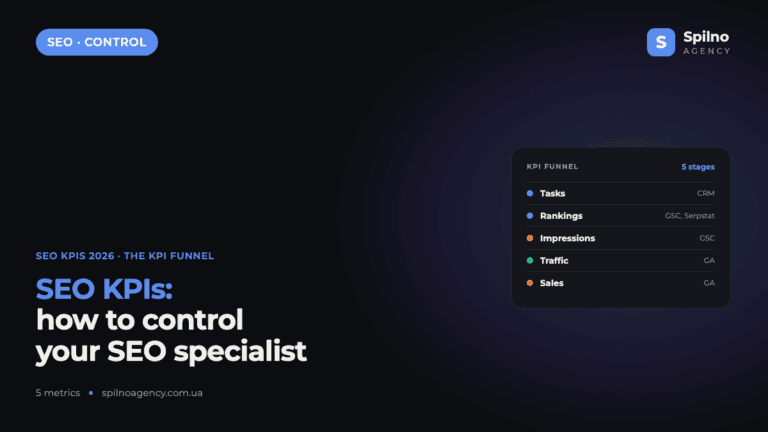
How to Control an SEO Specialist: The 5-Stage SEO KPI Funnel
SEO KPIs form a chain of five metrics that show, step by step, whether your SEO is actually…
Best CMS for an Online Store: Cloud vs Self-Hosted Platforms in 2026
Compare Shopify, WooCommerce, PrestaShop, OpenCart and Magento for your online store. Pros, cons, and a step-by-step CMS selection…