How Performance Max campaigns work in Google Ads: a guide for first-time advertisers


Performance Max (often abbreviated Pmax) is a goal-based campaign type in Google Ads that Google launched in November 2021 and made the default for retail in September 2022, when it auto-upgraded every Smart Shopping and Local campaign onto Pmax. In 2026, it is the fastest way to reach Search, YouTube, Display, Discover, Gmail, Maps, Shopping and Google Play from a single campaign — and let a Gemini-powered model decide where and to whom to show your ads.
This guide is for a marketer or business owner launching Pmax for the first time. We explain exactly how the algorithm works, what a campaign is made of, which metrics to watch and how they’re calculated, where Pmax fits in the marketing funnel — and which other tools you need around it.
What Performance Max is and how it differs from other campaign types
Every previous Google Ads campaign type was built around a channel: Search served text on the SERP, Display served banners across the GDN, Shopping showed product cards, Video served ads on YouTube. The marketer decided how much budget to give each channel, which keywords to target and whom to show ads to.
Performance Max breaks that logic. You give Google one campaign, one goal, one budget and a set of creative assets — and the algorithm distributes impressions across all surfaces in real time. A single model decides “should we bid or not” using the user’s full context: prior queries, YouTube viewing history, Gmail tabs opened, Maps route.

Pmax differs from other campaign types on four key dimensions:
- Inventory: Pmax = every Google surface at the same time. Search, Display, Shopping or Video are each limited to their own channel.
- Targeting: Search uses keywords, Display uses audiences. Pmax has no strict targeting — instead, audience signals are hints the model uses to learn faster but freely serves outside of them when it predicts higher conversion probability elsewhere.
- Creative: Pmax uses asset groups that contain text, images, video, logos and a Merchant Center feed all together. Google composes the right format for each channel on the fly.
- Bidding: no manual bids. Only Smart Bidding — Maximize Conversions, Maximize Conversion Value, with optional tCPA or tROAS targets.
According to Google’s own data, advertisers who add Pmax on top of Search see on average +18% conversions or conversion value at similar CPA/ROAS. It isn’t magic — one model reallocates a unified budget more efficiently than several separate campaigns with separate budgets and targets.
How Pmax works under the hood: Gemini, auction, audience signals
For every impression opportunity — a search query, a YouTube view, an open Gmail thread, a glance at a banner — the Pmax model makes four decisions in fractions of a second:
- Should we bid at all? (predicted conversion probability × predicted value > budget opportunity cost)
- Which channel — Search, YouTube, Display, Discover, Gmail, Maps or Shopping — has the highest probability?
- Which asset combination will work: headline A + description C + image 3 + video 2?
- What bid will hold the tCPA / tROAS target?
Since 2024 the engine behind Pmax has been Gemini — Google’s multimodal model. It generates long 90-char headlines, multiple image variants from a single product photo (in 2025 Imagen 2 added lifestyle imagery — people in action, not just product-on-white), and stitches together short videos from images when no video is uploaded. In 2026 two more pieces arrived: AI Brief — a free-text field where you describe brand, audience and tone to steer Gemini, and Gemini-powered Dashboards — reports you query in natural language.
One nuance beginners often miss: audience signals are not a target. If you upload 10,000 existing customers and select the “fridge in-market” segment, Pmax will learn faster on those people but will still serve outside that group whenever it predicts cheaper conversions elsewhere. The signal is a starting point, not a fence.
Asset Group: how to assemble creative so the algorithm can perform
An asset group is Pmax’s equivalent of an ad group. Each group is a thematic bundle of creative assets plus an audience signal plus (for e-commerce) a slice of your Merchant Center feed. A single Pmax campaign can hold up to 100 asset groups. The rule of thumb: one asset group = one product category, not one audience segment — the algorithm will find the right audience.

Google’s official specs for 2026:
- Short headlines — up to 15, up to 30 chars each (at least one required).
- Long headlines — up to 5, up to 90 chars. Gemini can generate them automatically.
- Descriptions — up to 5: one 60-char short + four 90-char long.
- Business name — 1, up to 25 chars.
- Logos — square 1:1 (recommended 1200×1200) and landscape 4:1 (1200×300).
- Images — up to 20 per aspect ratio: landscape 1.91:1 (1200×628), square 1:1 (1200×1200), portrait 4:5 (960×1200). Without portrait images you won’t appear on YouTube Shorts or mobile Discover.
- Video — up to 5, at least 10 seconds, ideally one per aspect ratio (9:16, 16:9, 1:1). Per Google’s data, having video gives +12% conversions. Skip it and Google will auto-generate videos from your images — worse than a real video.
- Extensions: 4–6 sitelinks, callouts, structured snippets, call, lead form, promotion, price — without these the Search inventory won’t fire.
- Search Themes — up to 50 per group (limit raised on 2 May 2025). A hint to the algorithm on which search categories to cover.
Every asset is rated Low / Good / Best after enough impressions. Target: at least 50% of assets rated “Best”. Refresh 20% of creative every 4–6 weeks — otherwise fatigue sets in and CTR drops.
Performance Max metrics: what each number means
Pmax exposes dozens of numbers, but a beginner needs to understand 14 core metrics. Here they are with formulas and meaning:

- Impressions — how many times the ad appeared on screen. Alone it says little: bots see ads too, and users scroll past without noticing.
- Clicks — clicks on the ad. A stronger interest signal.
- CTR (Click-Through Rate) = Clicks ÷ Impressions × 100%. Tells you how relevant and attractive the creative is. In Search Pmax 4–8% is normal; Display 0.5–1.5%; YouTube 0.4–1%.
- CPC (Cost Per Click) = Cost ÷ Clicks. The average auction price per click. Pmax 2025–2026: average CPC per WordStream is ≈ $0.68.
- Conv. — count of conversion events (purchase, lead form, call) marked as Primary in your account. Pmax optimises on these.
- Conv. value — total value of conversions. For e-com it’s revenue; for lead-gen it’s an estimated lead value.
- CPA (Cost Per Acquisition) = Cost ÷ Conversions. The most important metric for lead-gen.
- ROAS (Return On Ad Spend) = Conv. value ÷ Cost. How much revenue every dollar of ad spend returns. ROAS 4 = $4 of revenue per $1 spent. Average Pmax ROAS ≈ 125% (1.25×); top advertisers see 4–8×.
- tCPA (Target CPA) — the target cost per conversion you set for Smart Bidding.
- tROAS (Target ROAS) — the target return percentage (e.g. 400% = $4 per $1).
- New customer rate — share of new buyers among all buyers. Critical for growth quality vs. just remarketing.
- Search lost IS (rank) — % of search impressions Pmax missed due to low Ad Rank.
- Search top IS — % of impressions shown at the top of the SERP.
- Channel Performance — report rolled out in open beta in May 2025: breaks down conversions and cost by Search, YouTube, Display, Discover, Gmail, Maps individually.
How to set target values: start tCPA 10–15% above current Search CPA, and tROAS 10–20% below usual. Otherwise the algorithm finds nobody to serve and conversions are zero. Change targets no more than once every 1–2 weeks, by no more than 10–15% at a time.
Performance Max and the marketing funnel
The marketing funnel is the customer journey from “never heard of you” to “bought and came back”. The classic model: TOFU (awareness) → MOFU (consideration) → BOFU (decision) → Retention. Each stage needs different content, different KPIs and different paid tools.

TOFU — awareness
The user isn’t searching for your product yet. KPIs: Reach, Impressions, CPM, VTR, Brand Lift. Pmax is a weak TOFU tool: it optimises for conversion, so it only serves YouTube and Display to people close to purchase. For real top-of-funnel, use Demand Gen, YouTube Reach and Discovery. Tools: GA4 (Engaged Sessions, Brand Search), Search Console, YouTube Studio.
MOFU — consideration
The user knows the category, reads reviews, compares. KPIs: CTR, CPC, Engagement Rate, Time on Site, Add-to-cart, Scroll Depth. Pmax is strong here: Discover and YouTube In-feed cover the consideration phase. Add Demand Gen, Display remarketing and GA4 audiences. Tools: Microsoft Clarity, Hotjar, landing-page A/B tests.
BOFU — conversion
The user is ready to buy. KPIs: CR%, CPL, CPA, ROAS, ROMI, AOV. Performance Max is the primary BOFU tool, especially for e-commerce: Shopping + Search through a single campaign deliver maximum conversions for the money. Keep a brand-Search campaign and AI Max for Search for non-brand intent alongside. Tools: GA4, Looker Studio, CRM (HubSpot, Pipedrive) for lead-gen.
Retention
Bought once → comes back. KPIs: LTV, CAC, Retention Rate, Churn, NPS, Repeat Purchase Rate. Pmax has a dedicated Retention goal since 2024 — a campaign that re-engages lapsed customers via Customer Match. Alongside: email (Klaviyo, Mailchimp), push, loyalty programs, Meta/TikTok remarketing.
The digital marketer’s stack around Pmax
Pmax isn’t a “set and forget” tool. To influence the campaign deliberately you need 7–10 tools. The minimum 2026 stack:
- Google Ads UI — Pmax creation, budgets, targets, asset groups, Search Themes, Channel Performance report.
- Google Analytics 4 (GA4) — conversion import to Ads, audience building for Customer Match, attribution model checks.
- Google Tag Manager + Server-side GTM — to track everything the browser sees and recover data blocked by ITP and ad-blockers. Enhanced Conversions practically require GTM.
- Consent Mode v2 — mandatory for any EEA/UK traffic since 6 March 2024. From 21 July 2025 Google has started turning off remarketing and conversion tracking on non-compliant accounts.
- Merchant Center Next — the feed for e-commerce. A “red” feed kills the Shopping side of Pmax.
- Looker Studio — weekly dashboards for team and client.
- Microsoft Clarity — free alternative to Hotjar with session recordings and heatmaps.
- CRM / CDP (HubSpot, Salesforce, Pipedrive) — for offline conversions. Without them lead-gen Pmax optimises on form fills, not deals.
- Optmyzr / Adalysis — automation: budget monitoring, weak asset detection, search-terms analysis.
- Ahrefs, Serpstat, Semrush — research for Search Themes, brand query monitoring, competitive analysis.
Budget and learning period
Most often Pmax “doesn’t work” because of budget, not the algorithm. Google’s official guidance plus 2026 industry consensus:
- Daily budget ≥ 3 × tCPA. If a target conversion costs $20, the daily budget is at least $60. Otherwise fewer than one conversion lands per day and the model wanders blind.
- For tROAS — a different rule: budget should produce at least 50 conversions per week.
- Before launching Pmax you need a historical baseline of 30+ conversions in the last 30 days. Without it Smart Bidding has nothing to learn from.
- Learning phase: 2 weeks no matter what. Let it run. CPA/ROAS can look terrible for the first 7–10 days, then converge from day 14.
- Any big change (strategy switch, +30% budget, new conversion) resets learning.
10 common mistakes when launching Pmax for the first time
- Launching with empty analytics — zero conversion history, wrong primary actions, no Enhanced Conversions. Nothing to learn from.
- Budget below 3× tCPA — campaign starves.
- Thin creative — only square images, no portrait, no video. YouTube Shorts and mobile Discover skip you.
- No Conv. value passed — forces Max Conversions instead of tROAS.
- Empty or too narrow audience signal — learning takes longer.
- No Search Themes — Google has to guess.
- No Brand Exclusion — Pmax cannibalises cheap branded traffic that would have arrived anyway and inflates the stats.
- Brand and non-brand queries in one campaign — distorts ROAS.
- No campaign / account-level negatives — budget leaks to support, jobs, irrelevant queries.
- Scaling too fast: +50% budget overnight or –30% tCPA → instant learning reset and a 1–2 week dip.
Step-by-step launch checklist

Follow the order — skipping steps 1–3 cuts effectiveness by 30–60%, even if everything else is done right.
What to read in reports — weekly and monthly
Weekly 15-minute review:
- Channel Performance — Search share of conversions. If <50%, check Brand Exclusion and Search Themes.
- Asset rating — replace every “Low” asset older than 14 days.
- Search Themes usefulness — drop “not useful”, expand “useful”.
- Search Terms Insights — harvest negatives.
- Pacing & Search lost IS (budget) — are you hitting the budget ceiling?
Monthly 60-minute review:
- New Customer Acquisition value vs returning — is the business growing or just feeding regulars?
- tROAS / tCPA trend — is the system holding target?
- Creative refresh — swap ≈20% of assets.
- Audience signal performance — refresh Customer Match.
- Optmyzr/Adalysis scripts for placement exclusions (MFA sites, junk apps).
- Benchmark comparison: CTR, CPC, CR by vertical.
2025–2026 benchmarks by vertical
Per WordStream, Optmyzr and Tinuiti (2025) average Pmax numbers look like this:
- E-commerce: CTR 1–2%, CPC $0.40–0.80, CR 1.8–3.0%, ROAS 2–4× normal, 5–8× excellent.
- Fashion / Beauty: CTR 1.5–3%, CR 2–4%, ROAS 5–10×.
- Lead-gen / B2B: CTR 4–6%, CPC $3–8, CR 4–7%, CPA for cold lead $30–100.
- SaaS: CTR 3–5%, CPC $3–10, CR 1.5–3.5%, value-based bidding with LTV is mandatory.
- Local services: CTR 5–8%, CR 8–12%, Maps inventory is critical.
- Automotive: CR 15–16% — highest of all verticals per WordStream 2025.
- Finance / insurance: CTR 8%, but CR ≈ 2.5%.
Pmax vs AI Max for Search: when to use which
In 2025 Google launched AI Max for Search — not a new campaign type but a feature layer that toggles on within existing Search campaigns. Marketers get confused: “Pmax or AI Max?” Short answer — both.
- Pmax — when you have rich creative (photos, video), a product feed, and want to cover all Google surfaces. E-com, retail, multi-channel.
- AI Max for Search — when the business is search-driven, has mature keyword lists, and you want to expand intent without losing keyword control. B2B, services, travel.
- Power Pack (Google’s 2025 recommendation): Demand Gen (TOFU) + AI Max for Search (intent) + Pmax (conversion) — full funnel.
Conclusion
Performance Max is the single most powerful Google Ads campaign type of 2026, but the “black box” reputation is only skin-deep. Once you understand how the auction decides, how a signal differs from a target, how to set tROAS without breaking learning, why an Asset Group isn’t an ad group, and when Pmax fits vs. when you need Demand Gen — the algorithm stops being magic and becomes a tool.
The proven first-launch path: run one Pmax on your most profitable product category, do not touch it for 14 days, then run a 15-minute weekly review of Channel Performance + Asset Ratings + Search Themes, and a monthly cycle of refreshing 20% of creative and your Customer Match list. After 60–90 days the campaign becomes transparent — and you can scale it without surprises.
If you’d like the Spilno Agency team to set up your Performance Max — from tracking and Consent Mode v2 to Channel Performance reporting and optimisation — get in touch via our contacts.

Read also

Is an SEO specialist responsible for leads and sales? Our position
A LinkedIn discussion: should an SEO specialist be responsible for leads and sales from the SEO channel. Spilno…
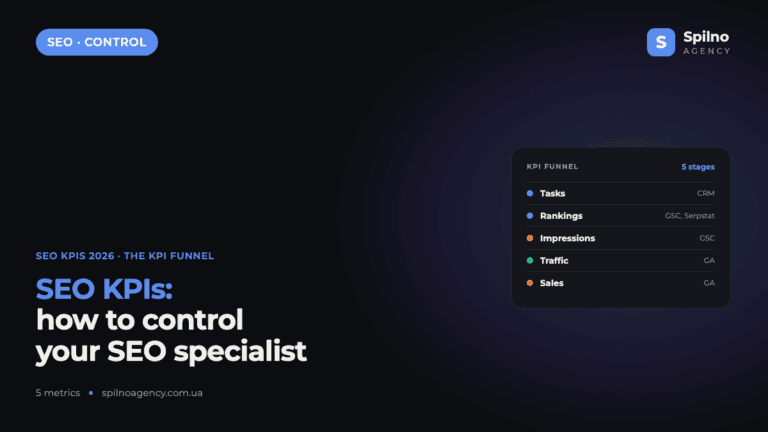
How to Control an SEO Specialist: The 5-Stage SEO KPI Funnel
SEO KPIs form a chain of five metrics that show, step by step, whether your SEO is actually…
Best CMS for an Online Store: Cloud vs Self-Hosted Platforms in 2026
Compare Shopify, WooCommerce, PrestaShop, OpenCart and Magento for your online store. Pros, cons, and a step-by-step CMS selection…