How to Define Your Target Audience? Step-by-Step TA Analysis by Spilno Agency

You’re spending money on ads but sales aren’t growing. You create content but it doesn’t resonate. You run promotions — and get silence. The most common reason: you don’t know your target audience.
In this article, we’ll break down how to define your target audience (TA) step by step, which tools to use, and how to build the analysis using the Spilno Agency methodology — the same one we apply working with clients in Ukraine and globally.
What Is a Target Audience and Why It Matters
A target audience (TA) is the group of people most likely to buy your product or use your service. Not just “anyone interested in our product” — but specific people with specific problems that your business solves.
Without understanding your TA, any marketing is shooting in the dark:
- Ad budget goes to the wrong people
- Content doesn’t connect with the audience
- High traffic but low conversion to purchases
- Slogans and offers fail to generate emotion
When the TA is defined accurately, every marketing dollar works harder — because you’re talking to people who already have a need for your product.
Spilno Agency’s Target Audience Analysis Methodology
At Spilno Agency, we use a data-driven analytical approach to defining target audiences. It’s based on the same logic as funnel analysis: first look at the data, then draw conclusions.
The principle: segment the audience — just as in funnel analysis we separate all traffic, organic users, and paid ads. Each segment behaves differently, and those differences are the key to understanding your TA.
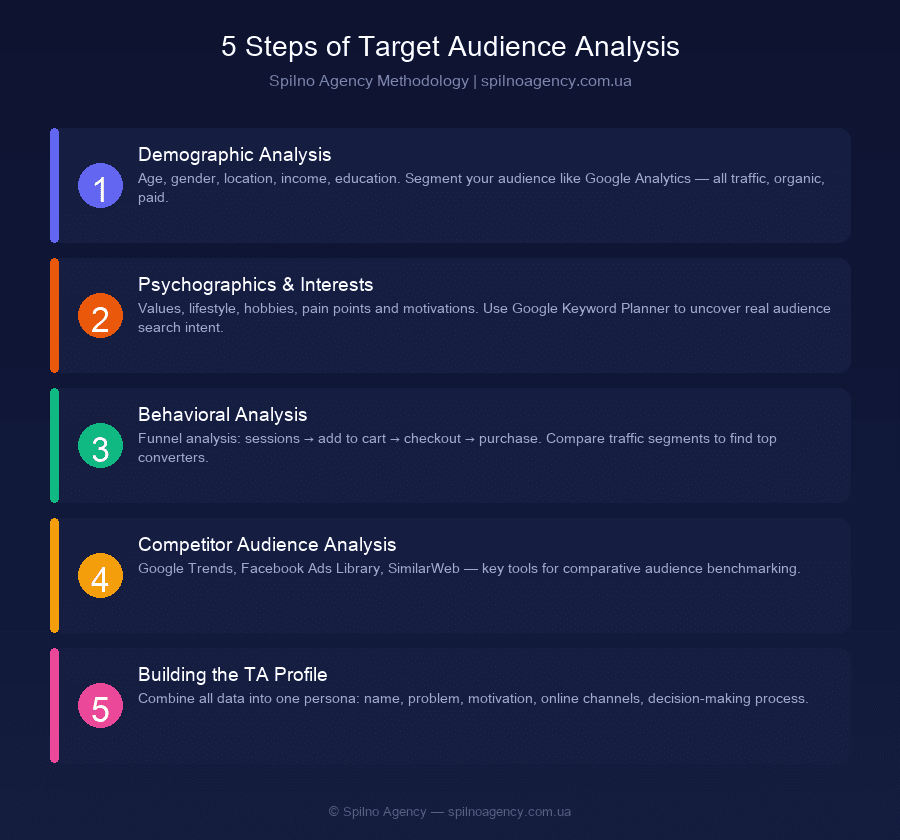
Step 1. Demographic Analysis
Demographic analysis is the foundation everything else is built on.
- Age — 18–25, 25–35, 35–50? Each group has different pain points and purchasing behavior
- Gender — check the data: often one gender purchases significantly more actively
- Location — country, region, city level targeting
- Income — budget, middle, premium segment
- Education and employment — student, employee, entrepreneur
Where to get data: Google Analytics 4, Facebook Audience Insights, CRM data.
Step 2. Psychographics and Interests
Psychographics is what you can’t see directly in numbers — but it’s exactly what makes people buy:
- Values — what matters in their life (family, career, health, status)
- Lifestyle — active, homebody, traveler
- Hobbies and interests — sports, technology, fashion, cooking
- Pain points and fears — what worries your customer
- Motivations — savings, status, convenience, security
Step 3. Behavioral Analysis
Audience behavior in the funnel is the most objective indicator. Key metrics (modeled on Spilno Agency’s sales funnel approach):
| Funnel Stage | What We Analyze | What It Tells Us |
|---|---|---|
| Sessions (traffic) | Who visits the site | General audience profile |
| Add to cart | % conversion from sessions | How relevant the offer is to the TA |
| Checkout start | % continuing to purchase | Trust and motivation level |
| Purchase | Final conversion rate | Real portrait of your buyer |
Compare different traffic segments: organic vs. paid ads vs. direct. The segment that converts best — that’s your core TA.
Step 4. Competitor Audience Analysis
Your competitors have already found their audience — use that to your advantage:
- Google Trends — compare query popularity in your niche by region
- Facebook Ads Library — see who competitors’ ads are targeting
- SimilarWeb — competitor site audience profile: age, interests, geo
- Comments and reviews — read what competitor customers write on social media
Step 5. Building the TA Profile
After collecting data — combine it into a single profile (buyer persona / customer avatar):
- Name: Sarah, 32 years old
- Job: Marketing manager at a tech company
- Location: Kyiv / London / Warsaw
- Pain: Not enough time to learn new marketing tools
- Motivation: Wants to grow professionally and stay in demand
- Online channels: LinkedIn, Instagram, professional Telegram channels
How to Study Your Target Audience with Google Keyword Planner
Google Keyword Planner isn’t just an SEO tool. It’s a window into the mind of your target audience. People type into Google exactly what they’re thinking, wanting, and worrying about.
1. Find what your audience is searching for
- Open Google Ads → Tools → Keyword Planner
- Enter your product or service name
- Select geolocation — your target country or region
- Analyze the suggested keyword list
What to look for:
- Informational queries (“how to choose”, “what is better”) — audience in research mode
- Commercial queries (“buy”, “price”, “order”) — audience ready to purchase
- Competitor brand queries — people already looking for alternatives
2. Identify demand seasonality
The query trend chart shows when your TA is most active — giving you insight into when to ramp up advertising.
3. Segment your audience through queries
Different keyword groups = different TA segments. Each segment needs its own messaging and content.
4. Check keyword competitiveness
Low-competition queries with decent volume are your opportunity to rank without a huge budget.
Tools for Defining Your Target Audience
| Tool | What It Provides | Price |
|---|---|---|
| Google Analytics 4 | Demographics, behavior, traffic sources | Free |
| Google Keyword Planner | What your audience searches, query volume | Free |
| Facebook Audience Insights | Interests, demographics, social behavior | Free |
| Google Trends | Interest trends, regional breakdown | Free |
| SimilarWeb | Competitor audience data | Free plan available |
| Serpstat / Ahrefs | Competitor keyword SEO analysis | Paid |
Common Mistakes When Defining Your TA
- “Our audience is everyone” — this isn’t an audience, it’s an absence of strategy
- Relying only on intuition — always verify with data; intuition is often wrong
- One TA for all channels — the same people behave differently on Instagram vs. LinkedIn
- Static TA profile — audiences evolve; update your analysis at least annually
- Ignoring segmentation — every business has multiple TA segments
Conclusion: TA Is the Foundation of Any Marketing
Defining your target audience means answering the central question of marketing: who are we selling to? Without that, any investment in ads and content will underperform.
Use the Spilno Agency methodology: data first, conclusions second. Start with demographics in Google Analytics, add keyword research in Keyword Planner, study competitors — and only then build your TA profile.
Want a professional target audience analysis for your business? Contact the Spilno Agency team. We work with data, not guesswork.

Read also
Call to Action (CTA): What It Is and How to Write One That Converts in 2026
A CTA (call to action) tells a user exactly what to do next. We break down CTA types,…
Google Data Studio (Looker Studio): What It Is and What It Can Do
Looker Studio (formerly Google Data Studio) is Google's free BI tool. We break down connectors, dashboards, and use…
Instagram: What Are Reels and How to Use Them
Reels are short vertical videos on Instagram that the algorithm shows even to non-followers. Technical specs, how Reels…