LTV and LT: What Are These Metrics and How to Use Them in Marketing

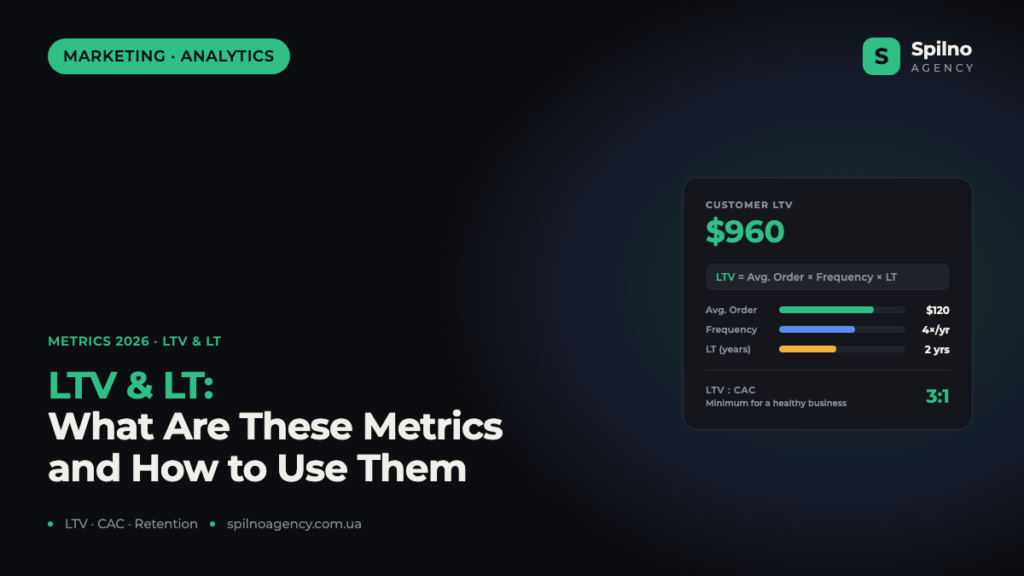
LTV (Lifetime Value) and LT (Customer Lifetime) are two key metrics that define how much revenue a customer generates throughout their relationship with your business. Understanding these metrics lets you allocate marketing budget more accurately, evaluate acquisition channel ROI, and build a long-term growth strategy.
What Is LTV (Lifetime Value)
LTV (Lifetime Value, or Customer Lifetime Value — CLV) is the total value of a customer to a business over the entire course of their relationship. Simply put: how much money one customer will bring your company from their first purchase to the end of the relationship.
This is not a one-time transaction or an average order value. LTV is the cumulative revenue or profit from a customer over their entire lifecycle in your business.
For example, a customer at an online clothing store makes 4 purchases a year with an average order of €30 and remains an active customer for 3 years. Their LTV = 4 × 30 × 3 = €360.
Why Track LTV
Most marketers focus on customer acquisition cost (CAC) and the first purchase. But this is an incomplete picture. A customer who bought once for €15 and a customer who buys every month for two years are fundamentally different assets for the business.
LTV answers questions that CAC and ROAS cannot: how much can we afford to spend on acquiring one customer? Which channels bring the most “long-term” customers? When does a customer break even?
What Is LT (Customer Lifetime)
LT (Lifetime or Customer Lifetime) is the average period during which a customer remains an active buyer in your business. LT is the “time horizon” for calculating LTV.
Calculating LT depends on business type:
- E-commerce and retail: LT = 1 / Churn Rate (annual). If 25% of customers stop buying each year, LT = 1 / 0.25 = 4 years.
- SaaS and subscriptions: LT = 1 / Churn Rate (monthly). At 5% monthly churn, LT = 1 / 0.05 = 20 months.
- Service businesses: LT is determined by the average contract duration or number of repeat engagements.
Important: LT should not be confused with the “term” of a product or contract. It is a statistical measure calculated from real customer data.
LTV Calculation Formulas
There are several ways to calculate LTV depending on available data and the accuracy you need.
Simple LTV Formula
Suitable for most e-commerce businesses and gives a quick estimate:
LTV = Avg. Order Value × Annual Purchase Frequency × LT (years)Example: Online cosmetics store. Average order — €40, customer buys 5 times a year, average LT — 2 years.
LTV = 40 × 5 × 2 = €400LTV with Gross Margin (more accurate)
Shows the actual profit from a customer, not just revenue:
LTV = Avg. Order Value × Purchase Frequency × LT × Gross Margin (%)Example: Same data + gross margin 35%.
LTV = 40 × 5 × 2 × 0.35 = €140 (net profit per customer)ARPU / Churn Formula (for SaaS)
LTV = ARPU (avg. monthly revenue per user) / Monthly Churn RateExample: SaaS service. ARPU = €50/month, Churn = 3%/month.
LTV = 50 / 0.03 = €1,667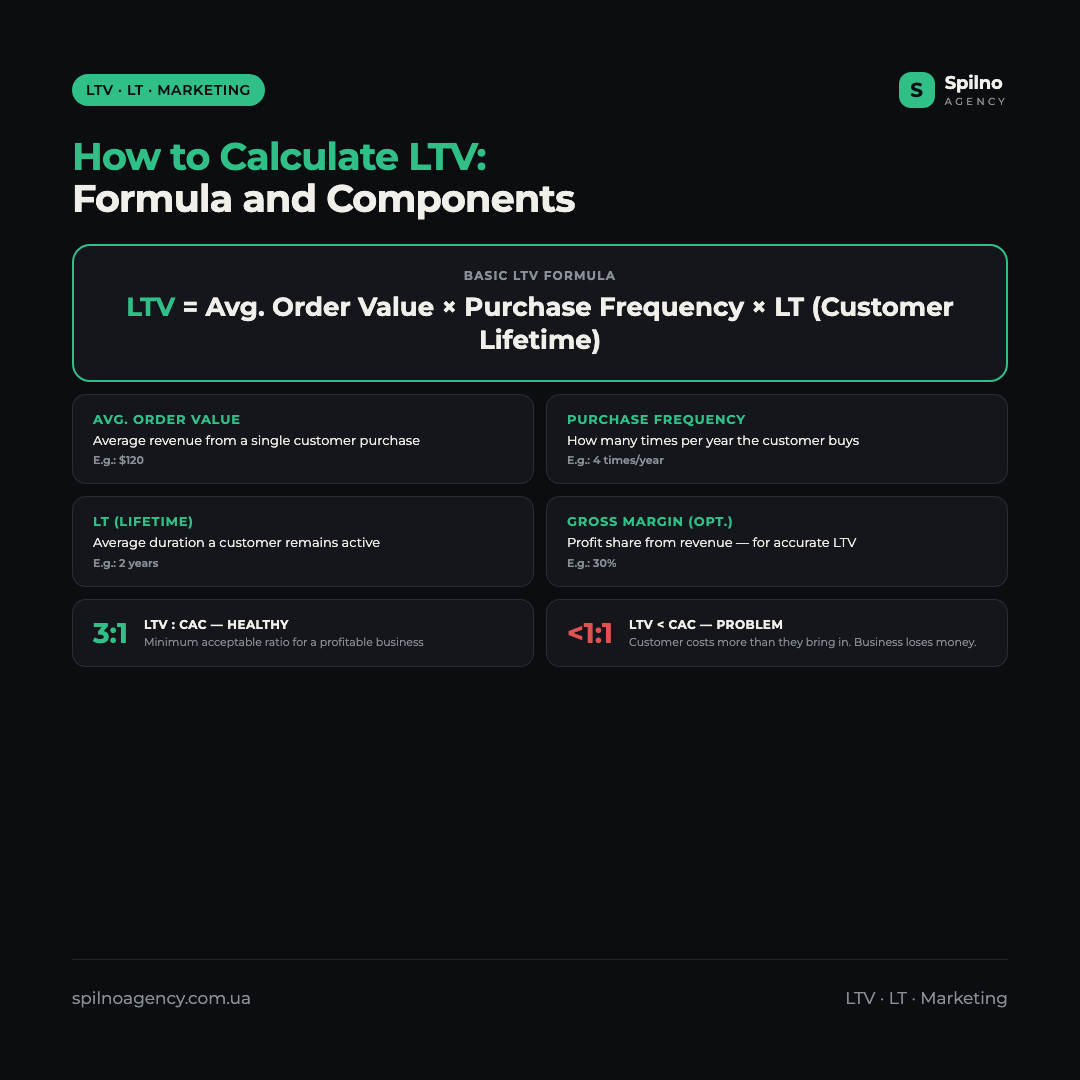
LTV and CAC: The Key Ratio in Marketing
LTV only makes sense in relation to CAC (Customer Acquisition Cost). The LTV:CAC ratio shows whether your marketing is profitable in the long run.
- LTV:CAC < 1:1 — catastrophic. You’re spending more to acquire a customer than they will ever bring in. The business is loss-making by definition.
- LTV:CAC between 1:1 and 3:1 — danger zone. Technically not a loss, but too little margin for operating costs, product development, and team.
- LTV:CAC between 3:1 and 5:1 — healthy. The classic benchmark for a solid business. Room to grow.
- LTV:CAC > 5:1 — either very efficient marketing, or you’re underinvesting in acquisition and leaving money on the table.
For most e-commerce and service businesses, the target is LTV:CAC ≥ 3:1. This is the minimum at which marketing pays off and the business has scaling potential.
LTV by Marketing Channel: Where Customer Quality Is Better
One of the most valuable practices is comparing LTV of customers acquired through different channels. Often the channel with the lowest CAC brings customers with the lowest LTV — and vice versa.
- Organic Search (SEO) — customers with the best LTV. They actively search for your product, have higher trust levels, return more often.
- Email marketing — highest LTV across all channels for e-commerce. Database customers already know the brand, lower churn.
- Google Ads (Search) — good LTV, especially for branded and transactional queries.
- Meta Ads / Facebook — often lower LTV due to cold traffic. Works well for initial acquisition followed by retargeting.
- Price comparison traffic — lowest LTV. Customers are loyal to price, not to the brand.
Takeaway: evaluate channels not only by CAC or first-purchase ROAS, but by the LTV of customer cohorts acquired through that channel over 6–12 months.
Cohort Analysis: How to Measure LTV Correctly
The most accurate way to measure LTV is cohort analysis. A cohort is a group of customers united by the time of their first purchase (e.g., “customers who joined in January 2025”).
- Select a cohort (e.g., all new customers in a specific month).
- Track their purchases month by month over 12–24 months.
- Calculate cumulative revenue from the cohort.
- Compare LTV between cohorts from different acquisition channels or campaigns.
In GA4, cohort analysis is available under Explore → Cohort Exploration. For more detailed analysis, use BigQuery or specialised tools (Lifetimely, Glew, Triple Whale).
5 Ways to Increase LTV
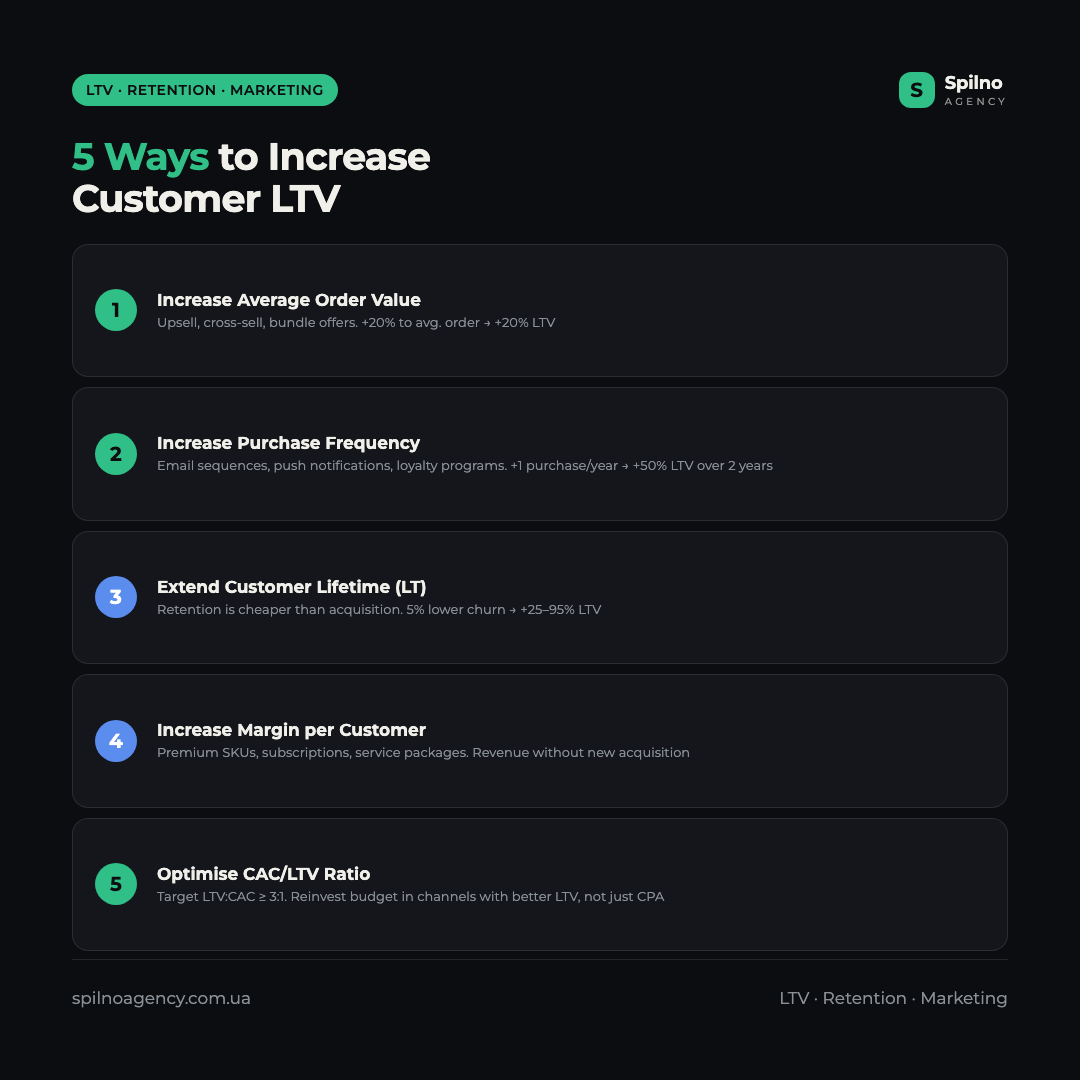
1. Increase Average Order Value (AOV)
Upsell (offer a higher-priced option), cross-sell (complementary products), bundle offers. Increasing average order value by 20% increases LTV by the same 20% — without acquiring new customers.
2. Increase Purchase Frequency
Email re-engagement sequences, push notifications, SMS remarketing, loyalty programmes with points. If a customer buys 3 times a year instead of 2 — LTV grows by 50%.
3. Extend Customer Lifetime (LT)
Reducing Churn Rate is the most effective lever. Research shows: reducing churn by 5% increases profit by 25–95% (Bain & Company). Tools: personalisation, win-back campaigns, subscriptions.
4. Increase Margin per Customer
Introducing premium SKUs or service packages, switching to a subscription model, improving delivery and service efficiency. Revenue grows without acquiring new customers.
5. Optimise LTV:CAC by Channel
Reallocate budget towards channels that deliver customers with better LTV. Even if CAC is higher in that channel, overall profitability may be better.
LTV in Different Business Models
LTV for E-commerce
Key drivers: repeat purchase frequency and retention. Typical LTV:CAC for successful e-commerce — 3:1 and above. Key tools for LTV improvement: email marketing, loyalty programmes, personalised recommendations.
LTV for SaaS
The key metric is Churn Rate. With monthly subscriptions, even a small churn dramatically reduces LTV. Target for SaaS: Churn < 2%/month and LTV:CAC > 3:1 with CAC payback within 12–18 months.
LTV for Agencies and Service Businesses
LTV is determined by the average monthly retainer and contract duration. Typical LT for digital agencies — 12–24 months. LTV improvement strategy: upselling new services, automation and NPS improvement.
Common LTV Mistakes
- Calculating LTV based on revenue, not profit. The real value of a customer is profit after deducting cost of goods, delivery, and returns.
- Ignoring segmentation. Average LTV across all customers is an uninformative number. Track LTV by channel, product category, geography.
- Not accounting for CAC payback period. Even with a good LTV:CAC of 3:1, if a customer breaks even in 18 months, the company may face cash flow issues.
- Confusing projected and actual LTV. Projected LTV is a hypothesis. Actual LTV is the result of cohort analysis. Both are needed, but they shouldn’t be mixed.
- Optimising CAC at the expense of LTV. Cutting CAC through cheap channels may reduce customer quality and overall business LTV.
LTV in Marketing Strategy: Practical Applications
- CAC ceiling: if LTV = €400 and target LTV:CAC = 3:1, you can spend up to €133 on acquiring one customer and remain profitable.
- Channel selection: Google Ads with CAC €80 and LTV €320 (4:1) is more profitable than social media with CAC €50 and LTV €100 (2:1), even though the second has lower CAC.
- Product prioritisation: if a certain product category brings customers with higher LTV — it’s worth scaling separately.
- Budget planning: business growth is measured not only by first-purchase ROAS but by cumulative LTV of cohorts.
FAQ: LTV and LT in Marketing
What is LTV in simple terms?
LTV (Lifetime Value) is the total amount of money one customer brings to your business over the entire relationship — from first to last purchase. If a customer buys 4 times a year for €30 and stays with you for 3 years, their LTV = €360.
What is the difference between LTV and LT?
LT (Lifetime) is the average duration a customer remains active. LTV is the monetary value over that period. LTV = Average Order × Purchase Frequency × LT.
What is a good LTV:CAC ratio?
The minimum acceptable is 3:1 (LTV three times the CAC). At 2:1 the business has virtually no profit after operating costs. At 5:1 and above — either very efficient marketing, or you’re underinvesting in acquisition.
How do I calculate LTV in GA4?
GA4 has a built-in LTV report under “Monetisation → Lifetime Value”. It shows average revenue from cohorts over the first 120 days. For full analysis beyond 6 months, use BigQuery or specialised tools (Triple Whale, Lifetimely).
What is Churn Rate and how does it affect LTV?
Churn Rate is the share of customers who stop buying within a given period. It directly determines LT: LT = 1 / Churn Rate. At 25% annual churn → LT = 4 years. Reducing churn by just 5% can double LTV.
Can LTV be increased without increasing CAC?
Yes, and this is one of the most cost-effective growth paths. Email marketing, loyalty programmes, upsell and cross-sell, product and support improvements — all these tools increase LTV without additional spend on new customer acquisition.
How is LTV used in Google Ads and Meta Ads?
Knowing LTV, you can set a higher target CPA or target ROAS for campaigns focused on long-term customers. Google Ads has a “conversion values based on LTV” feature that accounts for projected customer revenue, not just the first purchase. In Meta Ads, LTV helps choose the optimal budget for Lookalike Audience campaigns targeting “best” customers.

Read also

Is an SEO specialist responsible for leads and sales? Our position
A LinkedIn discussion: should an SEO specialist be responsible for leads and sales from the SEO channel. Spilno…
How to Control an SEO Specialist: The 5-Stage SEO KPI Funnel
SEO KPIs form a chain of five metrics that show, step by step, whether your SEO is actually…

Best CMS for an Online Store: Cloud vs Self-Hosted Platforms in 2026
Compare Shopify, WooCommerce, PrestaShop, OpenCart and Magento for your online store. Pros, cons, and a step-by-step CMS selection…