SEO Strategy for Website Promotion: How to Build One and What Types Exist

An SEO strategy is a documented action plan that defines your search engine optimization goals, priority channels, required resources, and success criteria. Without a strategy, SEO work becomes a chaotic set of actions with no clear direction. In this guide, you’ll learn what types of SEO strategies exist, how to build one step by step, and what mistakes are most commonly made at the start.
SEO by the Numbers
| 90.63% | of pages get zero organic traffic (Ahrefs, 2020) |
| 53.3% | of all web traffic comes from organic search (BrightEdge, 2019) |
| 27.6% | of clicks go to the #1 Google result (Backlinko, 2022) |
What Is an SEO Strategy and Why You Need One
An SEO strategy for website promotion is a systematic document describing: what results you want to achieve in search engines, which methods to use and in what order, what resources are needed (budget, team, tools), and how you’ll measure success. It’s not just a list of tasks in a project manager or a keyword spreadsheet. It’s a strategic plan where every action is justified and tied to business goals.
Without a strategy, an SEO specialist or agency acts reactively: fixing errors on the fly, writing articles without a system, building links without clear priorities. The result is unpredictable and slow.
Types of SEO Strategies: Which One to Choose
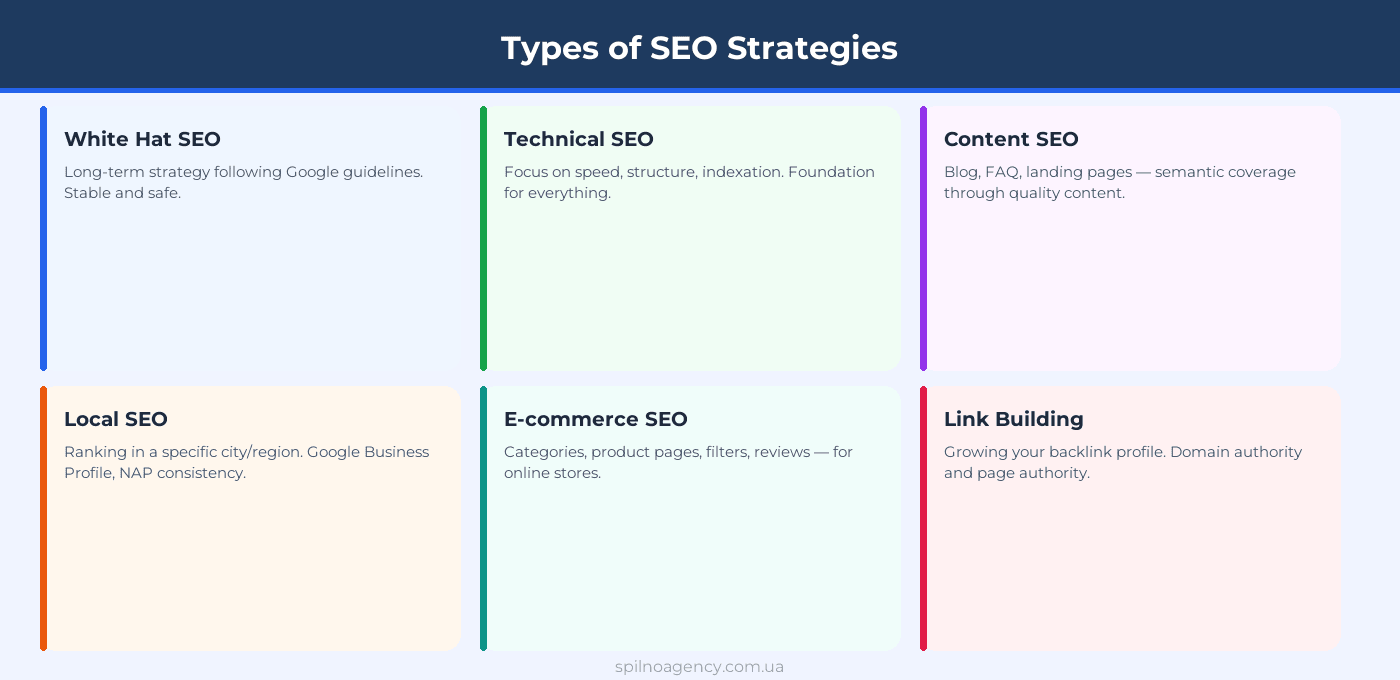
There is no single “correct” SEO strategy. The choice depends on site type, competitive environment, budget, and goals. Here are the main types:
White Hat SEO
A strategy that fully complies with Google’s official guidelines. Focus on content quality, technical excellence, and natural link growth. Slow start, but the most stable long-term result. Suitable for most legitimate businesses.
Technical SEO Strategy
Priority is removing technical barriers to crawling and indexation. Optimizing Core Web Vitals, fixing 4xx/5xx errors, configuring robots.txt and sitemaps, implementing structured data. Often the first stage of any comprehensive strategy.
Content SEO Strategy
Growth through large-scale quality content production: blog posts, guides, FAQ pages, comparison articles. Effective for informational and niche sites. Takes time but builds long-term topical authority in the niche.
Local SEO
Ranking in a specific geographic area. Includes Google Business Profile optimization, NAP data (Name, Address, Phone) management, local landing pages, and review generation. Essential for offline businesses: restaurants, clinics, law firms, beauty salons.
E-commerce SEO
Optimizing online stores: category pages, product cards, filtered URLs, duplicate content management. Special attention to the technical side (large catalogs = complex indexation) and commercial search intent.
Link Building Strategy
Deliberate growth of a quality backlink profile: guest posts on authoritative resources, HARO/journalist requests, digital PR, broken link reclamation. Domain authority (Domain Rating) is one of the key ranking factors.
How to Build an SEO Strategy: 7 Steps
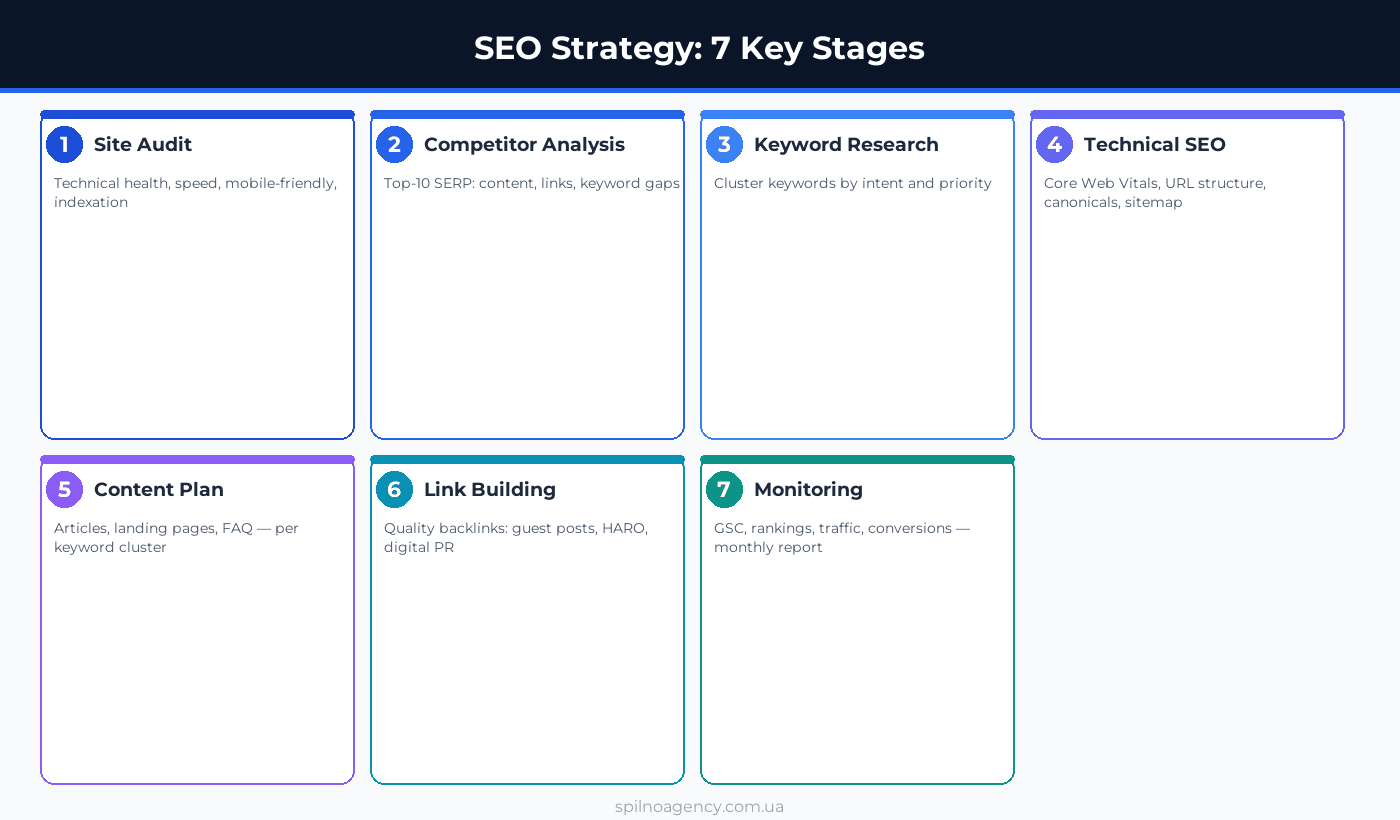
Step 1: Current Site Audit
Before planning anything, you need to understand where you are now. A technical audit reveals: critical errors (server errors, duplicates, broken links), indexation status, page speed (Core Web Vitals), mobile optimization. Without this step, strategy is built on an unstable foundation.
Tools: Google Search Console, Screaming Frog, PageSpeed Insights, Ahrefs Site Audit.
From Spilno Agency practice: In over 70% of new client audits, we uncover critical technical issues — duplicate pages, blocked robots.txt, hreflang misconfigurations, or missing canonicals. This means the site has been silently losing organic traffic for months, and the owner had no idea why.
Step 2: Competitor Analysis
Identify 5–10 direct competitors in search results (not necessarily business competitors). Analyze: their keyword profile, content structure, backlink base, technical health. This reveals entry opportunities and the resources needed to compete.
From Spilno Agency practice: In most competitive niches, the top 3 positions are held by sites with 3+ years of SEO history and DR above 40. Trying to outrank them in 2–3 months only leads to disappointment. A realistic goal for a new site: reach top-10 for long-tail queries within 6–12 months, then compete for head terms.
Step 3: Keyword Research and Clustering
Collect all relevant queries (from broad to long-tail). Cluster by intent: informational, navigational, commercial, transactional. Identify priority clusters for launch based on traffic potential and competition level.
Step 4: Technical Optimization
Fix critical errors found during the audit. Configure the technical base: proper URL structure, canonical tags, hreflang for multilingual sites, XML sitemap, robots.txt, Schema.org structured data.
Step 5: Content Plan Development
Based on your keyword clusters, create a publication plan: which pages to create, which to optimize, in what order. Consider priority by traffic volume, competition, and relevance to your goals.
From Spilno Agency practice: One of our B2B SaaS clients (HR automation niche) grew organic traffic from 200 to 3,400 visits/month in 8 months — purely through a systematic content plan: 4 articles per month targeting specific keyword clusters. No new backlinks, no technical changes — just quality, intent-matched content.
Step 6: Link Building
Develop a link-building strategy according to your budget and niche. Most reliable methods: topical guest posts, digital PR (coverage through valuable content or data), broken link reclamation, partnership content.
Step 7: Monitoring and Adjustment
SEO is not “set and forget.” Monthly analyze: organic traffic growth, position changes for target queries, technical site health, quality and quantity of new backlinks. Adjust strategy priorities based on data.
Common SEO Strategy Mistakes
- No audit before starting. Writing content on a broken site wastes resources.
- Focusing only on search volume. A query with 10 monthly searches but perfectly matching your audience is more valuable than a “hot” query with 10,000 where most users are irrelevant.
- Ignoring search intent. If Google shows commercial pages, an informational article won’t win. Content format must match intent.
- Lack of patience. SEO yields results in 3–12 months. A 1-month strategy is not a strategy.
- Neglecting technical SEO. Even the best content won’t rank if the site is poorly indexed or loads slowly.
- Working without KPIs. Without clear metrics, there’s no way to know if the strategy is working.
SEO Strategy KPIs and Metrics
Properly chosen KPIs allow you to objectively evaluate SEO strategy effectiveness and correct course in time.
- Organic Traffic — visits from search engines (Google Analytics 4 / GSC)
- Rankings for Target Queries — weekly/monthly tracking (Ahrefs, Serpstat, GSC)
- Domain Rating (DR) — domain authority on Ahrefs scale (grows with quality links)
- Number of Indexed Pages — semantic coverage growth
- SERP CTR — click-through rate (GSC)
- Organic Conversions — target actions from organic traffic (leads, sales, signups)
- Core Web Vitals — technical user experience score (LCP, CLS, INP)
SEO Strategy and GEO (Generative Engine Optimization)
GEO (Generative Engine Optimization) represents new challenges for SEO strategy as search engines (Google AI Overviews, Bing Copilot, Perplexity) generate direct answers in search results, reducing click-through rates. To appear in these AI-generated answers, your strategy must consider:
- E-E-A-T signals — Experience, Expertise, Authoritativeness, Trustworthiness
- Schema.org structured data — FAQPage, HowTo, Article, BreadcrumbList
- Clear, direct answers to questions in a format easy for AI to parse
- Citations and sources — AI prefers to cite authoritative, verified sources
- Brand authority — media coverage, niche backlinks, active presence in industry discussions
SEO Strategy Checklist
- ☐ Technical SEO audit completed (Screaming Frog, GSC, PageSpeed)
- ☐ 5–10 search competitors identified
- ☐ Keyword universe collected and clustered
- ☐ Critical technical errors fixed
- ☐ Title, H1, meta description optimized for priority pages
- ☐ Canonicals, hreflang (if multilingual), sitemap.xml configured
- ☐ Content plan created for 3–6 months
- ☐ Schema.org structured data implemented (Article, FAQ, BreadcrumbList)
- ☐ Link building launched (minimum 2–4 quality links/month)
- ☐ Rankings and traffic monitoring set up
- ☐ KPIs and achievement timelines defined
- ☐ Regular reporting (monthly minimum)
Frequently Asked Questions
What is an SEO strategy for website promotion?
An SEO strategy is a documented plan that defines the goal (rankings, traffic, conversions), priority work areas (technical SEO, content, link building), timeline, and KPIs. It answers the question of ‘what, when, and why’ to do with your website to grow in search results.
How long does SEO promotion take?
The first noticeable results typically appear 3–6 months after active work begins. Stable traffic and ranking growth takes 6–12 months. For competitive niches (finance, medicine, legal services) — 12–18 months. SEO is a long-term investment, not a quick result.
What types of SEO strategies exist?
Main types include: White Hat SEO (following Google guidelines), Technical SEO (speed, structure, indexation), Content SEO (blog, FAQ, guides), Local SEO (local promotion), E-commerce SEO (store optimization), and Link Building (growing backlinks). An effective strategy usually combines several approaches.
Where do I start with website SEO?
Start with a technical site audit to identify critical issues. Then analyze competitors and build your keyword universe. Follow with a content plan, fixing technical issues, optimizing existing pages, and gradually building a backlink profile.
How to measure SEO strategy effectiveness?
Key KPIs: organic traffic growth (Google Analytics / GSC), ranking improvement for target queries (Ahrefs, Serpstat), increase in indexed pages, Domain Rating growth and backlink count, and conversion rate from organic traffic.
Need an SEO strategy for your website? Spilno Agency will develop a personalized strategy tailored to your niche, competitors, and goals.

Read also

Is an SEO specialist responsible for leads and sales? Our position
A LinkedIn discussion: should an SEO specialist be responsible for leads and sales from the SEO channel. Spilno…
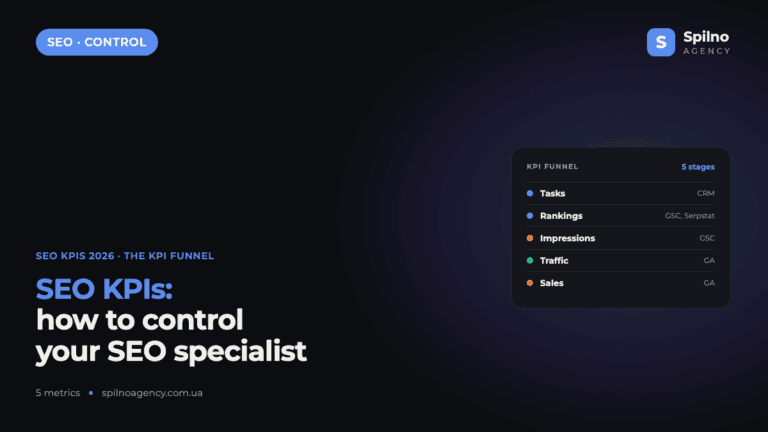
How to Control an SEO Specialist: The 5-Stage SEO KPI Funnel
SEO KPIs form a chain of five metrics that show, step by step, whether your SEO is actually…
Best CMS for an Online Store: Cloud vs Self-Hosted Platforms in 2026
Compare Shopify, WooCommerce, PrestaShop, OpenCart and Magento for your online store. Pros, cons, and a step-by-step CMS selection…