How to Advertise an Intimate-Products Store in Google Merchant Center

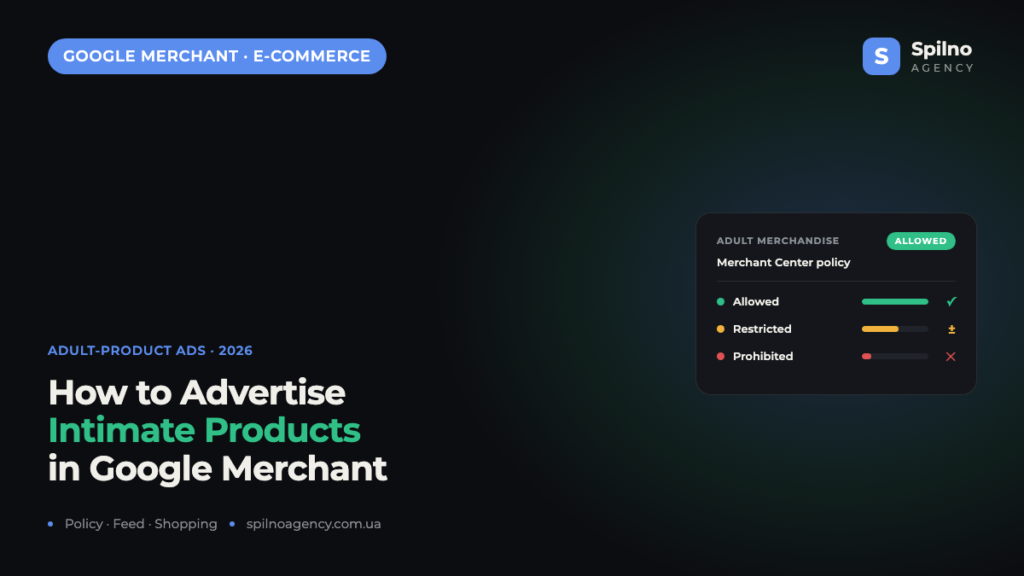
Yes, you can advertise intimate products on Google — it’s legal, and Google Merchant Center explicitly allows “adult-oriented merchandise” as long as it’s set up correctly. But the policy is strict, and accounts for these stores get suspended more often than the average e-commerce. The working strategy is to launch only “safe” categories (lubricants, personal care, neutral accessories), manually vet every item, and submit a separate feed of approved products to Shopping. Most importantly — have a specialist who reacts quickly to suspensions and knows how to deal with Google Support.
Can you advertise intimate products on Google: the short answer
Yes, you can. Google doesn’t ban intimate-products stores from advertising or appearing in Google Shopping and free listings. The Merchant Center policy has a dedicated category — Adult-oriented merchandise — which is restricted, not fully prohibited. Restricted means listings are allowed, but with conditions: correct labelling, neutral imagery, appropriate targeting and landing pages.
The challenge isn’t whether it’s possible — it’s the execution details. Because the niche is sensitive, moderation is more rigorous and the suspension risk is higher. So launching a store like this requires a different approach than regular e-commerce: not “upload the whole catalogue and wait”, but assembling a narrow, carefully vetted assortment and growing it gradually.
What Google allows and what it bans: the “adult merchandise” policy
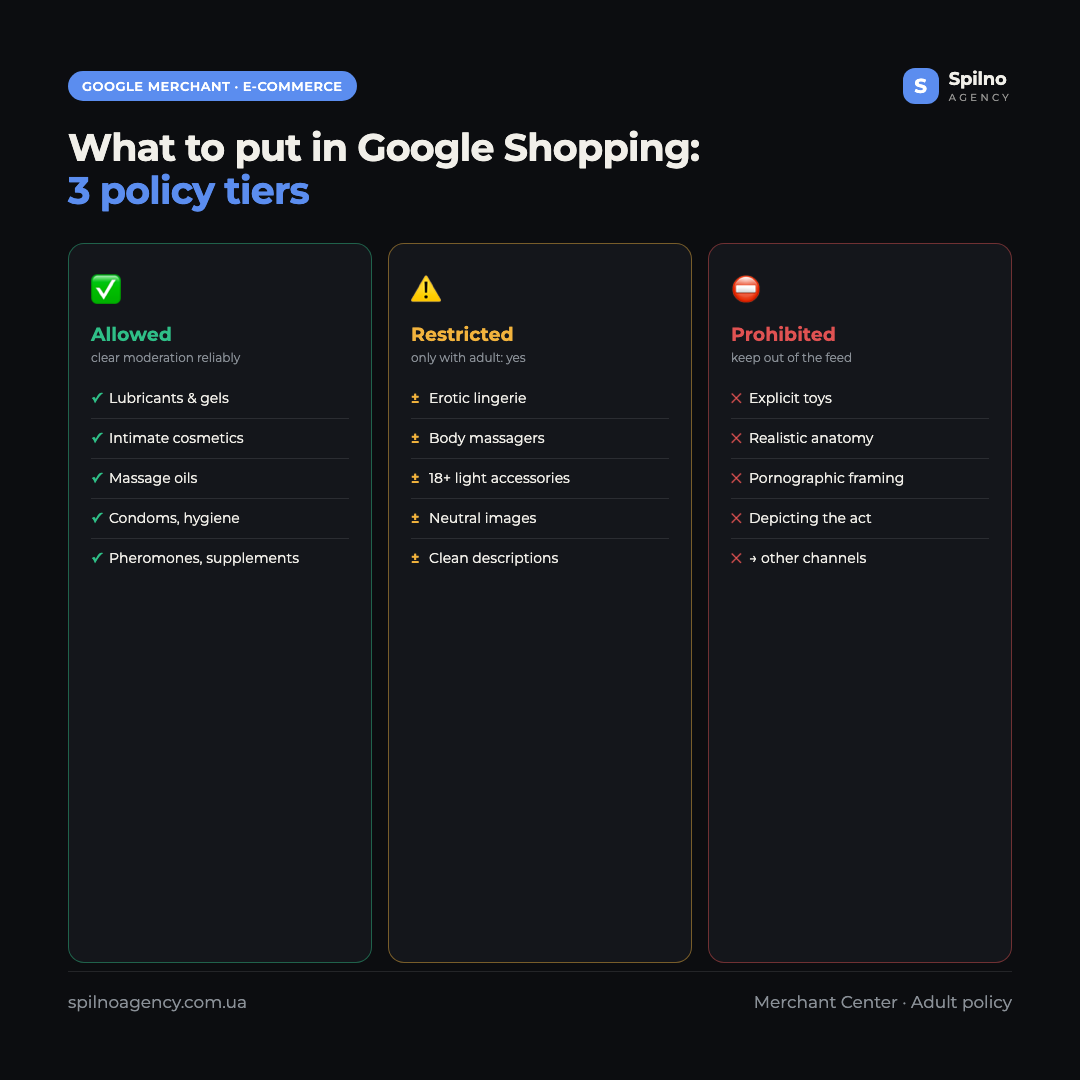
The key is learning to tell three levels apart. Your entire feed strategy depends on it:
- Allowed. Neutral sexual-wellness and personal-care products: water-based lubricants, intimate cosmetics and gels, massage oils, hygiene products, condoms, supplements without medical claims — provided the images and descriptions are appropriate.
- Restricted (adult). Adult products that may be shown only with the
adultlabel and in compliance with the rules: no explicit imagery in the feed, neutral titles, the correct Google category. Visibility is limited by surface, targeting and region. - Prohibited. Sexually explicit products, content depicting sexual acts, realistic genital replicas presented pornographically, 18+ material focused on shock value. These items simply won’t show in Google Shopping at all — they’re promoted through other channels.
An important nuance: even “allowed” products can be disapproved if the image or description presents them in a sexualised context. Google evaluates not just the product itself, but how it’s presented. A neutral photo of a lubricant on a white background is allowed; the same photo in an erotic scene triggers moderation.
Requirements for an intimate-products store in Google Merchant Center
The baseline requirements are the same as for any e-commerce, plus a few that are critical for the 18+ niche. Before launching, make sure every point is covered:
- Verified and claimed domain. Site verification in Merchant Center (via Google Search Console or a tag) and claiming ownership of the URL.
- Legal pages. Contact details, returns policy, shipping, privacy policy, terms of service. For 18+ — a mandatory age confirmation (age gate) at the store entrance.
- Configured shipping and taxes — without them, products won’t go live in listings.
- A correct feed. Unique
idvalues, realpriceandavailabilitymatching the site, populatedbrand,gtinormpn, and the rightgoogle_product_category. - Adult-content labelling. The
adultattribute for the relevant items in the feed, and an adult flag at the account/site level for an entirely “adult” store. - Neutral images. The product on a plain background, no nudity, no erotic context, no text or watermarks overlaid on the image.
- “Clean” titles and descriptions — no explicit wording, spam, ALL CAPS or prices in the title.
The adult attribute in the feed looks like this — it’s added to every item that qualifies as “adult” content:
<item>
  <g:id>SKU-1042</g:id>
  <g:title>Water-based lubricant, 100 ml</g:title>
  <g:google_product_category>Health & Beauty > Health Care > Sexual Wellness</g:google_product_category>
  <g:price>6.90 EUR</g:price>
  <g:availability>in_stock</g:availability>
  <g:adult>yes</g:adult>
</item>
Trying to “hide” the adult nature of a product (not setting adult: yes where it’s required) is the fastest route to an account-level suspension. Google treats it as policy circumvention, after which all your products stop showing — even the neutral ones.
Which products to launch: “safe” categories vs prohibited ones
The smartest tactic for launch is to not try to load the entire catalogue, but to carve out a “safe core”: products that pass moderation consistently and rarely get disapproved. That’s exactly what the first feed is built from.
- What to launch first: water-based lubricants and gels, intimate cosmetics and personal care, massage oils, condoms, hygiene products, pheromones, neutral accessories for couples, health supplements (without medical claims like “cures/enlarges”).
- What to launch cautiously (with
adultand a neutral photo): erotic lingerie presented discreetly, body massagers, “18+ light” category items. - What not to submit to Shopping at all: sexually explicit toys with realistic anatomy, products with pornographic positioning, anything depicting a sexual act. These categories are promoted through SEO, email, specialist marketplaces and content marketing.
The logic is simple: one disapproved “risky” product costs less than a full account suspension. So you only send to Shopping what you’re confident about, and keep anything questionable out of the feed. That preserves the account’s reputation — and with it, your access to free impressions in Google Merchant Center.
A separate feed of vetted products: why manual moderation is mandatory
An auto-generated “whole catalogue” feed for an intimate-products store is a ticking time bomb. In a large assortment there will always be items that breach policy, and they’ll drag the whole account down with them. The solution is a separate feed containing only manually vetted products.
Here’s how it works in practice:
- A specialist reviews every item manually — title, description, image, category — and decides: “safe”, “restricted (with
adult)” or “not for Shopping”. - Safe and restricted products are tagged with a separate marker in the CMS (for example, a custom field
gmc_ready: trueor a dedicated “Google Shopping” collection). - A separate feed is generated from the flagged products only — via a CMS rule, a feed manager (Mergado, Channable, GMC feed rules) or a separate supplemental feed.
- This feed is connected to Merchant Center, while the site’s main catalogue never reaches Google.
- New products don’t enter the feed automatically — they go through the same manual check first. This is the main safeguard against an accidental suspension.
That way the catalogue in Google always stays “clean”: it contains exactly the items that clearly comply with policy. The rest of the assortment sells on the site and is promoted through other channels, without putting the account at risk.
Why these accounts get suspended more often — and what actually helps
Let’s be honest: even with flawless setup, intimate-products stores face suspensions more often than the average e-commerce. The reasons:
- Automated moderation is more cautious with sensitive niches and sometimes disapproves even compliant products “just in case”.
- Site changes (a new photo, an updated description, an 18+ promo banner) can flip a product from “allowed” to “disapproved” the very next day.
- False positives happen regularly — the system sees a trigger word or image where there’s no violation.
- Google policy updates in this category happen more frequently, and requirements tighten.
What do you do about it? In this niche, a suspension isn’t “the end” — it’s an ongoing process you have to manage. What genuinely helps:
- A fast reaction. The sooner a violation is spotted and fixed, the lower the risk it escalates to a full account suspension.
- A well-built appeal. For a false positive, you need to file a request for re-review correctly and clearly argue that you comply with policy.
- Dialogue with support. Some suspensions are only lifted by contacting Google Ads / Merchant Center Support — and here it matters to know how to communicate with moderation and make your case.
- Feed segmentation. A separate feed of vetted products (see above) dramatically reduces the frequency of mass disapprovals.
Why having an experienced specialist is critical
In ordinary e-commerce you can launch Shopping “on your own” and figure things out as you go. In the 18+ niche the cost of a mistake is higher: one careless feed update and the account is suspended, with recovery taking weeks. That’s why an experienced specialist here isn’t a luxury — it’s a condition for survival. What they do differently:
- Knows the policy in detail — which products are allowed, which only with
adult, which are prohibited — and never lets anything into the feed that could sink the account. - Reacts fast. Monitors statuses daily and resolves issues before they escalate into an account-level suspension.
- Handles dialogue with Google Support — frames appeals correctly, escalates false positives, secures re-reviews.
- Builds a process, not a one-off launch — sets up a separate feed, a vetting workflow for new products and ongoing monitoring, so the store shows consistently for months.
This is exactly what Spilno Agency specialises in: we have hands-on experience launching and running advertising for intimate-products stores — from assembling a “safe” feed and configuring Merchant Center to dealing promptly with suspensions and communicating with Google Support. Whether your account is already suspended or you’re only planning a launch, we’ll help you do it legally and reliably. Details are on our e-commerce advertising and Google Ads setup pages.
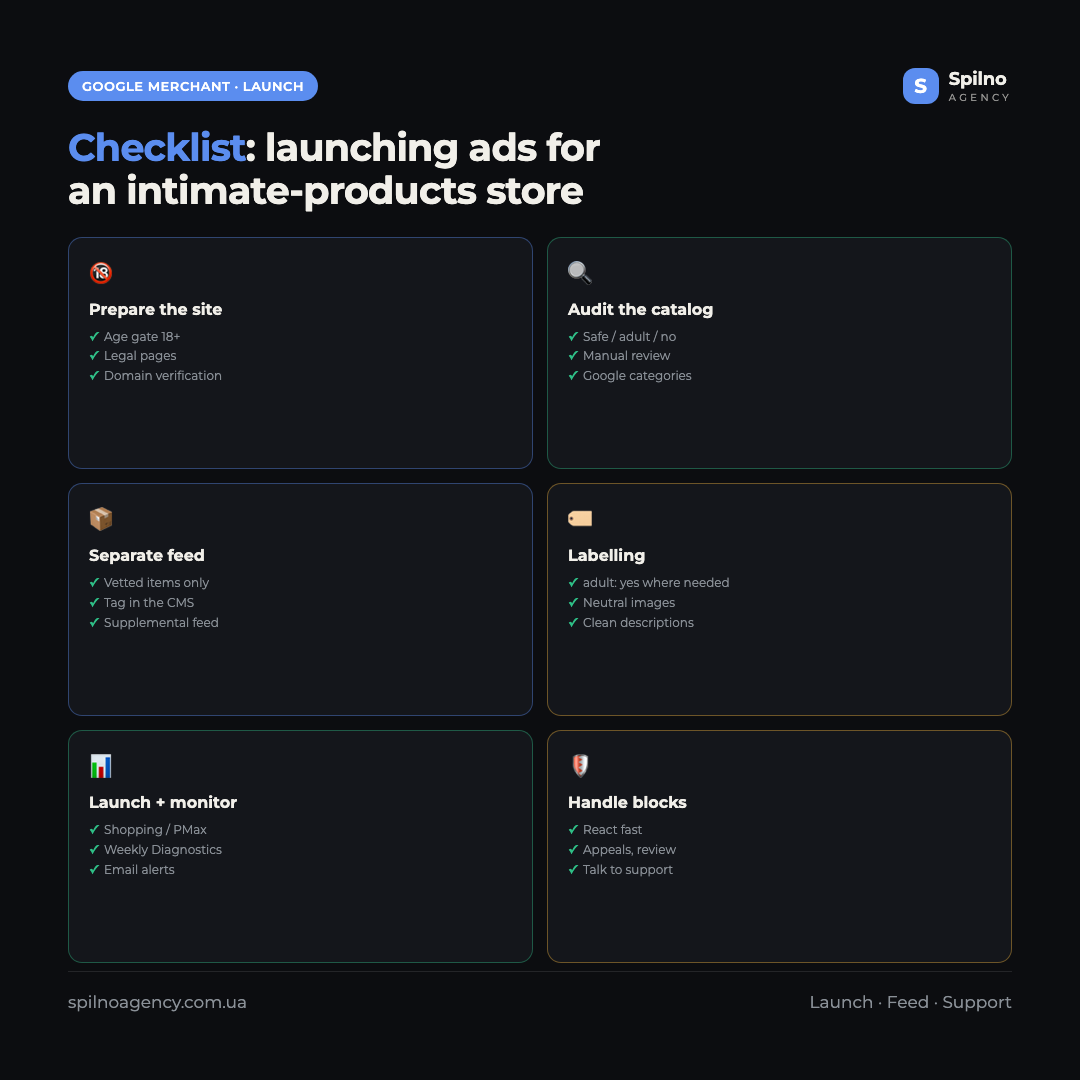
A step-by-step plan for launching intimate-products advertising
Order matters — first the foundation and the “safe core”, and only then expansion:
- Prepare the site. Age gate, legal pages, domain verification and claim in Merchant Center.
- Run a manual audit of the assortment. Sort products into “safe”, “restricted (adult)” and “not for Shopping”.
- Assemble a separate feed from vetted items only. Mark
adult: yeswhere needed. - Prepare neutral images and descriptions for all products in the feed.
- Configure shipping, taxes and identifiers (GTIN/MPN/brand).
- Upload the feed and wait for moderation (usually 1–3 days for a new account).
- Launch Shopping / Performance Max on the approved products and keep an eye on statuses.
- Set up monitoring. Check “Diagnostics” weekly + the day after any site changes; enable email alerts for critical issues.
- Scale gradually — add new vetted items without flooding the whole catalogue at once.
FAQ: advertising intimate products in Google Merchant Center
Is it legal to advertise intimate products on Google?
Yes. Google Merchant Center allows “adult-oriented merchandise” as a restricted (not prohibited) category. Advertising and free listings are possible with correct labelling, neutral imagery and policy compliance. Only sexually explicit products and pornographic content are prohibited.
Which sex-shop products can be launched in Google Shopping?
The “safe” categories pass moderation most reliably: water-based lubricants and gels, intimate cosmetics and personal care, massage oils, condoms, hygiene products, pheromones and neutral accessories. Sexually explicit toys aren’t submitted to Shopping — they’re promoted through other channels.
Why do you need a separate feed of vetted products?
So that only manually vetted items reach Google, and risky products from the main catalogue don’t get the whole account suspended. A specialist reviews each product, flags the “safe” ones in the CMS and builds a separate feed from those alone. New products are added to the feed only after review.
Why do intimate-products stores’ accounts get suspended more often?
Automated moderation is more cautious with sensitive niches and produces more false positives. Site changes (photos, descriptions) can flip a product to “disapproved”, and Google’s policies for this category update more frequently. That’s why you need constant oversight and a fast reaction, not a one-off launch.
What should you do if the account is already suspended for “adult content”?
Find the specific reason in Diagnostics → Account issues, remove or label the offending products, bring the feed into policy compliance and file a request for re-review. For a false positive — contact Google Support and argue your compliance with evidence. Speed and experience communicating with moderation are critical here.
What does the adult attribute in the feed mean?
The adult: yes attribute marks a product as adult content. It doesn’t “enable” the product in regular Shopping, but it’s mandatory for the relevant items — and Google treats its absence where it’s required as policy circumvention and suspends the account. Apply adult honestly and accurately.
Can you launch advertising for an intimate-products store yourself?
Technically yes, but the risk is expensive: one careless feed update can suspend the account for weeks. In this niche an experienced specialist knows the policy in detail, reacts to suspensions quickly and handles dialogue with Google Support — which significantly reduces risk and downtime.
How do Google’s requirements depend on the store’s language or country?
The baseline “adult merchandise” policy applies globally, but the availability of specific categories and listing surfaces varies by region. Before launching in a particular country, check the local Merchant Center restrictions and, if needed, limit targeting to permitted regions only.
Conclusion
Advertising an intimate-products online store in Google Merchant Center is realistic and legal. But it’s a game played by clear rules:
- Launch only “safe” categories (lubricants, personal care, accessories), and keep anything questionable out of the feed.
- Build a separate feed from manually vetted products only.
- Label adult content honestly with the
adultattribute and use neutral images. - Treat suspensions as an ongoing process: react fast, appeal, and communicate with support.
- Scale gradually and keep the catalogue in Google “clean”.
If you need a partner who has walked this path before and knows how to advertise an 18+ store without constant suspensions — Spilno Agency will help you do it legally, reliably and predictably.

Read also

Is an SEO specialist responsible for leads and sales? Our position
A LinkedIn discussion: should an SEO specialist be responsible for leads and sales from the SEO channel. Spilno…
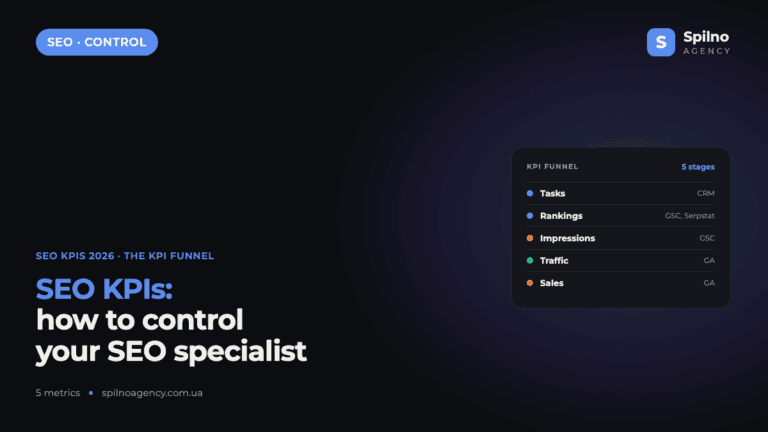
How to Control an SEO Specialist: The 5-Stage SEO KPI Funnel
SEO KPIs form a chain of five metrics that show, step by step, whether your SEO is actually…
Best CMS for an Online Store: Cloud vs Self-Hosted Platforms in 2026
Compare Shopify, WooCommerce, PrestaShop, OpenCart and Magento for your online store. Pros, cons, and a step-by-step CMS selection…