Google released its official GEO guide: we read it for you

On May 14, 2026, Google finally spoke up. A new page appeared on Search Central — the official guide to optimizing for generative AI features in Search. It’s the first public document where the company directly explains how to land in AI Overviews, AI Mode, and other AI-generated answers. Spoiler: “GEO” as a separate discipline doesn’t exist — it’s the same SEO with a few new emphases.
We read the guide for you, analyzed the official positions of the other AI giants (OpenAI, Anthropic, Perplexity, Microsoft), and put everything into one practical brief. No fluff, no marketing myths — only what Google has officially confirmed.
Table of contents
- Why this document matters
- How AI Search finds your content: RAG and Query Fan-Out
- 5 official recommendations from Google
- What does NOT work: the official myth-buster
- What the other AI giants say
- Checklist: what to do this week
- Takeaways for business
- FAQ
1. Why this document matters
For the past two years, the market has been drowning in new acronyms: GEO (Generative Engine Optimization), AEO (Answer Engine Optimization), LLMO, AIO. Hundreds of “experts” appeared, selling magical methodologies for optimizing for ChatGPT, Perplexity, and Gemini. Some pushed “chunking” content into atomic pieces, others promoted custom llms.txt files, others rewrote text in some imagined “AI style.”
Google has finally stated its position officially — and effectively closed the discussion. The core thesis of the document:
Generative AI features in Search run on the same ranking and quality systems as regular Search. Optimizing for AI is optimizing for Search overall.
Google Search Central, AI Optimization Guide
In short: if your site ranks well in classic Google, it automatically has a shot at appearing in AI Overviews. No special rituals required. This isn’t a “new discipline” — it’s an evolution of the same quality and E-E-A-T principles Google has emphasized for years.
2. How AI Search finds your content
For the first time, Google officially describes the two core technologies behind AI Overviews and AI Mode. These aren’t marketing terms — they’re the actual architecture that determines your visibility.
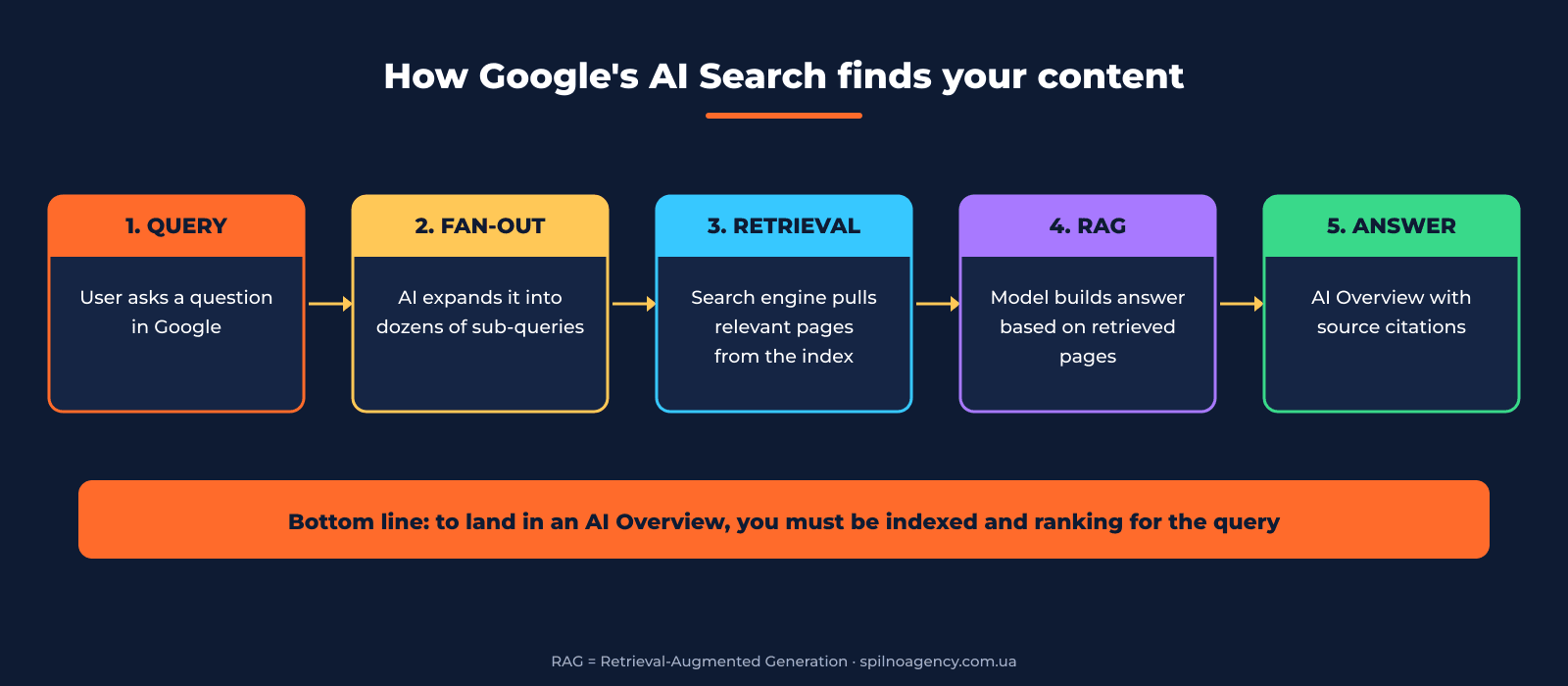
RAG (Retrieval-Augmented Generation)
Instead of generating answers “from memory,” the model first pulls relevant pages from search results and then uses them to build a response. The implication is clear: to land in an AI answer, you have to be indexed and rank for the relevant query. There is no magical shortcut around search.
Query Fan-Out
AI takes a single user query and expands it into dozens of related sub-queries. Google’s own example: a query like “how to fix a lawn” fans out into sub-queries about herbicides, grass types, weed prevention, watering schedules, and so on. AI fetches answers for all of them and assembles the final response.
Practical takeaway: one comprehensive long-form article that systemically covers a topic has a better shot at being pulled by AI than a pile of thin pages targeting narrow keywords. This brings us back to topic clusters and pillar content — now officially endorsed by Google itself.
3. Google’s 5 official recommendations
3.1. Create content with unique value
- Original takes, tests, case studies, real-world photos — not a Wikipedia rehash.
- People-first approach: write for humans, not algorithms.
- Clear structure: headings, paragraphs, lists, sub-sections.
- Quality images and video where relevant.
- Don’t create page “variations” for different keywords — that’s a spam-policy violation.
- If you use AI to draft content, you still need to meet Search Essentials.
3.2. Meet the technical requirements
- Pages must be indexed and snippet-eligible (no
noindex,nosnippet,max-snippet:0). - Content must be crawlable — Google’s generative models use publicly accessible content.
- Use semantic HTML — not for “AI,” but for human readability.
- Follow JavaScript SEO best practices if you run SPA / React / Next.
- Solid page experience across devices.
- Minimize duplicates.
3.3. Structured data — optional
Google states plainly: “Structured data isn’t required for generative AI search.” Schema.org is still useful for classic rich results (FAQ, Product, Article, How-To), but it’s not required for AI Overviews. If you already have good schema markup — keep it. If not — don’t treat it as a blocker for AI visibility.
3.4. Local business and e-commerce
- Fill in your Google Business Profile — for local businesses it’s the cheapest way to land in AI answers for “near me” queries.
- Use Merchant Center feeds — products from feeds get cited in AI Shopping and AI Mode.
- Watch the new Business Agent tool — it answers customer questions on behalf of your business in conversational form.
3.5. Think about agents
For the first time, Google officially mentions “agent-friendly website best practices” and the new Universal Commerce Protocol (UCP). AI agents will soon book hotels, compare products, and place orders on behalf of users autonomously. Sites that make that path smooth — clean forms, obvious CTAs, open APIs — will have an edge.
4. What does NOT work: the official myth-buster
This is the most valuable part of the guide. Google debunks five popular GEO myths — the very ones that hundreds of “AI-SEO services” on the market are built around.
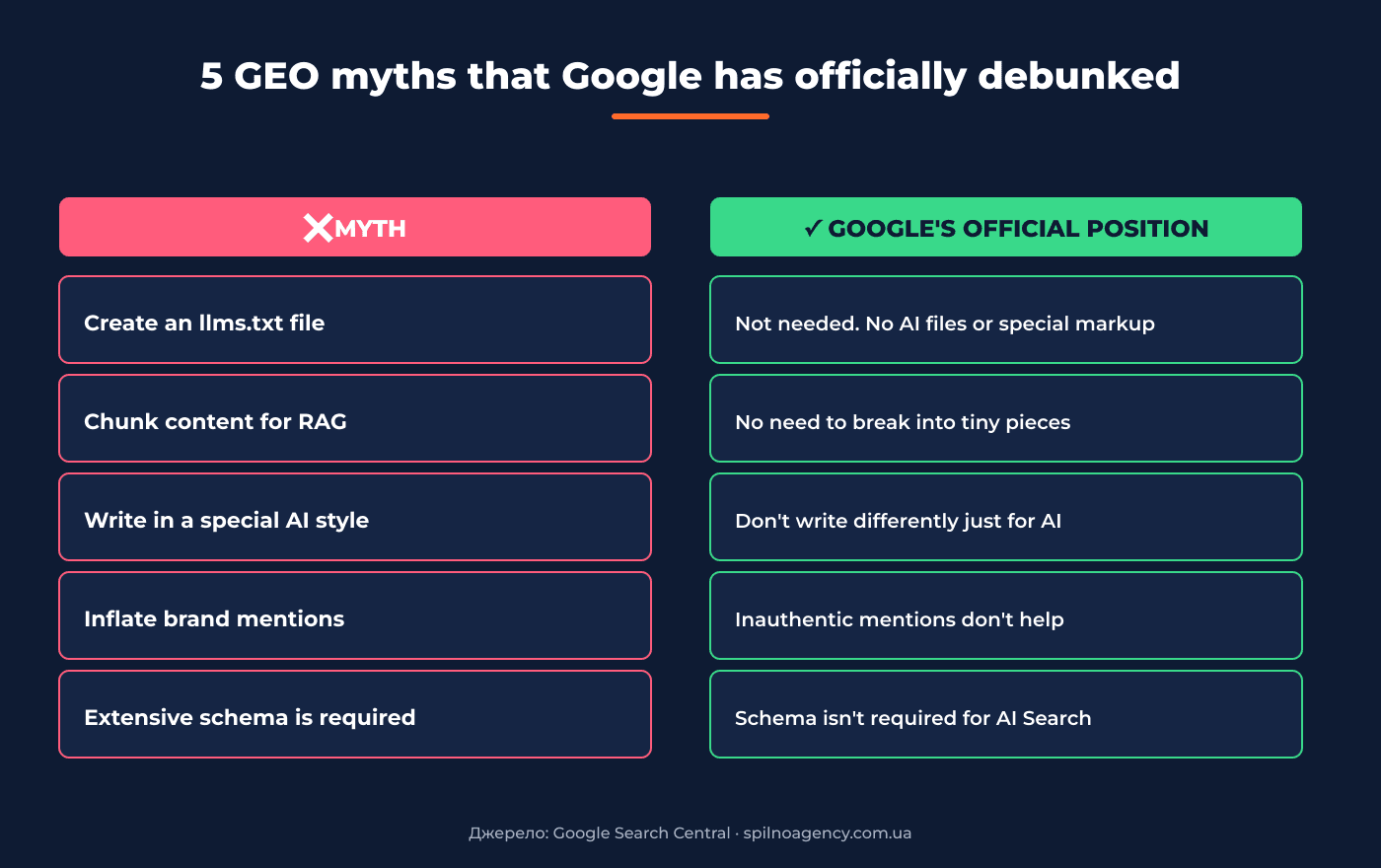
| Myth | Google’s official position |
|---|---|
You need to create an llms.txt file | “You don’t need to create new machine readable files, AI text files, markup, or Markdown” |
| Content has to be “chunked” — split into tiny pieces for RAG | “No requirement to break your content into tiny pieces” |
| You need to write in a special “AI style” | “You don’t need to write in a specific way just for generative AI search” |
| You need to buy or fake brand mentions across the web | Inauthentic mentions don’t help and may hurt |
| You can’t get by without extensive schema.org | Structured data isn’t a requirement for AI Search |
Bottom line: if someone is pitching you a “$5,000 GEO service” built around custom llms.txt, content chunking, and inflated brand mentions — that’s marketing BS. Google has officially said it doesn’t work. Any money you put into those practices is effectively burned.
Mea culpa: we were guilty of this too
Honest disclosure: on May 13, 2026 — one day before Google’s official guide dropped — we published a detailed article on llms.txt: what it is, how to fill it in, what it affects. At the time it seemed reasonable — the industry was discussing the format, rumors circulated that it would be honored, large SEO agencies were releasing guides. We wrote cautiously (“experimental standard, no guaranteed citation”) — but referencing the standard at all lends it credibility in a reader’s eyes.
A day later, Google officially said: llms.txt isn’t used. We’ll update that article with the new information — that’s the honest path. We mention it here not as penance, but as evidence of how fast the AI Search landscape shifts and why it’s critical to verify primary sources rather than trust industry consensus. If your agency still hasn’t updated its llms.txt content after May 14, that’s a red flag.
5. What the other AI giants say
Fair question: OK, Google has spoken — what about everyone else? We checked the official positions of the other four major AI Search players. Here’s the picture as of May 2026.
| Platform | Official guide | Stance on llms.txt | Analytics tool |
|---|---|---|---|
| Google (AI Overviews, AI Mode) | ✅ Yes (May 14, 2026) | ❌ Not used | GSC (no AI section yet) |
| Microsoft Copilot / Bing | ✅ Partial (Oct 2025) | 🤷 No comment | Bing WMT → AI Performance |
| OpenAI ChatGPT / SearchGPT | ❌ None | ❌ Not used | None |
| Anthropic Claude | ❌ None | ⚠️ Only for own documentation | None |
| Perplexity AI | ❌ None (Publisher Program only) | ❌ Not used | None (API-only) |
OpenAI (ChatGPT, SearchGPT)
OpenAI’s official documentation makes zero mention of llms.txt. There’s a technical page about bots (OAI-SearchBot, GPTBot, ChatGPT-User) and how to manage them via robots.txt — that’s it. No public commitment to reading or honoring llms.txt in production. An independent analysis of 515 million LLM-traffic events (May 2026) confirms: llms.txt is not a ranking factor in ChatGPT.
Anthropic (Claude)
Anthropic itself uses the llms.txt format — but only for its own documentation (docs.claude.com/llms.txt), so other LLMs can parse their docs. That’s not equivalent to an official “create llms.txt, we’ll read it when citing.” Anthropic has published no public recommendations for content teams optimizing for Claude.
Perplexity AI
In January 2026 they launched Comet Plus Publisher Program: a $42.5M payout pool, 80/20 in favor of the publisher. But Perplexity has not released an official “GEO document.” All the advice — “content freshness,” “structured paragraphs,” schema — comes from third-party SEO agencies, not the company. The strongest confirmed signal is freshness: content from the past 6 months gets cited 3-4x more often than older material.
Microsoft (Copilot, Bing)
The only platform besides Google with a partial official position. On October 8, 2025, Krishna Madhavan (Principal PM, Bing team) published official guidance for getting cited in Copilot’s AI answers. On February 9, 2026, Bing Webmaster Tools rolled out the AI Performance report (public preview): citation counts in Copilot, grounding queries, visibility trends. It’s currently the only official AI-visibility analytics tool on the market — worth connecting even if Bing is a small share of your traffic.
On llms.txt: Bing has not officially confirmed it as a standard. Claims that “Bingbot honors llms.txt” come from third-party agencies — there’s nothing in Microsoft’s own documentation.
Bottom line: none of the five major platforms has made llms.txt a required standard. If anyone is selling you “llms.txt optimization,” ask for the primary source from the relevant company’s official docs. It doesn’t exist.
6. Checklist: what to do this week
- Verify indexation. All key pages must be indexed. Search Console → Pages.
- Remove
nosnippetandmax-snippet:0from pages that should appear in AI answers. - Open content to crawlers. Check
robots.txt— Google-Extended should be allowed if you want to appear in AI answers. Same forOAI-SearchBot,PerplexityBot. - Connect Bing Webmaster Tools and check AI Performance — the only official citation report for Copilot.
- Review top pages with human eyes. Is there an original take, a case study, real data — or just a competitor rehash?
- Reinforce your long-form content. One deep piece beats ten thin ones. Query Fan-Out favors comprehensive guides.
- Complete Google Business Profile and Merchant Center where applicable.
- Refresh the publish date on materials you’ve genuinely updated — freshness is critical for Perplexity and important for Google.
- Check Core Web Vitals. Page experience still matters.
- Don’t waste budget on
llms.txt, AI chunking, or fake mentions. Google has officially said it doesn’t work.
7. Takeaways for business
- SEO isn’t dead — it’s just stricter on quality. Content farms, keyword stuffing, and competitor copy-paste are losing decisively.
- GEO as a separate discipline is a marketing myth. Everything you’ve been doing right in SEO (E-E-A-T, technical hygiene, unique content) works for AI Overviews too. No need to pay a separate “GEO” budget.
- Brands with real expertise win. AI cites those who have proprietary research, case studies, market data.
- Local and e-commerce get a bonus. Google Business Profile + Merchant Center feeds = the cheapest path into AI answers.
- Bing Webmaster Tools — mandatory. While other platforms stay silent, Microsoft is giving real AI-citation data. Don’t skip it because of Bing’s small traffic share — it’s the only window into AI analytics.
- Prepare for the agent era. In 12-18 months AI agents will start performing actions on behalf of users at scale. Sites with clean structure, obvious CTAs, and open APIs will win.
FAQ
Do I need to create llms.txt?
No. Google has officially said such files aren’t used. OpenAI, Perplexity, and Microsoft don’t confirm it as a ranking signal either. Anthropic uses the format, but only for its own documentation.
Do I need JSON-LD schema for AI Overviews?
Not required. Schema is useful for classic rich snippets, but AI Overviews work fine without it. If you already have quality markup — keep it. If not — prioritize content quality, not schema.
How do I know if I’m showing up in AI Overviews?
There’s no official report in Google Search Console yet. Use Bing Webmaster Tools (AI Performance — the only official tool), third-party trackers (Ahrefs Brand Radar, Serpstat), or manual checks on brand queries.
Should I block Google-Extended in robots.txt?
Only if you genuinely don’t want your content surfacing in AI answers. For most businesses that’s a visibility loss. Same applies to OAI-SearchBot, PerplexityBot, and other AI crawlers.
Should I rewrite old content for AI?
Not “for AI” — rewrite for humans, with extra focus on uniqueness, completeness, and structure. Same recipe as before, just no slack. Focus on: date refresh, your own case studies and data, clean H2/H3 structure, removing fluff.
What about agents and Universal Commerce Protocol?
UCP is a new protocol that lets AI agents perform transactions on websites on behalf of users. It’s still early experimental ground — too soon to restructure your site for it. But worth watching throughout 2026.
Want to figure out your site’s AI visibility?
Spilno Agency is a full-cycle SEO agency. We help businesses grow in Google, AI Overviews, Bing Copilot, and other channels. No chunking, no llms.txt, no other marketing myths — just what platforms have officially confirmed and what works in practice. Request a free audit →

Read also
BANT Lead Qualification Methodology: What It Is and How It Works
BANT is a lead qualification framework built on four criteria: Budget, Authority, Need, Timeline. What it is, example…
Best Claude Skills for Threads (2026)
Claude skills and MCPs for Threads: posts and threads, captions, carousel design, cross-posting from Instagram, the official Threads…
Best Claude Skills for X (Twitter) (2026)
Claude skills and MCPs for X (Twitter): tweets and threads, content planning, X Ads, analytics, outreach. Official X…