How to Write a Resume in 2026: Step-by-Step Guide

A resume is your personal marketing document. In 2026, recruiters spend an average of 7 seconds reviewing each application. This guide covers everything: what data to include in a resume, a formatted resume example, the best online CV builders, and step-by-step writing tips for European job seekers.
What Is a Resume and Why Does It Matter
A resume (or CV — Curriculum Vitae, as it is commonly called in Europe) is a structured document that outlines your professional experience, education, skills, and achievements. Its sole purpose is to convince a recruiter to invite you for an interview.
Unlike a cover letter, a resume is facts without emotion: job titles, companies, dates, and measurable results. A well-crafted resume significantly increases your chances of passing ATS screening (Applicant Tracking System) and reaching a human recruiter.
What Data You Must Include in a Resume
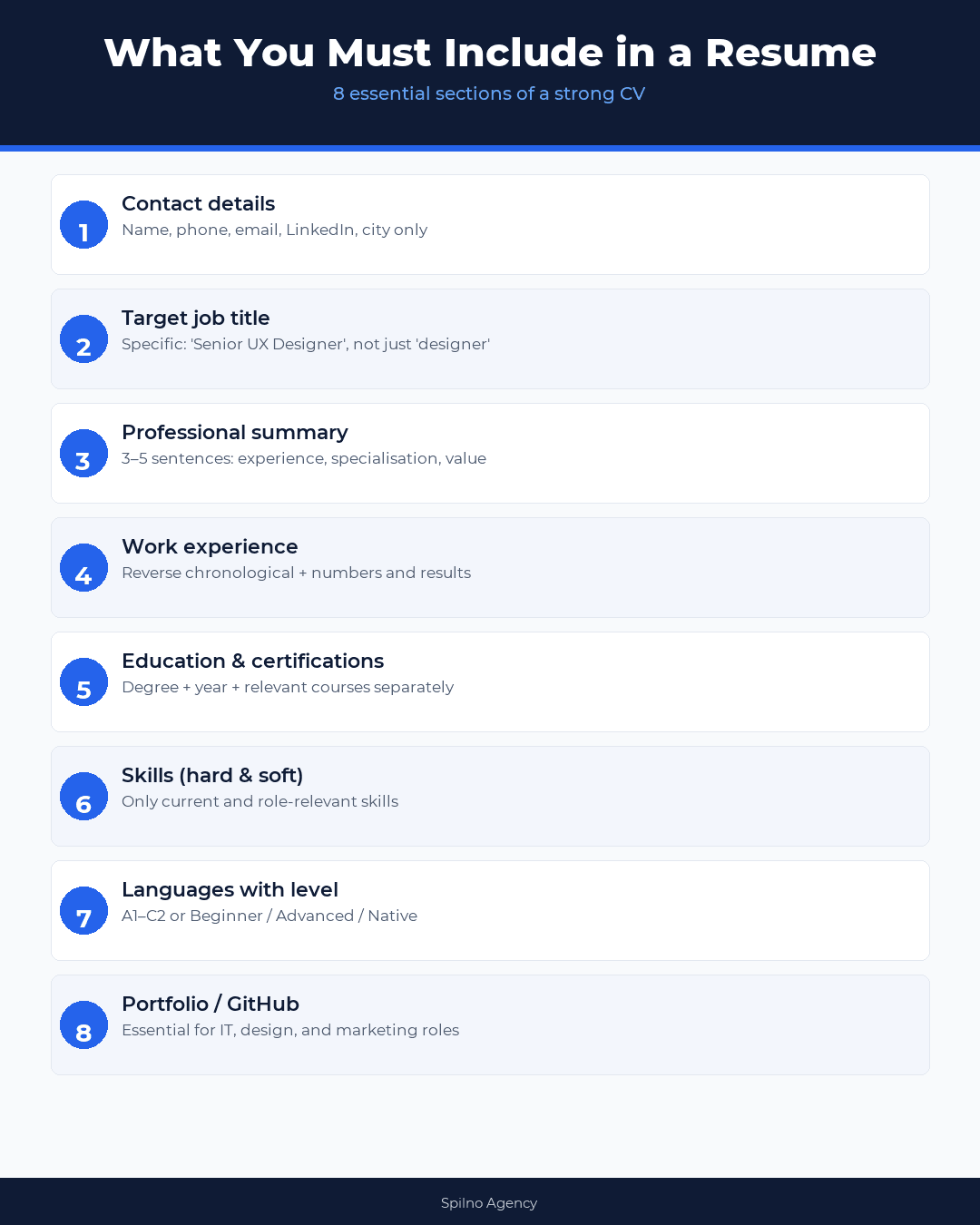
Regardless of the position or industry, every strong resume must contain these sections:
- Personal details and contact information — full name, phone, email, LinkedIn or portfolio URL. Include city only — no full address.
- Target job title — clearly state which position you’re applying for. “Senior UX Designer”, not just “designer”.
- Professional summary — 3–5 sentences about your experience, specialisation, and the value you bring to the employer.
- Work experience — reverse chronological order: company name, job title, dates, 3–5 bullet points with specific, measurable achievements.
- Education — institution, degree, graduation year. Courses and certifications in a separate section.
- Skills — hard skills (technical) and soft skills (communication, leadership). Only list skills relevant to the role.
- Languages — with proficiency level: A1–C2 or Beginner / Intermediate / Advanced / Fluent / Native.
- Additional information (optional) — volunteering, publications, patents, hobbies relevant to the role.
What NOT to include: date of birth, marital status, religion, passport photos, selfies. In the EU and UK, such details are not required and can expose you to discriminatory screening.
Resume Structure: Section by Section
1. Header
Your name in a large, clear font. Below: job title (the one you’re targeting), email, phone, city, LinkedIn or portfolio link.
2. Professional Summary
3–5 sentences answering: who you are, years of experience, your specialisation, and your core value to the employer. Write in first or third person — no clichés like “hardworking”, “team player” or “passionate”.
Weak: “Motivated professional seeking opportunities for growth in a dynamic environment.”
Strong: “Frontend developer with 4 years of experience in React and TypeScript. Reduced key page load time from 4.2s to 1.1s, increasing conversion rate by 23%.”
3. Work Experience
The most important section. Format for each role:
- Company name + location/remote
- Job title
- Dates: Month Year – Month Year (or “Present”)
- 3–5 achievements in the format: action + result + number
Use the STAR format: Situation → Task → Action → Result. Instead of “managed social media” — “grew Instagram engagement from 1.2% to 4.7% in 3 months through daily Reels strategy”.
4. Skills
- Hard skills: specific tools, technologies, platforms. Example: Google Ads, Figma, SQL, Python, HubSpot.
- Soft skills: no more than 4–5 items, backed by examples in your experience. Example: cross-functional team leadership, C-suite stakeholder communication.
Resume Example 2026
Here is a resume example for a Middle Digital Marketing Manager position. Adapt the structure and wording for any role:
═══════════════════════════════════════════════════════
ELENA KOVALENKO
Digital Marketing Manager
📧 [email protected]  📱 +44 7700 900123
📍 London (remote-ready)  🔗 linkedin.com/in/ekovalenko
═══════════════════════════════════════════════════════

PROFESSIONAL SUMMARY
Digital marketing manager with 5 years of experience in e-commerce and B2B SaaS.
Specialised in performance marketing (Google Ads, Meta Ads), SEO and analytics.
Improved average client ROAS from 2.1x to 4.8x within 6 months.

═══════════════════════════════════════════════════════
WORK EXPERIENCE
═══════════════════════════════════════════════════════

Spilno Agency | Senior Digital Marketer | Mar 2023 – Present | London
• Managed advertising budgets for 15+ clients (total budget $120K/month)
• Implemented GA4 ecommerce tracking for 8 online stores
• Reduced CPA by 34% through structural PMax campaign reorganisation
• Mentored a team of 4 junior specialists

TechCorp | PPC Specialist | Jun 2021 – Feb 2023 | Remote (EU)
• Launched Google Shopping for a new business line — ROI +210% in Q1
• Expanded keyword list from 200 to 4,800 targeted terms
• Reported results for 7 international clients via HubSpot CRM

═══════════════════════════════════════════════════════
EDUCATION
═══════════════════════════════════════════════════════
University of Kyiv | Marketing | 2017–2021
Certifications: Google Ads (2024), Meta Blueprint (2024), HubSpot CMA (2023)

═══════════════════════════════════════════════════════
SKILLS
═══════════════════════════════════════════════════════
Hard: Google Ads · Meta Ads · GA4 · Looker Studio · SEO · Ahrefs · HubSpot
Soft: Team leadership · Analytical thinking · Client presentations
Languages: Ukrainian (native), English (C1), Polish (A2)
This CV fits one page, is clearly structured, contains specific metrics, and is easily parsed by ATS systems. Copy the structure and adapt it to your own experience.
Common Resume Mistakes to Avoid
- No numbers or results. “Improved sales” is vague. “Increased sales by 47% in Q3 2024” is compelling.
- Too long. Under 3 years of experience: 1 page. 3–10 years: up to 2 pages. More only for senior executives.
- Generic clichés. “Results-driven”, “passionate”, “team player” — without proof, these are noise.
- Unprofessional email.
[email protected]won’t help. Use[email protected]. - One CV for every job. Customise your summary and skills for each specific vacancy.
- Outdated information. A 2012 certification and a job you held for two weeks — better to leave out.
- Missing keywords. ATS systems look for matches with the job description. If the vacancy mentions “project management” — your CV should too.
Best Resume Builders and CV Tools in 2026
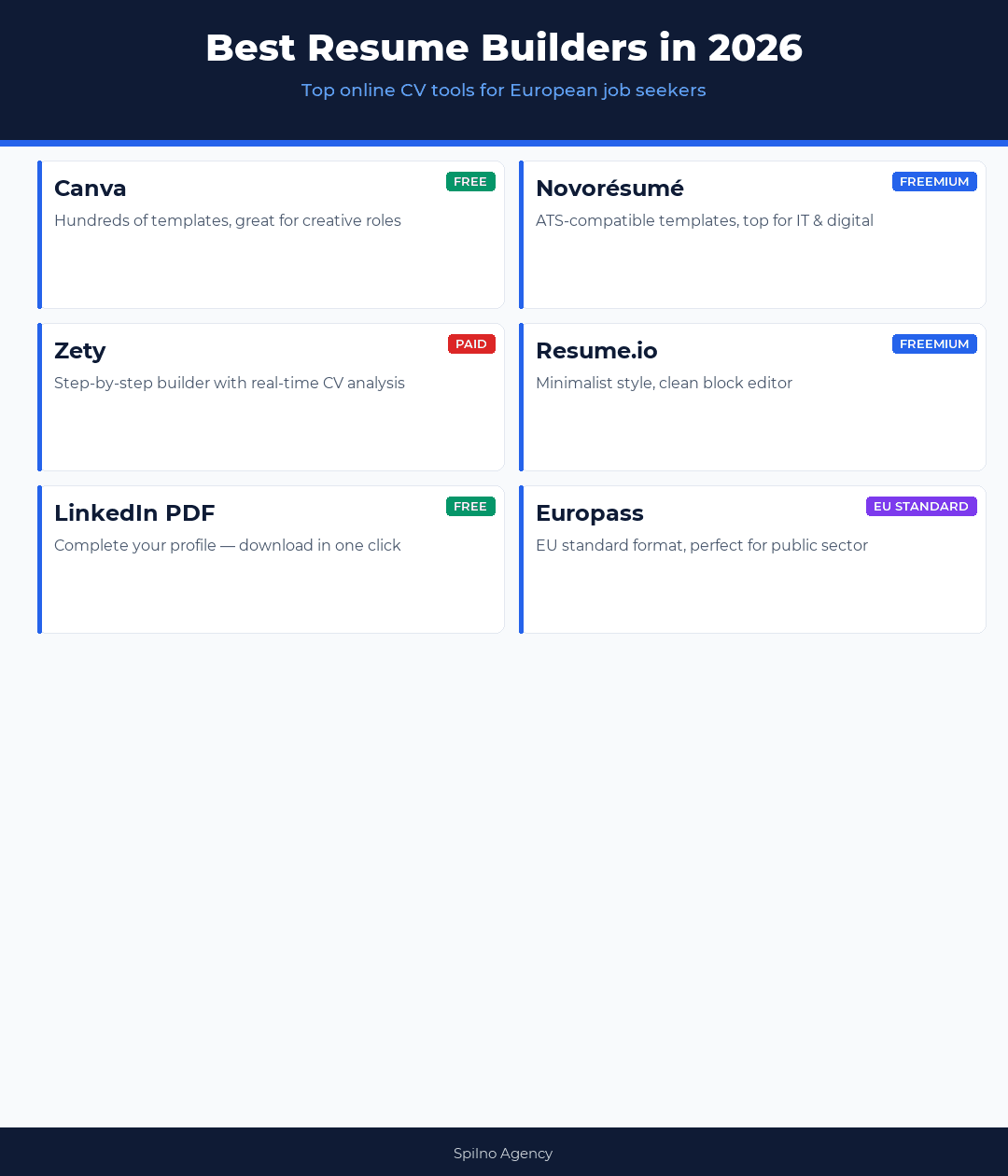
Instead of formatting in Word or Google Docs (where layout often breaks), use dedicated online tools that ensure ATS-compatible output:
- Canva — free builder with hundreds of CV templates. Best for creative roles (design, marketing). Note: some templates are not ATS-friendly.
- Novorésumé — one of the most popular platforms in Europe. Clean ATS-compatible templates, free tier available. Recommended for IT and digital roles.
- Zety — paid platform with a guided, step-by-step builder and real-time CV analysis. From €5.99/month.
- Resume.io — minimalist templates with a clean editor. Free plain-text download; PDF export requires paid plan.
- LinkedIn — “Save to PDF” from your profile. If your LinkedIn is complete, it generates a ready-to-send CV in one click.
- Enhancv — modern templates with achievement blocks and skill visualisation. Popular among product managers and tech leads.
- Europass — the European standard format. Widely accepted across the EU, especially for government and academic positions.
Spilno Agency recommendation: For most European roles — Novorésumé or Resume.io (ATS compatibility). For LinkedIn-heavy industries — export directly from LinkedIn. For creative positions — Canva, but verify with an ATS simulator first.
How to Tailor Your CV to a Job Description
- Read the job description carefully and identify key requirements and repeated terms.
- Compare with your CV: do you have these skills? If yes — ensure they are clearly stated.
- Rewrite your Summary to align with the role’s priorities.
- Move the most relevant skills to the top of your skills section.
- If you have achievements that directly address the job’s challenges — highlight them prominently.
This process takes 15–20 minutes per application but significantly improves your response rate.
Pre-Submission Checklist
- Proofread for spelling and grammar (Grammarly or LanguageTool)
- Confirm email and phone number are correct
- Save as PDF (not .docx — formatting may break in different viewers)
- Filename:
Resume_FirstName_LastName_JobTitle.pdf - Open the PDF and check how it renders — fonts sometimes break
- Confirm keywords from the job description appear in your CV
- Length: no more than 2 pages (unless 10+ years of experience)
Frequently Asked Questions
What is the ideal length for a CV?
Under 3 years of experience: 1 page. 3–10 years: 1–2 pages. Senior executives and academics: up to 3 pages. The key rule: every sentence must add value. If it doesn’t — remove it.
Should I include a photo on my CV?
In most European countries (Germany, Poland, France) — a professional photo is standard. In the UK and USA — generally not recommended due to anti-discrimination hiring practices. If you do include one: professional headshot, neutral background, slight smile.
How do I write a CV with no work experience?
Focus on: internships and volunteering, academic projects, courses and certifications, soft skills backed by examples. Replace an empty “Work experience” section with a “Projects” section — describe what you built and what the outcome was.
What is ATS and how do I write an ATS-friendly CV?
ATS (Applicant Tracking System) is software companies use to automatically filter candidates by keywords. To pass ATS: use standard section headings (“Work Experience”, “Education”, “Skills”), avoid placing text inside tables or graphics, save as .pdf or .docx, and include keywords from the job description.
Do I need a cover letter?
If the vacancy doesn’t require one — send the CV only. If required, keep it short (3–4 paragraphs): why this company, why this role, one specific achievement that supports your candidacy, and a clear call to action.

Read also

Calendar Rules for 2026. Part 1
Step-by-step guide: how to create and edit a video meeting in Google Calendar, add one or several guests,…
Best Claude Skills for SMM Specialists: 2026 Roundup
Top 10 Claude Skills for social media managers: brand-voice, content-creation, campaign-plan, canvas-design and more. What each skill does…
Best Claude Skills for Media Buyers and Paid Ads Specialists (2026)
Top 10 Claude Skills for media buyers: Google Ads and Meta Ads audits, ad creatives, competitor analysis, reporting.…