Who is a marketer and what does a marketer do in 2026

A marketer is a specialist who researches the market, audience and competitors, builds the product’s go-to-market strategy and manages customer communication across the entire funnel. In 2026, a marketer works simultaneously with SEO, GEO (AI search), paid traffic, content, analytics (GA4, GTM, Looker Studio) and AI tools (ChatGPT, Claude, Perplexity, Gemini).
In short — a marketer makes sure the right product reaches the right audience at the right moment and that they want to buy it. This guide covers the responsibilities, skills, tools and career path of a marketer in 2026, with extended checklists you can use immediately at work.
Who is a marketer
A marketer combines analytics, creativity and management to help a company sell more and build a recognisable brand. They study the market, define strategy, launch advertising, evaluate performance and continuously test hypotheses. Unlike a salesperson, a marketer works on a 3–12 month horizon, creating the conditions under which sales become predictable.
What a marketer does — the essentials
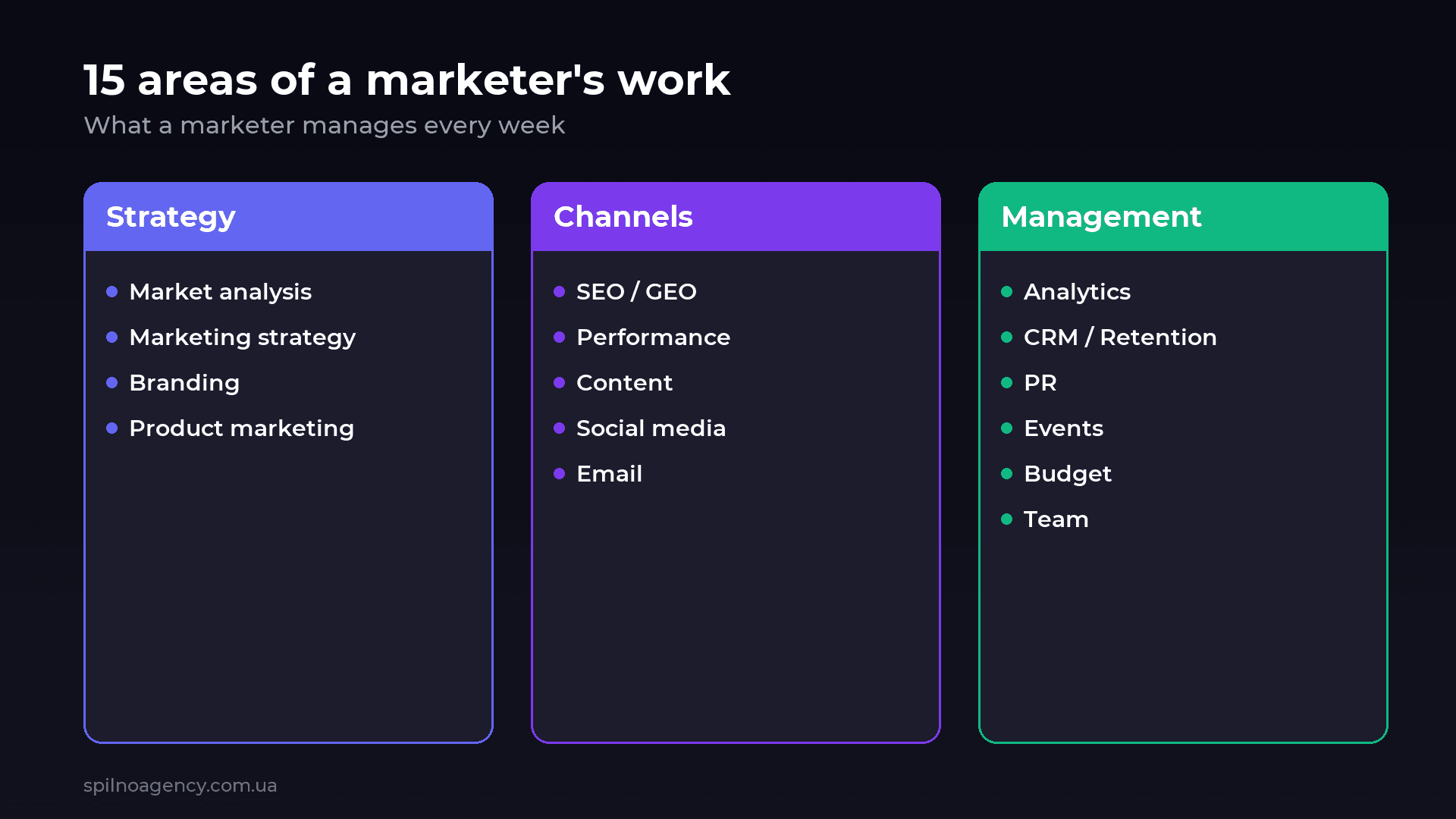
In a typical week, a marketer juggles:
- Strategy: positioning, target audiences, value proposition (USP).
- Channels: SEO, Google Ads, Meta Ads, TikTok, email, content, PR, marketplaces.
- Content: blog, landing pages, creatives, video, newsletters, social media.
- Analytics: GA4, GTM, GSC, Looker Studio, CRM, ROAS / ROMI / LTV.
- Team: copywriters, designers, paid specialists, SEO experts, contractors.
- Budget: allocation between channels, revenue forecasting, media planning.
Marketer’s responsibilities — extended checklist
Below are 15 core directions a marketer is responsible for, with concrete tasks. This isn’t ‘textbook theory’ — it’s the list we use at Spilno Agency during marketing audits.
- 1. Market and competitor analysis
- Researching market trends, market size, growth pockets.
- Competitor analysis: positioning, pricing, unique advantages, ad creatives.
- Demand analysis via Google Trends, Serpstat, Ahrefs, Similarweb.
- Audience segmentation by demographics, behaviour, values (jobs-to-be-done).
- PESTLE / SWOT / Porter’s 5 forces at the start of a strategy.
- 2. Marketing strategy
- Setting marketing goals using SMART (3, 6, 12 months).
- Defining target segments and customer profiles (ICP / Persona).
- Building the value proposition (Value Proposition Canvas).
- Marketing mix: product, price, place, promotion (4P → 7P for services).
- Channel launch roadmap and hypothesis prioritisation (RICE / ICE).
- 3. Branding and positioning
- Brand platform: mission, vision, values, brand promise, tone of voice.
- Identity: logo, colours, typography, guidelines.
- Consistency across every touchpoint.
- Reputation: monitoring mentions (Google Alerts, Brand24, Mention).
- Crisis communication and public brand stance.
- 4. SEO and GEO (AI search)
- Technical SEO: speed, Core Web Vitals, sitemap, robots.txt, schema.
- Keyword research and content plan aligned to intent.
- Link building and digital PR.
- Optimisation for AI Overviews, ChatGPT Search, Perplexity, Gemini.
- GEO signals: citability, facts, llms.txt, structured data.
- 5. Paid traffic (Performance)
- Google Ads: Search, Performance Max, Demand Gen, Shopping.
- Meta Ads: ABO/CBO campaigns, Advantage+, retargeting.
- TikTok Ads, LinkedIn Ads, X Ads — depending on audience fit.
- Marketplaces and shopping comparison engines (where relevant).
- Bid, creative and audience management; ROAS / CAC control.
- 6. Content marketing
- Content strategy: pillar / cluster / hub-and-spoke models.
- Editorial calendar: blog, video, email, social.
- Coordinating copywriters, editors, designers, video producers.
- Distribution: SEO + social + email + PR.
- Performance analysis: traffic, dwell time, conversions from content.
- 7. Social media and community
- Strategy for Instagram, Facebook, TikTok, YouTube, LinkedIn, Threads.
- Content plan, creatives, Reels / Shorts / TikTok.
- Working with influencers and brand ambassadors.
- Comment and DM moderation, reputation work.
- UGC strategy, contests, activations.
- 8. Email marketing and automation
- Segmentation, welcome / abandoned cart / win-back flows.
- A/B testing of subject lines, CTAs, send times.
- Working with ESPs: Mailchimp, Klaviyo, Customer.io, ActiveCampaign.
- Integration with CRM and behavioural triggers.
- Deliverability: SPF, DKIM, DMARC, domain reputation.
- 9. Analytics and reporting
- Setting up GA4, GTM, Looker Studio, GSC.
- Goals, events, conversions, ecommerce events.
- Attribution: data-driven, position-based, first/last-click.
- Channel dashboards, cohorts, retention, LTV.
- Regular stakeholder reports — framed as decisions, not numbers.
- 10. CRM and retention
- CRM setup (HubSpot, Pipedrive, Salesforce, Zoho).
- Database segmentation and communication personalisation.
- Loyalty programmes, bonus systems, referral mechanics.
- Win-back campaigns and dormant client reactivation.
- Sales and marketing alignment.
- 11. Product marketing
- Customer development (CustDev) research.
- USP and key messaging.
- Product launches (GTM strategy).
- Pricing, tariff plans, offer packaging.
- Product lifecycle and cannibalisation analysis.
- 12. PR and external communications
- Working with media and industry publications.
- Press releases, expert columns, conference appearances.
- Partnerships, sponsorships, collaborations.
- CSR initiatives and brand stance on social issues.
- Working with bloggers and influencers as ambassadors.
- 13. Event marketing
- Preparing and running webinars, conferences, trade shows.
- Promotion mechanics and special offers.
- Coordination with event agencies and contractors.
- Post-production content (video, landing pages, case studies).
- Performance evaluation by leads and contact quality.
- 14. Budget management
- Annual / quarterly marketing budget.
- Allocation between channels (performance / brand / retention).
- Revenue forecasting under budget changes (ROAS corridor).
- Cost, ROAS, CAC, payback period control.
- Optimisation: shutting down unprofitable campaigns, scaling winners.
- 15. Team and contractor management
- Setting tasks and KPIs (OKR / KPI).
- Selecting and briefing contractors (agencies, freelancers).
- Coordination between design, copywriting, development, sales.
- Mentoring junior specialists.
- Internal presentations of results and budget defence.
Marketer hard skills — 2026 checklist
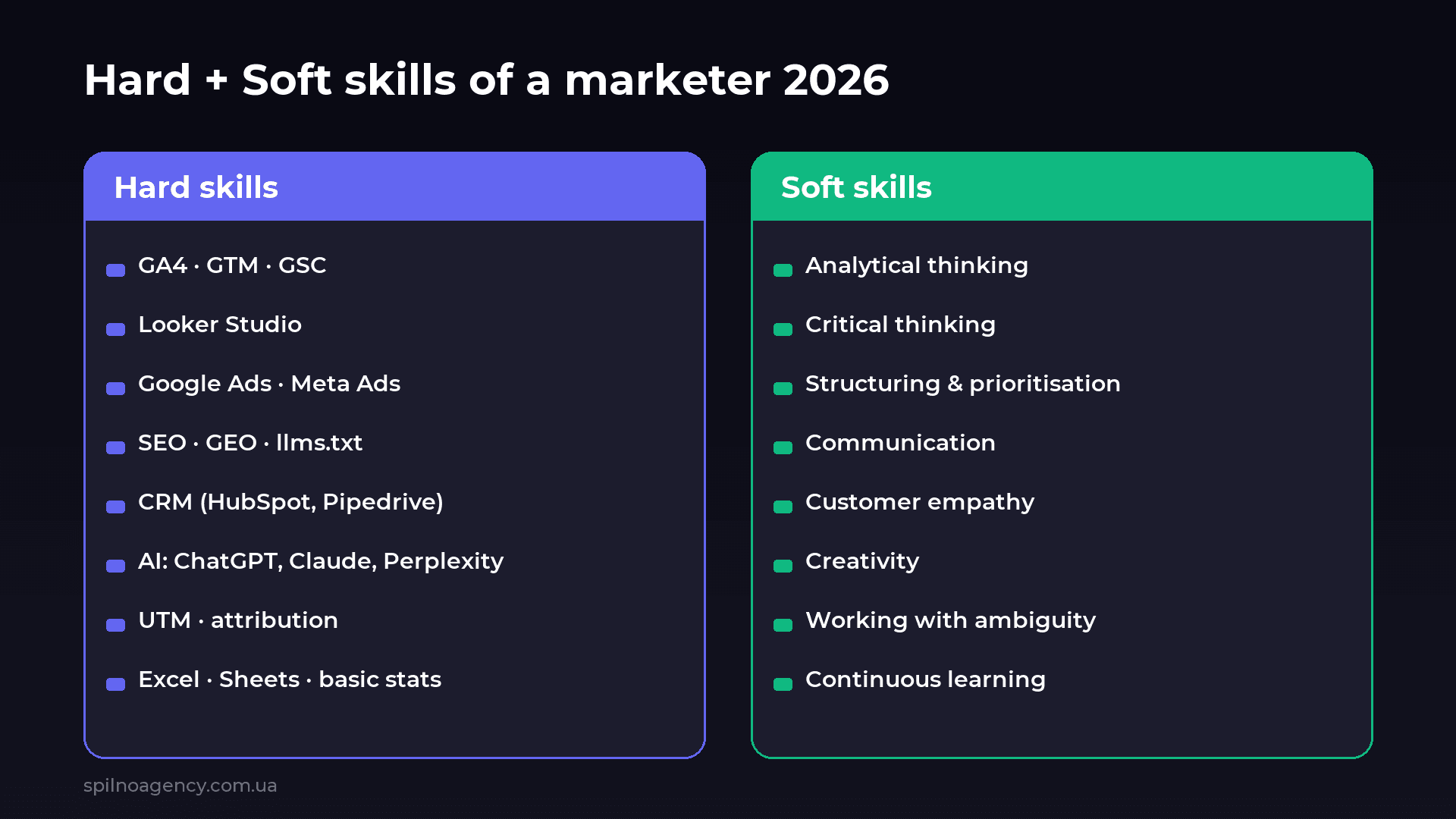
What a marketer should be able to do technically:
- Google Analytics 4 (events, conversions, ecommerce, explorations).
- Google Tag Manager: tags, triggers, dataLayer.
- Google Search Console: indexing, queries, technical issues.
- SEO: keyword research, technical audit, on-page, link building, GEO.
- Google Ads: Search, PMax, Shopping, Demand Gen, YouTube.
- Meta Ads Manager: campaign structure, Advantage+, custom audiences.
- Looker Studio or Power BI for dashboards.
- CRM work (HubSpot, Pipedrive, Salesforce).
- Excel / Google Sheets: formulas, lookups, pivot tables, basic stats.
- AI tools: ChatGPT, Claude, Perplexity, Gemini, Midjourney for speed-up.
- Basic HTML / CSS to understand page structure and brief developers.
- UTM tagging, tracking architecture, attribution.
- Email marketing: Mailchimp, Klaviyo, Customer.io, ActiveCampaign.
- Figma — reviewing creatives and briefing designers.
Marketer soft skills — checklist
What separates a good marketer from a mediocre one:
- Analytical thinking — connecting actions to metrics.
- Critical thinking — questioning assumptions and data.
- Structuring and prioritisation (Eisenhower, RICE).
- Communication with non-technical stakeholders.
- Customer empathy — understanding JTBD and pains.
- Creativity in formats and messaging.
- Writing skills — from briefs to industry columns.
- Working with ambiguity — hypotheses, tests, fast iterations.
- Time management and stamina (marketing is a marathon).
- Continuous learning — algorithms, platforms and AI shift monthly.
Marketer’s toolkit 2026
The baseline tech stack a modern marketer works with:
- Analytics: Google Analytics 4, Search Console, Tag Manager, Looker Studio, Hotjar, Microsoft Clarity.
- Paid traffic: Google Ads, Meta Ads Manager, TikTok Ads, LinkedIn Campaign Manager.
- SEO / GEO: Ahrefs, Serpstat, Screaming Frog, Sitebulb, Surfer SEO, Perplexity Labs.
- Content / AI: ChatGPT, Claude, Gemini, Perplexity, Notion AI, Midjourney, DALL-E, Runway.
- Email and automation: Mailchimp, Klaviyo, Customer.io, ActiveCampaign, Make / Zapier.
- CRM: HubSpot, Pipedrive, Salesforce, Zoho.
- Project management: Notion, ClickUp, Asana, Trello, Jira.
- Design and creative: Figma, Canva, Adobe Creative Cloud, CapCut, Veed.
Marketer KPIs — extended checklist
Marketing without measurement is guessing. Here are the metrics a marketer must own:
- Traffic funnel: Impressions, clicks, CTR, sessions, new users, engaged sessions.
- Conversions: Goal conversions, CR, cost per goal, micro-conversions.
- Economics: ROAS, ROMI, ROI, CAC, LTV, payback period, margin.
- Brand: Branded traffic, share of voice, brand search uplift, NPS.
- Retention: Retention rate, churn, purchase frequency, AOV, CLV.
- Content and SEO: Organic traffic, rankings, visibility, AI Overviews share of voice.
- Paid traffic: CPC, CPM, CPL, CPA, impression share, creative quality.
- Email: Open rate, CTR, unsubscribes, spam complaints, revenue per email.
What goals to set for a marketer
Goals depend on the company and product stage. Use SMART (Specific, Measurable, Achievable, Relevant, Time-bound). Examples:
- Grow organic traffic 35% in 6 months without losing conversion rate.
- Cut CAC by 20% within a quarter while keeping lead volume.
- Launch a new product, reaching 1,000 sales in the first 90 days.
- Increase LTV by 15% via a welcome series and loyalty programme.
- Grow branded traffic share to 25% of the total.
- Reach ROAS 6+ in Google Ads Search after PMax optimisation.
- Reduce churn from 8% to 5% in a year.
Marketer specialisations
In 2026, ‘just a marketer’ is rare — the profession has split into specialisations:
- Digital marketer: Runs a mix of online channels: SEO, paid, social, email.
- Performance / PPC: Paid traffic, ROAS, CAC, campaign optimisation.
- SEO specialist: Technical and content SEO, link building, GEO for AI search.
- Social media manager: Social channels, content, community, influencers.
- Content marketer: Content strategy, editorial, distribution, authority.
- Brand marketer: Positioning, identity, narrative, reputation.
- Product marketer: Launches, USP, pricing, GTM strategy.
- Growth marketer: Experiments, hypothesis-driven approach, product metrics.
- CRM / Lifecycle: Retention, email, push, loyalty.
- Marketing analyst: GA4, BI, LTV modelling, attribution, ROAS forecasting.
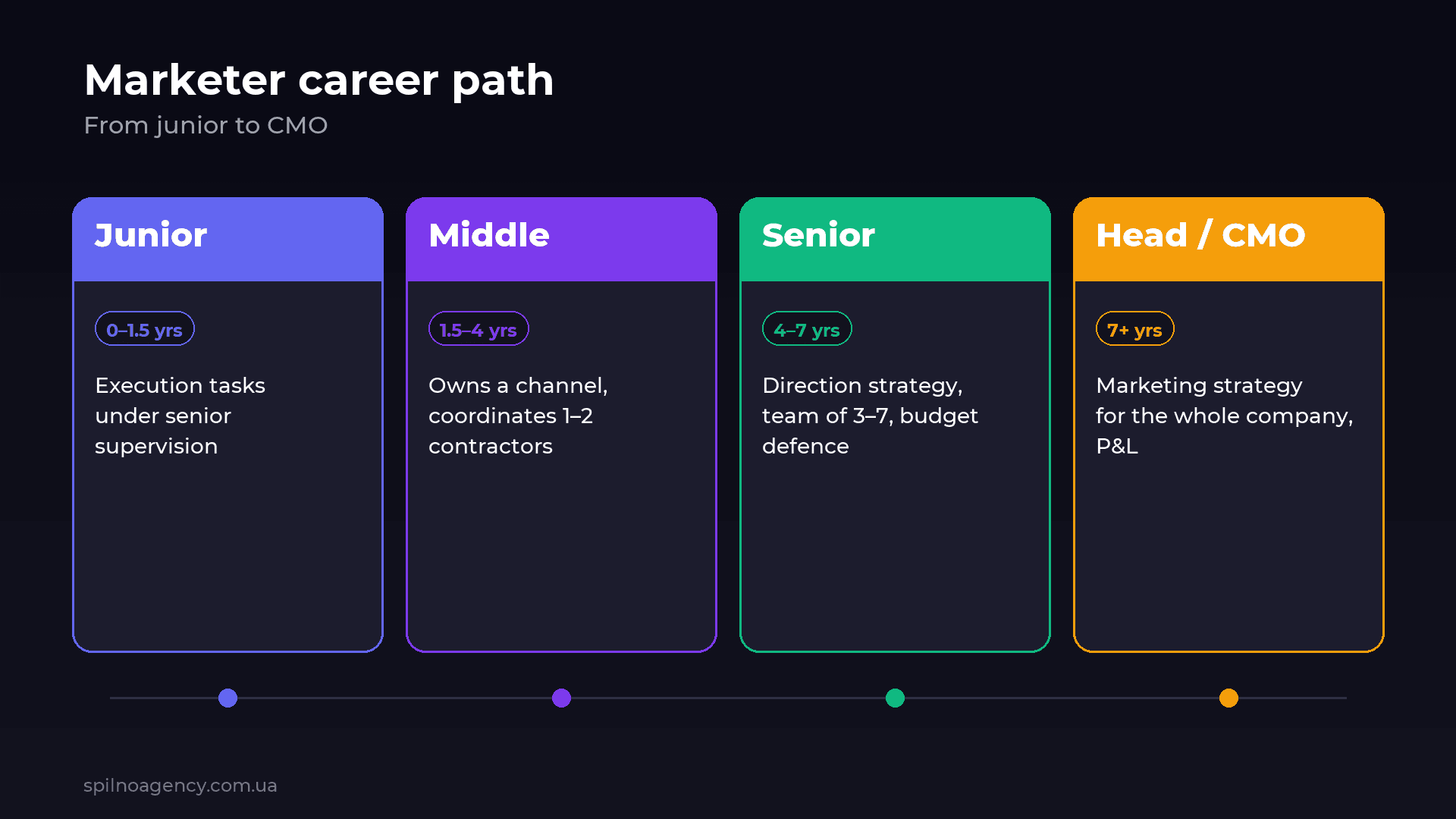
Marketer career path
The classic ladder:
- Junior (0–1.5 yrs): Execution: posts, creatives, basic reports, simple campaigns under senior supervision.
- Middle (1.5–4 yrs): Owns a channel or project. Sets goals, analyses results, optimises. May coordinate 1–2 contractors.
- Senior (4–7 yrs): Owns the strategy of a direction. Manages a 3–7 person team. Defends budgets. Accountable for channel P&L.
- Head of Marketing / CMO (7+ yrs): Marketing strategy for the whole company. Budget, team, P&L, board-level reporting.
How much a marketer earns
A marketer’s compensation depends on:
- Seniority (junior / middle / senior / head).
- Specialisation (performance marketers with proven ROAS command higher pay).
- Industry (fintech, SaaS, e-commerce pay above HoReCa).
- Company size and market (local vs. international).
- Documented cases and portfolio.
- Technical skills (SQL, GA4 BigQuery, AI tools, automation).
For current ranges in Europe, see Glassdoor, Payscale and local job boards.
Common beginner marketer mistakes
- Launching ads before analytics (GA4 + GTM) is set up.
- Chasing vanity metrics: likes, reach, followers — instead of leads and revenue.
- Copying competitors instead of researching your own audience.
- Skipping regular reporting — decisions made by gut feel.
- Spreading across every channel instead of focusing on 2–3.
- Saving on creative — weak creative burns even well-tuned campaigns.
- Ignoring SEO and brand traffic because ‘it takes too long’.
- Not testing hypotheses — defaulting to ‘how we always did it’.
How to choose a marketer or agency
When hiring a marketer or agency, check:
- Cases with measurable results (ROAS, CAC, traffic uplift, revenue).
- Whether the candidate understands your niche and business model.
- Working knowledge of GA4, GTM, GSC — table stakes in 2026.
- Whether they talk in hypotheses and tests, not ‘guaranteed results’.
- Reporting transparency — format, cadence, metrics.
- Engagement model (in-house / agency / freelance) matching scope.
- Contract with clear SLAs, KPIs and termination terms.
Marketing focused on revenue
Spilno Agency runs full-funnel marketing across Europe: SEO, GEO, Google Ads, Meta Ads, analytics and ROAS forecasting. See our services or contact us.
Frequently asked questions
Who is a marketer in simple terms?
A marketer helps a company understand its customers, build communication with them, and sell more. They combine analytics, creativity and budget management.
How is a marketer different from a salesperson?
A marketer works on a 3–12 month horizon and creates the conditions for predictable sales: awareness, demand, leads. A salesperson closes the deal here and now.
What skills does a marketer need in 2026?
Core analytics (GA4, GTM, GSC), SEO and GEO know-how, paid traffic (Google Ads, Meta), Looker Studio, AI tools (ChatGPT, Claude, Perplexity), plus soft skills: analytical thinking and communication.
Is a marketer the same as a social media manager?
No. SMM is one specialisation. A marketer owns the whole funnel — demand to retention — across 5–10 channels.
How long does it take to become a marketer?
Core skills in 6–9 months. To reach middle, 1.5–3 years of practice. Senior — 4+ years with real cases.
Does a marketer need a university degree?
Not mandatory. Cases, portfolio, certifications (Google Ads, GA4, HubSpot) and data fluency matter more in 2026.
Which AI tools should a marketer know?
ChatGPT and Claude — text, analysis, briefs. Perplexity and Gemini — research. Midjourney or DALL-E — visuals. Notion AI — knowledge base and docs.
How do you measure if a marketer is doing well?
Through agreed metrics: ROAS, CAC, LTV, organic traffic share, conversion rate, channel revenue. Avoid vanity metrics (followers, reach) as the only KPI.

Read also

Calendar Rules for 2026. Part 1
Step-by-step guide: how to create and edit a video meeting in Google Calendar, add one or several guests,…
Best Claude Skills for SMM Specialists: 2026 Roundup
Top 10 Claude Skills for social media managers: brand-voice, content-creation, campaign-plan, canvas-design and more. What each skill does…
Best Claude Skills for Media Buyers and Paid Ads Specialists (2026)
Top 10 Claude Skills for media buyers: Google Ads and Meta Ads audits, ad creatives, competitor analysis, reporting.…