Sales Manager in a Digital Agency: Responsibilities, Skills & KPIs

A Sales Manager in a digital agency is the professional who turns cold prospects into signed contracts. They don’t just sell — they analyse the market, build lasting client relationships, and drive the agency’s revenue. Discover the responsibilities, skills, and KPIs that define a successful digital agency sales manager.
Who Is a Sales Manager in a Digital Agency?
A Sales Manager in a digital agency is the professional responsible for acquiring new clients and growing company revenue. Unlike a traditional salesperson, a digital sales manager must deeply understand the full spectrum of agency services: SEO, PPC, social media, content marketing, web development and analytics.
In today’s competitive digital marketing landscape, selling “just advertising” is no longer enough. European clients want a strategic partner who understands their business, speaks in ROI terms, and can justify investment before the contract is even signed. That’s why a digital agency sales manager is simultaneously a seller, a strategist, and a consultant.
Sales Manager vs Account Manager: What’s the Difference?
| Criterion | Sales Manager | Account Manager |
|---|---|---|
| Primary goal | Acquire new clients | Retain and grow existing clients |
| Focus | New deals, new markets | Loyalty, upsell, long-term relationships |
| Success metrics | New deals, revenue from new clients | Churn rate, LTV, NPS |
| Client interaction | Before contract signing | After contract signing |
In smaller agencies one person often covers both roles, but as the agency scales these functions are separated.
Core Responsibilities of a Digital Agency Sales Manager
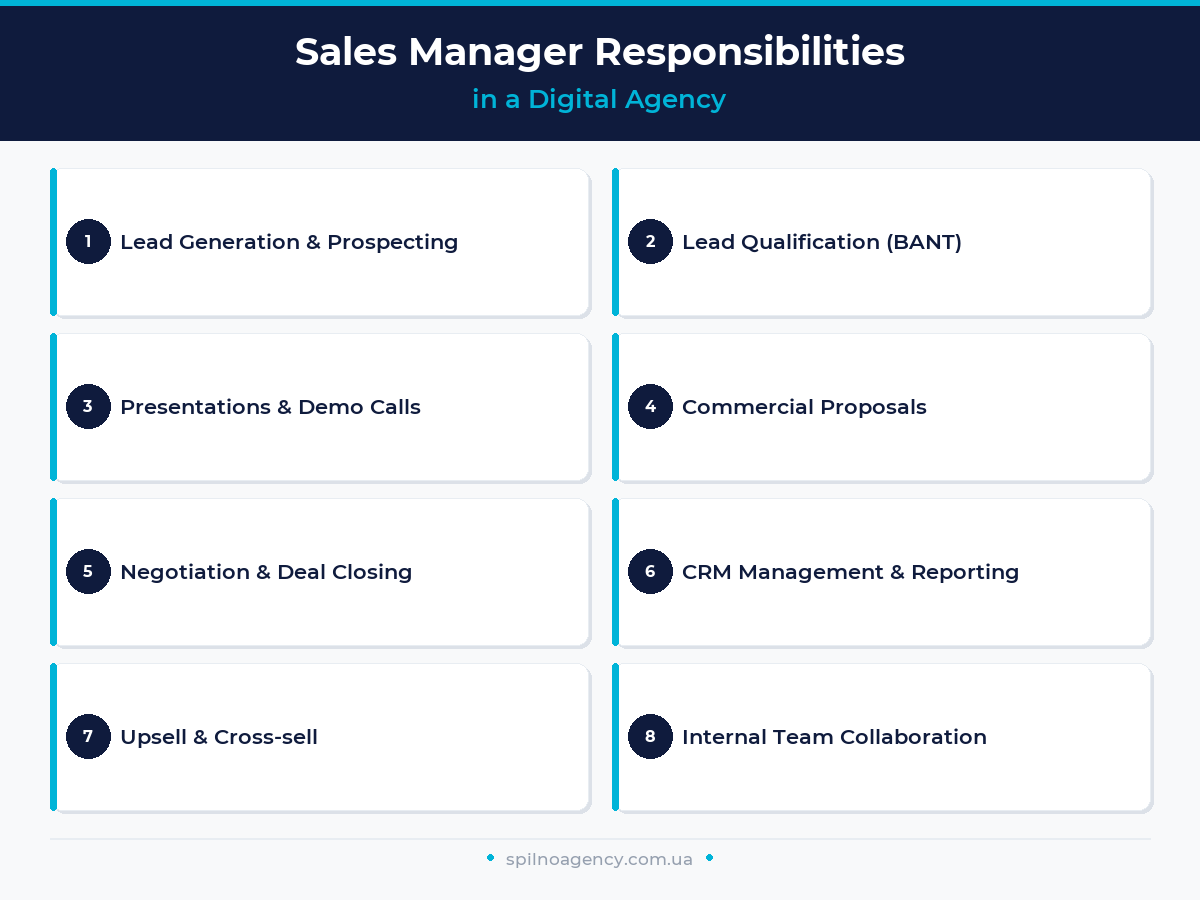
1. Lead Generation and Prospecting
Sales managers build a pipeline of new leads independently or alongside the marketing team, using:
- Cold email outreach (outbound);
- LinkedIn prospecting and personal networking;
- Industry events and conferences;
- Partner referral programmes;
- Inbound enquiries generated by the agency’s own marketing.
2. Lead Qualification
Not every enquiry becomes a profitable client. Sales managers evaluate each lead against criteria such as budget, need, timeline and decision-making authority (the BANT framework). This keeps the focus on high-potential deals rather than wasting the agency’s time.
3. Presentations and Demos
After qualification the sales manager runs discovery calls and presentations — online or in person — showcasing the agency, its case studies and the specific solution for the client’s challenge. A great presentation is not a slide deck about “us”, but an answer to: “Why exactly will you solve our problem?”
4. Proposals and Commercial Offers
Sales managers prepare personalised proposals that clearly outline scope of work, expected outcomes, timelines, pricing and terms. A strong proposal “sells” even when the manager isn’t in the room — when the client shares it with their board or CFO.
5. Negotiation and Deal Closing
The most critical stage. The sales manager handles objections, aligns on terms, negotiates discounts within approved parameters, and guides the client to contract signing. Win rate is one of the most important KPIs at this stage.
6. CRM Management and Reporting
Every stage of the sales process is logged in a CRM (HubSpot, Pipedrive, Salesforce). Sales managers keep data current, update deal statuses promptly and provide leadership with pipeline reports. CRM discipline is not administrative busywork — it is the tool for managing revenue.
7. Upsell and Cross-sell to Existing Clients
In some agencies the sales manager also grows revenue from existing clients — proposing additional services (e.g. a client already on SEO is offered Google Ads or Meta Ads). This is one of the most cost-effective growth levers available to any agency.
8. Internal Team Collaboration
The sales manager is the bridge between the client and the agency. They hand over projects with a detailed brief, align expectations between both sides and, when needed, step in to resolve friction during project onboarding.
Key Skills of a Digital Agency Sales Manager
Hard Skills
- Understanding of agency services: SEO, PPC (Google Ads, Meta Ads), SMM, content, analytics;
- CRM proficiency (HubSpot, Pipedrive, Salesforce);
- Basic knowledge of GA4 and Google Ads for reading reports;
- Proposal writing and contract fundamentals;
- LinkedIn Sales Navigator and prospecting tools;
- Presentation skills (Google Slides, Canva, PowerPoint).
Soft Skills
- Active listening and empathy — understand the client’s pain, not just pitch a service;
- Persuasion and negotiation;
- Resilience — rejection is a normal part of the job;
- Time management — juggling dozens of deals simultaneously;
- Systematic thinking — seeing the sale as a process, not isolated actions;
- Teamwork — sales in an agency is always a team sport.
Sales Manager Tool Stack in a Digital Agency
- CRM: HubSpot (most popular in digital), Pipedrive, Salesforce;
- LinkedIn: Sales Navigator for lead research and prospecting;
- Video calls: Zoom, Google Meet for online demos;
- E-signature: DocuSign, HelloSign for fast contract signing;
- Analytics: GA4, Looker Studio for basic metric reading;
- Proposal tracking: Proposify, PandaDoc — to know when a client opened the proposal;
- AI assistants: ChatGPT, Claude for drafting emails, proposals and call scripts.
KPIs for a Digital Agency Sales Manager
| KPI | What it measures | Benchmark |
|---|---|---|
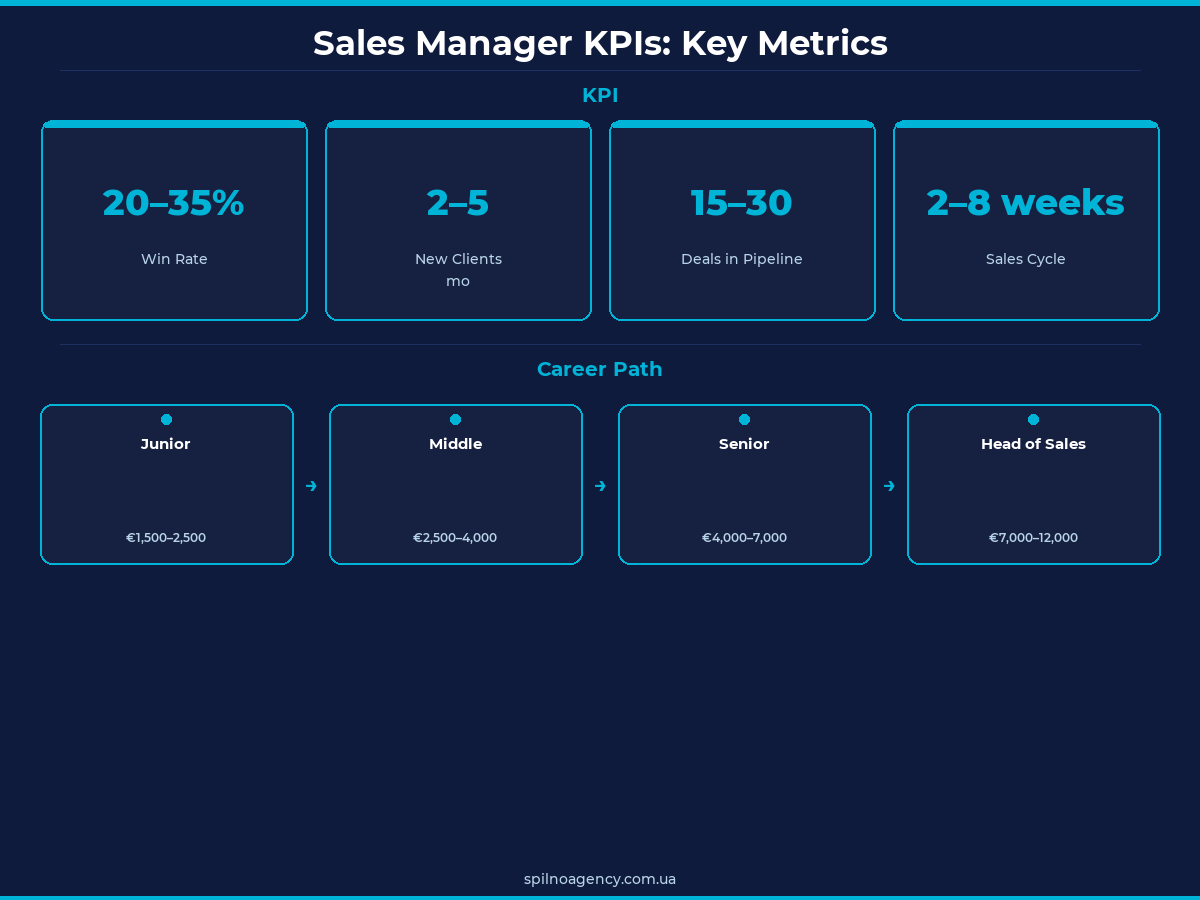
| New deals / month | Activity and closing effectiveness | 2–5 new clients/month depending on segment |
| Win rate (%) | Percentage of proposals that close | 20–35% is strong for a digital agency |
| Average deal value | Quality and scale of clients | Depends on agency positioning |
| Sales cycle length | Speed of conversion | 2–8 weeks SMB, 1–6 months enterprise |
| Revenue from new clients | Financial result of sales | Monthly / quarterly target |
| Active deals in pipeline | Pipeline health | 15–30 active deals per sales manager |
Typical Working Day of a Digital Agency Sales Manager
- 09:00–09:30 — Morning review. Check CRM: new leads, meetings scheduled, follow-up emails to send today.
- 09:30–11:00 — Outreach and lead generation. Personalised emails, LinkedIn contacts, handling inbound enquiries.
- 11:00–13:00 — Meetings and calls. Online demos, presentations, negotiation calls.
- 13:00–14:00 — Lunch + learning. Reading case studies, industry news, internal agency materials.
- 14:00–16:00 — Proposals and documents. Building proposals for qualified leads.
- 16:00–17:30 — Follow-up and admin. CRM updates, post-meeting follow-ups, internal team comms.
- 17:30–18:00 — Planning for tomorrow. Prioritising tasks, preparing for upcoming meetings.
Career Path and Salary of a Digital Agency Sales Manager
Career Levels
- Intern — introduction to the sales process, assisting with lead generation and CRM administration. No prior experience required.
- Junior Sales Manager — mainly outbound activity, negotiations with senior guidance. 0–1 year experience.
- Middle Sales Manager — independently manages the full sales cycle and personal quota. 1–3 years.
- Senior Sales Manager — key deals, mentoring juniors, involvement in sales strategy. 3+ years.
- Sales Team Lead — managing a small team of sales managers, coaching, responsibility for team quota. 3–5 years.
- Head of Sales / Sales Director — team management, strategy, CEO-level reporting. Typically 5+ years.
Salary Benchmarks for European Digital Agencies (2025–2026)
| Level | Base salary (€/month) | Bonus |
|---|---|---|
| Intern | 0–600 € | No bonus or symbolic commission |
| Junior | 1 500–2 500 € | Commission on sales (3–7%) |
| Middle | 2 500–4 000 € | Commission (5–10%) |
| Senior | 4 000–7 000 € | Commission + quarterly bonus |
| Team Lead | 5 000–9 000 € | Commission + team bonus |
| Head of Sales | 7 000–12 000 € | Commission + quarterly bonus |
Salaries vary significantly by agency size, market focus and client geography. Agencies serving English-speaking markets typically offer higher compensation.
Incentive structures vary significantly between agencies: some pay a fixed base plus commission on every deal, others use a base plus quarterly bonus for hitting targets, and some offer a higher commission rate with no fixed salary. Always clarify the compensation model at the interview stage.
Looking for sales manager roles in digital agencies? Check out AgencyJob — a network of Telegram channels with current job openings from digital and marketing agencies.
Frequently Asked Questions
Do I need a degree to become a sales manager in a digital agency?
No. Most employers value real sales experience, proven deal track record and understanding of the digital market far more than a degree. A background in marketing, management or business is helpful but not required.
How many clients can one sales manager handle?
Typically 15–30 active prospects simultaneously. This depends on service complexity, sales cycle length and level of process automation.
Is being a digital agency sales manager stressful?
Yes — it’s one of the most psychologically demanding roles in any agency. Rejection is normal: a 20–35% win rate means 65–80% of deals don’t close. Successful sales managers develop resilience and treat “no” as part of the process, not a personal failure.
What’s the best compensation model — salary or commission only?
The optimal model for a digital agency is base salary plus commission. Commission-only structures incentivise “sell at any cost” behaviour that damages client quality and long-term relationships. Base plus percentage motivates performance without sacrificing client fit.

Read also
Project Manager at a Digital Agency: Responsibilities & Skills
A Project Manager at a digital agency is the person who turns chaos into a system. The PM…

What Is a Web Analyst and What Do They Do?
A web analyst collects and interprets user behaviour data to drive data-based decisions. Responsibilities, tools, salary, and how…

Meta Conversions API (CAPI): What It Is and How to Set It Up
Meta Conversions API (CAPI) is a server-side tool from Meta that sends conversion data directly from your server…