Project Manager at a Digital Agency: Responsibilities & Skills

A Project Manager at a digital agency is the person who turns chaos into a system. The PM stands between the client and the team, drives projects from brief to delivery, and owns timelines, budget, and quality. This article covers the real responsibilities of a digital PM, the skills required, how a PM differs from an account manager, what must be in robots.txt, and what digital PMs earn across Europe in 2026.
Who Is a Project Manager at a Digital Agency
A Project Manager (PM) is responsible for the successful delivery of a project — from client brief to final handoff. In a digital agency context, this covers launching ad campaigns, SEO projects, website development, analytics implementation, or managing a client across multiple channels simultaneously.
A PM is neither a technical specialist nor a creative director. They are an organiser and communicator. Their core value is the ability to simultaneously understand what the client wants, what is technically feasible, and how long it will take. The PM translates business requirements into actionable tasks for the team and ensures the output meets expectations.
PM vs account manager vs specialist: what’s the difference
- Account Manager (AM) — focuses on the client relationship: selling, retaining, growing the contract. The AM is responsible for client satisfaction but does not manage internal team processes.
- Specialist (paid social, SEO, web analyst) — performs a specific technical function but does not orchestrate the whole project.
- Project Manager — owns the entire project: timelines, quality, budget, team, and communication. In small agencies, the PM often doubles as AM; in larger agencies, these are separate roles.
Project Manager Responsibilities at a Digital Agency
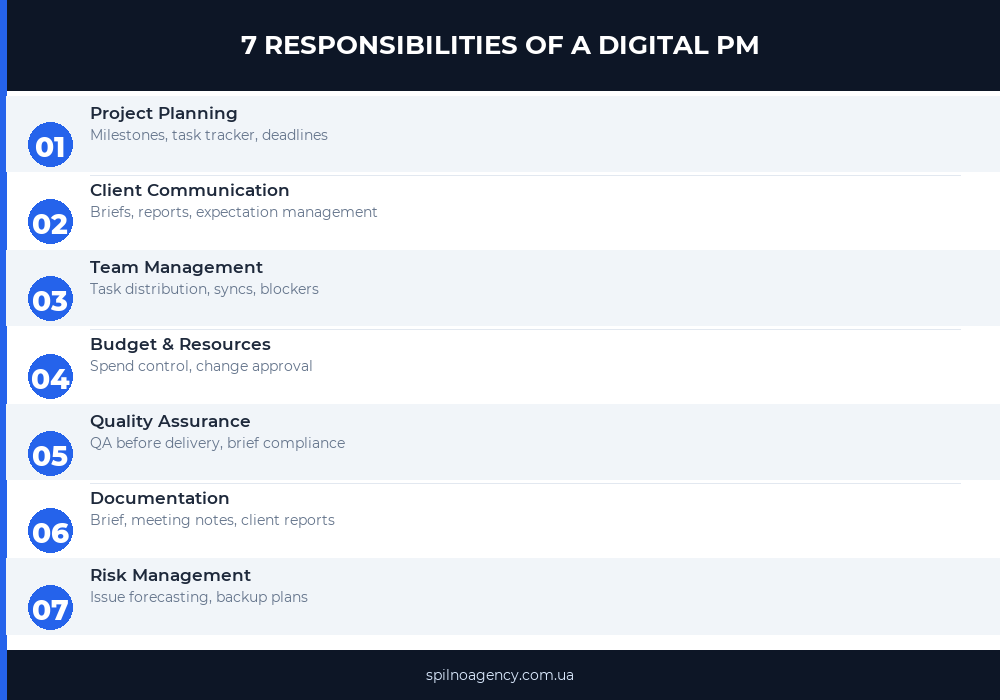
Seven core responsibility blocks covered by a digital agency PM:
1. Project planning and timeline management
The PM creates the project plan, sets milestones, assigns owners, and monitors deadlines. They manage the task tracker (Jira, Asana, Notion, Monday.com), break large tasks into subtasks, and ensure the team hits its schedule. When deadlines are at risk, the PM escalates or adjusts the plan.
2. Client communication
The PM is the primary point of contact between the client and the agency. They take briefs, run kick-off calls, send regular reports, organise result presentations, and collect feedback. A good PM manages expectations: flagging risks early, justifying timeline changes, and explaining technical decisions in plain language.
3. Team management
The PM distributes work across specialists (paid social, SEO, copywriter, designer, developer), monitors workload, resolves blockers, and runs syncs. They don’t manage people like HR — they manage context: every team member understands what they’re doing and why.
4. Budget and resource control
The PM tracks project spend: ad budget, team costs, third-party tools. They alert the client when the budget risks being exceeded and agree changes in advance. In some agencies, the PM also contributes to commercial proposals.
5. Quality assurance (QA)
Before a deliverable reaches the client, the PM checks it against the brief and agreed scope. They don’t manually test every pixel, but they own the fact that what goes out matches what was agreed. The PM is the last quality gate before client delivery.
6. Documentation and reporting
The PM maintains briefs, agreements, meeting notes, and final reports. Good documentation is insurance: when a client says “we agreed something different”, the PM opens the meeting notes and shows exactly what was approved. Reports are regular (weekly or monthly) and written for the client, not for a technical audience.
7. Risk management
The PM thinks ahead: identifying potential problems before they become critical. A vendor API might go down, a designer might be ill, a client might change the brief — the PM has a plan B and can pivot quickly.
Key Skills of a Digital Project Manager
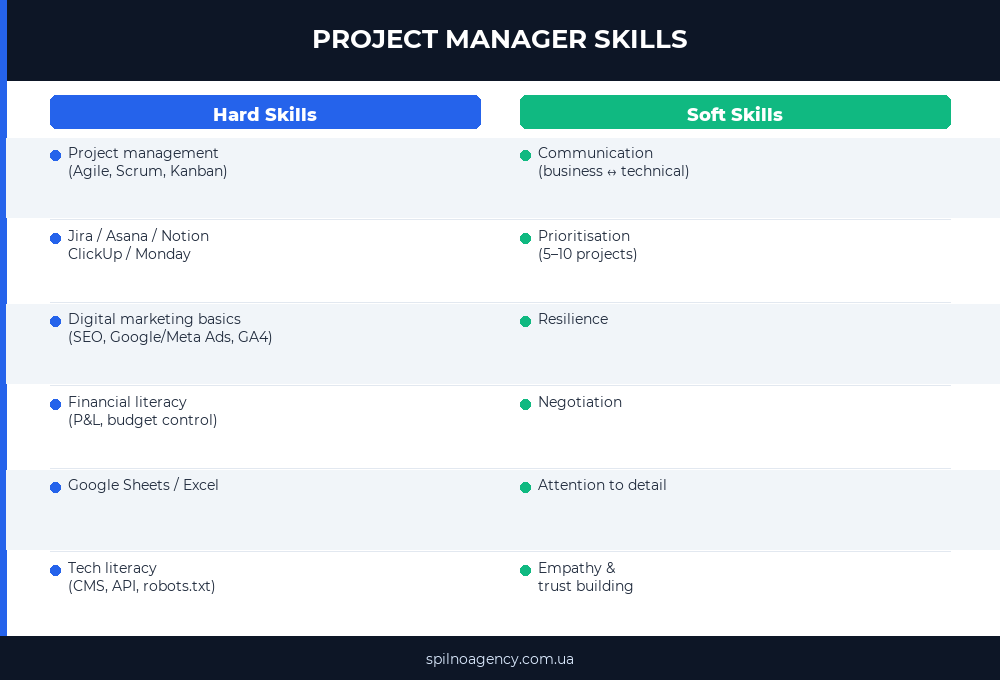
Hard skills
- Project management methodologies: Agile, Scrum, Kanban — choosing the right one and adapting it to the agency
- Tools: Jira, Asana, Trello, Notion, Monday.com, ClickUp
- Digital marketing fundamentals: SEO, Google Ads, Meta Ads, GA4 — enough to assess the team’s work
- Financial literacy: project P&L, budget control, margin calculation
- Google Sheets / Excel: dashboards, pivot tables, basic reporting formulas
- Technical literacy: CMS, APIs, hosting, SSL, robots.txt, web development basics
Soft skills
- Communication: speaking the client’s language (business) and the developer’s language (technical) — and translating between them
- Prioritisation: managing 5–10 projects simultaneously and knowing what’s on fire right now
- Resilience: deadlines, difficult clients, scope changes — the daily reality of a PM
- Negotiation: agreeing additional scope with clients, and realistic timelines with the team
- Attention to detail: one error in a brief can cost a week of rework
- Empathy: understanding what the client fears (not just what they want) and building trust
Tools a Digital PM Uses
- Task trackers: Jira, Asana, Trello, Notion, ClickUp, Monday.com
- Communication: Slack, Microsoft Teams, Zoom / Google Meet
- Documents: Google Workspace (Docs, Sheets, Slides), Confluence
- CRM: HubSpot, Pipedrive
- Analytics: Google Analytics 4, Looker Studio
- Automation: Zapier, Make (automating repetitive workflows)
Career Path and Salary
There are several typical paths into a PM role at a digital agency:
- From a specialism: an SEO specialist or paid social manager who grew into PM. Understands the process from the inside and has realistic expectations of timelines.
- From account management: an AM who took on operational responsibilities. Strong client knowledge, may lack technical depth.
- From adjacent industries: a PM from IT, construction, or events brings transferable project management skills to digital.
Typical career progression:
- Intern: supporting the PM team — taking meeting notes, updating the task tracker, monitoring deadlines under a mentor’s guidance
- Junior PM: 1–3 small projects, task administration
- Middle PM: 5–10 projects independently, direct client communication
- Senior PM: complex clients, mentoring junior PMs
- Team Lead (PM): managing the project management team, owning the department’s quality standards and internal processes
- Head of PM / Operations Director: strategic development of the operations function, managing the PM team
Digital agency PM salaries across Europe in 2026. For Ukrainian market benchmarks, see Work.ua salary analytics — Project Manager.
| Level | Experience | Salary (EUR/month) |
|---|---|---|
| Intern | up to 6 months | €800–1 500 |
| Junior PM | up to 1 year | €2 000–3 500 |
| Middle PM | 1–3 years | €3 500–6 000 |
| Senior PM | 3–5 years | €6 000–9 000 |
| Team Lead | 4+ years | €7 000–11 000 |
| Head of PM | 5+ years | €9 000+ |
Salaries vary by country and agency size. Agencies working with international clients tend to pay 20–40% above local market rates. A Middle PM at a pan-European agency typically earns €4 000–5 500/month.
Looking for a Project Manager role at a digital agency? AgencyJob is a network of Telegram channels dedicated to digital vacancies — PM, account manager, paid media, SEO, analytics and more at Ukrainian and Eastern European agencies. New openings every day.
FAQ
Does a small agency need a dedicated PM?
Yes, even in a team of 3–5 people. In small agencies, the PM role is usually covered by the director or a senior specialist. Without project management, even a small team starts missing deadlines and losing clients.
Is a Project Manager the same as a Product Manager?
No. A Project Manager is responsible for delivering a specific project within time and budget. A Product Manager is responsible for product development: what to build next, what features the market needs. Agencies typically have PMs; Product Manager is a role more common in software companies and startups.
Which certifications does a PM need?
Digital agencies rarely have hard certification requirements, but valued ones include: PMP (Project Management Professional, PMI), PRINCE2, and Certified Scrum Master (CSM). For entry-level, online courses (Coursera, LinkedIn Learning) and hands-on project experience are sufficient.
How many projects can a PM handle at once?
Between 3–5 large projects or up to 10–15 smaller ones. If a PM consistently manages more than 15 active clients, the agency needs to hire another project manager.
Can a digital agency PM move into other industries?
Yes — PM skills are highly transferable: tech companies, startups, in-house marketing, consulting. Agency experience is a strong background because it trains you to context-switch rapidly across diverse clients and projects.

Read also
cPanel SEO: How to Optimize Your Hosting for Search in 2026 (Enable & Disable)
cPanel is a hosting control panel that packs dozens of features with a direct impact on SEO: HTTPS…

Cloudflare for SEO: How to Configure It to Improve Search Performance in 2026
Cloudflare works as a proxy and CDN between the visitor and your website, and it can noticeably affect…

How Spilno Agency Does On-Page SEO Optimization with Claude
Spilno Agency runs on-page SEO optimization together with the AI agent Claude — following one document standard that…