What Is a Web Analyst and What Do They Do?

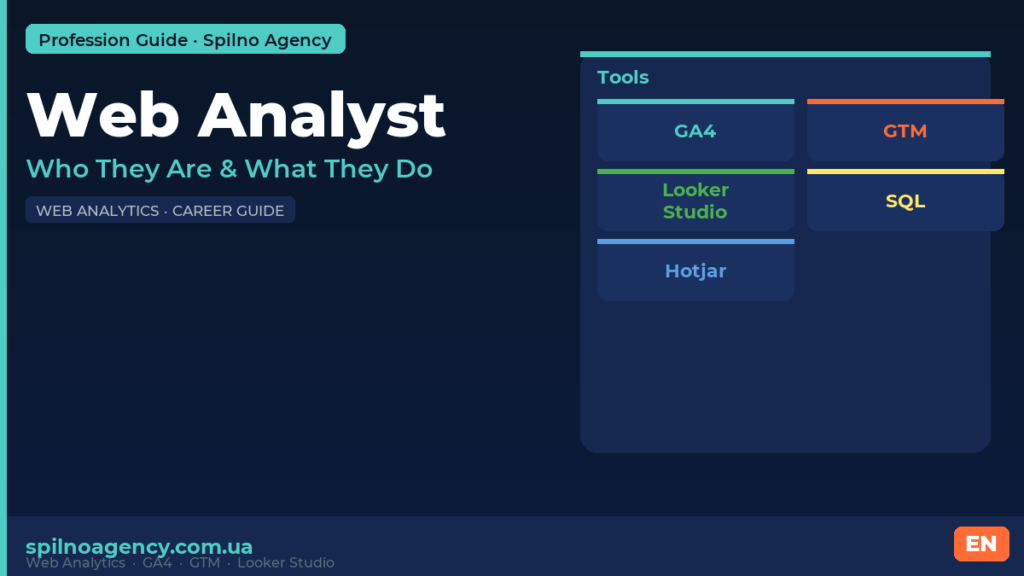
A web analyst turns raw website data into actionable business insights — setting up GA4 and GTM, building Looker Studio dashboards, and finding conversion growth opportunities across traffic channels.
What Is a Web Analyst?
A web analyst (web analytics specialist) is a digital analytics professional who collects, processes, and interprets data about user behaviour on a website or app. Their core purpose is to turn raw numbers from GA4 reports into concrete recommendations for marketing, product, and business strategy.
Unlike a marketer who plans campaigns or an SEO specialist who optimises content, a web analyst is the bridge between data and decisions. They answer questions like: where do users come from, why do they leave without converting, which advertising channels deliver the best ROAS, and where exactly in the funnel are leads dropping off.
Web Analyst Job Description: Core Responsibilities
A web analyst’s responsibilities span the full cycle from data collection to business action:
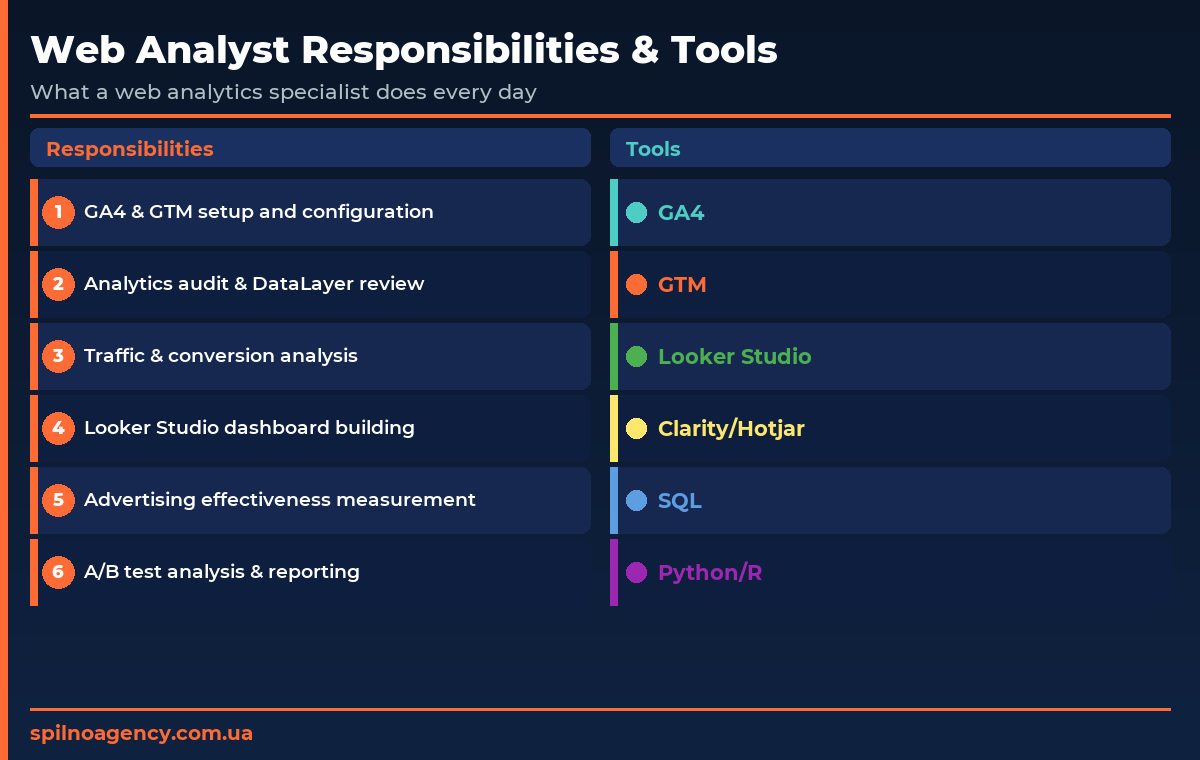
- Analytics setup. Implementing and configuring GA4 via Google Tag Manager — creating tags, triggers, variables, ecommerce events, and conversion goals.
- Analytics audit. Verifying that tracking is accurate — checking for duplicate events, missing DataLayer parameters, and data gaps.
- Traffic and behaviour analysis. Investigating traffic sources, bounce rates, session depth, time on page, and conversion paths.
- Dashboard building. Creating clear, interactive reports in Looker Studio for marketing teams and leadership.
- A/B test analysis. Forming hypotheses and interpreting split-test results to improve conversion rates.
- Advertising effectiveness measurement. Calculating ROAS, CPL, and CPA by channel — Google Ads, Meta Ads, TikTok Ads — based on reliable analytics data.
- Reporting and recommendations. Preparing regular reports with concrete findings and next steps for the team.
Web Analyst Tools
The core toolkit every web analyst relies on:
- Google Analytics 4 (GA4) — the primary web analytics platform. Tracks sessions, users, events, conversions, and ecommerce data.
- Google Tag Manager (GTM) — tag management system. Enables adding and configuring analytics and advertising tags without touching the site’s source code.
- Looker Studio — Google’s free tool for building interactive dashboards connecting GA4, Google Ads, BigQuery, and other data sources.
- Microsoft Clarity / Hotjar — session recording and heatmap tools that show exactly how users interact with individual pages.
- SQL — essential for working with BigQuery (GA4 raw data exports), CRM databases, and large datasets.
- Google Sheets / Excel — for ad-hoc analysis, pivot tables, and manual attribution modelling.
- Python / R — for automated reporting, statistical analysis, and machine learning (advanced level).
Web Analyst Skills
Technical skills
- GA4 configuration: properties, data streams, ecommerce, audiences, custom dimensions
- Google Tag Manager: tags, triggers, variables, DataLayer, GTM Preview debugging
- SQL at SELECT, JOIN, GROUP BY, subquery level
- Excel / Google Sheets: pivot tables, VLOOKUP, cohort analysis formulas
- Looker Studio: data source connections, calculated fields, filters, embedded reports
- Basic HTML and JavaScript understanding (for DataLayer debugging)
- Familiarity with advertising platforms: Google Ads, Meta Ads — at the reporting level
Analytical and soft skills
- Critical thinking: challenging data assumptions and verifying hypotheses
- Communication: translating complex analytical findings into plain language for clients and teams
- Attention to detail: spotting data anomalies others miss
- Self-organisation: prioritising tasks and meeting deadlines across multiple projects
- Curiosity: always asking “why?” about the data
Web Analyst Salary
| Level | Europe (€/month) | US ($/year) | Poland (PLN/month) |
|---|---|---|---|
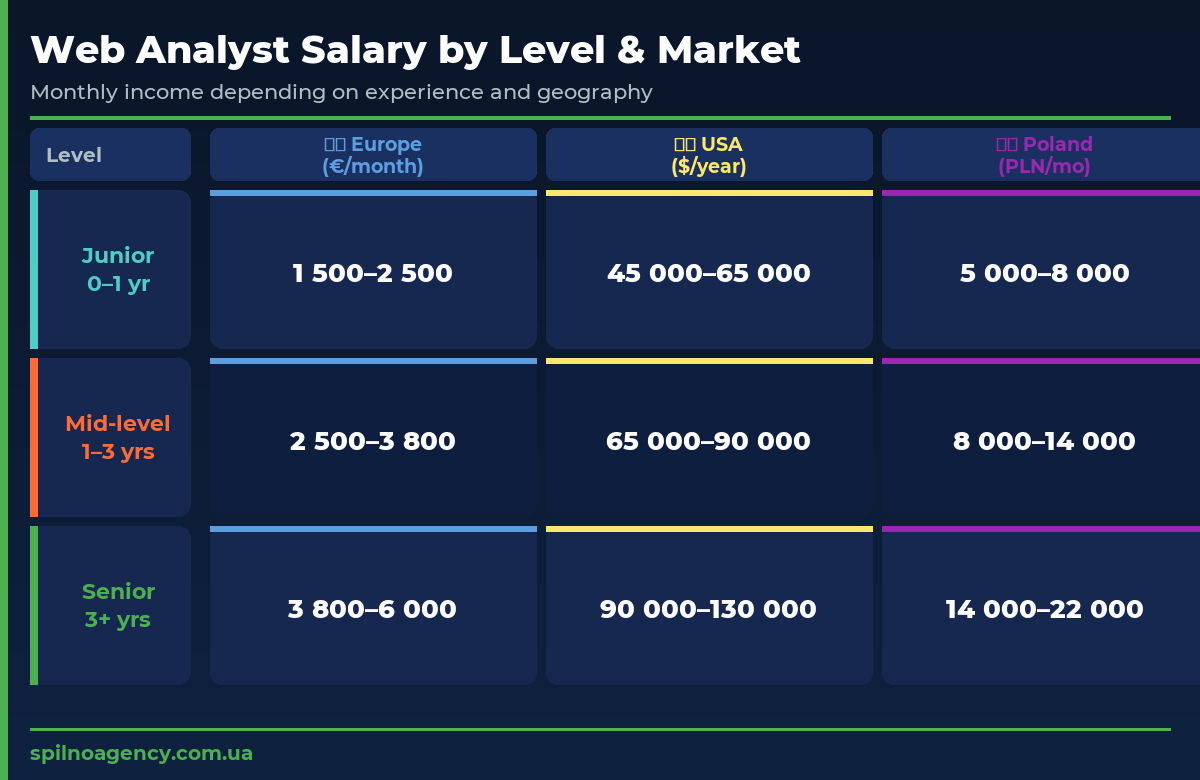
| Junior (0–1 yr) | 1 500–2 500 | 45 000–65 000 | 5 000–8 000 |
| Mid-level (1–3 yrs) | 2 500–3 800 | 65 000–90 000 | 8 000–14 000 |
| Senior (3+ yrs) | 3 800–6 000 | 90 000–130 000 | 14 000–22 000 |
Specialists with BigQuery, Python, and advanced attribution modelling experience command higher rates at every level. Working at large e-commerce companies or agencies with enterprise clients typically offers the highest compensation.
How to Become a Web Analyst
- Learn GA4. The official Google Analytics 4 course on Google Skillshop is free and includes a certification. Also complete the Google Tag Manager Fundamentals course.
- Practice on the demo account. Google provides a GA4 demo account with real data — explore reports, find insights, and build reports in Looker Studio.
- Learn SQL. Mode Analytics SQL Tutorial and Khan Academy are free starting points. SQL is essential for BigQuery and large datasets.
- Find your first real project. Offer a free analytics audit to a business you know — the best hands-on learning and your first portfolio case.
- Understand marketing fundamentals. Knowing conversion funnels, ROAS, CPA, CPL, and retention makes you significantly more valuable as an analyst.
- Join the community. MeasureCamp, Analytics Edge, and web analytics communities on LinkedIn and Reddit provide learning and networking opportunities.
Web Analyst vs Related Roles
| Role | Focus | Key tools |
|---|---|---|
| Web analyst | Website/app behaviour, conversions, funnels | GA4, GTM, Looker Studio |
| Data analyst | Broad business analysis, CRM, financial metrics | SQL, Python, Power BI, Tableau |
| Marketing analyst | Marketing channel performance, ROMI | GA4, Google Ads, Meta Ads, Excel |
| Product analyst | UX, feature adoption, in-product user journeys | Mixpanel, Amplitude, SQL |
In practice, in small and mid-sized businesses one specialist often combines web analyst and marketing analyst responsibilities. At larger organisations these roles are clearly separated.
Web Analytics Services from Spilno Agency
Spilno Agency provides web analytics services for e-commerce, SaaS, and service businesses across Europe. We set up GA4 ecommerce tracking, audit existing analytics, build Looker Studio dashboards, and help teams make decisions based on reliable data.
Need an analytics audit or GA4 setup from scratch? Get in touch — we offer a free initial consultation.
Frequently Asked Questions About Web Analysts
What is a web analyst?
A web analyst sets up analytics systems (GA4, GTM), collects data on website user behaviour, and translates it into business insights — where leads drop off, which channels perform best, and how to improve conversion rates.
What tools does a web analyst use?
Core stack: Google Analytics 4, Google Tag Manager, Looker Studio, Microsoft Clarity or Hotjar, SQL. Advanced analysts also use BigQuery, Python, and Power BI.
What is a web analyst’s salary?
In Europe, junior web analysts earn €1,500–2,500/month; mid-level €2,500–3,800/month; senior €3,800–6,000/month. In the US, web analytics specialists typically earn $55,000–130,000/year depending on level and company.
How do I become a web analyst?
Take the free GA4 and GTM courses on Google Skillshop, learn basic SQL (Mode Tutorial), build your first Looker Studio dashboard using demo data, then find a real project to practise on and build your portfolio.
What is the difference between a web analyst and a data analyst?
A web analyst focuses on the website: GA4, GTM, sessions, conversions, page behaviour. A data analyst works with broader business data — CRM, ERP, financial data — and typically uses Python, R, Tableau, or Power BI for deeper analysis.

Read also

Top Claude Skills for TikTok Ads Specialists (2026)
9 verified Claude skills and MCP servers for TikTok Ads: Pixel/Smart+ audits, Spark Ads hook/hold rate, creator sourcing,…
(data not available) in Google Analytics 4: What This Value Means in 2026
The value (data not available) in Google Analytics 4 reports means that traffic-source information has reached GA4 but…

Google Ads Rules: Maximum Lead Price, Customer Price, and How Much to Spend Before a Campaign Fails
There is no such thing as a universal “good cost per lead” — €20 per lead can be…