Content Plan 2026: What It Is, How to Build It + Template & Checklists

A content plan is a publication calendar for 1–3 months ahead — date, channel (blog, Instagram, TikTok, Telegram, YouTube), format, topic, goal, owner. Strategy comes first (audience, tone, pillars), then the plan + checklists + AI drafts. Below: 7 steps, a Google Sheets template, checklists for 5 channels, and answers to 8 FAQs for 2026.
A content plan isn’t just a «table of topics» — it’s the team’s working tool: it synchronises SEO, SMM, design and copywriting around a single goal. In this guide we break down how to build a content plan in 2026 — with AI drafts, new formats (Shorts, Reels, TikTok Lives) and real KPIs that prove content works.
What a content plan really is
A content plan is a structured schedule for creating and publishing content across a brand’s online channels for a fixed period (a week, month or quarter). It’s a table or calendar that specifies for every publication: date and time, channel (blog, Instagram, TikTok, Telegram, YouTube, email), format (article, post, Reel, Short, Story, newsletter), topic, target keyword or hashtags, goal (traffic / engagement / sales / reach), owner and status.
Why you need a content plan in 2026
In 2026 brands routinely work across 4–6 channels at once: search (SEO), Google Discover, Instagram, TikTok, Telegram, YouTube, email. Without a plan that becomes chaos: the team forgets about cadence, content gets duplicated across channels, the designer finds out about a post one hour before it goes live. A content plan solves 5 problems:
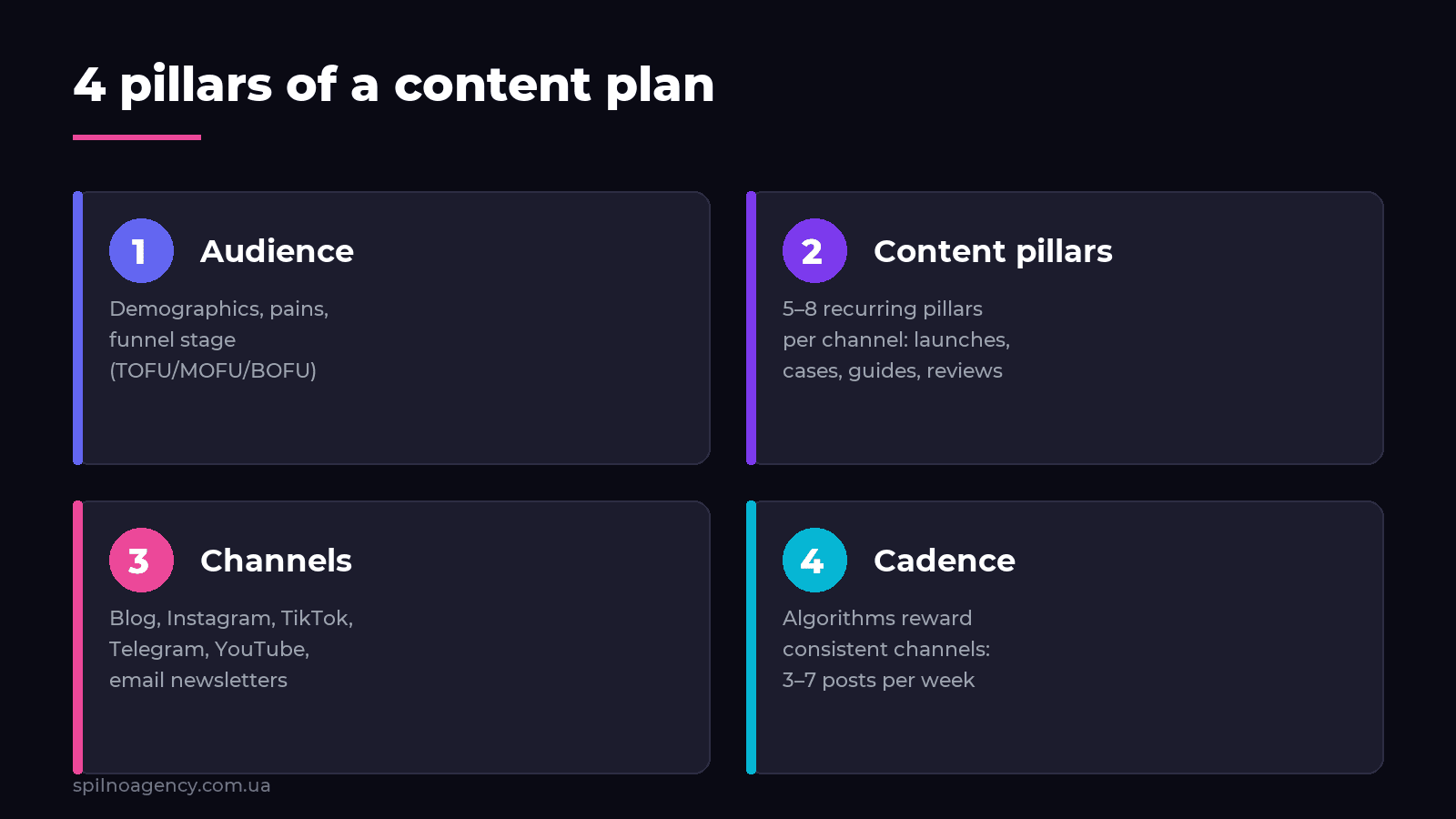
- Consistency. Instagram, TikTok and YouTube algorithms favour channels that publish 3–7 times a week. A plan = a guarantee you won’t disappear for 10 days.
- Alignment with business goals. Every publication has a purpose: lead, sale, reach, retention, education. Without a plan 60% of posts are «neutral» — no measurable KPI.
- Resource allocation. You see a month ahead how much copy, video and design is needed — and can commission it on time.
- Seasonal prep. Black Friday, Easter, back-to-school, holiday campaigns get planned 4–8 weeks ahead — not «in a week».
- Analytics. The plan is a list of hypotheses. After a month you see which pillars drove traffic / reach / sales and adjust the next cycle.
Content plan vs content strategy — what’s the difference
These are two different documents that get mixed up. Strategy is «why» and «for whom». A plan is «what», «when» and «how».
| Parameter | Content strategy | Content plan |
|---|---|---|
| Horizon | 6–24 months | 1 week — 3 months |
| What it covers | Audience, positioning, tone of voice, pillars, channels, goals | Specific publications: date, channel, topic, format, owner |
| Who owns it | Marketing director, content strategist, project lead | SMM manager, content marketer, copywriter |
| Format | Document (Google Docs, PDF) | Table or calendar (Sheets, Notion, Asana, ClickUp) |
| Update cadence | 1–2× a year | Weekly |
| KPIs | Brand awareness, share of voice, authority | Reach, CTR, leads, sales, publishing frequency |
Without strategy a plan becomes «let’s post anything». Without a plan strategy stays on paper. Strategy first — then plan.
Who builds a content plan in the team
In 2026 a content plan is owned not by one person but by 4–6 roles. Here’s the RACI matrix:
| Role | Responsibility within the plan |
|---|---|
| Content marketer / strategist | Aligns the plan with business goals, pillars, audience. Signs off the monthly theme plan. |
| SMM manager | Builds the plan for social: IG, TikTok, Telegram, YouTube. Owns the posting schedule. |
| SEO specialist | Supplies topics for blog and YouTube based on keyword research and semantic gaps. |
| Copywriter | Writes copy against the plan, aligns tone and deadlines. |
| Designer / video creator | Prepares visuals, thumbnails, Reels and Shorts based on briefs from the plan. |
| Project manager / lead | Tracks deadlines, approves final versions, owns KPI reporting. |
How to build a content plan in 7 steps
This is the working algorithm we use at Spilno Agency for clients across e-commerce, SaaS and B2B services.
- Set a goal for the period. «+ 30% blog traffic in 3 months» or «+ 1,000 TikTok followers in 30 days». Without a goal the plan becomes «content for the sake of content».
- Describe the audience and its pain points. Demographics, funnel stage (TOFU/MOFU/BOFU), what they Google, where they hang out, which format suits them.
- Lock down content pillars. 5–8 recurring pillars per channel — for a fashion brand: new arrivals, look book, reviews, behind-the-scenes, fabric care, promos, material facts, size guide.
- Run a competitor audit. 3–5 direct competitors: topics, formats, cadence, what worked (by likes / comments). It’s a source of hypotheses, not a template to copy.
- Gather keywords and trends. For blog and YouTube — Ahrefs, Serpstat, Google Trends. For IG/TikTok — TikTok Creative Center, Pinterest Trends, Instagram Reels Insights, AnswerThePublic.
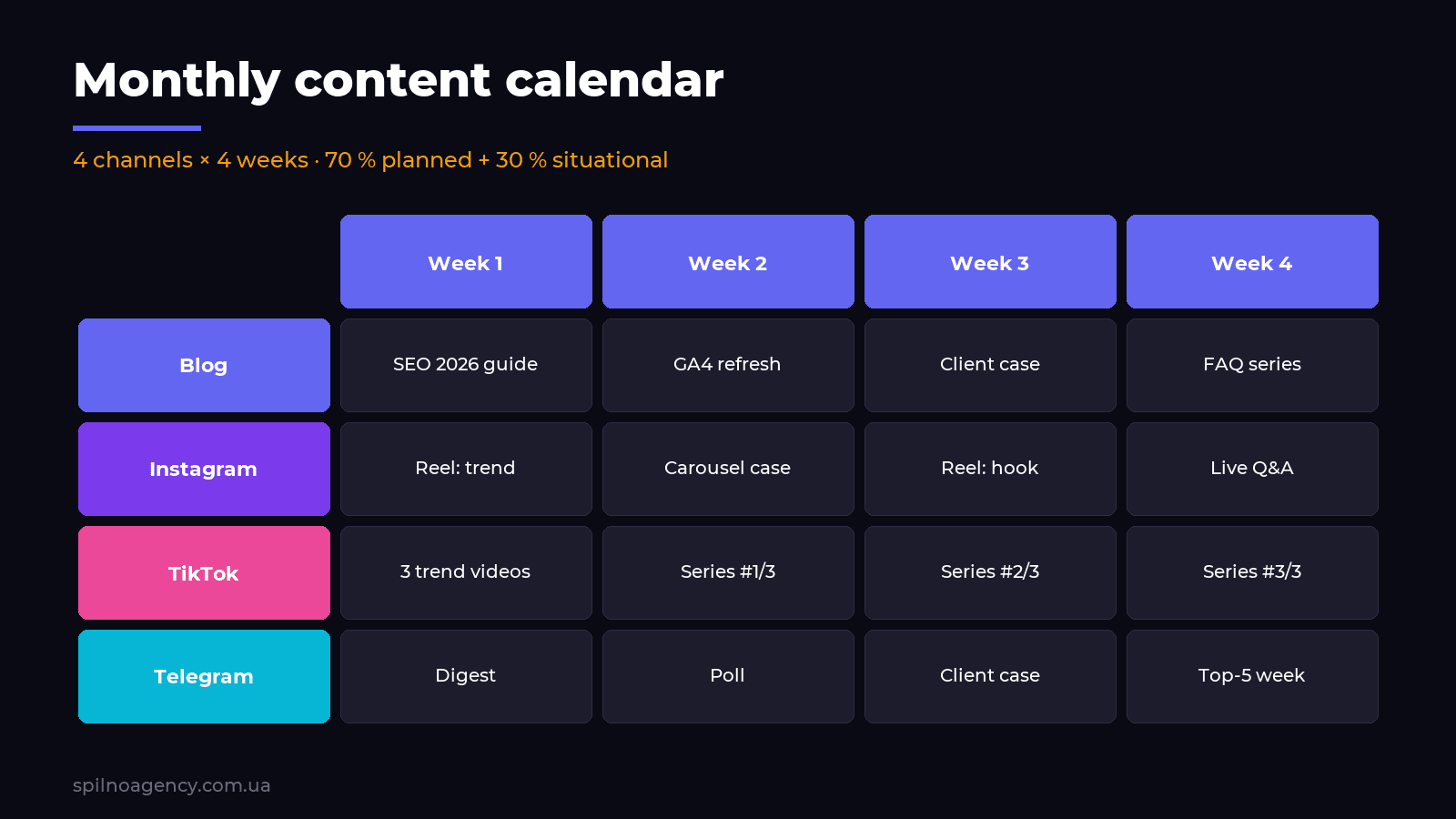
- Lay out slots in the calendar. Week × channel × format. Allocate 70% planned content, 30% situational (trends, news jacks, reactions).
- Assign owners and deadlines. Copy 5 days before publication, design 3 days, final sign-off 1 day. Without that you’re shipping «day-of» — quality drops.
How to build a content plan for a blog (SEO)
- Semantic core of 80–150 keywords, broken into clusters (informational, commercial, navigational).
- Prioritisation matrix: start with topics that have high volume and medium difficulty (DR<30 in Ahrefs).
- Cadence: 4–8 articles per month for a growing blog, 1–2 for maintenance mode.
- Slot structure: date → topic → primary keyword → cluster keywords → format (guide / list / comparison / case) → word count (1,500/3,000/5,000+) → internal links → author → deadline.
- Old article refresh: 30–50% of slots should be updating existing posts, not new ones. Google rewards a fresh modified date.
How to build a content plan for Instagram
- Feed: 3 recurring pillars per week + 1 situational. Stay on the visual palette.
- Reels: 4–7 per week, 7–60 seconds. This is the main reach driver in Instagram 2025–2026.
- Stories: 3–5 daily with interactive elements — polls, questions, quizzes, tags.
- Lives: 1–2 per month (interview, Q&A, launch). Record and cut into Reels.
- Collab posts and Carousels: 1–2 per week — the highest-engagement formats.
How to build a content plan for TikTok
- Cadence: 1–3 videos per day in growth phase, 4–7 per week in maintenance.
- Length: 15–60 sec is the baseline, 1–3 min for explainers, 60+ min for Live.
- Hook in the first 1.5 sec: problem, promise, intrigue or contrast.
- Trends: review TikTok Creative Center and the beat stash weekly; adapt your messaging to current sounds.
- Series: 3–7 episodes on a single topic (e.g. «SEO mistakes #1…#5»). Keeps viewers in your channel.
How to build a content plan for Telegram
- Cadence: 1–3 posts per day is the norm. Less than 3 per week — the channel «dies» in the feed.
- Formats: long-read with image, news digest, original ≤60 sec video, voice note, poll, news reaction.
- Weekly «top picks» digest — makes the channel «navigable».
- Cross-channel ads in other Telegram channels: 2–4 buys per month — the main audience growth lever.
- Bot / preview / emoji reactions: configure Telegram Premium tools — they drive engagement.
How to build a content plan for YouTube and Shorts
- Long-form (8–15 min): 1–2 per week. The main organic growth channel via YouTube search.
- Shorts (≤60 sec): 4–7 per week. Separate feed, separate algorithm, separate plan.
- Thumbnails: test 3 variants through YouTube Studio Test & Compare.
- Series and playlists: group videos into thematic playlists of 5–10 — drives 20–40% of channel watch time.
- Live + Premiere: 1 per month — a strong product-drop tool.
Content plan tools in 2026
In 2026 most teams move from plain Google Sheets to platforms with calendar, approval and auto-posting. The current stack:
- Google Sheets — universal template, free, collaborative. Fits teams of 1–5.
- Notion — table + calendar + knowledge base. Great for content marketing and SEO plans.
- Asana / ClickUp — for bigger teams with approval flows, deadlines and roles.
- Trello — Kanban board for simple SMM plans. Free for small teams.
- Later / Buffer / Metricool / Hootsuite — specialised SMM schedulers with auto-posting for IG, TikTok, FB, X, LinkedIn.
- Airtable — flexible database, suits editorial teams with many authors.
- Google Calendar — syncs deadlines across teams; integrates with Notion, Trello, Asana.
- SE Ranking / Semrush / Ahrefs / Serpstat — source of topics for the SEO block of the plan.
AI in content planning: what to delegate in 2026
AI tools (ChatGPT, Claude, Gemini, Perplexity, Midjourney, Sora) in 2026 aren’t «post generators» — they’re planning assistants. Here’s what to delegate to AI and what not:
Delegate to AI:
- Brainstorming pillars and topics (50 ideas in 5 minutes).
- Drafts of headlines and meta descriptions for a target keyword.
- Reverse competitor analysis (paste their posts into Claude and get insights).
- TikTok / Reels script drafts (3 hooks + 3 CTA variants).
- Adapting one piece across channels (article → 5 IG cards → TikTok script → Telegram post).
- First drafts of low-risk content: industry news, guides, FAQs.
Don’t delegate to AI:
- Expert pieces, case studies, opinion — that’s YOU, not AI.
- Claims about your brand, prices, guarantees or testimonials.
- Content in regulated niches (healthcare, finance, legal) without expert review.
- Images featuring real members of your team or clients.
- First-person copy without fact-checking — AI «hallucinates».
How to automate publishing
- Set up auto-posting in an SMM scheduler (Later, Metricool, Buffer, Hootsuite). Connect IG, TikTok, FB, X, LinkedIn in one account.
- Zapier / Make integrations: when Google Sheets row is marked «Ready», the post auto-enters the queue.
- Telegram bots for scheduled publishing: Postibot, ControllerBot, JCSBot.
- WordPress + Schedule Posts plugin for blog: set a date, it publishes automatically.
- YouTube Premiere: upload in advance, set premiere start time.
KPIs and metrics for a content plan
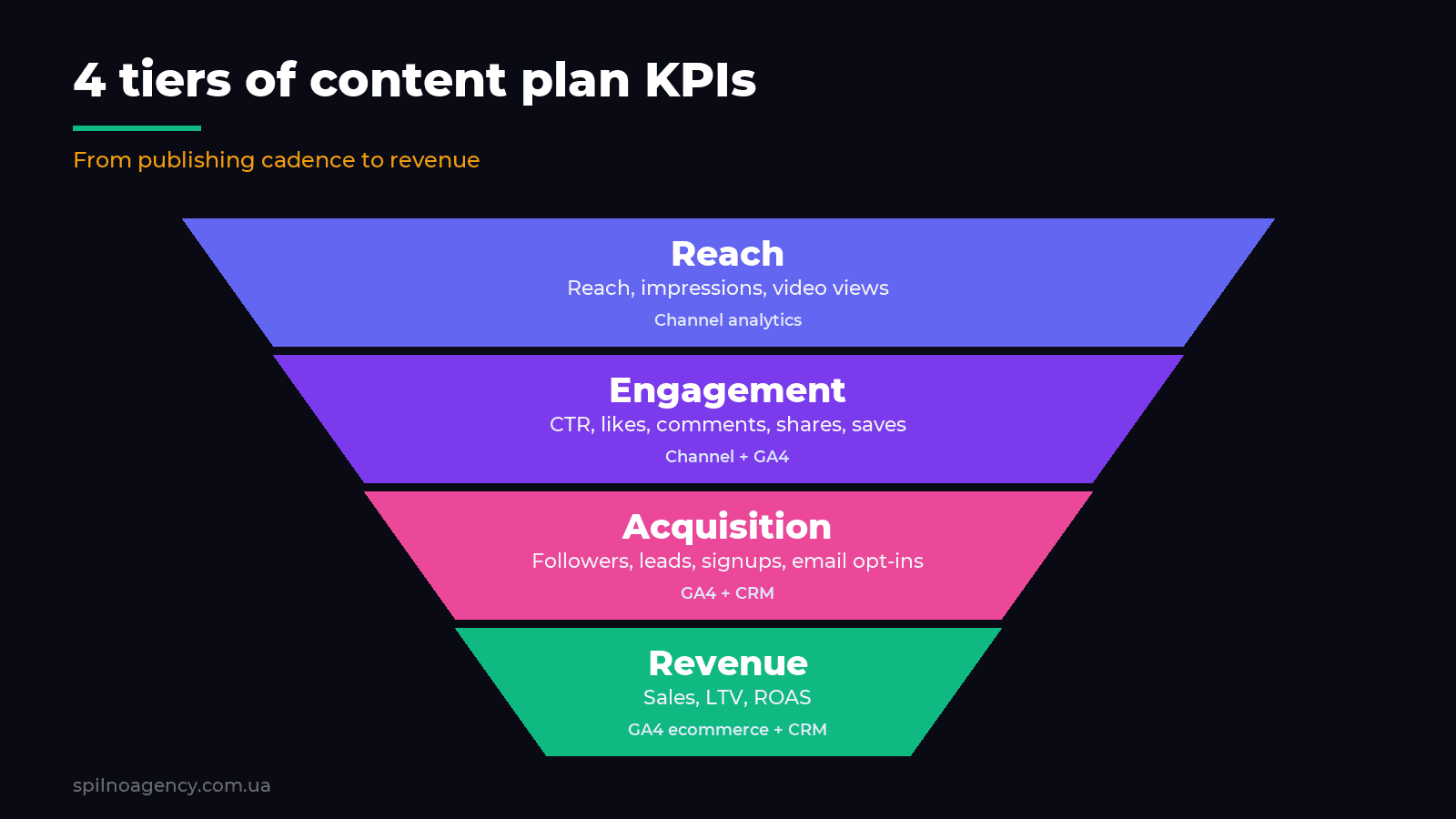
A content plan is a set of hypotheses. After 30 days you measure what worked and what didn’t. Metrics fall into 4 tiers:
| Tier | Metric | How to measure |
|---|---|---|
| Reach | Impressions, reach, video views | Native channel analytics |
| Engagement | CTR, likes, comments, shares, saves, watch time | Native + GA4 for blog |
| Acquisition | Followers, leads, signups, email opt-ins | GA4 + CRM |
| Revenue | Content-driven sales, customer LTV, ROAS | GA4 ecommerce + CRM |
Extended content plan checklists
Below are 6 ready-to-copy checklists per channel. Drop them into your plan and tick them off weekly.
Universal checklist (10 items)
- Period goal is explicitly defined (month/quarter).
- Audience and funnel stage are described.
- 5–8 recurring pillars are locked in.
- Slots planned 4 weeks ahead (minimum).
- Each slot has: date, channel, format, topic, owner, deadline, status.
- Seasonal / trend slots are reserved (Black Friday, Easter, back-to-school, etc.).
- 30% of slots are situational (editable without approval).
- Internal links between pieces are mapped out.
- Monthly KPIs are set and measurable.
- Content strategy is current (reviewed in the last 6 months).
Blog checklist (12 items)
- Semantic core of 80–150 keywords is collected.
- Keywords are clustered and prioritised by volume × difficulty.
- Publishing cadence is set (4–8/month).
- 30–50% of slots are refreshes of existing posts.
- Each article has a primary kw + 3–5 cluster kws.
- Word count is planned: 1,500 / 3,000 / 5,000+.
- Internal links between articles are mapped.
- Schema is planned (Article / HowTo / FAQ / Product).
- 16:9 cover image and localised alt-text are planned.
- Canonical, hreflang and OG tags are checked pre-publish.
- Article passes readability (Hemingway, grade-7 reader).
- Post-publish: request indexing in GSC + annotation.
Instagram checklist (12 items)
- 3 recurring pillars + 1 situational per week.
- Reels: 4–7 per week, 7–60 sec.
- Carousels: 1–2 per week, 7–10 slides.
- Stories: 3–5 daily with interactions.
- Live: 1–2 per month.
- Collab posts with partners: 1–2 per month.
- Hashtags: 7–15 per post, trend-checked.
- UTM tags for all profile links.
- Single visual palette across the feed.
- Captions ≤2,200 characters with a closing CTA.
- Reels text exists in caption + on-screen + voice — for deaf viewers, no-sound viewers and algorithms.
- Weekly analytics: top 5 posts, top 5 Reels.
TikTok checklist (12 items)
- Hook in the first 1.5 sec: problem or contrast.
- Length: 15–60 sec for the main feed, 1–3 min for education.
- Series of 3–7 episodes on a single theme.
- Trending sounds — weekly TikTok Creative Center review.
- Hashtags: 3–5 targeted + 2–3 trending.
- On-screen text: large, high contrast, not covered by UI.
- CTA in description (buy, subscribe, link in bio).
- Weekly analytics: average watch time, view duration, completion rate.
- 1 live per week to boost reach.
- Recording original sounds — an extra ranking factor.
- Don’t overuse Reels watermarks — TikTok throttles reach.
- Cross-post to Reels and Shorts only after primary TikTok lift (24h).
Telegram checklist (10 items)
- Cadence: 1–3 posts per day.
- First line = promise / news / hook (otherwise no «show more» click).
- Image / media in 80% of posts.
- Emoji reactions enabled, tracked weekly.
- Polls 1–2 per week — boosts reach.
- «Top of the week» digest — weekly.
- Ads in other Telegram channels: 2–4 buys per month.
- Chat for subscribers (comment chat or linked group).
- Telegram Stories for channels ≥1k subs — use them.
- TGStat / Telemetr analytics weekly.
YouTube checklist (10 items)
- Long-form: 1–2 videos per week, 8–15 min.
- Shorts: 4–7 per week, up to 60 sec.
- Test 3 thumbnails via YouTube Studio.
- Tags, description ≤5,000 chars, first 150 chars = hook.
- Chapters with timecodes — mandatory for long-form.
- End screen with 2 video recommendations.
- Playlists: groups of 5–10 videos.
- Live or Premiere — 1 per month.
- Weekly analytics: thumbnail CTR, average view duration, audience retention.
- Cross-promotion from Shorts to long-form (pinned comment, link).
Universal content plan template
Copy our Google Sheets content plan template — 4 tabs (Blog, Instagram, TikTok, Telegram), colour-coded pillars and a KPI column. Adapt to your brand and start shipping.
Content plan risks and how to avoid them
- Over-planning. Team plans a quarter, week 1 it all falls apart. Fix: 70% planned + 30% situational.
- Content without a goal. «Post for the sake of cadence». Fix: every slot has a KPI and success metric.
- Loss of flexibility. The plan doesn’t allow reacting to trends. Fix: 1–2 reserve slots per week.
- Cross-channel duplication. Same post on IG, FB and Telegram. Fix: adapt format, headline and CTA per channel.
- Team overload. 7 publications a day across 5 channels = burnout. Fix: «base + variations»: one piece → 4–5 adaptations.
Frequently asked questions
How is a content plan different from a content strategy?
Strategy is «why» and «for whom» (audience, tone of voice, pillars, goals) over 6–24 months. The plan is «what», «when» and «how» (specific publications, dates, owners) over 1 week — 3 months. Without strategy a plan becomes «let’s post anything»; without a plan strategy stays on paper.
How far ahead should I plan — a week, a month or a quarter?
The most effective rhythm is a monthly plan with a quarter-ahead overview. Quarterly view covers seasonal events and campaigns, monthly view fixes specific slots, weekly view tunes the details. Larger brands run «rolling 3 months»: each week one new week is added to the plan.
How many publications per week per channel in 2026?
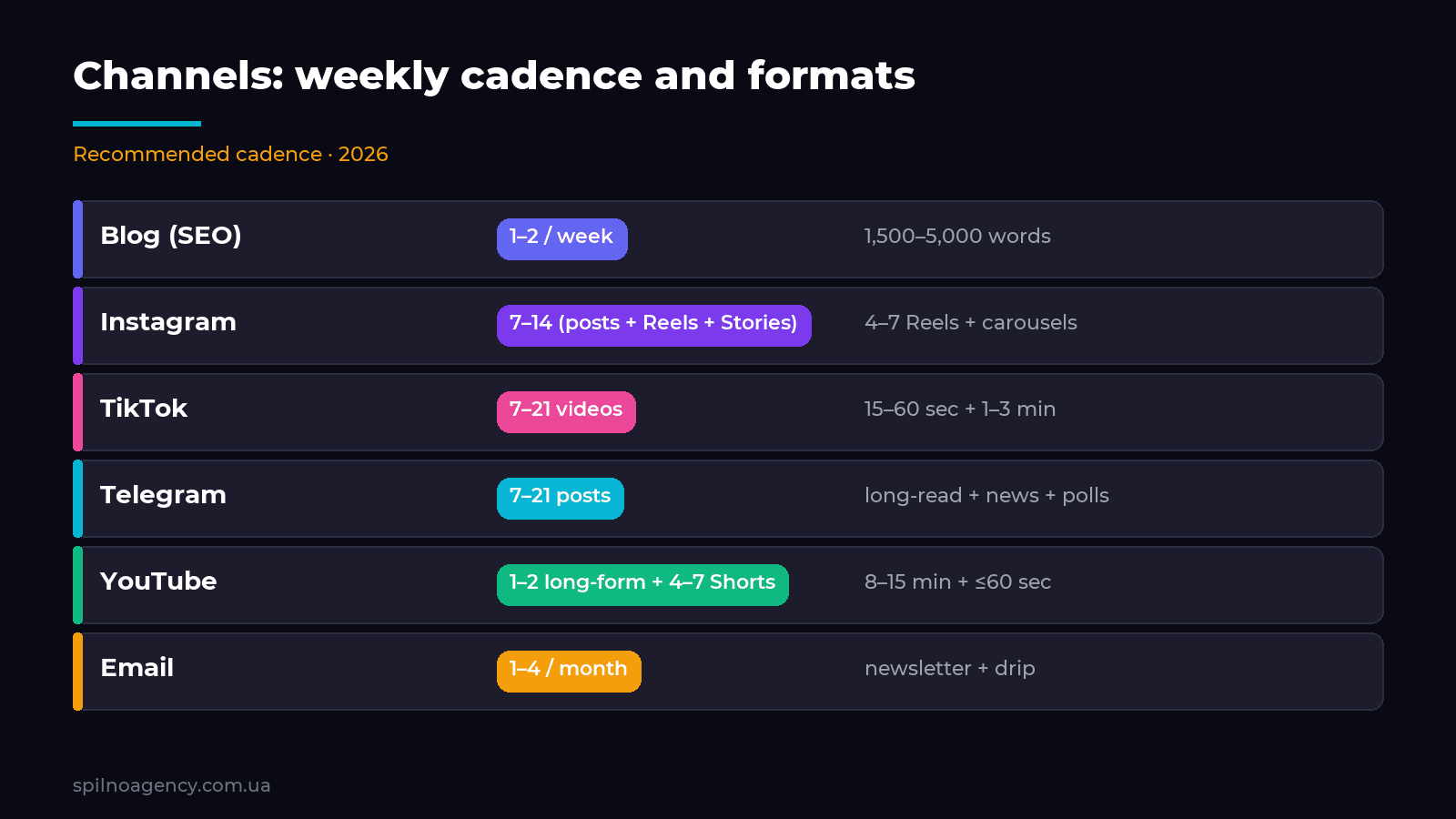
Benchmarks: blog 1–2 / wk, Instagram 7–14 (posts + Reels + Stories), TikTok 7–21 videos, Telegram 7–21 posts, YouTube 1–2 long-form + 4–7 Shorts. Less — algorithms «forget» you; more — team burnout. Consistency beats peaks.
Who owns the content plan in the team?
Usually the SMM manager (for social) and content marketer / SEO specialist (for blog and YouTube). Strategy is signed off by a content marketer or marketing director. Designer, copywriter and video creator are executors. The PM owns deadlines.
Can I delegate content plan creation to AI?
AI is good at generating pillar ideas, draft headlines and Reels/TikTok hook variants. But strategic decisions (period goal, audience, tone of voice, approval) stay with humans. AI is an assistant, not an editor.
Which KPIs should I set for a content plan?
4 metric tiers: Reach (impressions, reach), Engagement (CTR, likes, watch time), Acquisition (followers, leads), Revenue (sales, ROAS). For a month — pick 1 key metric + 2–3 supporting ones, not 10 at once.
How often should I review the plan?
Weekly — operational sync (done, in progress, postponed). Monthly — KPI review and adjustment. Quarterly — pillar and channel review. Every 6–12 months — strategy review.
Which tools are best for managing a content plan in 2026?
Google Sheets — the universal pick. Notion — for teams with knowledge bases. Asana / ClickUp — for 5+ person teams. Later / Metricool / Buffer — for SMM with auto-posting. Trello — for simple Kanban plans. The choice depends on team size and number of channels.
Need a content plan built for your brand? The Spilno Agency team designs a content strategy + 3-month plan across 4–6 channels: SEO blog, Instagram, TikTok, Telegram, YouTube, email. Drop us a line — we’ll talk through your goals. Spilno Agency

Read also
Google Data Studio (Looker Studio): What It Is and What It Can Do
Looker Studio (formerly Google Data Studio) is Google's free BI tool. We break down connectors, dashboards, and use…
Instagram: What Are Reels and How to Use Them
Reels are short vertical videos on Instagram that the algorithm shows even to non-followers. Technical specs, how Reels…
UGC Content: What It Is and How to Use It in 2026
UGC content is reviews, unboxings, and videos made by real people. Types of UGC, what a UGC creator…