BANT Lead Qualification Methodology: What It Is and How It Works

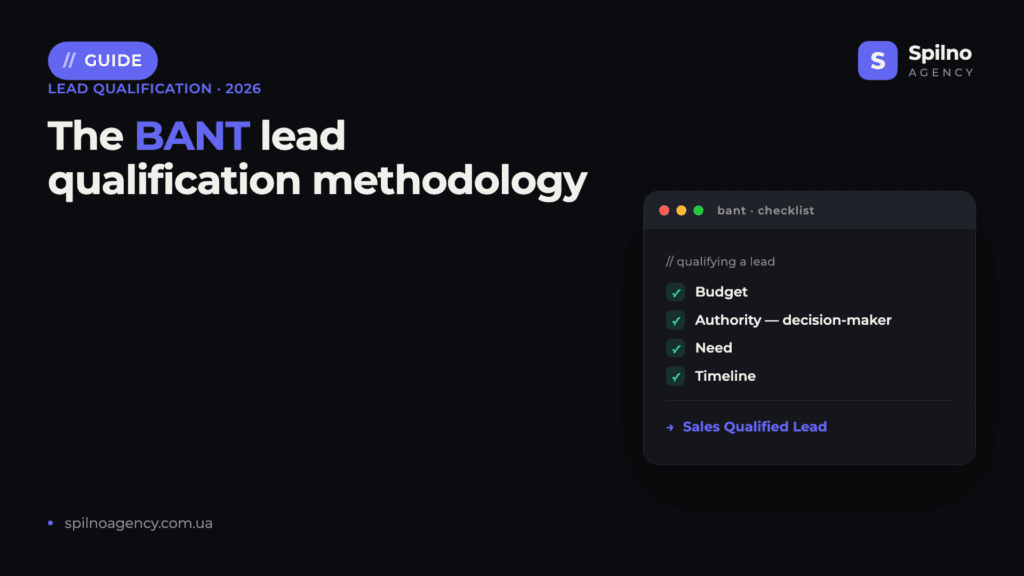
BANT is a classic lead qualification methodology first formalised at IBM in the 1950s. The name is an acronym for four criteria: Budget, Authority, Need and Timeline. If a prospect meets all four, they are treated as sales-ready and passed to the sales team. Below we break down what BANT stands for, which questions to ask for each criterion, the pros and cons of the method, and how it compares with MEDDIC and other modern frameworks.
What is the BANT methodology
BANT (Budget, Authority, Need, Timeline) is a lead qualification framework that helps a sales team answer one key question fast: is this contact worth your time right now. Instead of chasing everyone who submits a form, the rep checks a lead against four criteria and decides how ready they are to buy.
Lead qualification is a filtering process: out of the whole inbound flow, you keep the contacts most likely to turn into a sale. A lead that passes qualification is a Sales Qualified Lead (SQL) — ready for a conversation with a salesperson. BANT is one of the oldest and simplest ways to run that qualification.
The logic is straightforward: if a prospect has the money, makes the decision, has a real problem and wants to solve it soon — that is a high-quality lead. If even one criterion is weak, the deal will either stall or fall through. BANT gives the rep a structure to verify rather than guess.
What BANT stands for: the 4 qualification criteria
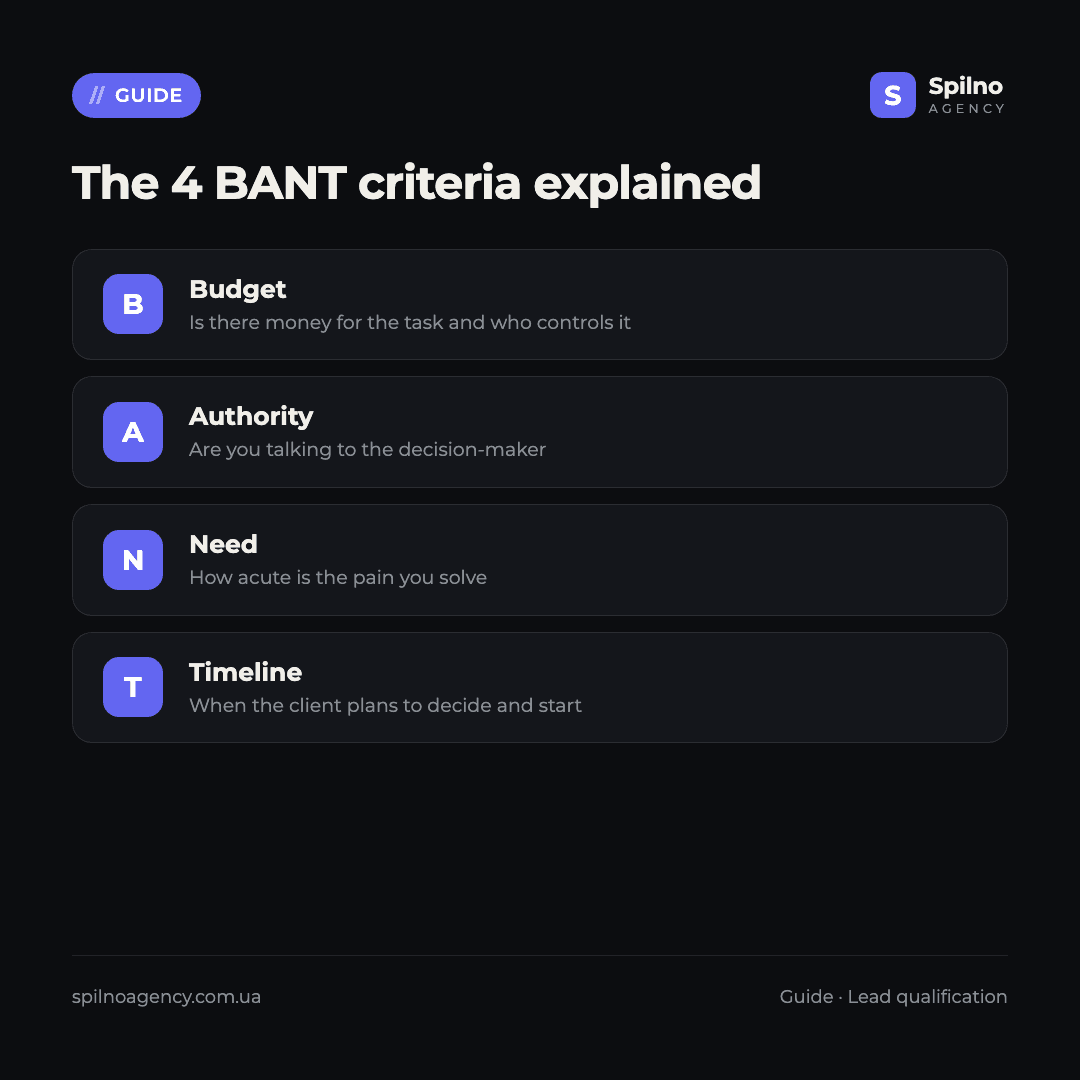
B — Budget
Whether the prospect is ready to spend what your solution costs. What matters is not just “is there money at all”, but whether a budget is allocated for this specific task and who controls it. Ideally the client’s price expectations match your real pricing; if they expect to pay a third of it, that is a mismatch signal.
A — Authority
Whether you are talking to the person who makes the buying decision. In B2B, a deal is often approved by several people: the initiator, the manager, the finance director. If your contact is not the decision-maker, you need to find out who else is involved and reach them. Otherwise you risk “selling” to someone who cannot say yes.
N — Need
How acute the problem your product solves really is. A need can be explicit (“our sales are dropping, we need advertising”) or hidden (“we are just looking at the market”). The rep’s job is to understand the real pain and connect it to the value of your solution. No need — no deal, however much budget and authority there is.
T — Timeline
When the client plans to decide and get started. “We needed it yesterday” and “maybe sometime next year” are two different leads with different priority. The timeline criterion helps you build a queue: hot deals with clear deadlines are worked first, while “someday” leads go into nurture. A firm deadline is often tied to goals set with the SMART system, which include a specific timeframe.
How BANT works in practice: example questions
Qualifying with BANT is not an interrogation against a checklist — it is a natural conversation in which the rep gently collects answers across four blocks. Here are examples you can adapt to your product:
- Budget: “What budget do you have in mind for this?”, “Have you already allocated funds, or are you still estimating?”, “What cooperation model are you expecting?”
- Authority: “Who else on your side will be involved in the decision?”, “How do purchases like this usually get approved with you?”, “Who should we loop in so nothing gets lost?”
- Need: “What problem do you want to solve first?”, “What is not working in your current approach?”, “What happens if you leave things as they are?”
- Timeline: “When are you planning to start?”, “Is there a deadline by which you need results?”, “What affects your decision timing?”
The order is not rigid. It is often more natural to start with Need — first understand the problem, then talk budget and timing. The key is to have answers across all four criteria by the end of the call.
A BANT qualification example
Imagine an online store owner reaches out to an agency. The rep runs the conversation and records:
- Budget ✓ — the client is ready to invest a set amount per month, expectations match the pricing.
- Authority ✓ — the contact is the owner and decides alone.
- Need ✓ — sales are stagnating, they need a steady flow of orders from advertising.
- Timeline ⚠ — they plan to start “in two or three months”, with no firm deadline.
Three of four criteria are closed — this is a quality lead, but with a fuzzy timeline. The right tactic: do not push for the deal head-on, put the lead into nurture, agree on the next touch, and come back closer to the start. That way the rep keeps the relationship and does not burn resources on premature closing.
Pros and cons of the BANT methodology
Advantages
- Simplicity. Four criteria are easy to remember and explain, even to a sales beginner.
- Speed. You can qualify in a single call and immediately understand a lead’s priority.
- Resource focus. The team does not scatter across hopeless enquiries and works with those genuinely ready to buy.
- Versatility. BANT fits most B2B sales with a short-to-medium deal cycle.
Disadvantages
- Seller-centric, not client-centric. BANT checks “is this lead good for us”, not “how do we help the client” — too little for modern complex sales.
- Budget first. Early on a client often does not yet know the exact budget, and blunt money questions can scare them off.
- Weak with inbound. For warm leads who came in through content, value and trust matter more than a rigid checklist.
- Ignores complex deals. When a committee of 5–7 people decides, four criteria are not enough — MEDDIC or GPCTBA are stronger here.
BANT vs MEDDIC, CHAMP and GPCTBA
BANT is not the only qualification methodology. Over the decades, frameworks emerged that handle complex deals more deeply. Here is how they relate:
| Methodology | Meaning / focus | Best fit |
|---|---|---|
| BANT | Budget, Authority, Need, Timeline | Simple to mid-size B2B deals, fast qualification |
| CHAMP | Challenges, Authority, Money, Prioritization — starts with the client’s problem | When understanding pain matters more than budget upfront |
| MEDDIC | Metrics, Economic buyer, Decision criteria, Decision process, Identify pain, Champion | Complex enterprise deals with a long cycle |
| GPCTBA/C&I | Goals, Plans, Challenges, Timeline, Budget, Authority + Consequences & Implications | Inbound sales, consultative approach |
The key difference: BANT and MEDDIC look at a deal from different angles. BANT quickly answers “is this worth your time”, while MEDDIC digs deep into how the decision is actually made in a large company. Many teams start with BANT as a primary filter and switch to MEDDIC for larger deals.
How to implement BANT in your sales team
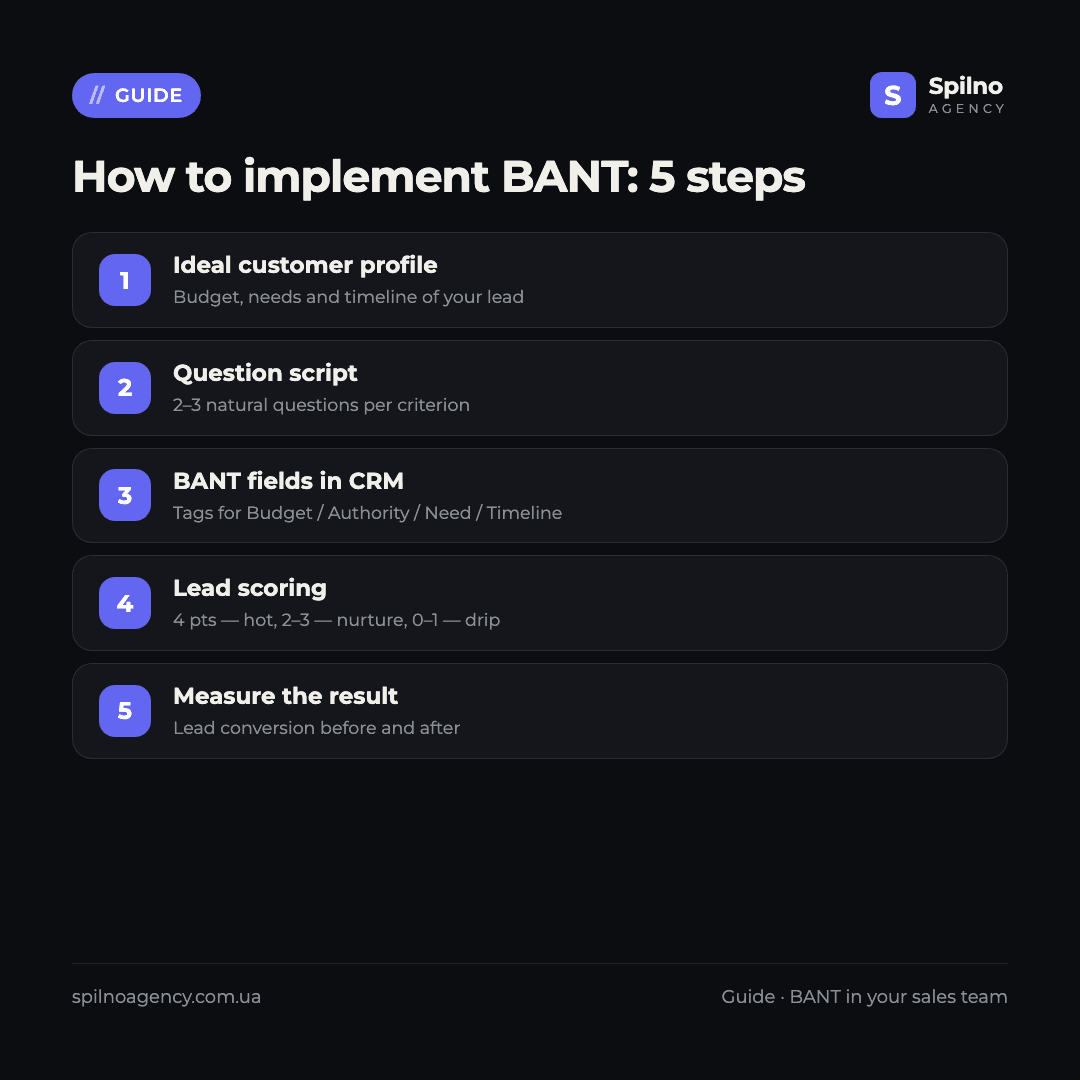
- Define your ideal customer profile. Determine the budget, needs and timelines typical of “your” lead — this is the basis for the criteria.
- Build a question script. Write 2–3 natural questions per BANT criterion that the rep weaves into the conversation.
- Add BANT fields to your CRM. So every lead is tagged on Budget/Authority/Need/Timeline — it becomes clear what is missing to move to sales.
- Introduce scoring. For example, each closed criterion is a point; 4 points = a hot lead to work, 2–3 = nurture, 0–1 = into a drip campaign.
- Measure the result. Compare lead conversion before and after implementation and adjust the criteria. We show how to gather this data in our guide on the digital marketing fundamentals.
BANT works best when it is embedded in the wider marketing and sales system — from traffic acquisition to analytics. Many European businesses use it as a first filter and then layer richer methodologies on top for high-value accounts.
Frequently asked questions about the BANT methodology
What does the acronym BANT stand for?
BANT is an acronym for four lead qualification criteria: Budget, Authority (the power to make the decision), Need (a genuine need for the product) and Timeline (the decision timeframe). A lead that meets all four is considered sales-ready.
Who invented the BANT methodology?
The methodology was formalised at IBM back in the 1950s–1960s as an internal standard for qualifying prospects. Since then BANT has become one of the most widespread techniques in B2B sales worldwide.
How is BANT different from MEDDIC?
BANT is a quick four-criteria filter for initial qualification. MEDDIC is a deeper six-element methodology (Metrics, Economic buyer, Decision criteria, Decision process, Identify pain, Champion) that maps how a decision is made in detail. BANT fits simple deals; MEDDIC fits complex enterprise sales.
Is BANT still relevant in 2026?
Yes, with a caveat. BANT is still useful as a fast lead-prioritisation tool, especially in outbound sales. However, for inbound and complex deals it is often complemented by client-centric methods (CHAMP, GPCTBA) or replaced with MEDDIC. Many teams use BANT as a baseline filter rather than the only criterion.
Which BANT criterion should you start with?
Although Budget comes first in the acronym, modern practice usually starts the conversation with Need — first understand the client’s problem, then move to budget and timing. Blunt money questions upfront can scare a lead off. The key is to collect answers across all four criteria by the end of the dialogue.
What is a Sales Qualified Lead (SQL)?
A Sales Qualified Lead (SQL) is a lead that has passed qualification and is ready for a conversation with a sales rep. Under BANT it is a lead that meets all four criteria. By contrast, an MQL (Marketing Qualified Lead) is a contact who has shown interest but has not yet confirmed readiness to buy.
Can BANT qualification be automated?
Partly. The Budget/Authority/Need/Timeline fields and scoring are easy to set up in a CRM, and some data can be collected at the enquiry stage via a quiz or form. However, final qualification — especially assessing need and authority — is better left to a rep, because it requires a live conversation.
Want a system that brings not just form submissions but qualified, purchase-ready leads? Spilno Agency sets up traffic acquisition, analytics and the funnel so your sales team works with hot contacts. Leave a request — we start with a free consultation.

Read also
Call to Action (CTA): What It Is and How to Write One That Converts in 2026
A CTA (call to action) tells a user exactly what to do next. We break down CTA types,…
Google Data Studio (Looker Studio): What It Is and What It Can Do
Looker Studio (formerly Google Data Studio) is Google's free BI tool. We break down connectors, dashboards, and use…
Instagram: What Are Reels and How to Use Them
Reels are short vertical videos on Instagram that the algorithm shows even to non-followers. Technical specs, how Reels…