Translation Bureau Google Ads Case Study: From 0 Leads to Full ROI

Case study: a translation bureau received 0 leads from two consecutive PPC agencies. Spilno Agency audited the setup, identified the root cause in the website — not the ads — launched a new landing page, and within 3 months cut CPL from UAH 1,387 to UAH 504, achieving full Google Ads ROI in month three.
About the Client: Who and What
The client is a Ukrainian translation bureau offering document translation, notarised translations, and technical and legal localisation services. Before approaching Spilno Agency, they had already worked with two separate PPC agencies running Google Ads. Both engagements produced the same result: zero leads — not “few leads”, but literally zero enquiries from either agency.
Based on our experience managing Google Ads for service businesses in Ukraine, a well-managed search campaign for translation services should achieve a CPL of UAH 300–500. That benchmark became our target. The first objective was understanding why two agencies had failed to generate even one enquiry.
Audit: Why Zero Leads with Active Advertising
We audited the complete funnel: ad accounts, bidding strategies, ad copy, keyword lists, negative keywords, and landing pages. The ad setup was technically reasonable — standard strategies that work for most clients. Yet zero leads. Not even spam enquiries — which are practically unavoidable in the translation niche where any contact form attracts some volume of irrelevant submissions.
The absence of even spam was a critical signal: the problem was not the ads — it was the website.
Issues found during the site audit:
- Forms with 5–6 required fields. First name, last name, email, phone, source language, target language — too much friction for a first-time visitor who simply wants a price estimate or to leave a contact.
- 5–6 simultaneous communication channels. Phone, email, Viber, Telegram, online form, live chat — instead of reducing effort, this created decision paralysis. Users didn’t know which channel to choose.
- No single clear CTA. Everything competed for attention. There was no one obvious next step.
- Poor mobile experience. The majority of search traffic arrives on smartphones, and the site rendered incorrectly on mobile devices.
Conclusion: the website was repelling potential clients before they could submit an enquiry. The ads were driving traffic — the site was failing to convert it.
Microsoft Clarity: How We Visualised User Behaviour on the Site
Identifying that “the problem is the website” is a hypothesis. Proving it — and pinpointing the exact drop-off points — required data. We used Microsoft Clarity, a free session recording and heatmap tool, to watch real users navigate the site.
We installed Clarity on the client’s site and within a few days had recordings of real user sessions. Here is what the data revealed:
- Dead clicks on the form. Clarity captured widespread dead clicks — users were clicking on form fields but abandoning the form after completing 2–3 fields. Most left the page without submitting.
- Rage clicks on the Submit button. A portion of users clicked “Send” multiple times in frustration — the form was not providing clear feedback after a successful submission.
- Scroll depth on mobile did not reach the form. On smartphones, most users left the page without ever seeing the form — it was buried below a large, heavy hero section.
- Click heatmap. The highest click density was not on the main contact form but on the messenger icons in the header — Viber and Telegram. These contacts were not tracked as conversions, so every enquiry via these channels was invisible to the campaigns.
The Clarity data confirmed the audit findings: the site was technically receiving traffic, but the conversion path was broken at the UX level. These insights became the basis for two decisions — simplifying the existing form and building a new dedicated landing page.
We also connected Clarity to the new landing page from day one. The behavioural shift was immediate: scroll depth increased significantly, rage clicks dropped to zero, and the average time from page load to first form interaction fell from 45 seconds to 12.
Google Ads Campaign Structure for a Translation Agency
The translation services niche differs from typical B2C businesses. The audience searches for a specific service at a specific moment of need — which means a search campaign with phrase and exact match keywords consistently outperforms any awareness-driven alternative.
The keyword clusters we used:
- Service + city — “document translation Kyiv”, “notarised translation Kharkiv”
- Document type — “passport translation”, “diploma translation”, “medical document translation”
- Urgency — “urgent translation”, “same-day translation”, “translation in 2 hours”
- Price intent — “document translation cost”, “how much does translation cost”
- Order intent — “order translation”, “order notarised translation”
Negative keywords blocked irrelevant traffic: “free”, “DIY translation”, “online translator”, “Google Translate”, “translation job vacancies”.
Bidding strategy: we started with manual CPC for full cost control, then switched to Target CPA once the campaign accumulated 30+ conversions per month.
First Launch: Simplifying the Forms
The first phase: reduce the contact form to 2–3 required fields (name + contact detail + translation type) and consolidate communication to a single primary channel.
We ran the same campaign configuration as the previous agencies — deliberately, to isolate the effect of the website change on conversion.
First launch results:
- Leads appeared immediately — confirming that the site was the bottleneck, not the ads.
- Initial CPL: UAH 1,400
- After one week of ad copy optimisation: UAH 1,100
UAH 1,100 is still more than twice the target benchmark for translation services. But the channel was generating leads. The next question: was this the ceiling of the old site — or could performance improve further?
Hypothesis: New Landing Page Instead of the Old Site
Even after form simplification, the website remained problematic: complex structure, heavyweight design, and poor mobile rendering. Our hypothesis: a purpose-built, minimal landing page would improve conversion 3–4×.
Rather than commissioning a full site rebuild — expensive and slow — we built a dedicated MVP landing page on the Weblium website builder:
- Development cost: $300
- Build time: 7 days
- Single 3-field form, one CTA (“Request a Quote”), fully mobile-optimised
- Pricing table and client testimonials to build trust
Second Launch: Testing the New Landing Page
We redirected the existing campaign to the new landing page with the budget unchanged — a clean A/B-style test.
CPL trend after switching to the new landing page:
- Week 1: CPL UAH 600 (−57% vs. the previous result)
- Week 2: CPL <UAH 500
- After one month: CPL <UAH 400
The hypothesis was confirmed in full. The new landing page converted the same traffic 3–4× more effectively — at identical ad spend.
3-Month Google Ads Results
| Metric | Month 1 | Month 2 | Month 3 |
| Revenue | UAH 25,023 | UAH 33,469 | UAH 37,898 |
| Ad spend (incl. VAT) | UAH 38,834 | UAH 30,815 | UAH 23,762 |
| Number of orders | 28 | 30 | 49 |
| CPL (cost per order) | UAH 1,387 | UAH 1,027 | UAH 504 |
| Average order value | UAH 894 | UAH 1,116 | UAH 772 |
Key takeaways from the 3-month data:
- Orders grew +75% month-on-month (28 → 49)
- CPL dropped −64% — from UAH 1,387 to UAH 504
- Ad spend fell −39% while the number of leads grew
- In month 3, Google Ads fully paid for itself: revenue exceeded the combined cost of advertising and agency fees
How to Calculate Google Ads ROI for a Translation Agency
For service businesses like translation agencies, a robust ROI framework looks like this:
- Establish your average order value — in our case approximately UAH 800–1,100 per transaction.
- Calculate your margin — for example, 40% margin = UAH 320–440 net profit per order.
- Compare with CPL — if CPL = UAH 504 and net profit = UAH 400, the first order doesn’t yet break even on its own.
- Factor in client LTV — a returning translation client may place 4–10 orders per year. This changes the entire economics of the channel.
This is precisely why full ROI was achieved in month three: clients acquired in months one and two became repeat customers, and cumulative revenue exceeded total spend across all three months.
Key Lessons from This Case Study
- Zero leads almost always indicate a site problem, not an ads problem. If campaigns are technically sound but generate no enquiries, audit the landing page first.
- Short forms convert significantly better. 2–3 fields vs 5–6 can produce a 3–5× difference in conversion rate.
- One CTA beats five contact channels. More options create decision paralysis; a single clear path reduces friction and increases submissions.
- A $300 MVP landing page can solve what months of agency work could not. Fast hypothesis testing costs far less than prolonged optimisation on a broken site.
- The CPL benchmark for translation services is UAH 300–500. If your CPL is higher, fix the conversion layer before increasing ad budget.
- LTV matters more than first-order CPL. Translation agencies depend on repeat clients — evaluate advertising performance over a 3–6 month horizon.
Launch Checklist: Google Ads for a Translation Bureau
- Audit all forms — no more than 3 required fields for a first enquiry.
- Choose one primary contact channel (form or messenger).
- Ensure the site or landing page renders correctly on mobile.
- Set up conversion tracking before launching any campaigns.
- Start with a test budget of $300–500/month on search campaigns.
- Add negative keywords: “free”, “online translator”, “job vacancies”, “translate myself”.
- If CPL exceeds UAH 700 after two weeks — review landing page conversion, not bids.
- If the main site is outdated — build a dedicated MVP landing page (Weblium, Tilda, Readymag).
- Track orders, revenue, and repeat orders separately — CPL alone is insufficient.
- Once CPL ≤ UAH 500 — scale the budget by 20–30% every two weeks.
What’s Next: Scaling Options
Once Google Ads demonstrates positive ROI, a translation bureau has three strategic growth paths:
- Scale the budget. Increasing ad spend by 30–50% delivers proportional order growth at a stable CPL.
- Expand channels. Adding organic SEO, remarketing, and Meta Ads to capture audiences who are not yet actively searching.
- Increase average order value. Upselling notarised certification, express translations, or post-editing services to the existing client base.
Request for marketing consultation
Frequently Asked Questions
What is a realistic CPL for a translation bureau using Google Ads?
Based on our experience and market benchmarks, a well-optimised Google Ads search campaign for translation services in Ukraine should achieve a cost per lead of UAH 300–500. If your CPL is higher, the primary cause is almost always landing page conversion rate — not the ad settings.
Why did previous agencies fail to generate any leads?
The issue was the website, not the ad configuration. Forms with 5–6 required fields and five simultaneous contact channels created excessive friction. Even a perfectly optimised campaign cannot compensate for a landing page that fails to convert traffic into enquiries.
How long does it take to see the first results from Google Ads?
With a properly configured campaign, the first enquiries typically arrive within 3–7 days of launch. An optimal CPL is usually achieved within 4–8 weeks, once the Google algorithm has accumulated sufficient conversion data to optimise effectively.
Does a translation bureau need a new website to run Google Ads?
A full site rebuild is not required. A separate, focused landing page built on a website builder (Weblium, Tilda, etc.) is usually sufficient. Cost: $200–500. Build time: 5–10 days. This approach lets you validate the hypothesis quickly without a major investment.
How can you control lead quality in the translation niche?
In the translation industry, some enquiries will be spam or job applications. To reduce these: add negative keywords (“vacancies”, “free”, “online translator”), include a qualifying question in the form (e.g. “Which language pair do you need?”), and configure conversion tracking segmented by enquiry type.
What is the minimum budget to start Google Ads for a translation bureau?
The recommended starting budget is $300–500 USD per month (approximately UAH 12,000–20,000). This provides enough data to reach the target CPL within 4–8 weeks. A smaller budget significantly extends the time to result and may not generate enough conversions for algorithmic optimisation to function effectively.

Read also
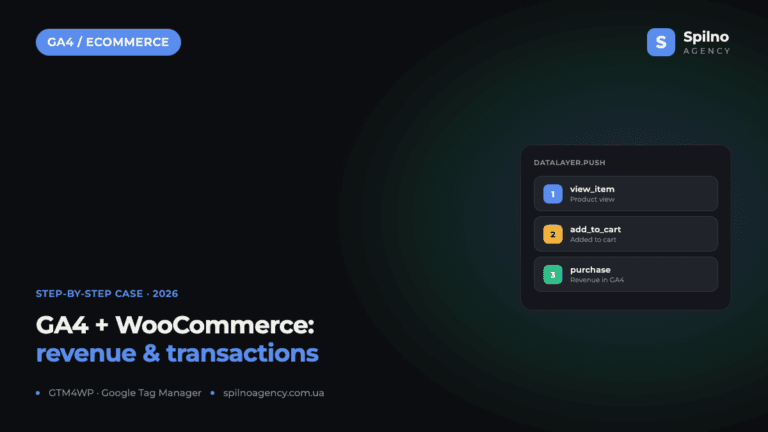
How to Track Revenue, Transactions and Purchases in Google Analytics 4 from WordPress WooCommerce
Introduction WooCommerce store owners are often convinced that Google Analytics 4 already shows them revenue, transaction counts and…
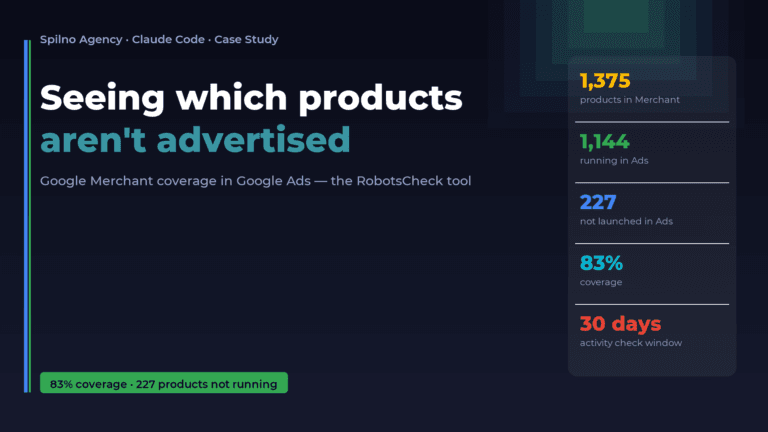
How Claude Helps Spilno Agency: Google Merchant Coverage in Google Ads
An online store lists 1,375 products in Google Merchant — but how many of them are actually running…
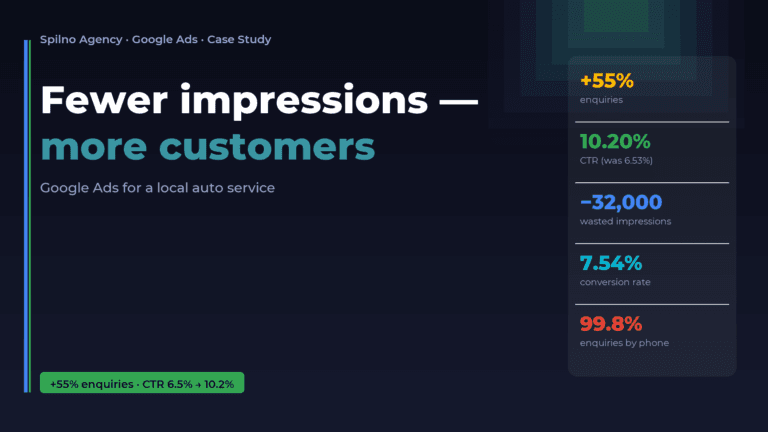
Google Ads for a Local Auto Service: Fewer Impressions, More Customers (Case Study)
A local auto service was spending its ad budget on tens of thousands of cheap impressions that barely…