Case Study: Scaling Sales for a Women’s Footwear Brand with Meta Ads — 276 Purchases, ROAS 5.35

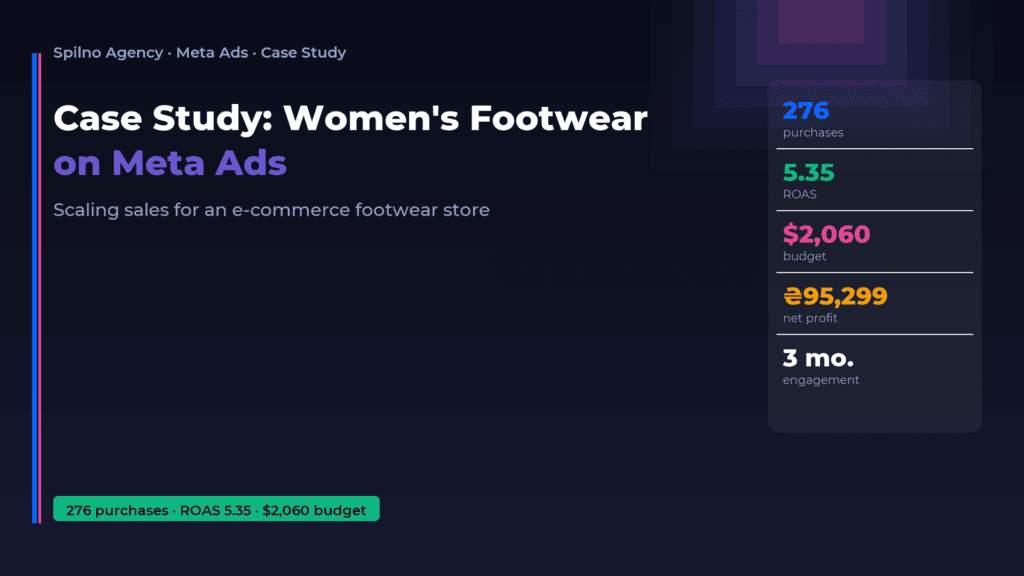
Our client is a mid-range women’s footwear retailer with an offline store network and its own e-commerce shop. Showroom sales stayed stable, but the online channel underperformed: ads had run before, but without a systematic approach — one-off launches, limited audience testing, and a handful of near-identical creatives. We completely rebuilt the Meta Ads logic: a full account audit, a regular audience-and-creative testing system, and a predictable scaling model. Over three months, this delivered 276 purchases on a $2,060 budget at a ROAS of 5.35. Here’s a step-by-step look at how we turned unstable one-off launches into a scalable system.
About the client
The client is a mid-range women’s footwear retailer with both a physical store and its own online shop. Despite stable offline sales, the online channel wasn’t delivering the results the business needed. Meta Ads had run before, but campaigns performed inconsistently and scaling sales proved difficult. The main goal of our engagement was to build a systematic sales model through Meta Ads and grow the share of online orders.
The problem the client came with
At the start of our engagement, the ad account already had a launch history, but the system had no clear strategy behind it. Key issues:
- campaigns launched one-off, without systematic optimisation;
- audience testing was limited;
- only a small number of near-identical creatives were used;
- it was unclear which audiences performed best;
- decisions were made without comprehensive results analysis;
- scaling ad campaigns was unstable.
As a result, advertising wasn’t creating a predictable sales system — it was running as a series of disconnected short-term launches.
The client’s request
The main goal was to increase online sales through Meta Ads and build an advertising system that could be scaled. The client’s expectations:
- increase the number of purchases;
- find audiences that consistently convert into sales;
- understand which creatives perform best;
- build a clear testing and optimisation system;
- ensure steady, sustainable growth in results.
Our strategy
After auditing the ad account, it became clear that the core issue wasn’t individual settings — it was the lack of a systematic approach to advertising. So we rebuilt the entire logic from scratch.
Key changes
- ran a comprehensive audit of previous launches;
- analysed every ad campaign, audience, and creative;
- built a regular testing system;
- identified the most effective audience segments;
- tested different ad material formats;
- developed a proprietary creative approach that consistently delivered strong results.
What we did
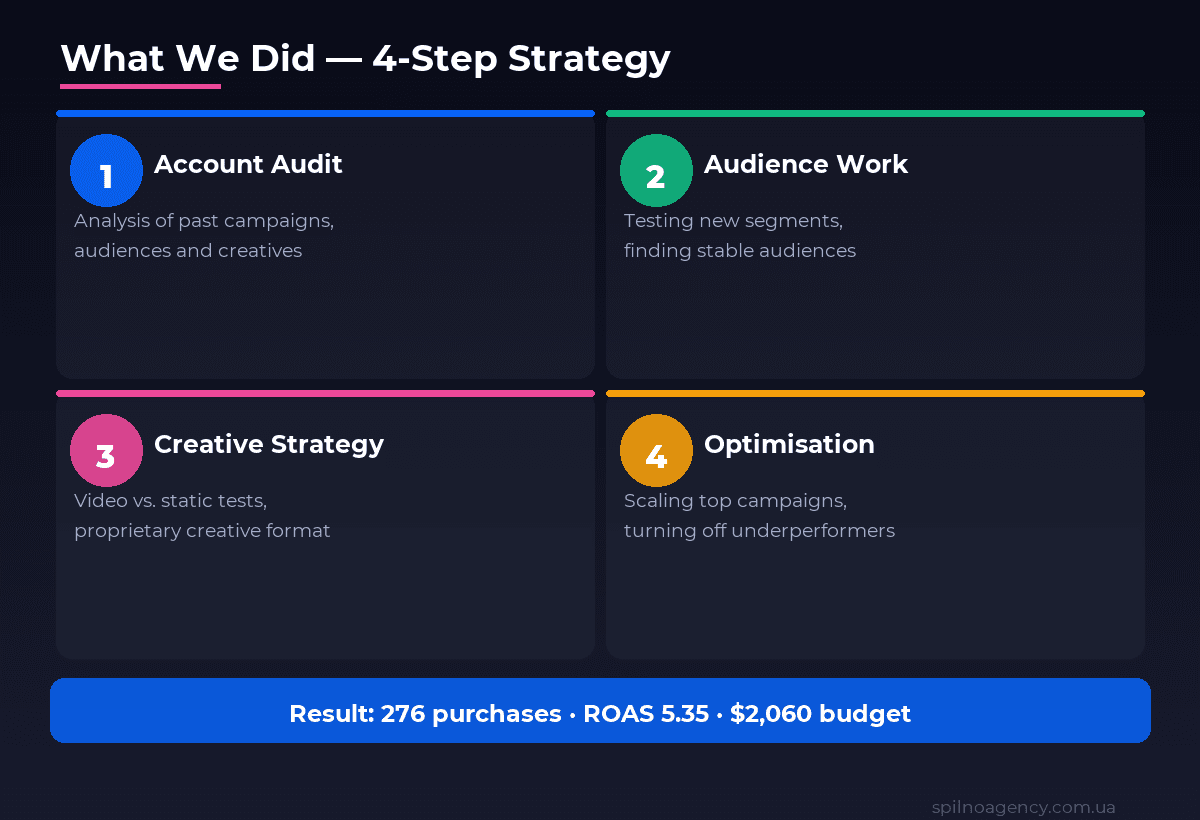
After an in-depth analysis of the ad system, the work was split into four workstreams.
1. Ad account audit
- analysis of previous campaigns;
- audience performance analysis;
- ad creative analysis;
- campaign structure analysis;
- identifying the strengths and weaknesses of the ad system.
2. Audience work
- tested new segments;
- identified audiences that consistently delivered sales;
- optimised the campaign structure based on testing results.
3. Creative strategy
We paid particular attention to testing ad materials, trialling different:
- video formats;
- static creatives;
- product presentation styles;
- ad offers;
- product demonstration scenarios.
As a result, we developed a proprietary creative format that consistently showed strong performance.
4. Ad system optimisation
Throughout the engagement, campaigns were regularly optimised based on the data collected. This made it possible to:
- scale the best-performing campaigns;
- turn off underperforming ad sets;
- continuously improve sales performance.
Comment from a Spilno Agency expert

Results
Over the engagement period (December 2025 – February 2026, three months), we delivered:
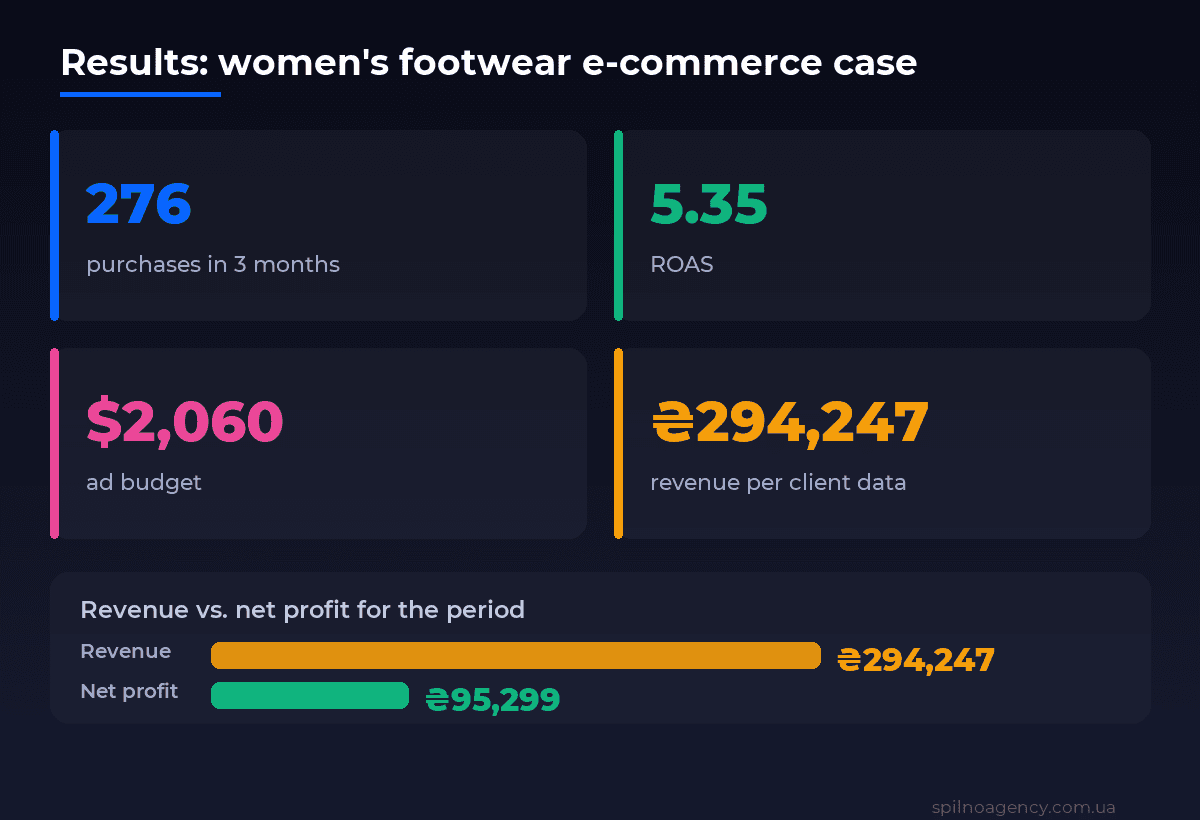
| Metric | Value |
|---|---|
| Purchases | 276 |
| Ad budget | $2,060 |
| ROAS | 5.35 |
| Revenue (per client data) | UAH 294,247 |
| Profit | UAH 176,548 |
| Net profit | UAH 95,299 |
| Period | December 2025 – February 2026 |
*In the client’s CRM, revenue and profit can’t be clearly split by channel. Per GA4 data, Meta Ads drives 55% of the client’s revenue.
Key improvements
Over the course of the engagement, we managed to:
- build a systematic model for running ad campaigns;
- find audiences that consistently delivered sales;
- develop an effective testing system;
- identify the creative format that worked best for this specific business;
- ensure stable scaling of ad campaigns;
- grow the share of online sales.
Conclusion
In this project, the key success factor wasn’t a bigger ad budget — it was building systematic work with data. A comprehensive audit, regular testing of audiences and creatives, and continuous campaign optimisation made it possible to build a predictable online sales system that can keep scaling further.
If your e-commerce business is dealing with unstable sales and one-off ad launches instead of a system — get in touch, and we’ll review your ad account and put together a plan to build a scalable sales system.


Read also
How to Track Revenue, Transactions and Purchases in Google Analytics 4 from WordPress WooCommerce
Introduction WooCommerce store owners are often convinced that Google Analytics 4 already shows them revenue, transaction counts and…
How Claude Helps Spilno Agency: Google Merchant Coverage in Google Ads
An online store lists 1,375 products in Google Merchant — but how many of them are actually running…
Google Ads for a Local Auto Service: Fewer Impressions, More Customers (Case Study)
A local auto service was spending its ad budget on tens of thousands of cheap impressions that barely…