SMART Goals: The Complete Guide for European Businesses 2026

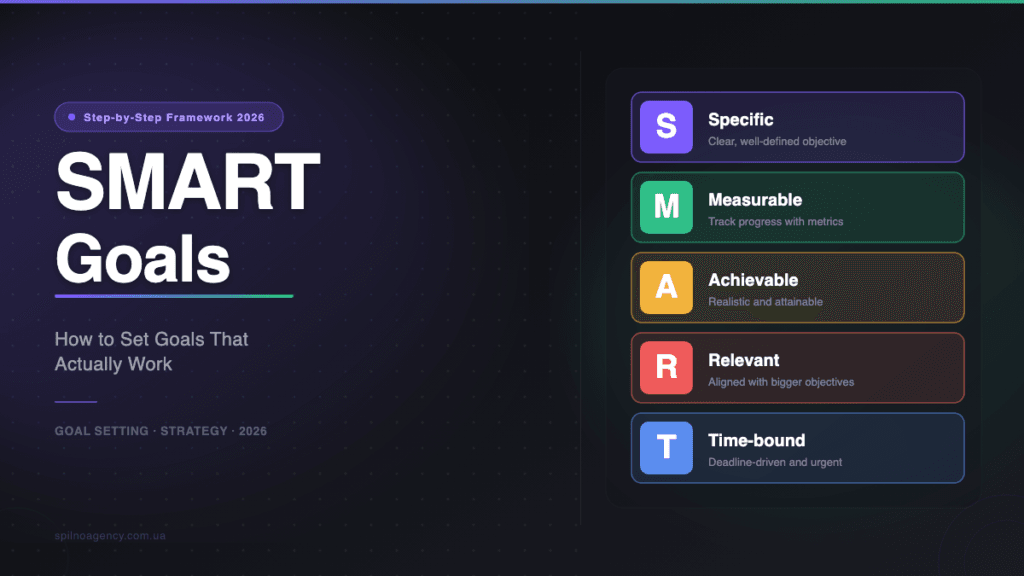
SMART goals transform vague intentions into structured, trackable objectives — giving marketing teams, freelancers, and business owners a clear path from idea to measurable result. The SMART framework defines goals that are Specific, Measurable, Achievable, Relevant, and Time-bound, making it the most widely adopted goal-setting methodology in business and digital marketing. This guide breaks down every component with real-world digital marketing examples and practical steps you can apply today.
What are SMART goals?
A SMART goal is a goal defined through five precise criteria — Specific, Measurable, Achievable, Relevant, and Time-bound — that together turn a broad ambition into an actionable plan. The concept was introduced by George T. Doran in his 1981 paper “There’s a S.M.A.R.T. Way to Write Management’s Goals and Objectives,” published in Management Review. Doran argued that most organisational goals fail not because of poor execution, but because they are poorly defined from the start.
The SMART framework has since become the global standard for goal-setting in business management, HR, project management, and digital marketing. Decades after its introduction, the method remains highly relevant — particularly in 2026, when marketing budgets across Europe face greater scrutiny and every euro spent on ads, SEO, or content needs to justify its return. Vague goals like “grow our Instagram” or “get more leads” cannot be tracked, cannot be budgeted, and cannot be evaluated. SMART goals solve all three problems simultaneously.
In digital marketing specifically, the SMART goal framework provides the connective tissue between high-level business strategy and day-to-day campaign decisions. When a performance marketing team agrees on a SMART objective before launching a Google Ads campaign, everyone — the account manager, the client, the creative team — understands what success looks like. That shared clarity reduces conflict, speeds up decision-making, and dramatically improves the likelihood of hitting targets.
Decoding SMART — what each letter means
S — Specific
A specific goal answers the five W’s: What do you want to accomplish? Who is involved? Where will it happen? Which resources or constraints apply? Why does this goal matter? Without specificity, a goal is just a wish. The more precisely you define a goal, the easier it is to build a plan around it, assign responsibility, and communicate expectations to stakeholders.
Specificity also forces strategic thinking. When you have to articulate exactly what you want to achieve, you are compelled to clarify assumptions, expose ambiguities, and align on definitions — before work begins rather than after it ends.
✅ Good example: “Increase the number of qualified demo requests from our Google Ads Search campaign targeting B2B SaaS decision-makers in Western Europe by improving ad copy and landing page conversion rate.”
❌ Weak example: “Get more leads from Google Ads.” — No channel specifics, no audience, no mechanism for improvement.
M — Measurable
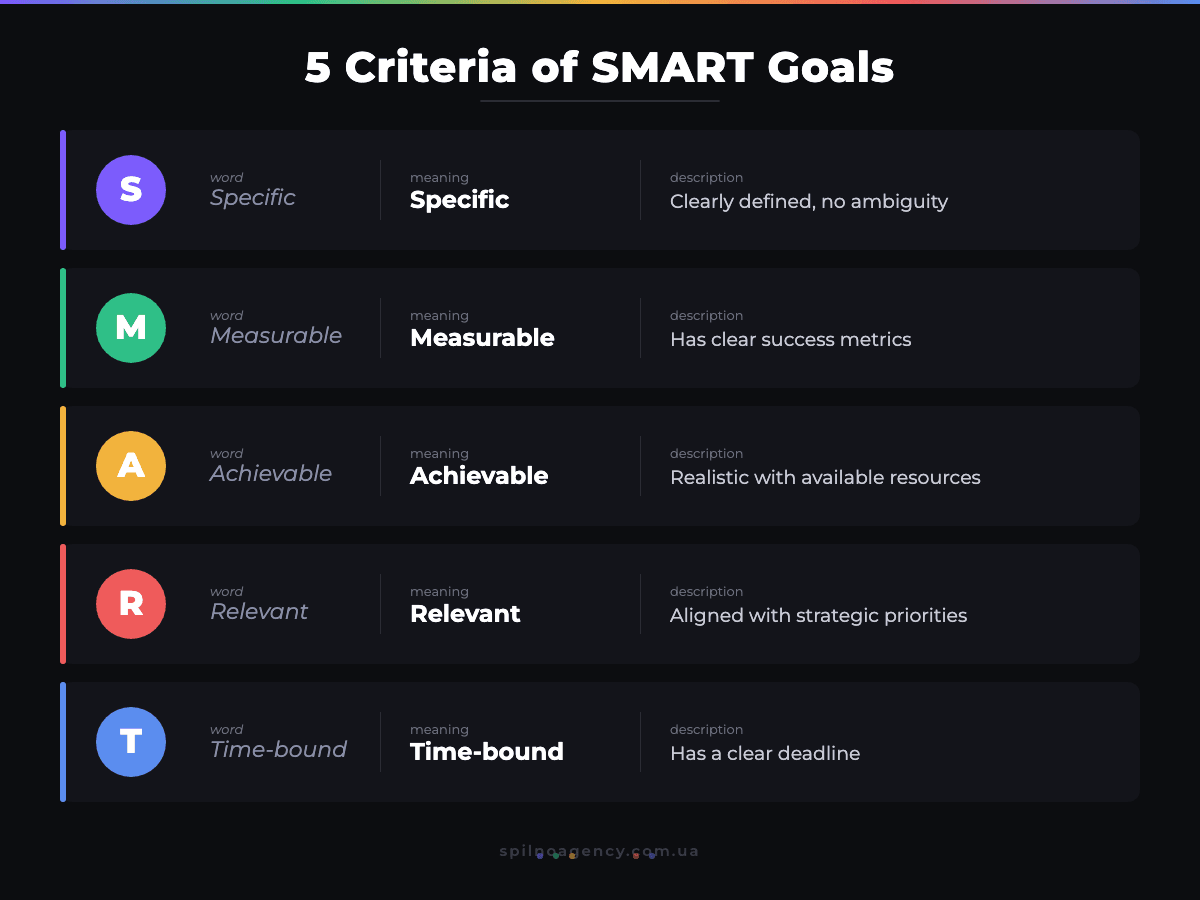
A measurable goal has a concrete metric attached — a number, percentage, ratio, or clearly defined outcome that can be tracked over time. If you cannot measure a goal, you cannot manage it. Measurement transforms a goal from a subjective statement into an objective record of progress.
In digital marketing, measurability is relatively straightforward because platforms like Google Ads, GA4, and Meta Ads Manager provide detailed, real-time data. The challenge is choosing the right metric — one that genuinely reflects business value, not just activity. Vanity metrics (page views, follower counts) are measurable but often not meaningful. Lead quality, conversion rate, cost per acquisition (CPA), and return on ad spend (ROAS) are far more informative for most European businesses running paid campaigns.
✅ Good example: “Reduce the cost per lead (CPL) in our Google Ads Search campaign from €45 to €30 by the end of Q3.”
❌ Weak example: “Improve Google Ads performance.” — No metric, no baseline, no target value.
A — Achievable
An achievable (also called “attainable”) goal is ambitious but realistic, given your current resources, constraints, and market conditions. Setting goals that are too easy produces complacency; setting goals that are impossible produces demoralisation and cynicism. The sweet spot is a goal that requires genuine effort and focused execution, but is within reach if that effort is applied.
Achievability is context-dependent and should be benchmarked against industry data, historical performance, and available budget. A new e-commerce brand targeting a 5× ROAS in their first month on Google Shopping is setting an unachievable goal. A brand with 12 months of performance data, optimised product feeds, and a well-structured campaign might realistically target a 4× ROAS improvement after a systematic Performance Max restructure.
✅ Good example: “Increase organic search traffic to the blog by 35% over six months by publishing two long-form, keyword-targeted articles per week and fixing 40+ identified technical SEO issues.”
❌ Weak example: “Triple our organic traffic in one month.” — Inconsistent with how search engines index and rank content; not achievable in the stated timeframe.
R — Relevant
A relevant goal is aligned with broader business priorities and the direction the organisation is heading. It answers the question: does achieving this goal actually matter to the business right now? A goal can be specific, measurable, and achievable — and still be irrelevant if it does not connect to the company’s current strategy.
Relevance is especially important in marketing, where teams can easily get drawn into optimising metrics that are disconnected from revenue. Growing social media followers is measurable and achievable, but if the business model depends on B2B enterprise deals closed through referrals and outbound sales, a follower-growth goal is irrelevant to this quarter’s priorities. Relevant SMART objectives keep marketing effort focused on activities that genuinely move business metrics.
✅ Good example: “Launch a LinkedIn Ads lead generation campaign targeting HR directors at companies with 100–500 employees across Europe, aligned with our new HR software product launch in Q2.”
❌ Weak example: “Grow our TikTok following to 10,000 during Q2” — for a B2B HR software company, this channel/goal pairing lacks strategic relevance.
T — Time-bound
A time-bound goal has a defined deadline or timeframe. Without a deadline, goals drift indefinitely. The urgency created by a time constraint forces prioritisation, triggers planning, and provides a natural evaluation point. Time-bound goals also enable retrospectives: after the deadline, you can assess what worked, what did not, and what to adjust in the next cycle.
For digital marketing campaigns, timeframes naturally align with budget cycles, product launches, seasonal peaks, or reporting periods. Monthly, quarterly, and annual SMART goals serve different planning horizons and should all coexist within a well-structured marketing plan. Short-term goals (one to four weeks) are ideal for campaign tests and iterative optimisation; medium-term goals (one to three months) suit channel-level strategies; annual goals drive brand-level positioning and SEO roadmaps.
✅ Good example: “Achieve a 3× ROAS on the Google Shopping campaign by 31 August, allowing six weeks for performance data collection and bid strategy optimisation.”
❌ Weak example: “Eventually improve our ROAS on Google Shopping.” — No deadline, no urgency, no accountability.
Step-by-step guide to setting SMART goals
- Start with the business outcome, not the marketing activity. Before writing a SMART goal, identify what the business actually needs: more revenue, lower customer acquisition cost, improved retention, or faster market penetration. Every SMART marketing goal should trace back to a business outcome. If you cannot draw a straight line from your proposed goal to a business metric, reconsider the goal.
- Define your baseline. You cannot set a meaningful target without knowing where you currently stand. Pull data from GA4, Google Ads, your CRM, or your SEO tool of choice to establish the baseline metric. If you want to reduce CPL from €45 to €30, you need evidence that €45 is your current CPL — not an estimate, but an actual figure from the last 30 to 90 days of campaign data.
- Write the goal in one clear sentence using the SMART criteria. Draft a sentence that naturally incorporates all five elements. A useful template: “We will [achieve X metric / move from Y to Z] by [deadline] through [specific actions/channels/resources].” Test each element: Is it specific enough? Is it measurable? Is it achievable given your resources? Is it relevant to the current business priority? Does it have a clear deadline?
- Assign ownership and define supporting milestones. A SMART goal without a named owner is rarely completed. Assign a responsible person or team, then break the goal into monthly or weekly milestones. Milestones create accountability checkpoints and allow you to catch underperformance early — before the deadline arrives and the opportunity to course-correct has passed.
- Schedule review cadences and document everything. Build a recurring review — weekly for short campaigns, bi-weekly for monthly goals, monthly for quarterly goals — where the team examines actual vs. target metrics. Document the goal, the baseline, the milestones, and every review outcome. This documentation becomes the institutional knowledge that makes future goal-setting faster and more accurate.
SMART goals in digital marketing
Google Ads campaigns
Performance marketing is where the SMART framework delivers its most immediate value, because every metric — impressions, clicks, conversions, CPA, ROAS — is available in real time. A well-constructed SMART goal for a Google Ads account might read: “Increase the conversion rate on the Search campaign targeting [product category] keywords from 2.1% to 3.5% over the next eight weeks by A/B testing five new responsive search ad variants and updating landing page CTAs.”
This goal is specific (Search campaign, defined keyword set), measurable (conversion rate from 2.1% to 3.5%), achievable (a 67% uplift is ambitious but attainable through systematic testing), relevant (conversion rate directly impacts CPA and profitability), and time-bound (eight weeks). The named interventions — ad variant testing and landing page updates — give the team a clear action plan, not just a number to chase.
SEO and organic growth
SEO goals are inherently longer-horizon than paid media goals, which makes the time-bound element especially important for keeping teams motivated and accountable. A realistic SMART goal for an SEO project might be: “Move the top 10 target keywords from an average position of 18 to an average position of 9 within six months, by publishing 24 optimised long-form articles, acquiring 15 editorial backlinks, and resolving all critical Core Web Vitals issues.”
Notice how this goal avoids the common trap of targeting traffic volume directly — a metric Google controls — in favour of ranking position, which is more directly influenced by the SEO team’s actions. Traffic will follow improved rankings, but rankings are the more actionable leading indicator. Tying the goal to specific deliverables (24 articles, 15 backlinks, CWV fixes) makes it achievable rather than aspirational.
Social media and SMM
Social media goals are frequently the worst-formulated SMART objectives in digital marketing, precisely because vanity metrics (followers, likes, reach) are easy to measure but often disconnected from business value. A more rigorous SMART SMM goal: “Generate 120 qualified leads through LinkedIn Lead Gen Forms over 90 days at a cost per lead below €25, targeting marketing directors at mid-market e-commerce companies across Europe.”
This goal anchors social media activity to a revenue-relevant outcome (qualified leads, defined CPL ceiling) rather than engagement metrics. It is also audience-specific, which guides creative strategy, bidding approach, and content tone in ways that a follower-growth goal never could.
Email marketing
Email marketing SMART goals often focus on engagement or revenue metrics: “Increase the average open rate of our weekly newsletter from 19% to 26% over 12 weeks by implementing A/B testing on subject lines, segmenting the list into three engagement tiers, and cleaning inactive subscribers older than 180 days.” Each element is precisely defined, the actions are concrete, and the timeframe is realistic for email list optimisation cycles.
SMART goals for personal development and teams
Individual professional growth
The SMART framework applies equally well to personal career development as it does to campaign management. A digital marketing specialist might set the following personal SMART goal: “Complete Google Ads certification and Measurement certification within 60 days, dedicating 90 minutes each weekday to study, to qualify for a senior account manager role in Q3.” This goal is motivating because it has a clear endpoint, a daily action plan, and a defined reason — the career progression tie-in provides the “relevant” element.
For team leads and managers, SMART objectives work well for skill development planning, performance reviews, and onboarding. Rather than vague feedback like “improve your analytical skills,” a SMART development goal gives the team member something concrete to work toward — and gives the manager an objective basis for assessing progress at the next review cycle.
Integrating SMART with OKRs
Many organisations use OKRs (Objectives and Key Results) at the company and department level, then translate those OKRs into SMART goals at the team and individual level. This two-layer approach works well: OKRs define the ambitious, directional objectives (“become the leading Google Ads agency for e-commerce brands across Europe”), while SMART goals define the specific, time-bound actions that drive progress toward those objectives (“acquire five new e-commerce clients through inbound in Q2 at an average contract value above €2,000/month”).
The key is maintaining clear traceability — every SMART goal should link to at least one OKR Key Result. When reviewing SMART goal progress in weekly team meetings, the conversation naturally stays connected to the bigger strategic picture, preventing the common drift where teams execute activity efficiently but in the wrong direction.
Common mistakes when setting SMART goals
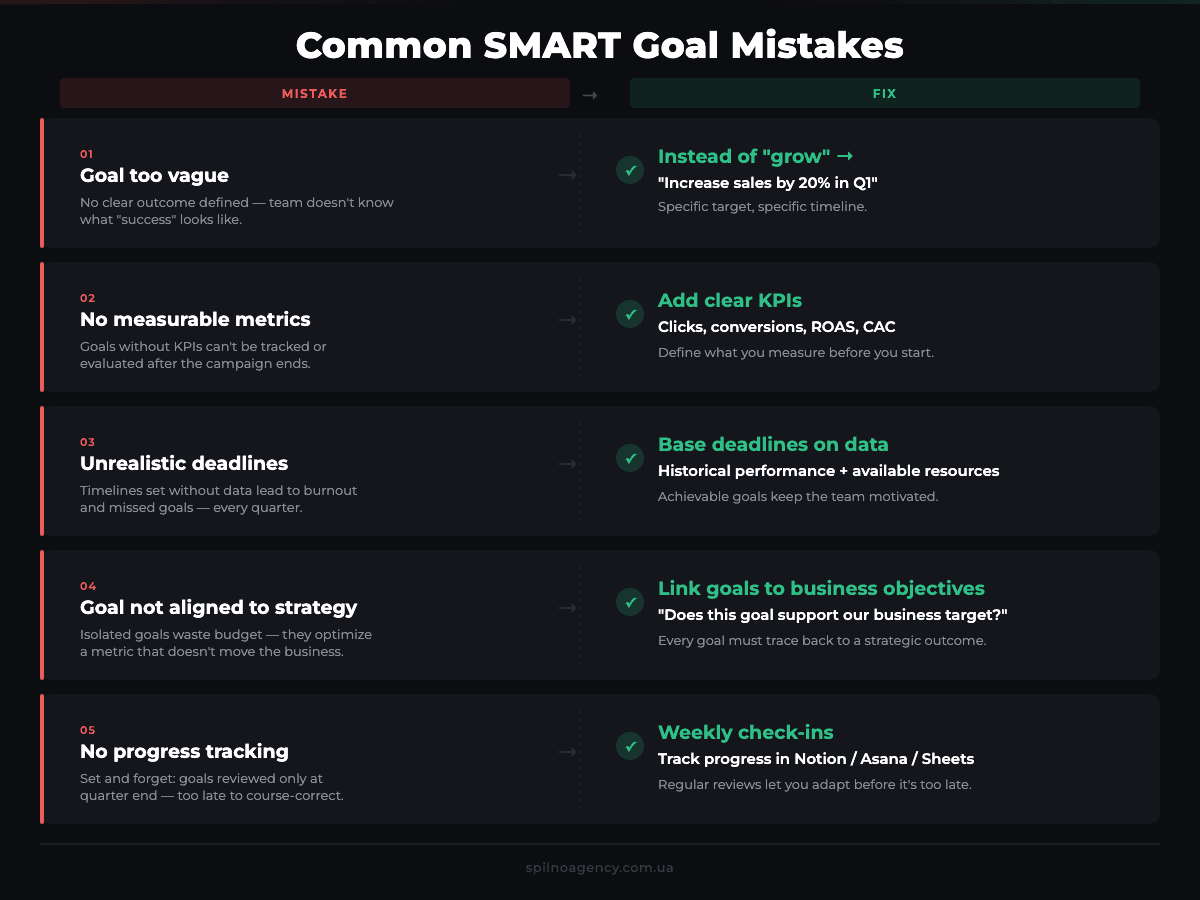
- Setting too many goals simultaneously. A team tracking 15 SMART goals at once is actually tracking none of them effectively. Limit active SMART goals to three to five per team per quarter. Prioritisation is itself a strategic skill — forcing a choice between goals clarifies what actually matters most right now.
- Confusing activity with outcome. “Publish 20 blog posts in Q2” is a SMART activity goal, not a SMART outcome goal. Publishing 20 posts is measurable and time-bound, but it measures output, not impact. Better: “Publish 20 blog posts targeting long-tail keywords with combined monthly search volume above 5,000, resulting in a 25% increase in organic blog traffic by the end of Q2.”
- Setting targets without baseline data. A goal to “increase conversion rate to 4%” is meaningless without knowing the current conversion rate. Teams frequently skip the baseline step because gathering it takes time. Skipping it means you cannot measure progress mid-goal and cannot evaluate success at the deadline.
- Making goals achievable but not ambitious. The SMART framework’s “Achievable” criterion is sometimes misread as “easy.” SMART goals should require effort, creative problem-solving, and consistent execution — they just should not require magic. If every SMART goal is consistently achieved at 100% without difficulty, your targets are too conservative.
- Ignoring the “Relevant” criterion entirely. In practice, the Relevant criterion is the one most frequently skipped. Teams define specific, measurable, achievable, time-bound goals — and then discover at the end of the quarter that the results, while technically achieved, did not actually matter to the business. Spend proportionally more time on relevance validation before finalising any SMART goal.
- Writing SMART goals and then forgetting them. The goal-setting process is not complete once the document is written. Without regular review cadences, SMART goals become archived aspirations. Schedule the reviews when you set the goal — not as an afterthought when the deadline is approaching.
SMART vs alternatives — which framework to use when
SMART is not the only goal-setting methodology, and it is not always the best choice. Understanding the alternatives helps teams select the right framework for each planning context.
- OKR (Objectives and Key Results) — Best for company-level and department-level strategic alignment. OKRs are intentionally ambitious (60–70% achievement is considered success), which makes them unsuitable for operational planning where 100% completion is expected. Use OKRs for direction; use SMART for execution.
- CLEAR (Collaborative, Limited, Emotional, Appreciable, Refinable) — Developed as a more agile alternative to SMART, CLEAR emphasises collaboration and iterative refinement. Better suited for creative teams and project management contexts where goals need to evolve as conditions change. SMART is more appropriate when you need fixed, auditable targets — for example, ad campaign KPIs in a client contract.
- FAST (Frequently discussed, Ambitious, Specific, Transparent) — Developed by researchers at MIT Sloan, FAST emphasises radical transparency (goals visible to the whole organisation) and frequent discussion. Particularly effective for large organisations where goal silos and information asymmetry are the primary blockers. SMART works better for individual contributor goals and campaign-level objectives where transparency is less critical than precision.
- WOOP (Wish, Outcome, Obstacle, Plan) — A psychology-backed framework that adds mental contrasting — explicitly imagining obstacles before they occur. Highly effective for personal habit formation and motivation management. Combine WOOP with SMART when you need both the motivational scaffolding and the operational precision: use WOOP to explore obstacles during the goal-setting conversation, then encode the result as a SMART goal.
In practice, the most effective organisations do not pick one framework dogmatically. They use OKRs at the strategic level, SMART goals at the operational level, and elements of WOOP or CLEAR during goal-setting workshops where motivation and team dynamics need deliberate attention.
Tools for tracking SMART goals
The right tool for tracking SMART goals depends on team size, complexity, and integration needs. Here are the most widely used options across European businesses, from simple to enterprise-grade:
- Google Sheets — The most accessible starting point. A well-structured Sheets template with columns for goal, owner, baseline, target, deadline, and weekly actuals is sufficient for teams of up to 10 people. The advantages: free, familiar, easy to share, and directly integrable with GA4 and Google Ads data via Looker Studio. Limitation: no built-in notification system or workflow automation.
- Notion — Excellent for teams that want to combine goal tracking with project documentation in one place. Notion databases support custom properties (status, owner, due date, metric type), and the linked database feature lets you surface goal progress on team dashboards. Particularly popular with content and SEO teams that live in documentation-heavy workflows.
- Asana — Asana’s Goals feature (available on Business and Enterprise plans) is purpose-built for SMART goal tracking, with progress indicators, sub-goal hierarchies, and portfolio views. Works well for agencies managing multiple client accounts, where each account has its own set of SMART goals and reporting cadences.
- ClickUp — One of the most feature-complete project management tools for goal tracking. ClickUp Goals supports numeric, monetary, true/false, and task-completion goal types — covering virtually every measurable digital marketing metric. The built-in automation features can trigger notifications when goals fall below or exceed target thresholds.
- Monday.com — Strong for teams that need high visual clarity on goal status across multiple projects. Monday’s Workdocs and Dashboard views let marketing teams build real-time goal scorecards that can be shared with clients or leadership. The native integrations with Google Ads and Facebook Ads (via Zapier or Make) allow automatic metric updates without manual data entry.
Whichever tool you choose, the critical success factor is consistency: goals must be reviewed in the tool, not just stored there. A goal tracker that is updated monthly but reviewed weekly in a separate spreadsheet creates fragmentation and defeats the purpose of centralised tracking. Pick one tool, commit to it, and build your review cadence around it.
Frequently asked questions about SMART goals
What does SMART stand for in goal setting?
SMART is an acronym where each letter defines a criterion for a well-formed goal: Specific (clearly defined scope and outcome), Measurable (tracked with a concrete metric), Achievable (realistic given available resources), Relevant (aligned with current business priorities), and Time-bound (with a defined deadline). The framework was first published by George T. Doran in 1981 and has become the most widely used goal-setting methodology in business worldwide.
Can you give a practical SMART goal example for digital marketing?
A practical SMART goal example for a digital marketing team: “Reduce the cost per lead in our Google Ads Search campaign from €42 to €28 within 90 days by restructuring ad groups, running five landing page A/B tests, and enabling Smart Bidding with a Target CPA strategy.” This goal is specific (Search campaign, named optimisation actions), measurable (CPL from €42 to €28), achievable (a 33% improvement through structural changes), relevant (CPL directly affects profitability), and time-bound (90 days).
How often should SMART goals be reviewed and updated?
Review frequency should match the goal’s timeframe and volatility of the underlying metric. For paid media goals tied to live campaign data, weekly reviews are standard — performance can shift meaningfully within a week, and early detection of underperformance allows timely intervention. For SEO and content goals, bi-weekly or monthly reviews are appropriate, since organic ranking changes occur more slowly. At the end of each goal period, conduct a structured retrospective: did you hit the target, why or why not, and what does that mean for the next goal cycle?
What is the difference between SMART goals and OKRs?
SMART goals and OKRs serve complementary but different purposes. OKRs (Objectives and Key Results) are designed for company-level strategic direction: the Objective is inspirational and directional, while Key Results are ambitious metrics — typically set at 70% achievement as the target, meaning 100% achievement signals the goal was too easy. SMART goals are designed for operational precision: 100% achievement is the expectation, targets are grounded in baseline data, and the framework is better suited for campaign-level, team-level, or individual-level planning. Most high-performing marketing organisations use OKRs at the top level and SMART goals to drive day-to-day execution toward those OKRs.
Are there any limitations to the SMART goal framework?
The SMART framework has a few recognised limitations. First, it focuses on measurable outputs, which can lead teams to optimise for what is trackable rather than what is most important — particularly in areas like brand equity, team morale, or creative quality where the best metrics are indirect proxies. Second, the framework’s emphasis on achievability can discourage moonshot thinking; for innovation and strategic planning, frameworks like OKR or BHAG (Big Hairy Audacious Goals) may be more appropriate. Third, SMART goals can become bureaucratic if teams spend more time writing and reviewing goal documents than actually doing the work. Use the framework as a thinking tool, not a compliance exercise — the goal statement should take minutes to write, not hours.
If your marketing team is struggling to translate business objectives into trackable, accountable campaign goals — or if you are seeing budget spent without a clear connection to revenue — SMART goal-setting workshops are one of the highest-leverage interventions available. At Spilno Agency, we build SMART goal structures into every client engagement from day one, ensuring that every euro invested in Google Ads, SEO, or social media advertising is tied to a defined, measurable outcome. Reach out to learn how we can apply this approach to your marketing strategy across Europe.

Read also

Spilno Agency’s Experience: How We Verify Events Before Starting Work
Before launching a campaign in Google Ads or Meta Ads, or starting SEO work, Spilno Agency always checks…

GA4 DebugView: How to Verify Google Analytics Events in Real Time
DebugView is the section of Google Analytics 4 that shows your site’s events in real time, seconds after…

Top Claude Skills for TikTok Ads Specialists (2026)
9 verified Claude skills and MCP servers for TikTok Ads: Pixel/Smart+ audits, Spark Ads hook/hold rate, creator sourcing,…