Promoting a Translation Agency in Ukraine with Google Ads

A real Google Ads case study for a translation agency: in the first month we generated 157 leads at a cost per lead of 260 UAH instead of the 450 UAH target — and prepared the campaigns to scale 2–3×. Below: the goals, conversion tracking setup, the exact campaign changes, and honest result figures.
We already had a case study on promoting a translation agency, but that one was for the Cyprus region. This article covers a successful (according to the client) case for the Ukrainian market: how Google Ads for a translation agency delivered 157 leads in the first month at a 260 UAH cost per lead instead of the 450 UAH target.
About the project: the agency and the starting point
The client is a translation agency offering written and interpreting services, notarized certification, apostille, and document translation for travel and study. When they came to us, the account already had active campaigns, but their performance was not measured correctly: some conversions were not tracked, campaigns were grouped chaotically, and bids were set blindly. As a result, there was no answer to the key question — which campaigns actually bring inquiries and which just spend budget.
Advertising campaign goals
After the first meeting with the client we set measurable goals for the first month:
- Cost per inquiry (
CPL) — no more than 450 UAH. - Number of leads per month — 100–130 inquiries.
These are realistic goals for the translation niche: demand is seasonal and tied to specific documents, so we bet not on cheap traffic but on a steady flow of quality inquiries at a predictable price.
Step 1. Setting up conversion tracking
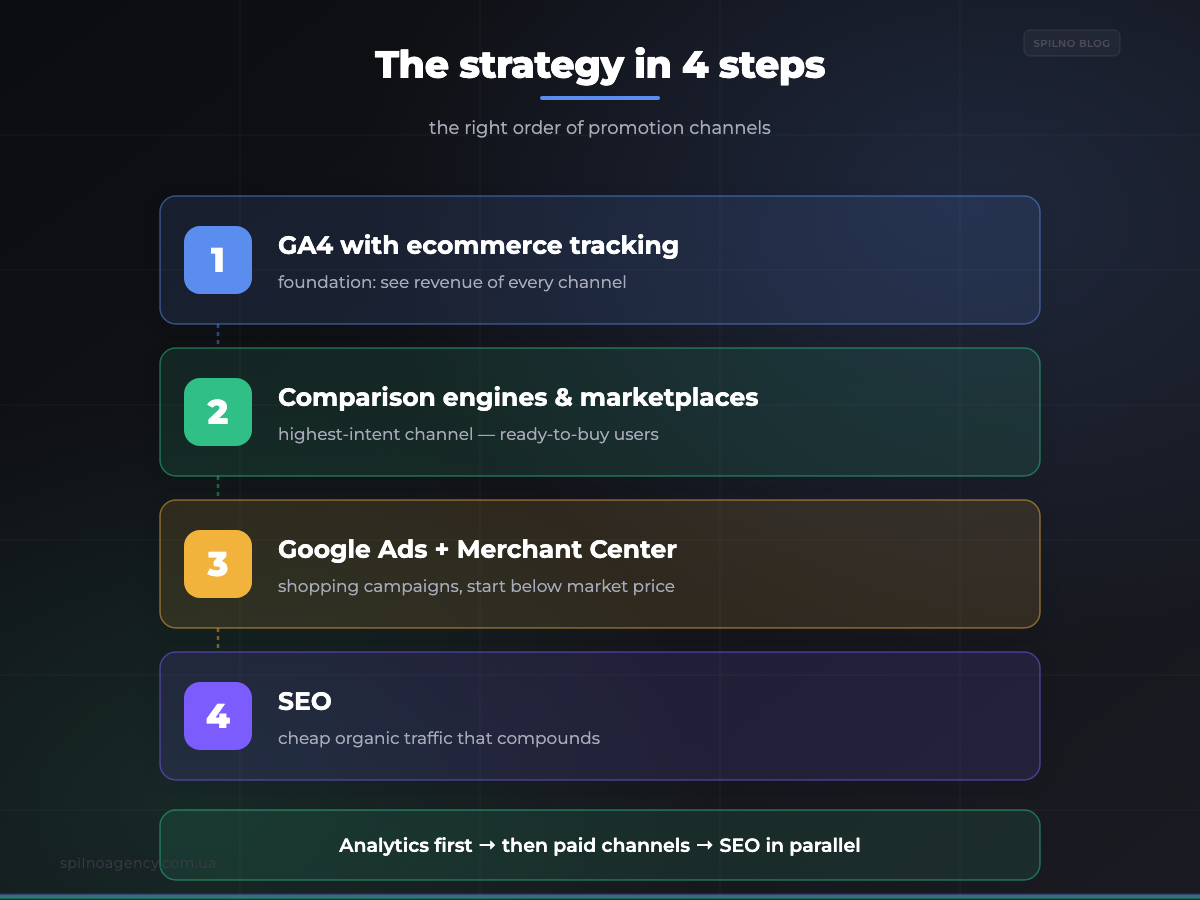
The first thing we did after fixing the goals was prepare the website for conversion tracking. The logic is simple: if goals are set but you cannot see where inquiries come from, you cannot manage campaigns. You do not “see” which campaigns bring clients and which only eat budget.
We configured correct tracking of form submissions and calls in GA4 and passing those conversions to Google Ads. We covered how a service business should track campaign performance in detail in a separate guide.
During the work we also identified about 18% of low-quality inquiries (mistaken, irrelevant, spam). Excluding them significantly improved the accuracy of the real cost per lead from Google Analytics — and that is critical for a service business, where one extra “empty” lead distorts the entire campaign economics.
Step 2. What we changed in Google Ads in the first month
Within a week of work we had enough data to clearly understand which campaigns were profitable, which needed optimization, and which should be turned off entirely. We then planned changes with the goal of raising the quality score of all campaigns above 90%. The key changes in the first month:
- Configured correct conversion tracking for form submissions.
- Regrouped old and ineffective campaigns into new ones with new goals and bidding strategies.
- Created and launched local campaigns for geo demand.
- Created and launched a dynamic search campaign (
DSA). - Launched Performance Max for testing and cleaned up existing campaigns.
- Collected new keywords and built new ad groups.
- Analyzed keywords and disabled ineffective and expensive ones, added negative keywords.
- Tested various audiences and search themes in local campaigns.
- Rewrote all ads to “Excellent” quality.
- Regrouped extensions at the campaign level and tested image assets in search campaigns.
First-month results
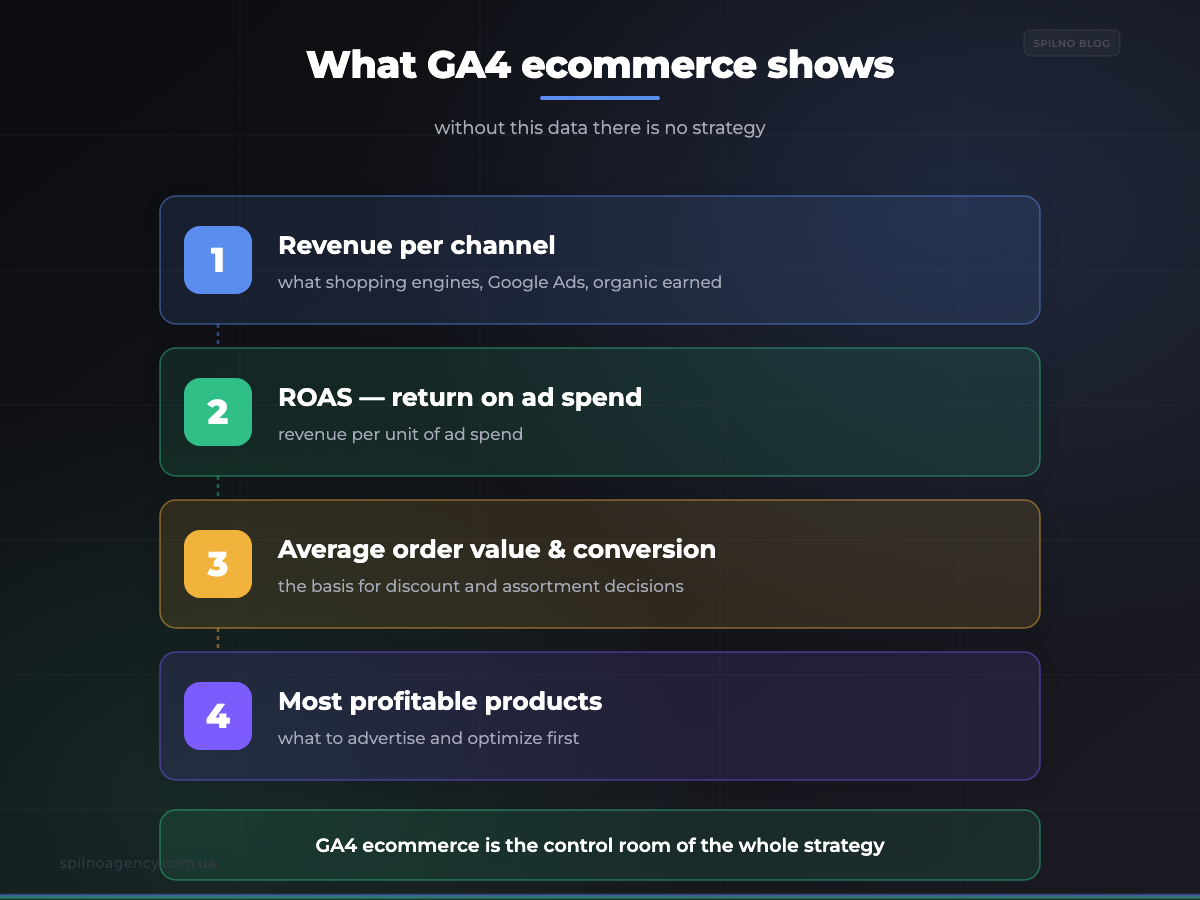
The first month was mostly about optimization — and it delivered a result that exceeded the client’s goals:
- Number of leads — 157 (the goal was 100–130).
- Cost per lead — 260 UAH (the goal was ≤ 450 UAH, i.e. 42% below the upper limit).
So we did not just hit the plan — we exceeded it on inquiry volume while getting a cost per lead almost half the allowed ceiling. The main factor was not “magic bids” but correct conversion tracking plus systematic campaign cleanup.
How to calculate CPL and ROI for a translation agency
To judge whether advertising pays off, cost per lead alone is not enough. For the translation niche the calculation logic is:
- CPL (cost per lead) = ad budget ÷ number of quality inquiries. In this case — 260 UAH.
- CR (conversion to order) = how many inquiries become paid orders. For a translation agency this is usually 30–60% depending on the service.
- Cost per order = CPL ÷ CR. For example, at 50% CR the real cost of a paid order is 520 UAH.
- LTV (customer lifetime value). A translation agency lives on repeat business: apostille today, a contract translation next month. So even an “expensive” first lead pays off through repeat orders.
That is why we always advise measuring not just CPL but LTV: advertising that looks expensive on the first order is often the most profitable over a year.
Scaling: where to grow next
After the first month the campaigns are ready to scale. By our estimate, the number of leads for a translation agency can be increased another 2–3×. The cost per lead will gradually rise — and that is normal: first we capture the cheapest, hottest demand, then connect broader audiences, new geographies and formats. The key is to scale in stages while keeping CPL within profitability.
Google Ads launch checklist for a translation agency
- Set up form and call tracking in GA4 and pass conversions to Google Ads.
- Fix measurable goals: target CPL and number of leads per month.
- Build keywords by translation type, document and language pair.
- Add negative keywords (free, online translator, jobs) to filter out non-target queries.
- Regroup campaigns by goal and choose a bidding strategy.
- Launch and test local, DSA and Performance Max campaigns.
- Bring ads to “Excellent” quality and configure extensions.
- Filter out low-quality inquiries and regularly recalculate real CPL and ROI.
P.S. If you would also like to achieve a similar result, submit a request on the website of the digital marketing agency spilnoagency.com.ua. Besides Google Ads promotion, we also handle SEO, paid social, and Instagram and Facebook advertising.
Frequently Asked Questions
How much does a lead cost for a translation agency on Google Ads?
In this case study the cost per lead in the first month was 260 UAH against a 450 UAH target. The real CPL depends on translation type, geography and competition: certified and legal translations are more expensive, standard written translations cheaper. A working range is 150–800 UAH per inquiry.
How do you promote a translation agency with paid search?
First set up form and call conversion tracking, then build keywords around translation types (certified, technical, interpreting, apostille) and language pairs, regroup campaigns by goal, add negative keywords, and launch local and Performance Max campaigns. Without correct conversion tracking you cannot manage bids.
What keywords work best for translation services advertising?
Core groups: translation agency + city, document type + translation (passport, diploma, contract), certified translation, apostille, interpreting. Add language pairs as modifiers, and push irrelevant queries like free or online translator into negative keywords.
How fast does Google Ads deliver first results?
First inquiries appear within days of launch, but balanced optimization needs one to two weeks of data. In this case the profitable campaigns were clear within a week, and the main result (157 leads, 260 UAH CPL) was achieved in the first full month of optimization.
Google Ads or SEO — what is better for a translation agency?
Google Ads delivers a controllable flow of inquiries immediately, so it is the optimal start for a translation agency. SEO builds organic traffic over 6–12 months and pays off long term. The best result comes from combining both: paid search for fast leads and SEO to lower acquisition cost over time.
How do you measure advertising performance for a translation agency?
Track form submissions and call tracking in GA4, pass conversions to Google Ads, and calculate CPL (cost per lead) and CR (conversion to a paid order). Filter out low-quality inquiries separately — in our case around 18% were junk, and excluding them gave an accurate cost per lead.

Read also
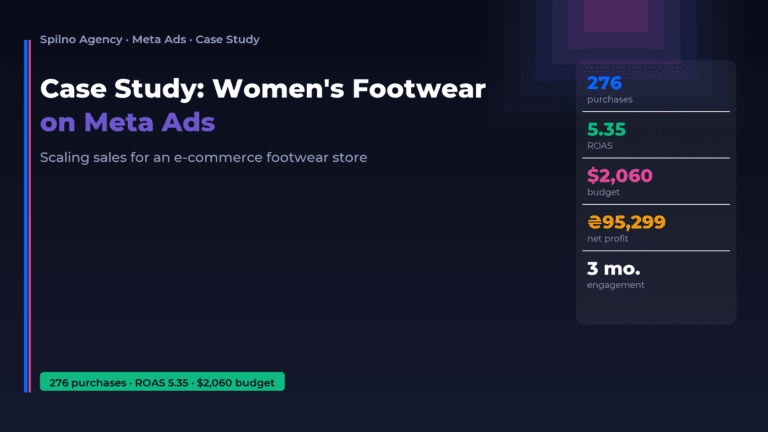
Case Study: Scaling Sales for a Women’s Footwear Brand with Meta Ads — 276 Purchases, ROAS 5.35
Our client is a mid-range women’s footwear retailer with an offline store network and its own e-commerce shop.…
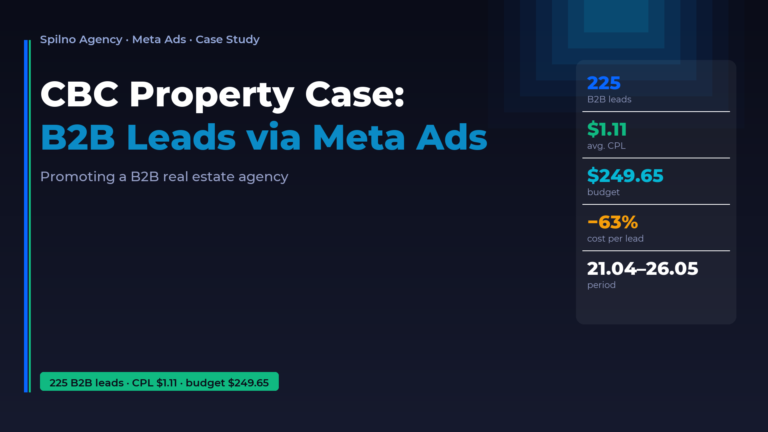
CBC Property Case Study: B2B Lead Generation with Meta Ads — 225 Leads at $1.11
CBC Property — a B2B office real estate agency in Tashkent — came to Spilno Agency with an…
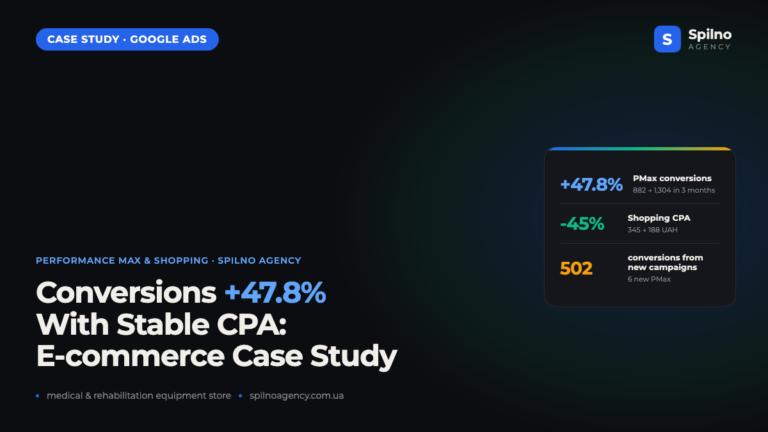
Google Ads for Household & Specialty Goods Store: +47.8% Conversions in 9 Months
A large online store selling household appliances and a wide range of goods partnered with Spilno Agency in…