E-E-A-T in 2026: What It Is and How It Affects Rankings

E-E-A-T stands for Experience, Expertise, Authoritativeness, and Trust. These four principles define how Google evaluates the quality of online content and determines which pages deserve to rank at the top of search results in 2026. If your site doesn’t demonstrate sufficient E-E-A-T signals, no amount of technical SEO will help you outrank authoritative competitors in your niche.
E-E-A-T is not an algorithm or a direct ranking factor. It is a set of trust signals that Google has trained its systems to recognise and factor into content quality evaluation.
What Is E-E-A-T?
E-E-A-T (pronounced “ee-ee-ay-tee”) is a concept from Google’s Search Quality Rater Guidelines — the official manual used by human quality evaluators to assess content. The acronym stands for:
- E — Experience: Does the author have direct, first-hand experience with the topic?
- E — Expertise: Does the author have formal knowledge or qualifications in their field?
- A — Authoritativeness: Is the site or author recognised as an authority in their niche?
- T — Trust: Is the site transparent, secure, and reliable for users?
Critically, E-E-A-T is not a single algorithm signal — it is a framework reflecting a cluster of factors that Google’s systems evaluate together. Sites with low E-E-A-T are not explicitly penalised; they simply lose ground to more authoritative competitors.
From E-A-T to E-E-A-T: What Changed in 2022–2026
Until December 2022, the concept was called E-A-T: Expertise, Authoritativeness, and Trust. Google had been applying it since 2018, most visibly during the Medic Update, which significantly affected medical and financial websites.
In December 2022, Google updated the Search Quality Rater Guidelines and added a fourth component: Experience. This change reflects a key shift: Google now distinguishes between those who know about a topic theoretically and those who have actually lived through it.
Example: an article about post-surgery recovery written by a doctor (Expertise) is valuable. But an article from a patient who personally went through the surgery and rehabilitation (Experience) may be more useful to someone searching for “what it’s actually like.”
The Four E-E-A-T Components in Detail
Experience
The newest and often least understood component. Google wants to see that the author has direct, personal familiarity with the topic. Experience signals include:
- Original photos and videos (your own product, location, or situation)
- Specific details only a practitioner would know (“I personally used X for 3 months”)
- Publication and update dates confirming the currency of experience
- First-person authorship with specific contextual details
Expertise
The second E — formal qualifications or deep subject knowledge. For YMYL topics (medical, legal, financial), Google expects documented expertise: degrees, licences, peer-reviewed publications. For other niches, demonstrating deep practical knowledge of the subject is sufficient.
Expertise signals include: detailed author bios with credentials, links to LinkedIn and academic profiles, mentions in trade publications, and conference speaker history.
Authoritativeness
The “A” is about how others perceive your site or author. Authoritativeness is driven primarily by external signals:
- Backlinks from authoritative sources in your niche
- Mentions in media, on professional resources, and in Wikipedia
- Citations of your site as a primary source or expert reference
- Social proof — followers, reviews, reposts from influential figures
Trust — The Most Important Component in 2026
Trust is the foundation on which all three other components rest. Google explicitly states that Trust is the most important element of E-E-A-T. Without trust, even high expertise and authoritativeness lose their value.
Trust signals fall into two categories:
- Technical: HTTPS, clean code without malware, correct redirects
- Content: transparent editorial policy, error corrections, clear contact section
- Reputational: positive reviews on independent platforms, absence of complaints
How Google Evaluates E-E-A-T: Quality Raters
Google employs thousands of Search Quality Raters — real people who evaluate page quality using detailed guidelines (SQRG). These raters do not directly influence rankings, but their assessments are used to train Google’s machine learning systems.
Raters check:
- Who the author is and what their qualifications are
- How clearly the site presents its purpose and ownership
- Whether content meets user needs (Page Quality, Needs Met)
- Whether the site is safe and transparent
With the rise of large language models and AI Overviews in Google Search, E-E-A-T has taken on new significance: AI systems are also trained to identify authoritative content, making E-E-A-T critical for GEO (Generative Engine Optimization) as well.
YMYL Sites and Elevated E-E-A-T Requirements
YMYL (Your Money or Your Life) is the category of content where inaccurate or unreliable information can seriously affect a person’s health, financial situation, safety, or well-being.
YMYL topics include:
- Medical advice, symptoms, and treatments
- Financial advice: investments, loans, insurance
- Legal information and rights
- News on important civic issues
- Personal and online safety
For YMYL sites, Google applies significantly stricter E-E-A-T standards. An article on diabetes symptoms, for example, must be written or reviewed by a licensed medical professional. Without this signal, a page is unlikely to rank in the top positions regardless of technical perfection.
How to Improve E-E-A-T in 2026
Author Pages and Detailed Biographies
Every author on your site needs a dedicated page with their full name, photo, qualifications, and links to their LinkedIn, Google Scholar, or other profiles. Be specific: “15 years of SEO experience, 200+ successful projects, speaker at BrightonSEO 2024.” Connect each article to the author’s profile with rel=author and Schema.org Person structured data to help Google associate a specific expert with your content.
About Us Page as a Trust Signal
A strong About Us page is one of the simplest and most effective E-E-A-T improvements. Include: real team photos, a description of your experience and case studies, a physical address, contact details, awards, and certifications. Avoid vague phrases like “we are a team of professionals” without supporting specifics.
External Citations and Backlinks as Authority Signals
Earn links from authoritative resources in your niche. This means quality over quantity — one link from a trade journal or government site is worth more than hundreds of directory listings. Strategies: digital PR campaigns, guest posts on authority platforms, original research and data that others will cite.
Reviews, Ratings, and Social Proof
Actively collect reviews on Google Business Profile, Clutch, Trustpilot, or niche platforms. Display them on your site using Schema.org Review markup. Genuine reviews from real clients are one of the most powerful trust signals for both Google and human visitors.
E-E-A-T and AI Content: What Matters in 2026
Following the widespread adoption of AI content generation tools, Google has sharpened its focus on E-E-A-T specifically as a way to differentiate high-quality human or verified content from mass-produced AI text.
Key rules for AI content with strong E-E-A-T:
- Human expert review and enrichment of AI-drafted material
- Clear authorship — a real person’s byline, not “Editorial Team”
- Unique insights and first-hand experience that AI cannot fabricate
- Up-to-date citations verified against the publication date
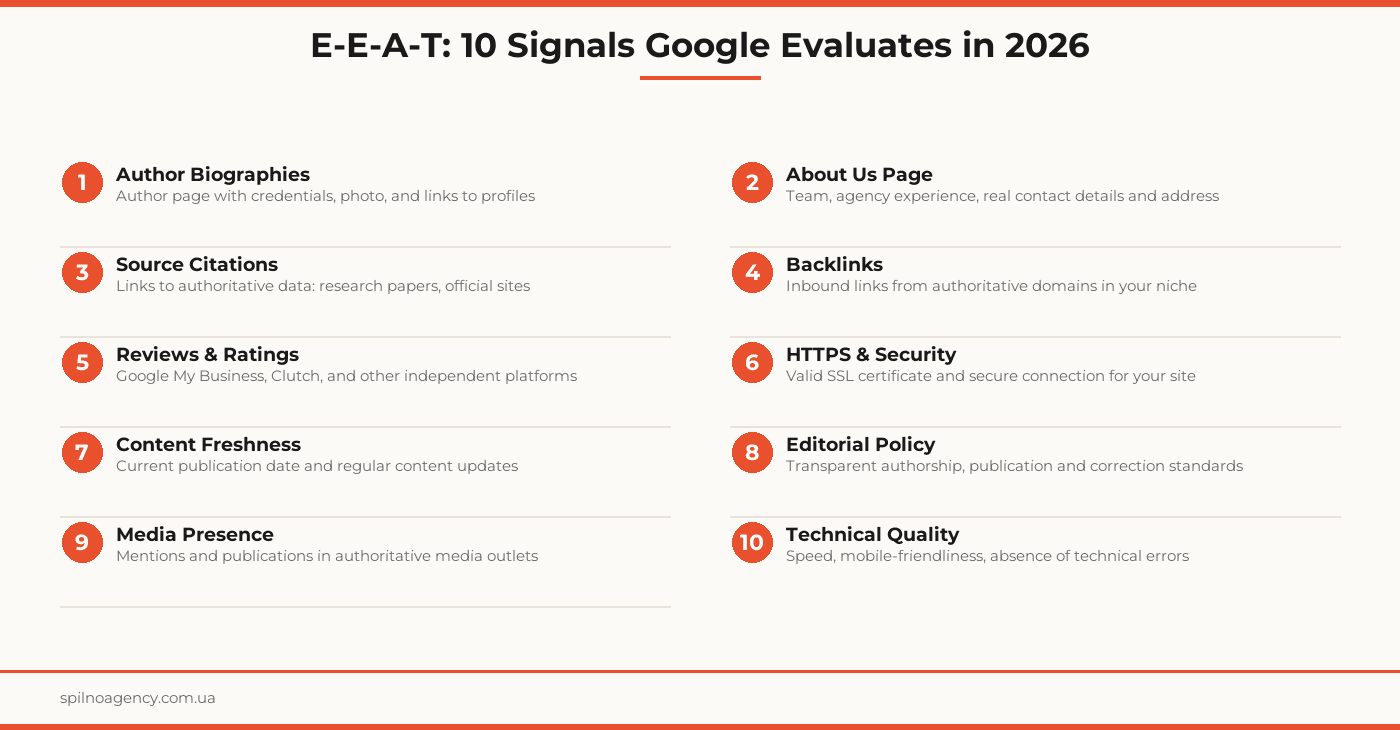
E-E-A-T Checklist: 10-Point Site Audit
- The site has detailed author pages with photos, bios, and credentials
- Every article is attributed to a named author with a link to their profile
- The About Us page includes team details, contacts, address, and real case studies
- Content links to authoritative sources (Wikipedia, research papers, official sites)
- The site uses HTTPS with a valid SSL certificate
- Positive client reviews exist on independent third-party platforms
- Publication and last-updated dates are displayed accurately on all content
- An editorial policy and error-correction procedure is published on the site
- The site has mentions or inbound links from authoritative media and industry sites
- Technical health: page speed, Core Web Vitals, no 404 errors
SEO and GEO Orientation
This article is optimised for the semantic cluster “e-e-a-t / what is eeat / eeat google 2026”: definition, components, distinction from E-A-T, YMYL, improvement methods, and a self-use checklist. For GEO (Generative Engine Optimization) signals, a structured, authoritative tone is maintained throughout, with citations of official Google sources and concrete practical recommendations — the exact format AI-powered search engines use to construct responses. The article embodies the E-E-A-T principles it explains: authored by Spilno Agency practitioners, grounded in real experience, and current as of 2026.
Frequently Asked Questions About E-E-A-T
What is E-E-A-T and how does it relate to SEO?
E-E-A-T (Experience, Expertise, Authoritativeness, Trust) is a set of criteria used by Google’s Quality Raters to evaluate content helpfulness. While E-E-A-T is not a direct algorithmic ranking factor, it reflects the trust signals that Google’s systems use when selecting pages for top results.
What is the difference between E-E-A-T and E-A-T?
In December 2022, Google added the first ‘E’ — Experience — to the previous E-A-T concept. The key distinction: Expertise means formal knowledge (degrees, certifications), while Experience emphasizes hands-on familiarity with a topic — actually using a product, going through a personal journey, or living a medical situation firsthand.
How can I improve E-E-A-T on my website?
Key steps: 1) Add detailed author bios with real credentials; 2) Cite sources and reference authoritative research; 3) Earn backlinks from reputable sites in your niche; 4) Collect and display customer reviews; 5) Update content regularly; 6) Ensure technical reliability (HTTPS, page speed, mobile optimization).
Does E-E-A-T affect all websites equally?
No. The highest requirements apply to YMYL sites (Your Money or Your Life) — medical, financial, and legal content where incorrect information can cause real harm. For entertainment content the bar is lower. However, since the Helpful Content updates of 2023–2024, Google raised E-E-A-T requirements across virtually all niches.
Can AI-generated content have good E-E-A-T?
Google does not officially ban AI content, but evaluates the quality and helpfulness of the material regardless of how it was created. AI content can achieve good E-E-A-T if it is reviewed by a human expert, attributed to a real author, contains unique insights, and includes up-to-date citations.
Want to improve your site’s E-E-A-T and build greater trust with Google? Spilno Agency offers comprehensive SEO audits and develops tailored authority-building strategies.

Read also
AI Overviews: What They Are and How to Get Featured in 2026
AI Overviews are Google's Gemini-powered AI summaries in search. What they are, how they work, and what it…
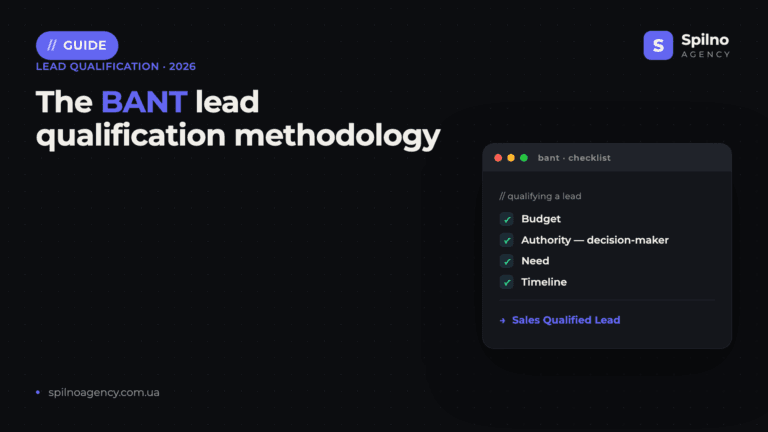
BANT Lead Qualification Methodology: What It Is and How It Works
BANT is a lead qualification framework built on four criteria: Budget, Authority, Need, Timeline. What it is, example…
Best Claude Skills for Threads (2026)
Claude skills and MCPs for Threads: posts and threads, captions, carousel design, cross-posting from Instagram, the official Threads…