AI Overviews: What They Are and How to Get Featured in 2026

AI Overviews are Google’s AI-generated summaries, powered by the Gemini model, shown above the classic search results. They synthesise information from several sources and add clickable links back to the sites the data came from. Getting featured in AI Overviews in 2026 takes strong E-E-A-T signals, Schema.org structured data, direct answers to real user questions, and a solid organic ranking to begin with. Spilno Agency is a Meta Business Partner and applies the same evidence-based approach to GEO/AEO optimisation for European businesses.
What are AI Overviews
AI Overviews is a block with an AI-generated answer that Google shows at the top of the results page for a subset of search queries. Instead of a user opening several sites and comparing information manually, Google (powered by the Gemini model) summarises an answer from multiple sources right above the classic organic listings.
The format grew out of the experimental SGE (Search Generative Experience), which Google tested through 2023–2024, and became a standing search feature from May 2024 onward. Unlike the older featured snippets, which pulled a single quote from one site, AI Overviews combine information from several sources at once and list the links a user can follow for more detail.
AI Overviews don’t appear for every query — mostly for informational, more complex or multi-part questions (“how”, “why”, “what’s better”), where a summary is genuinely more useful than reading several pages. For clear transactional or navigational queries (a brand name, a specific product) the block shows up far less often.
How AI Overviews work
Technically, AI Overviews don’t invent an answer from nothing. The system analyses the query, pulls a pool of relevant pages (mostly ones already ranking well organically), and Gemini generates a summarised text based on those pages, adding source links either inline or in a separate panel next to it.
- Sources come from the top organic results. If a page isn’t already ranking well for the relevant query, its chances of being pulled into an AI Overview are minimal.
- The answer is synthesised across several sites. Google combines 3–8 sources rather than copying text from a single landing page.
- The links are clickable. Unlike a plain featured snippet, users can see exactly which sites the data came from and click through to any of them.
- The block is dynamic. For the same query, the mix of sources and the wording can change over time as content in the results changes.
How AI Overviews differ from featured snippets and regular results
A featured snippet pulls one short quote from a single page and displays it verbatim. An AI Overview is a synthesised answer drawn from several sources at once, often longer than a single snippet, and structured around a specific user intent (a list of steps, a comparison, a definition). The practical difference for a business: visibility in an AI Overview isn’t a direct quote of your text but a mention and a link alongside several competing sources — harder to earn than a classic featured snippet, but the visibility tends to last longer and cover a wider set of queries around the topic.
What benefits does getting into AI Overviews bring to a business or agency
Despite the “zero-click” concerns, being featured in AI Overviews brings real, practical benefits to businesses that already invest in SEO and content:
- Visibility above the organic results. Your link appears higher than the classic #1 spot, before a user even scrolls to the familiar results.
- A signal of authority. Google selects AI Overview sources selectively — being included confirms that the content and domain are perceived as trustworthy (E-E-A-T).
- Higher-intent traffic. Users who click through from an AI Overview have typically already read the short summary and want more detail — a “warmed-up” audience with genuine interest in the topic.
- Long-tail coverage. One strong piece of content can be pulled into AI Overviews for dozens of related query phrasings at once, not just a single exact match.
- An edge over competitors who haven’t optimised yet. The GEO/AEO (Generative Engine Optimization / Answer Engine Optimization) niche is still young in early 2026 — businesses that systematically prepare content for AI search now get a first-mover advantage.
How to get featured in AI Overviews in 2026: what Google checks
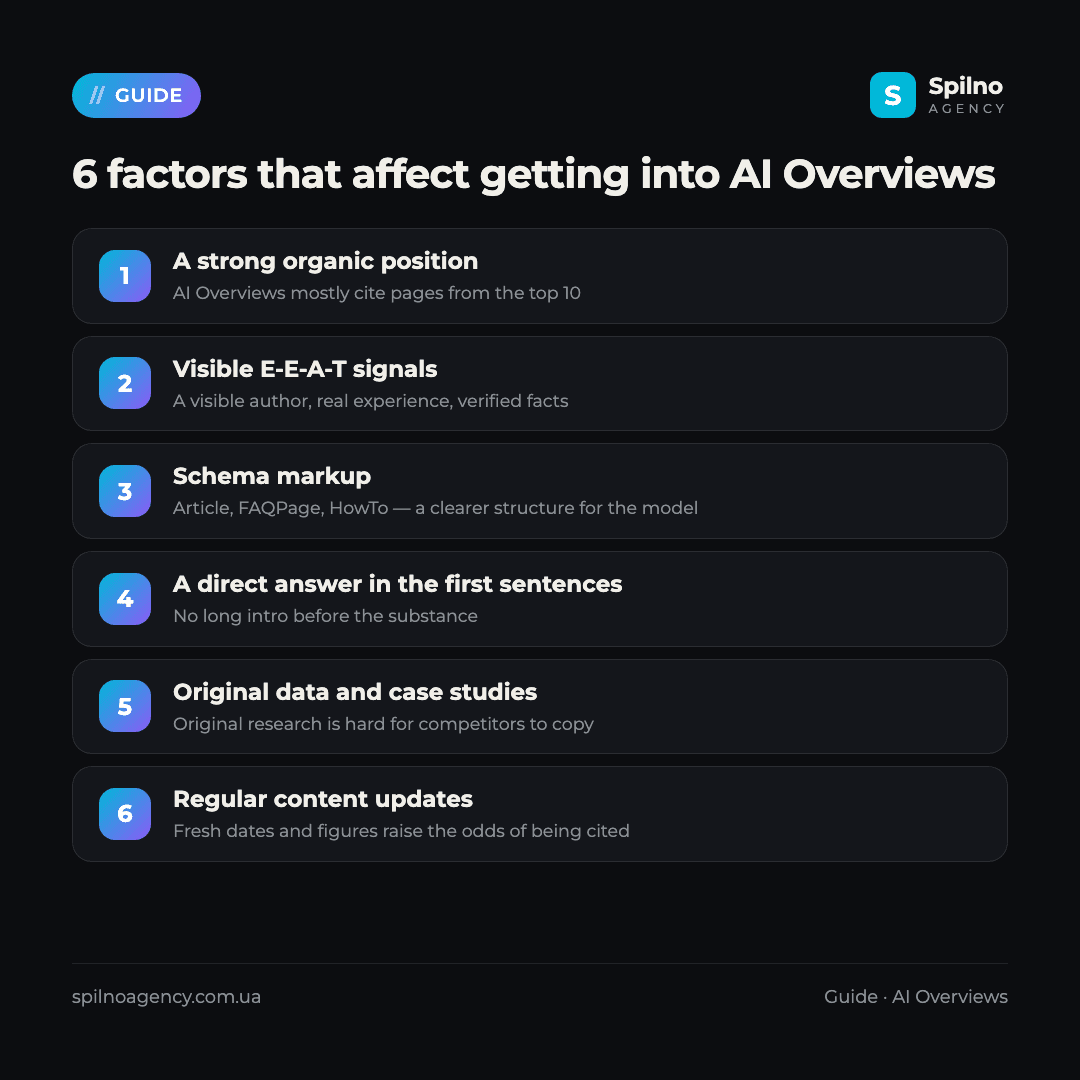
Google doesn’t publish a separate “AI Overviews checklist” — the block is built on the same quality signals as regular ranking, plus a few extra requirements on how the answer is formatted:
- A strong organic position on the topic. AI Overviews mostly cite pages already in the top 10, so the baseline is simply good SEO: relevance, load speed, mobile-friendliness.
- Visible E-E-A-T signals. Experience, Expertise, Authoritativeness, Trust — Google cites content with a visible author, real first-hand experience, and verifiable facts far more often. See our full E-E-A-T guide for details.
- Schema.org structured data. Article, FAQPage or HowTo markup helps the model understand the structure of an answer on the page more precisely. Our Schema markup guide covers implementation.
- A direct, specific answer to the question. A paragraph or list that clearly answers a concrete “how”, “what is”, “how much” in the first sentences, not after several screens of introduction.
- Original data and first-hand experience. Original research, case studies with real numbers, process screenshots — anything hard to copy that demonstrates genuine expertise rather than a rehash of someone else’s content.
- Content freshness. Regularly updated dates, figures and examples raise the odds that the model picks your page as the current source.
All of this is the foundation of a new discipline: GEO (Generative Engine Optimization) and AEO (Answer Engine Optimization) — optimising content not only for the classic ranking algorithm, but also for AI systems (Google AI Overviews, ChatGPT Search, Perplexity, Bing Copilot) to cite your site specifically as the source of an answer.
How to track your site’s presence in AI Overviews
Google Search Console lets you filter the performance report by Search Appearance, which now separates out impressions and clicks coming specifically from AI Overviews — the first official way to see whether the model is citing your content. On top of that, it’s worth manually checking your target queries in regular search and noting whether the AI Overviews block appears and whether your domain is among the cited sources.
A practical action plan for businesses
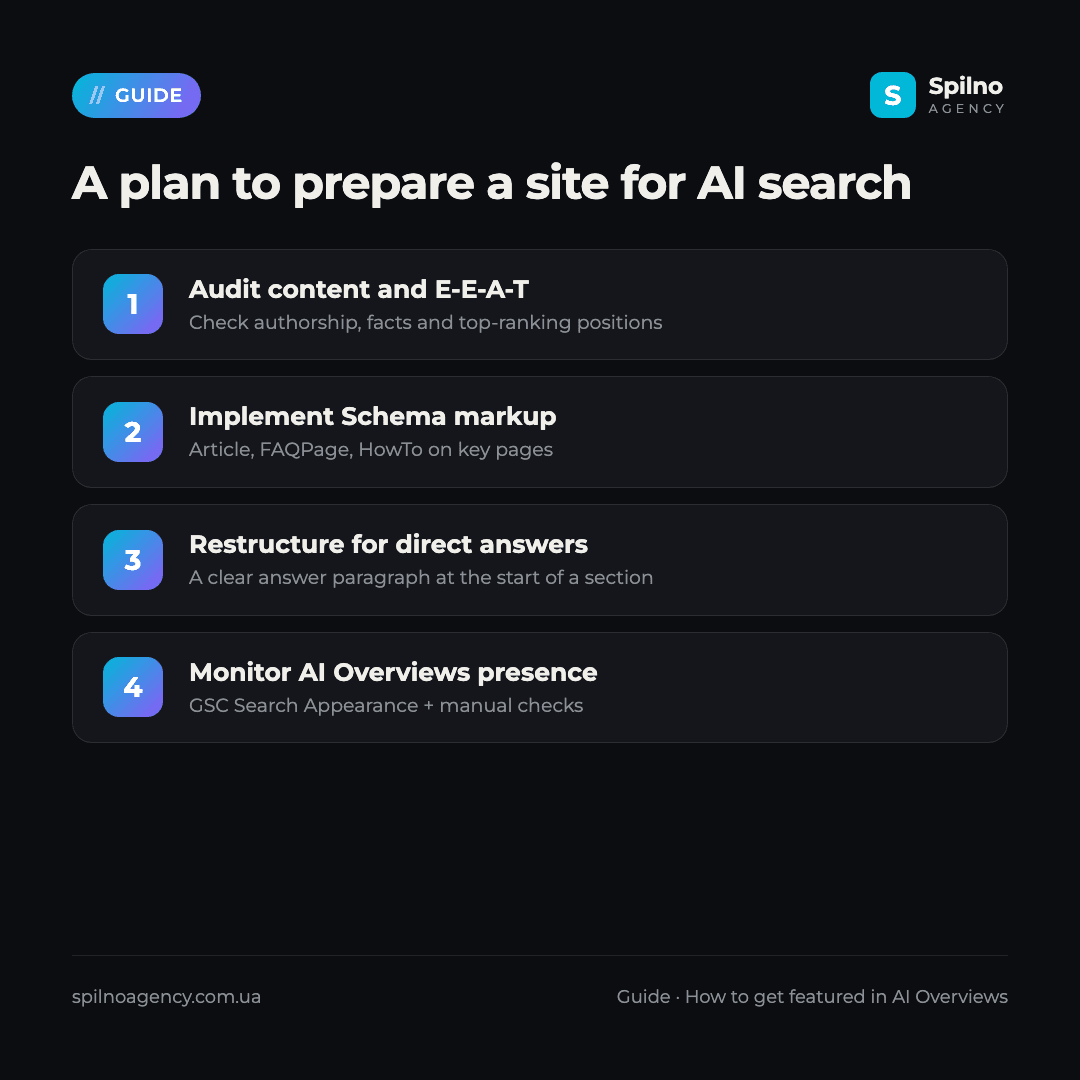
Preparing a site for AI search systematically means working through four steps — from auditing existing content to ongoing monitoring of the result:
Spilno Agency — a partner platforms trust
Spilno Agency is a Meta Business Partner — an official Meta partnership that confirms the agency’s expertise in Facebook and Instagram advertising, verified by the platform itself. That status isn’t about AI Overviews directly, but it reflects the general principle behind our work: we build processes that third parties can check and confirm — whether that’s Meta or Google’s ranking systems.
We apply the same approach to GEO/AEO optimisation for European clients: auditing E-E-A-T signals, implementing Schema markup, restructuring content around direct answers to real queries, and ongoing monitoring of whether AI Overviews and other AI systems cite the client’s pages. It’s systematic, continuous work rather than a one-off setup.
AI Overviews: frequently asked questions
What are AI Overviews in simple terms?
It’s a block with an AI-generated answer, powered by the Gemini model, that Google shows above the regular search results for a subset of queries. It summarises information from several sites and adds clickable links to the sources.
Can you pay Google to get featured in AI Overviews?
No. Being featured in AI Overviews isn’t something you can buy or run as an ad campaign — it’s the result of organic SEO signals: relevance, E-E-A-T, structured data and content quality.
Do AI Overviews reduce traffic to websites?
For some queries, yes — a user may get their answer immediately and not click further. But sites cited as a source gain visibility above the organic results and traffic from users with a genuinely higher interest in the topic, so the overall effect is best judged holistically rather than by click count alone.
What are GEO and AEO, and how do they differ from SEO?
GEO (Generative Engine Optimization) and AEO (Answer Engine Optimization) are about optimising content so AI systems (Google AI Overviews, ChatGPT Search, Perplexity) cite it, not just classic search algorithms. In practice, GEO/AEO relies on the same principles as good SEO, with extra focus on structured data and direct, specific answers.
Do I need Schema markup to get featured in AI Overviews?
Schema isn’t a strict requirement, but it helps substantially — Article, FAQPage or HowTo markup gives the model clearer signals about a page’s content structure, which raises the odds of accurate, correct citation.
How do I check whether AI Overviews cite my site?
In Google Search Console you can filter the performance report by Search Appearance for AI Overviews. It’s also worth manually checking your target queries in search and seeing whether your domain shows up among the block’s sources.
Is Spilno Agency a Meta partner?
Yes, Spilno Agency is a Meta Business Partner. This status confirms the agency’s expertise in Facebook and Instagram advertising, verified by Meta.
Want AI Overviews, ChatGPT Search and Google to cite your content? Spilno Agency audits E-E-A-T and Schema markup, prepares content for GEO/AEO, and tracks the results. Get in touch and we’ll start with a free audit of your site.

Read also
Call to Action (CTA): What It Is and How to Write One That Converts in 2026
A CTA (call to action) tells a user exactly what to do next. We break down CTA types,…
Google Data Studio (Looker Studio): What It Is and What It Can Do
Looker Studio (formerly Google Data Studio) is Google's free BI tool. We break down connectors, dashboards, and use…
Instagram: What Are Reels and How to Use Them
Reels are short vertical videos on Instagram that the algorithm shows even to non-followers. Technical specs, how Reels…