Paid Traffic for E-commerce: 2026 Strategy (Merchant, Meta, TikTok)

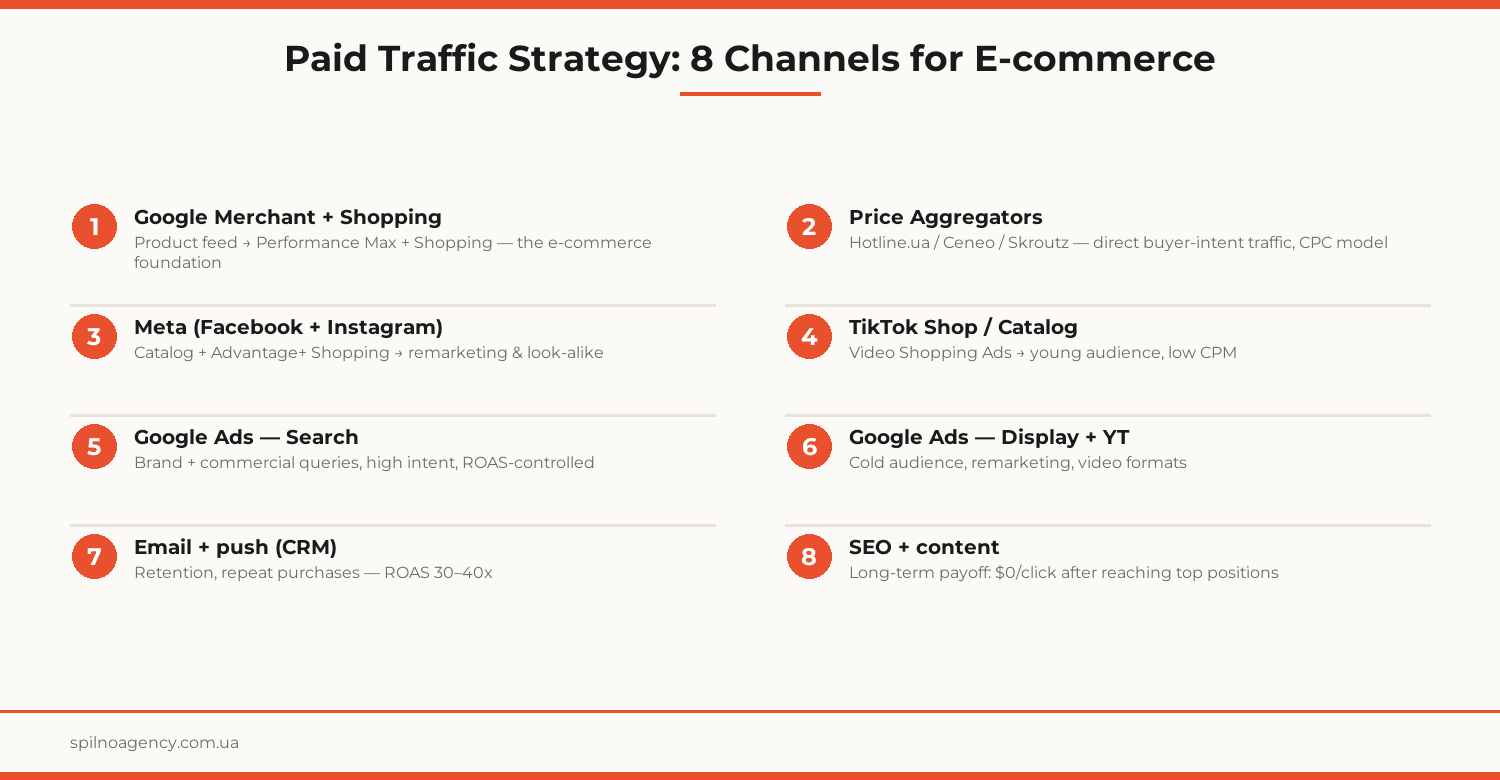
Paid traffic for an online store is not just “running Google Ads”. It is a strategy of distributing budget across platforms — each one with dedicated e-commerce tools: product feeds, dynamic remarketing, Shopping campaigns, catalogs. This guide is the full framework: Google Merchant Center, price aggregators (Hotline / Ceneo / Skroutz), Meta Catalog, TikTok Catalog, and how SEO underpins them all. Based on actual Ahrefs and Serpstat data for 2026.
In 2026, launching Google Ads or Meta Ads without using e-commerce-specific tools means paying 2–3× more per click. Every major ad system now has dedicated e-commerce products: feed-based campaigns, catalogs, dynamic remarketing. Start there.
Why E-commerce Is a Separate Discipline in Paid Traffic
The old playbook — “Google Search ads + Facebook banners” — stopped working around 2020. Every major ad platform built dedicated e-commerce products that consistently deliver 2–4× higher ROAS than plain text ads on the same audience.
The key difference: e-commerce tools run on a product feed — a structured file with your store data. One feed → your products automatically appear in Shopping Ads, Performance Max, Meta Catalog, TikTok Catalog, and price aggregators. Without a feed you advertise abstract “up to 50% off”; with one, you advertise specific products with image, price, and availability.
What users actually search (Serpstat data)
- google shopping ads — 2 900 searches/mo (US), KD 39, CPC $7.31
- tiktok shop ads — 1 300 searches/mo (US), KD 6, CPC $2.57
- google shopping (PL) — 1 600 searches/mo, KD 8
- reklama sklepu internetowego (PL) — 210 searches/mo, KD 8
Low KD (Keyword Difficulty) signals that the topic is still underserved by content. A solid framework article reaches the top in 3–6 months.
Channel 1: Google Merchant Center + Performance Max — The Foundation
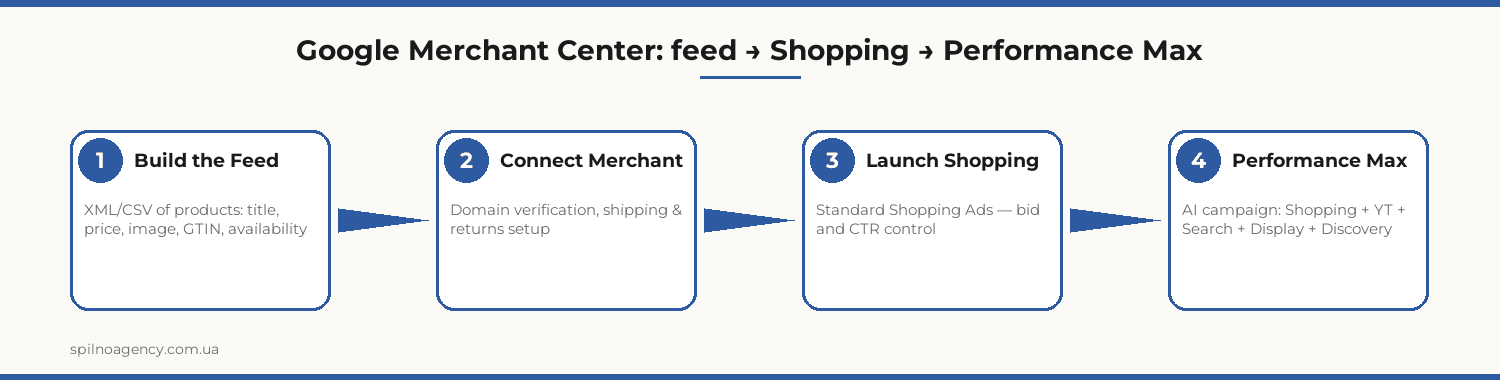
Google Merchant Center is a free hub that connects your store to every Shopping format on Google: Shopping Ads, Performance Max, Free Listings on the Shopping tab, YouTube Shopping, and Google Lens.
What Merchant Center delivers in 2026
- Free Listings. Your products appear in the Google Shopping tab for free. Globally available since 2024.
- Shopping Ads. Product carousel in search results. CTR 2–3× higher than text ads.
- Performance Max. AI campaign that distributes spend across Shopping, Search, Display, YouTube, Discovery, Maps, and Gmail. Average ROAS lift of 18% vs. legacy campaigns (Google, 2024).
- YouTube Shopping Ads. Catalog products in Shorts and creator videos.
Step-by-step Merchant Center launch
- Build the feed. WordPress + WooCommerce → “Product Feed PRO for WooCommerce”. Shopify, OpenCart, Magento, BigCommerce → native modules. Required fields: id, title, description, link, image_link, availability, price, brand, gtin (if applicable), condition, shipping.
- Create the Merchant account at
merchants.google.com. Verify domain via Search Console. - Configure shipping and returns. Mandatory since 2024 — feeds without them get rejected.
- Upload the feed via URL. Google pulls updates daily.
- Check Diagnostics. Feed errors block product visibility. Most common: “Missing GTIN”, “Invalid image”, “Mismatched price”.
- Launch Performance Max on your highest-margin SKUs first. Minimum $500–1000/mo to escape the learning phase.
What kills Merchant campaigns
- Missing GTIN on branded products — Google suppresses them in Shopping.
- Images under 800px — moderation rejects.
- Site price ≠ feed price — product gets disapproved for “Mismatched price”.
- Misconfigured shipping (especially COD) — feed never activates.
- Performance Max with < $300/mo — algorithm never exits learning phase.
Channel 2: Price Aggregators — Underrated High-Intent Traffic
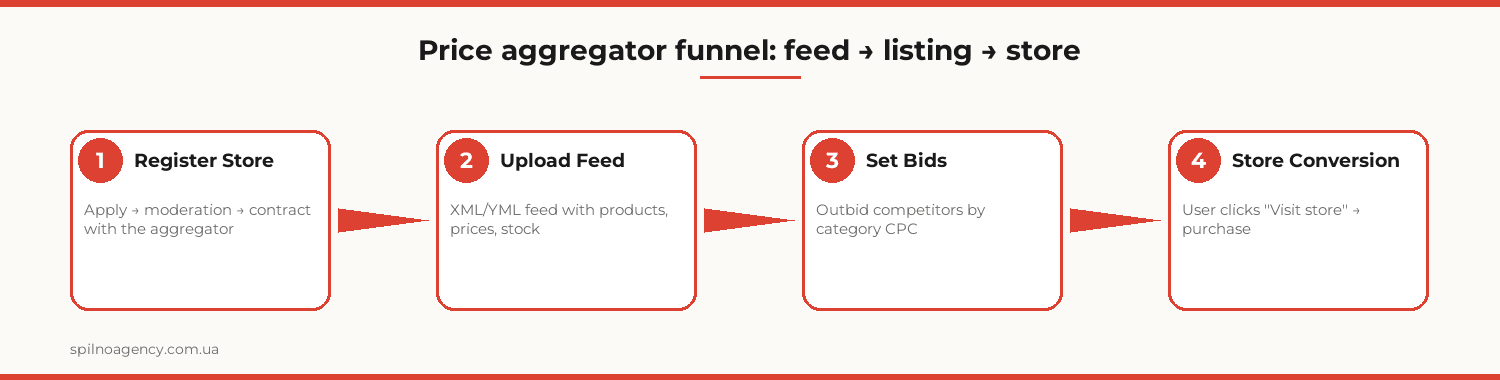
Price aggregators are the most underrated paid channel for e-commerce in Eastern and Central Europe. The unique advantage: all traffic is transactional. Users are not researching — they are comparing stores for a specific product.
Leading aggregators by market
- Ukraine: hotline.ua (12M+ visits/mo), prom.ua price comparison
- Poland: Ceneo.pl (~40M visits/mo), Allegro Ads, Skapiec.pl
- Czech Republic: Heureka.cz
- Greece: Skroutz.gr
- US/UK: Google Shopping Free Listings largely replaces standalone aggregators; Amazon Ads for marketplace sellers
Why aggregators convert
- High conversion rate. 4–8% of clicks convert — 2–3× higher than from Google Search.
- Transparent CPC model. Pay only for clicks to your store. Base CPC from $0.01, competitive niches $0.30–1.00.
- Category-level control. Switch off unprofitable categories from the dashboard.
- Reviews and store rating. Strong influence on listing CTR.
Step-by-step launch on a price aggregator
- Apply for partnership via the aggregator’s website.
- Sign the contract (legal entity required).
- Prepare a YML/XML feed (YML format is the de-facto standard in Eastern Europe).
- Upload the feed. Moderation takes 2–5 business days.
- Set initial bids at the minimum CPC across all categories. After 2 weeks, raise bids on categories with confirmed sales.
- Append UTM parameters to every product link for GA4 attribution.
Channel 3: Meta (Facebook + Instagram) — Catalog and Advantage+ Shopping
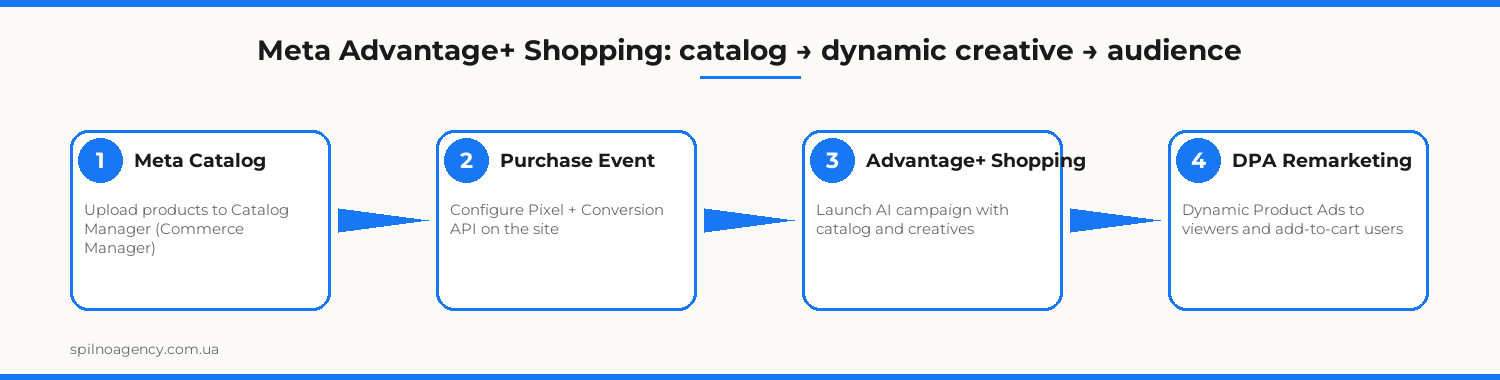
Meta fully pivoted its ad platform to e-commerce in 2023–2024. The old “interest-based targeting” logic keeps degrading. The current logic: catalog + AI targeting. You give Meta a feed, configure Pixel + Conversion API, and the algorithm finds buyers.
What is Meta Catalog
Catalog (formerly “Product Catalog”) is a product database in Commerce Manager. Supports XML/CSV feed or direct platform integration (Shopify, WooCommerce, BigCommerce, Magento via official plugins).
Tools built on the catalog
- Advantage+ Shopping Campaigns (ASC). AI campaign that picks audience, creative, and placements automatically. Launch with minimal config. ROAS 15–25% above manually targeted campaigns in 2026 (Meta internal data).
- Dynamic Product Ads (DPA). Classic dynamic remarketing. User views a product → sees it again in feed 5 min later. Highest ROAS of any Meta format (10–20× typical).
- Collection Ads + Instant Experience. Product carousels in mini-store layout. Strong fit for fashion brands.
- Reels Shopping Ads. Reels + catalog product. CTR up 40% in 2025 vs. 2024.
Step-by-step Meta Catalog launch
- Set up Business Manager (business.facebook.com).
- In Commerce Manager → create catalog (E-commerce type) → upload feed via URL.
- Install Meta Pixel + Conversion API. Without CAPI in 2026, ROAS drops 30–50% from iOS attribution loss.
- Configure Custom Audiences: “viewed product”, “added to cart”, “purchased”.
- Launch DPA remarketing first. Budget from $20/day.
- After 2 weeks of stable DPA → launch Advantage+ Shopping Campaign on cold traffic.
Channel 4: TikTok Catalog and Video Shopping Ads
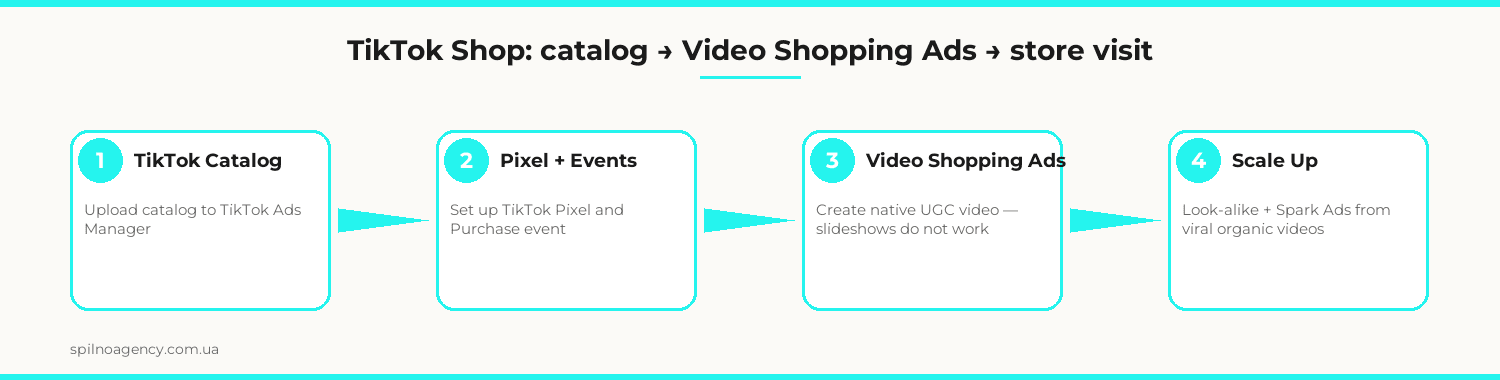
TikTok became a serious e-commerce ad channel in 2024–2025. TikTok Shop (embedded checkout) is available in select markets; Catalog Ads and Video Shopping Ads via TikTok Ads Manager work everywhere — the user clicks through to your site after watching the product video.
Why TikTok matters in 2026
- CPM 2–3× lower than Meta in most markets.
- 18–35 audience — the dominant buying segment for fashion, beauty, accessories, consumer electronics.
- Vertical video — TikTok has a 5-year head start that Meta is still catching up to via Reels.
- Spark Ads — promote organic viral videos as ads tied to your catalog.
What does NOT work on TikTok Ads
Feed-based slideshows. TikTok’s algorithm optimizes for native video of 7+ seconds. Slideshow carousels get CPM 5× the average. Invest in UGC video production or partner with TikTok creators.
Step-by-step TikTok Catalog launch
- Create a TikTok Business Account.
- TikTok Ads Manager → Assets → Catalog Manager → upload feed (XML/CSV).
- Install TikTok Pixel + Events API on the site.
- Produce 3–5 native vertical videos (9:16, 15–30s, with captions). Production budget from $500.
- Launch Video Shopping Ads tied to the catalog. Starting budget $30–50/day per ad group.
- After 2 weeks — Spark Ads from your best organic TikTok content.
Channel 5: Google Ads — Search and Display
Classic text campaigns in Google remain critical for two scenarios:
- Brand queries. If your store has any recognition, competitors will bid on your brand. Brand defense is cheap and mandatory.
- High-intent commercial queries. “Buy iPhone 16 Pro Max 256GB”, “Bosch refrigerator price” — the user knows what they want. Search ads with price get 8–15% CTR.
Display + YouTube for remarketing and upper funnel. Performance Max absorbs much of these placements, but a separate Display campaign with manual placement control is still useful for branding.
Channel 6: SEO and Content — The Bedrock of Paid Traffic
SEO does not compete with paid traffic — it amplifies and de-risks it.
How SEO improves paid campaign ROAS
- Brand queries for free. Your site must rank #1 for your store name — otherwise you pay Google Ads for your own brand.
- Look-alike audiences from SEO traffic. Users arriving via informational queries seed higher-quality look-alikes for Meta and TikTok than random interest buckets.
- Quality Score. Google Ads discounts CPC up to 50% for sites with low bounce rate and good UX. Technical SEO directly improves these signals.
- Categories and filters. Optimized category URLs rank in both Shopping and organic, capturing more SERP real estate.
SEO priorities for an online store
- Technical audit. Load time < 2.5s (Core Web Vitals), mobile-first, sitemap.xml, robots.txt, HTTPS, canonical tags on pagination.
- Semantic mapping per category. Each category = standalone landing with unique H1, 300–800-word description, optimized title.
- Product pages. Unique descriptions (not manufacturer-copy), Schema.org/Product markup with reviews, price, availability.
- Informational content. Blog covering product selection, comparisons, how-tos. Captures top-funnel queries that later convert.
- Backlinks. PR placements on relevant media; guest posts in vertical blogs.
Budget Allocation Across Channels
Default split for a new online store (monthly budget $3 000–10 000):
- 40% — Google Ads (Performance Max via Merchant + Search for brand and high-intent)
- 25% — Meta (Catalog DPA-remarketing + Advantage+ Shopping)
- 15% — price aggregators (where available in market)
- 10% — TikTok Catalog (with mandatory native UGC video)
- 10% — new-format tests (Pinterest, Reels Ads, YouTube Shorts)
After 2–3 months, reallocate by actual ROAS. Cut channels below 3×, scale channels above 6× (+20% budget per week).
KPIs to Track
- ROAS (Return on Ad Spend) — the primary metric. Target for e-commerce: 4–6× at average margin, 8×+ at high margin.
- CPA (Cost per Acquisition) — compare against LTV (Lifetime Value).
- CTR — Shopping Ads 1–3%, Meta Catalog DPA 1.5–4%, TikTok Video Shopping 0.8–2%.
- Conversion Rate — online store norm 1.5–3.5%; premium segment 0.5–1.5%.
- Cart Abandonment Rate — over 70% is normal; over 85% signals checkout or trust issues.
E-commerce Paid Traffic Launch Checklist
- Product feed (XML/CSV) generated with all required fields
- Google Merchant Center configured and domain verified
- Performance Max launched with feed and audience signals
- Connected to relevant price aggregator(s) for your market
- Meta Catalog created in Commerce Manager
- Meta Pixel + Conversion API installed on key pages
- DPA remarketing live in Meta
- Advantage+ Shopping Campaign launched
- TikTok Catalog created and Pixel installed
- 3–5 native UGC vertical videos shot for TikTok Video Shopping Ads
- Brand defense Search campaign live in Google Ads
- Analytics configured: GA4 + Enhanced Ecommerce + UTM on every channel
- Technical SEO audit completed (Core Web Vitals, mobile, Schema.org)
- Weekly ROAS-based budget reallocation scheduled
Frequently Asked Questions
Which channel should an online store start with?
Google Merchant Center + Performance Max — the e-commerce foundation in 2026. A properly configured product feed automatically powers Shopping Ads, Performance Max, YouTube, and Display. Highest ROAS at launch: shoppers see image, price, and store before they click. Layer in Meta Catalog, TikTok Catalog, and price aggregators next.
What is a product feed and why is it critical?
A feed is a structured file (XML, TXT, or Google Sheets) with product data: title, price, SKU, image, availability, GTIN, description. Every 2026 ad system (Merchant, Meta, TikTok, Amazon, price aggregators) runs on a feed. Without a clean feed you cannot run any e-commerce-specific tool — only plain text ads, which cost more and convert worse.
Is TikTok Ads worth it for an online store?
Yes — if your audience is 18–35 and the niche is visually demonstrable (fashion, beauty, electronics, accessories). TikTok Shop and Video Shopping Ads work via the product catalog. CPM is 2–3× lower than Meta in most markets, but conversion requires native video creative — feed-based slideshows do not perform.
How should I split the budget between channels?
Default split for a new store: 40% Google Ads (Merchant/Shopping + Search), 25% Meta Catalog (remarketing + look-alike), 15% price aggregators, 10% TikTok Catalog, 10% tests. After 2–3 months reallocate by ROAS: cut channels under 3×, scale channels above 6×.
How does SEO support paid traffic?
SEO lowers average cost per acquisition. Brand SEO queries pull traffic you would otherwise pay Google Ads for. Informational content fuels look-alike audiences for remarketing. Technical SEO reduces Bounce Rate, which improves Quality Score in paid campaigns. On a 12+ month horizon organic traffic delivers ROAS 15–30× — unmatched by any paid channel.
How long does Performance Max take to optimize?
First 2 weeks — machine learning phase: ROAS will fluctuate. Do not pause campaigns before 4 weeks even if it “looks broken”. After 4–6 weeks the algorithm stabilizes. Critical conditions: minimum 30–50 conversions per week, clean feed, audience signals configured.
Do price aggregators still matter in 2026?
Yes — they are the most underrated paid channel for e-commerce in CEE and Eastern Europe. Hotline (Ukraine), Ceneo (Poland), Skroutz (Greece), Heureka (Czech) and similar platforms own up to 30% of price-comparison traffic in their markets. Buyer intent is far higher than on social: users are 2–3 clicks away from purchase.
Need to launch paid traffic for your online store? Spilno Agency configures Google Merchant, price aggregators, Meta Catalog, and TikTok Catalog as one connected system with per-channel ROAS reporting.

Read also

Is an SEO specialist responsible for leads and sales? Our position
A LinkedIn discussion: should an SEO specialist be responsible for leads and sales from the SEO channel. Spilno…
How to Control an SEO Specialist: The 5-Stage SEO KPI Funnel
SEO KPIs form a chain of five metrics that show, step by step, whether your SEO is actually…
Best CMS for an Online Store: Cloud vs Self-Hosted Platforms in 2026
Compare Shopify, WooCommerce, PrestaShop, OpenCart and Magento for your online store. Pros, cons, and a step-by-step CMS selection…