What Is Dropshipping and Is It Still Worth It in 2026?

Dropshipping is an online retail model where the seller takes the order and payment from the customer but never holds stock — the supplier packs and ships the product straight to the buyer. In 2026 the model still works, but it has changed: the low competition and easy money associated with 2015–2019-era dropshipping are long gone. This guide covers how the model works, whether it’s still worth entering now, how much money you need to start, and which mistakes to avoid.
What is dropshipping in simple terms
Dropshipping is a sales model where an online store sells a product it doesn’t physically keep in stock. When a customer places and pays for an order, the seller forwards that order to a supplier (a manufacturer or a wholesale warehouse), and the supplier packs and ships the product directly to the end customer. In this setup, the seller acts as the storefront and marketer — responsible for the store, advertising and customer service, but not for manufacturing, storage or logistics.
The seller’s profit is the difference between the price paid to the supplier and the price charged to the customer. For example, if a supplier sells a product for €4, and the store sells it for €12, the seller’s margin is €8 minus advertising costs, payment processing fees and running costs.
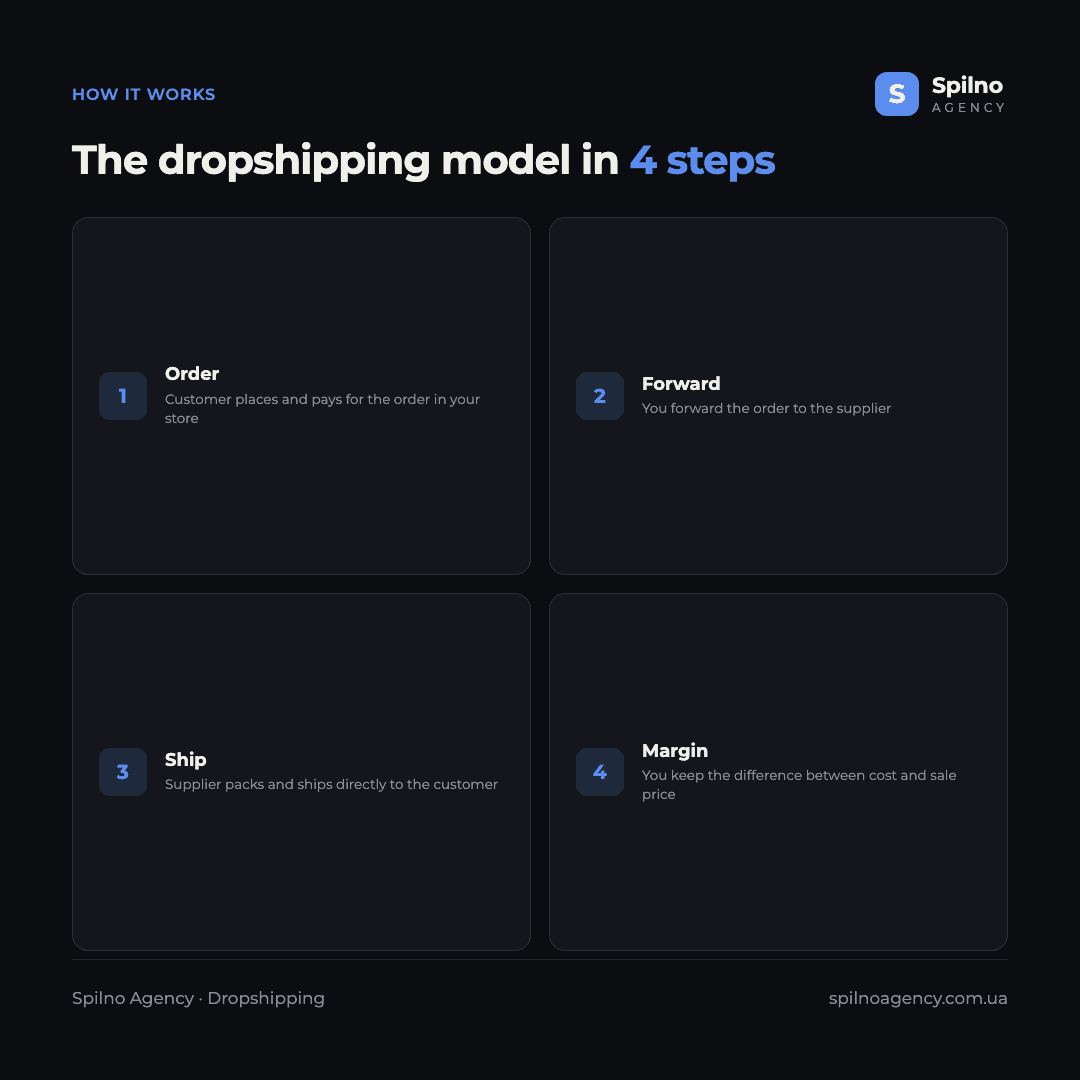
How the dropshipping model works: a 4-step flow
Technically the process is the same across every niche, from apparel to electronics:
- The customer places and pays for an order in your online store.
- You forward the order details to the supplier (manually or automatically via an integration).
- The supplier packs the product and ships it directly to the customer, often in neutral packaging without their own branding.
- You keep the difference between the wholesale price and the retail price, minus advertising, fees and ongoing costs.
The key difference from classic retail is that the seller never physically sees or handles the product. This lowers the barrier to entry, but it also takes away the seller’s control over packaging quality, delivery times and exactly what the customer receives.
Is dropshipping still worth it in 2026?
Short answer: yes, but the 2026 version of the model looks very different from the “easy money” of the mid-2010s. Global e-commerce keeps growing, and dropshipping remains part of it — but the barrier to entry has shifted from financial to skill-based.
- Competition has multiplied. Millions of stores on Shopify, WooCommerce and other platforms are fighting for the same audience, so cloning someone else’s store product-for-product no longer works.
- Advertising has gotten more expensive. Meta Ads and Google Ads CPCs and lead costs have risen over the past few years — without well-optimised campaigns, ad spend eats the margin.
- AI tools have sped up launches. Product-description generation, automated supplier sourcing, and order automation apps have significantly shortened the technical setup.
- Customers have become more demanding. Delivery speed, transparent returns and reviews matter more than a low price alone — stores that work with regional suppliers offering shorter shipping times win.
- Niche focus and branding win over generic stores. Stores building a recognisable brand around a focused niche with quality content are pushing out “a bit of everything” stores with a random assortment.
In short, dropshipping in 2026 isn’t a way to make quick money effortlessly — it’s a business like any other e-commerce venture, requiring a marketing strategy, brand-building and solid customer service. Getting started is easy; consistent profit takes systematic work.
Pros and cons of dropshipping
Before you start, it’s worth weighing both sides of the model honestly:
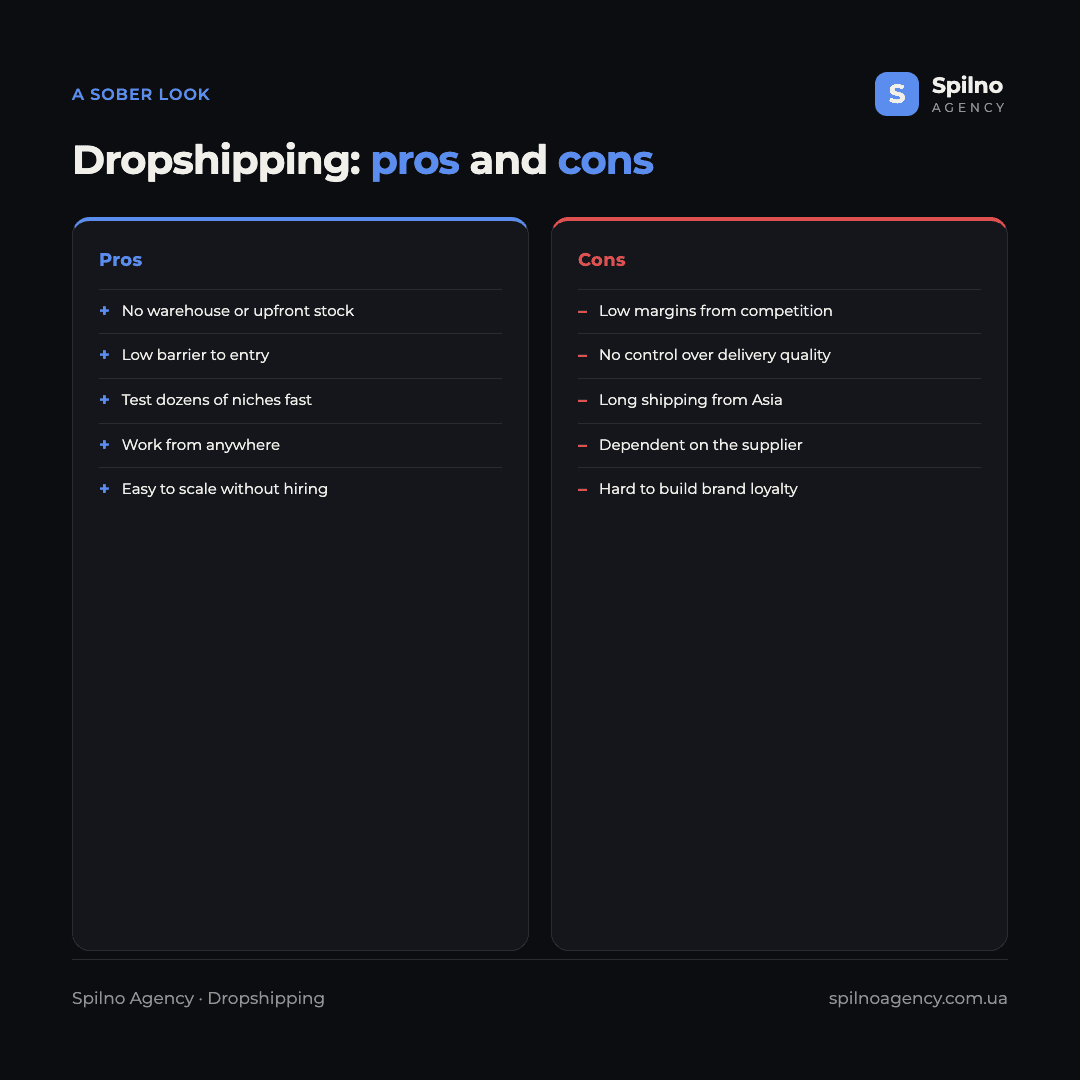
The main takeaway from this comparison: dropshipping reduces financial and operational risk at launch, but shifts the risk onto service quality and control over the customer experience. That’s worth factoring in when you pick a niche and a supplier.
How much money do you need to start dropshipping?
You genuinely can start dropshipping on a small budget — but “no investment” in practice means “minimal investment,” not free. A rough breakdown of starting costs:
- Store setup — from free store builders to paid Shopify plans or a self-hosted WooCommerce store.
- Domain and basic design — a small fixed yearly cost.
- Testing ad budget — usually the biggest line item: you need to budget for testing several products and audiences in Meta Ads or Google Ads before finding a working product–offer–audience combination.
- Automation tools — product-sourcing and order-automation services often have a free starter tier.
A realistic approach is to set aside enough budget for a few weeks of testing different products and ad creatives, rather than expecting profit from day one. Most stores that eventually reach stable revenue went through several failed niche tests before finding a working one.
How to start dropshipping: a step-by-step guide
- Pick a niche. Focus on products that solve a clear problem rather than copying whatever’s “trending” in someone else’s video — the most obvious trends have the highest competition.
- Vet the supplier. Order the product yourself first, check packaging quality, real delivery times, and whether the item matches the photos and description.
- Build the store. The minimum viable version needs a working catalogue, clear checkout, and transparent shipping and returns terms.
- Launch ads with a small test budget. Run several creatives and audiences at once so you can quickly rule out what doesn’t work.
- Track your unit economics. Watch margin, not revenue — after subtracting product cost, shipping, ads and payment fees — since margin is what tells you whether a niche is worth scaling.
- Scale what works. Once a product–offer–audience combination shows consistent profit, gradually increase ad spend and expand the assortment around that winning product.
Popular platforms and suppliers
For the storefront, most sellers choose Shopify (with a large ecosystem of dropshipping apps) or a self-hosted WooCommerce store on WordPress. Suppliers are typically sourced through AliExpress and CJdropshipping for international fulfilment, or through regional wholesale suppliers, which offer shorter delivery times — a factor that has a major impact on customer satisfaction and return rates.
Common beginner mistakes in dropshipping
- Cloning someone else’s store product-for-product without any positioning or added value — such stores get lost among hundreds of identical ones.
- Working with an unvetted supplier without a test order first — the risk of defects, mixed-up shipments or missed deadlines can wreck a store’s reputation.
- Betting everything on one product with no diversification — when demand drops or the supplier disappears, the store is left with no revenue.
- Ignoring unit economics — launching ads without calculating real margin often means running at a loss even though revenue looks fine.
- No transparent shipping and returns policy — especially critical with long shipping times: customers who don’t know when their order will arrive are more likely to file chargebacks.
FAQ
What is dropshipping in simple terms?
It’s a retail model where the seller takes the order and payment from the customer but doesn’t hold stock — the supplier packs and ships the product directly to the customer. The seller earns the difference between the wholesale price and the retail price.
Is dropshipping still worth it in 2026?
Yes, the model still works, but competition and advertising costs have risen sharply compared to 2015–2019. Stores with a focused niche, vetted suppliers and solid unit economics win — not attempts to quickly clone someone else’s successful store.
How much money do you need to start dropshipping?
The starting budget can be small — the main costs are the store, a domain and a testing ad budget to validate products and audiences. “No investment” in practice means minimal investment, not zero.
How is dropshipping different from regular online retail?
In regular retail, the seller buys and stores inventory in their own or a rented warehouse. In dropshipping, the supplier stores and ships the product, and the seller is only responsible for the store, marketing and customer service.
What are the main risks of dropshipping?
Low margins due to high competition, no control over packaging quality and delivery times, dependency on the supplier’s reliability, and longer shipping when working with suppliers overseas.
How do I choose a niche for dropshipping?
Pick a niche that solves a specific problem for your target audience, rather than just copying a trending product from someone else’s video. Niches where you can build a recognisable brand and an assortment around it perform best — better than betting on a single random product.
Dropshipping in 2026 is a real, but now “grown-up,” business model: getting started is simple, while consistent results require real work on your niche, suppliers and advertising. If you need help setting up Google Ads or Meta Ads for an e-commerce project, calculating unit economics, or building an SEO strategy for your online store, the Spilno Agency team is ready to help at any stage.

Read also

Is an SEO specialist responsible for leads and sales? Our position
A LinkedIn discussion: should an SEO specialist be responsible for leads and sales from the SEO channel. Spilno…
How to Control an SEO Specialist: The 5-Stage SEO KPI Funnel
SEO KPIs form a chain of five metrics that show, step by step, whether your SEO is actually…
Best CMS for an Online Store: Cloud vs Self-Hosted Platforms in 2026
Compare Shopify, WooCommerce, PrestaShop, OpenCart and Magento for your online store. Pros, cons, and a step-by-step CMS selection…