Remarketing: What It Is and Which Services Offer It in 2026

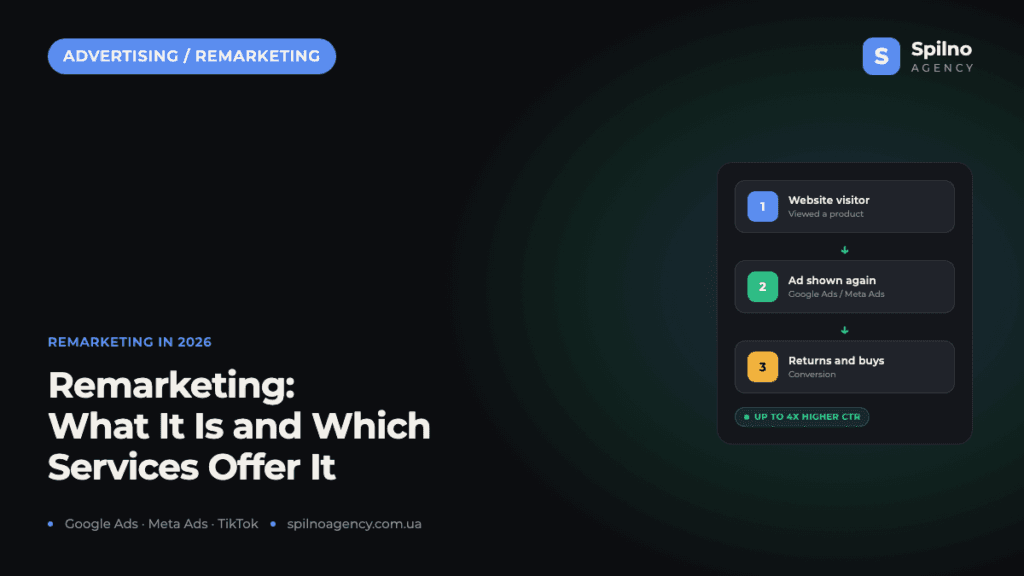
Remarketing means showing ads to people who already visited your website, opened your app, or viewed a product but didn’t convert. In 2026, remarketing is available across Google Ads, Meta Ads, Microsoft Advertising, TikTok Ads, LinkedIn Ads, Pinterest, Snapchat, and dedicated platforms such as Criteo and AdRoll.
What is remarketing
Remarketing is a digital advertising format that shows ads to people who already had contact with your brand: visited your site, added a product to their cart, watched a video, or installed your app, but didn’t complete the desired action. Instead of targeting a cold audience that knows nothing about the business, remarketing targets a warm audience — people who already showed interest.
It’s one of the most cost-efficient ad formats: click-through rates in remarketing campaigns are typically 2–4 times higher than in campaigns targeting new audiences, and cost per conversion is lower, since the user is already familiar with the product and only needs a reminder or an extra nudge to complete the purchase.
How remarketing works technically
Every remarketing setup relies on three building blocks:
- A tag or pixel — a tracking snippet (Google tag,
Meta Pixel, GA4 tag via Google Tag Manager) installed on the site or in the app. - An audience (remarketing list) — a segment of users built from an event:
page_view,view_item,add_to_cart,purchase, and so on. - Sync with an ad platform — the list is passed to Google Ads, Meta Ads, or another network, which then shows ads to those exact people on other sites, in apps, or in their social feed.
One important detail: a well-built campaign always excludes anyone who has already completed the target action (e.g. purchased) — otherwise you’re spending budget on ads that no longer serve a purpose.
Remarketing vs retargeting — what’s the difference
One of the most common questions on this topic is how remarketing differs from retargeting. In practice, most marketers use the two terms interchangeably, but historically the distinction looked like this:
- Remarketing — the term Google uses: showing ads (Display, Search, YouTube) and sending emails to a list built from your own site data.
- Retargeting — the term more commonly used by agencies and dedicated platforms (Criteo, AdRoll): showing banner ads based on cookie/pixel tracking across a network of partner sites.
Today both terms describe the same core idea: showing ads to people who already had contact with your brand. Throughout this article we use “remarketing” as the umbrella term.
Main types of remarketing
Standard (list-based) remarketing
The simplest format: banner ads shown to everyone on the remarketing list, regardless of which specific pages they viewed.
Dynamic remarketing
Shows the exact products or services a user viewed on the site, powered by a data feed (e.g. Google Merchant Center or Meta’s product catalog). This is the most effective format for e-commerce: the user sees an ad for the exact jacket or phone they left in their cart.
Search remarketing (RLSA)
RLSA (Remarketing Lists for Search Ads) lets you adjust bids or ad copy in Google Ads search campaigns depending on whether a person has previously visited your site.
Video remarketing
Ads on YouTube shown to people who already watched your brand’s videos, visited your channel, or visited your website — effective for boosting recall and re-engagement.
Email remarketing
Automated emails for abandoned carts or browse abandonment (viewed but not purchased products) — one of the cheapest and most effective channels for bringing users back.
Customer list remarketing (Customer Match)
Uploading an email or phone list from your CRM into an ad platform to show ads to existing customers (cross-sell, repeat purchases) or to build lookalike audiences.
Which services offer remarketing in 2026
Remarketing is supported by virtually every major ad platform today. Here’s an overview of the key services and what each one is best suited for.
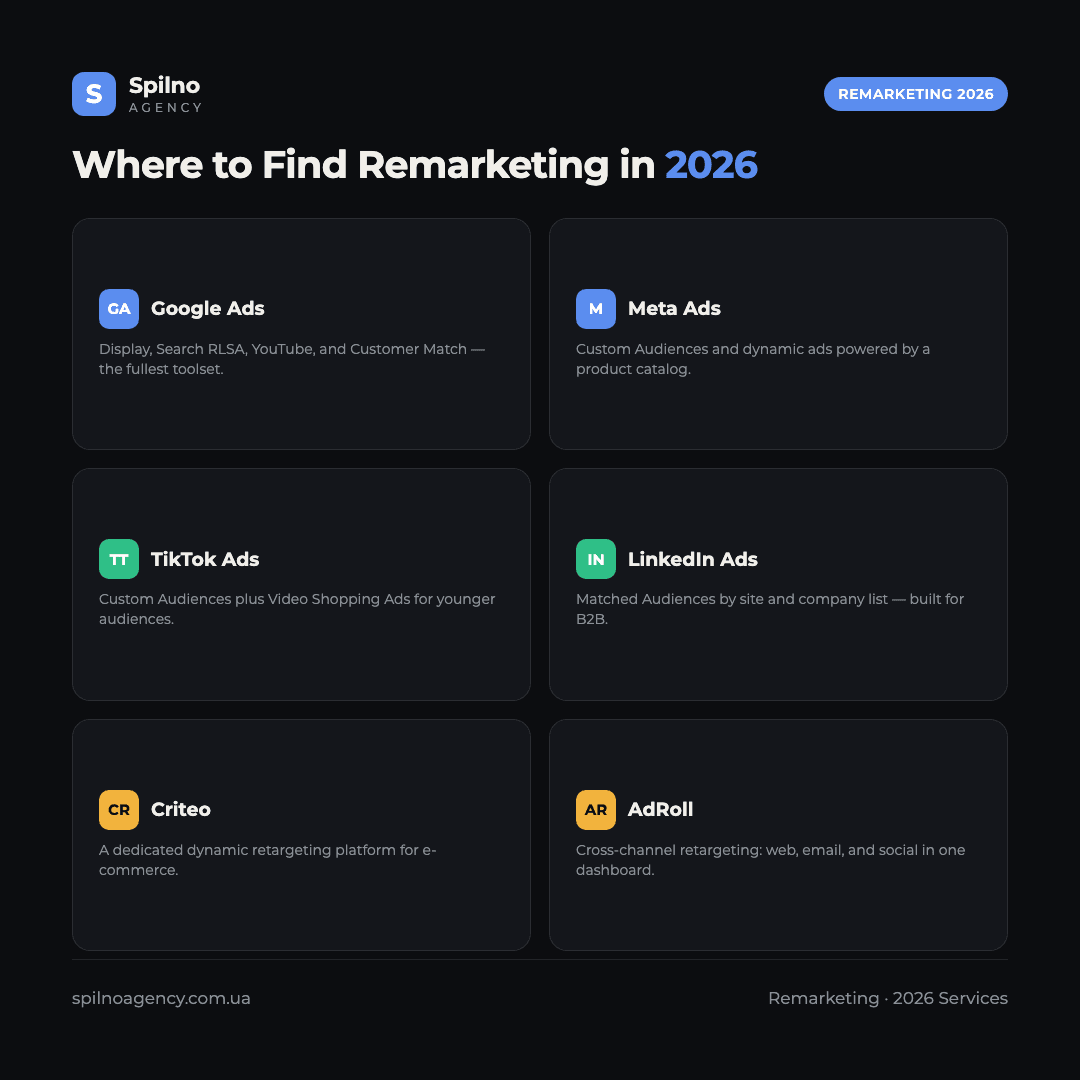
Google Ads
The most complete toolset: standard and dynamic remarketing on the Display Network, RLSA in Search, video remarketing on YouTube, and Customer Match. Requires the Google tag (via GTM) and GA4 audiences.
Meta Ads (Facebook and Instagram)
Custom Audiences based on website visitors, content engagement, or a customer list, plus dynamic ads powered by a product catalog. One of the most cost-efficient remarketing channels per impression.
Microsoft Advertising (Bing Ads)
An RLSA equivalent for the Bing search network plus banner remarketing via the UET tag. A less competitive channel, often cheaper per click compared to Google Ads.
TikTok Ads
Custom Audiences based on site traffic, in-app actions, or video engagement, plus Video Shopping Ads powered by a product catalog. Works well for younger audiences and impulse purchases.
LinkedIn Ads
Matched Audiences: remarketing to website visitors, company lists, or contact lists. The best fit for B2B, where the decision cycle is longer and needs multiple touchpoints.
Pinterest Ads
Remarketing to website visitors and customer lists — a strong fit for design, home décor, fashion, and wedding/event niches.
Snapchat Ads
Custom Audiences powered by the Snap Pixel — remarketing for younger audiences, popular across European and North American markets.
Criteo
A dedicated dynamic retargeting platform for e-commerce with its own publisher network and cross-device tracking. Often used to complement Google Ads and Meta Ads for larger online stores.
AdRoll
A cross-channel retargeting platform (web, email, social) in a single dashboard — popular among small and mid-sized European e-commerce businesses.
Email platforms (Klaviyo, SendPulse, Mailchimp)
Automated email flows triggered by on-site behaviour — abandoned cart, browse abandonment, and repeat discount reminders.
Infographic: remarketing services at a glance
How to choose a remarketing service for your business
- E-commerce: Google Ads (dynamic remarketing) plus Meta Ads (Dynamic Ads) as the foundation, with Criteo as an additional scaling channel.
- B2B: LinkedIn Matched Audiences combined with Google RLSA — a longer sales cycle needs multiple touchpoints.
- SaaS / apps: Meta Ads and TikTok Ads with remarketing based on in-app events (sign-up, trial, payment).
- Local business and services: Google Display remarketing plus Meta Ads — the lowest budget entry point.
Remarketing best practices for 2026
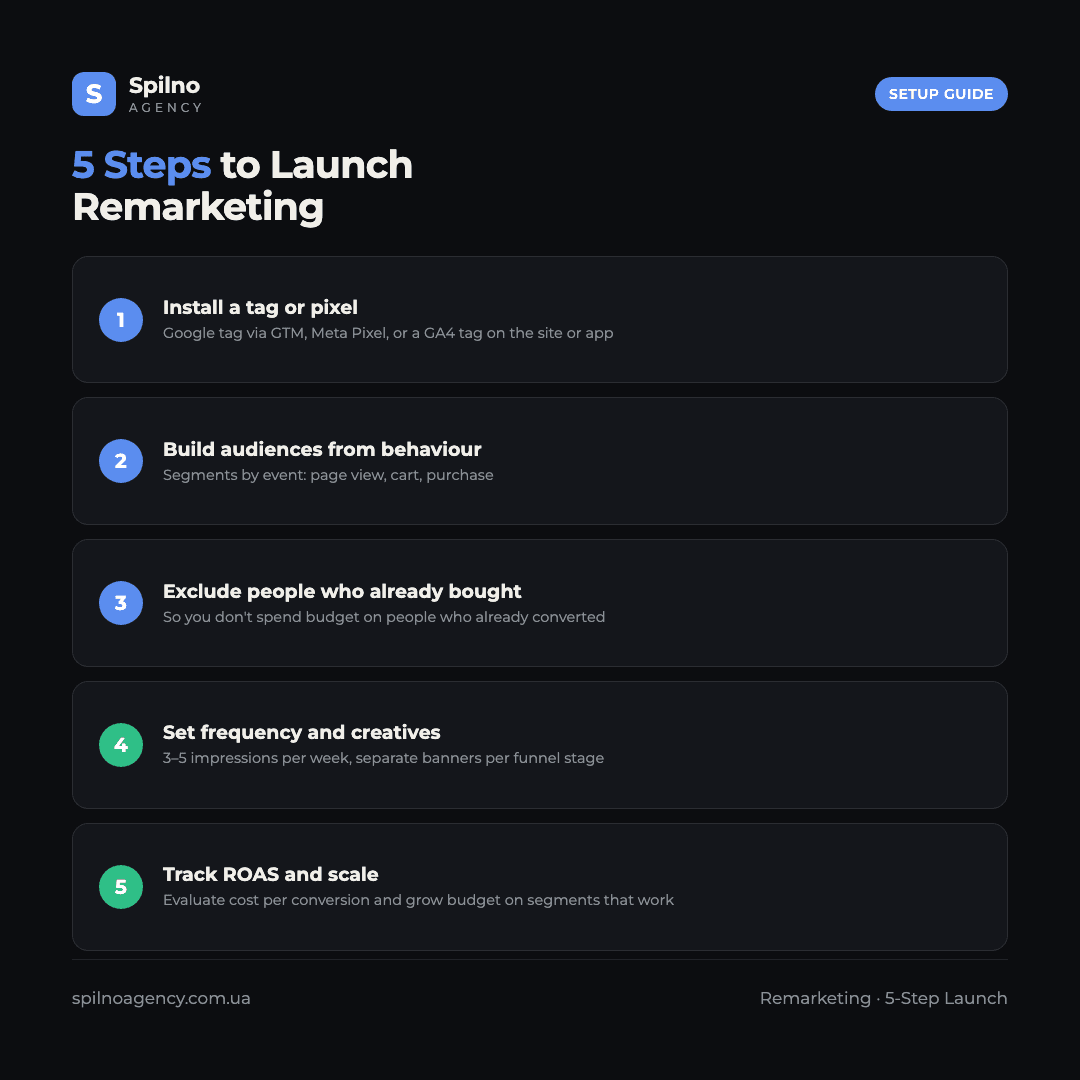
- Exclude converters — otherwise you waste budget showing ads to people who no longer need them.
- Cap frequency — 3–5 impressions per week per user is usually enough to avoid ad fatigue.
- Segment by funnel stage — use different creatives for people who only viewed a page versus those who added a product to their cart.
- Use dynamic creatives — personalised ads convert better than static banners.
- Respect Consent Mode v2 and privacy requirements — remarketing depends on cookie consent; without a correctly configured Consent Mode, your audiences will be incomplete.
- Refresh creatives every 2–4 weeks — stale banners lower CTR and raise cost per conversion.
Infographic: 5 steps to launch remarketing
Conclusion
Remarketing remains one of the most cost-efficient ways to bring back users who already showed interest in a brand and move them toward a purchase. In 2026, the toolset extends far beyond Google Ads and Meta Ads — TikTok, LinkedIn, Pinterest, Snapchat, and dedicated platforms like Criteo and AdRoll let European businesses build remarketing that fits virtually any niche and budget.
If you need help setting up remarketing or auditing your existing campaigns, the Spilno Agency team is ready to help.
Frequently asked questions about remarketing
What is remarketing in simple terms?
Remarketing means showing ads to people who already visited your website, opened your app, or viewed a product but didn’t complete a purchase. The goal is to remind them about the brand and bring them back.
What’s the difference between remarketing and retargeting?
Historically remarketing is Google’s term, while retargeting is used by dedicated cookie/pixel-based platforms. Today both terms are mostly used interchangeably.
How much does it cost to launch remarketing?
A few tens of euros per day is enough for testing. Cost per conversion is usually lower than in new-audience campaigns, since the audience is already warm.
Which services offer remarketing in 2026?
Google Ads, Meta Ads, Microsoft Advertising, TikTok Ads, LinkedIn Ads, Pinterest Ads, Snapchat Ads, plus Criteo, AdRoll, and email services like Klaviyo or SendPulse.
Can you run remarketing without a website, for example for an app?
Yes, via in-app events (Firebase, MMP platforms, the native SDKs of Meta Ads and TikTok Ads) — no website is required.
How long should remarketing target a single user?
30 to 90 days depending on the decision cycle: 14–30 days for impulse purchases, 60–180 days for B2B and high-value purchases.

Read also

Is an SEO specialist responsible for leads and sales? Our position
A LinkedIn discussion: should an SEO specialist be responsible for leads and sales from the SEO channel. Spilno…
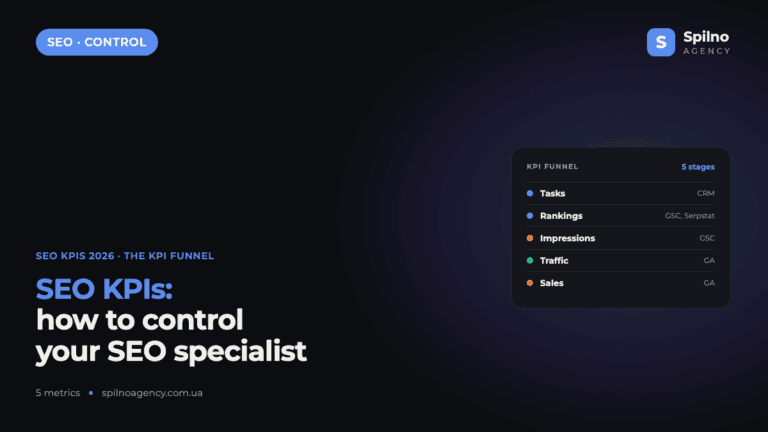
How to Control an SEO Specialist: The 5-Stage SEO KPI Funnel
SEO KPIs form a chain of five metrics that show, step by step, whether your SEO is actually…
Best CMS for an Online Store: Cloud vs Self-Hosted Platforms in 2026
Compare Shopify, WooCommerce, PrestaShop, OpenCart and Magento for your online store. Pros, cons, and a step-by-step CMS selection…