The Marketing Funnel: How to Use Digital Marketing Tools at Every Stage

The marketing funnel isn’t a textbook abstraction — it’s a map of real user decisions: from the moment they first see your brand in TikTok, to clicking “Buy” in Google Shopping, to returning a year later for a repeat purchase. In 2026, in markets like Ukraine, that path spans 5–7 channels and 8–15 touchpoints: Reels, Google search, Hotline, Meta remarketing, email triggers, push, SMS. The digital marketer’s job isn’t to “run ads” — it’s to match the right tool to each stage of the funnel. In this guide we break down which SEO, Google Ads, Meta Ads, TikTok Ads and Hotline tools work at TOFU, MOFU, BOFU and LOYALTY, which KPIs belong at each level, and how to design a customer journey where every channel reinforces the others instead of competing with them.
What the marketing funnel is and why it matters
A marketing funnel is a model describing the user’s journey from first brand contact through purchase and repeat sale. The “funnel” metaphor works because the top stage attracts the widest audience (tens of thousands of impressions), while only a few buyers come out the other end. Every stage is a filter — it screens out people not ready to buy and moves the ready ones forward.
For a business the funnel serves three practical purposes. One — diagnostics. If 100,000 people land in your store every month and only 50 buy, the bottleneck could be anywhere: wrong traffic, weak comparison content, expensive products, painful checkout. Without a funnel, all you see is “low sales” — you don’t know what to fix. Two — budget allocation. The funnel tells you which channel works on which stage: PMax on BOFU, TikTok Reels on TOFU, email on retention. Three — KPIs and reporting. At TOFU you don’t demand sales from advertising — you demand reach. At BOFU it’s the opposite: reach is secondary, ROAS and CPA rule.
Classic models: AIDA, AARRR, See–Think–Do–Care
The marketing funnel isn’t one universal template — it’s a family of complementary models. The most popular: AIDA (Attention → Interest → Desire → Action), AARRR by Dave McClure for SaaS and e-commerce (Acquisition → Activation → Retention → Referral → Revenue), and See–Think–Do–Care by Avinash Kaushik — the model Google uses for planning modern digital campaigns.
For day-to-day work in e-commerce and services, it’s most practical to use a simplified four-tier model: TOFU / MOFU / BOFU / LOYALTY. It maps cleanly onto ad-platform structures (Awareness → Consideration → Conversion + Retention in Meta, different campaign objectives in Google Ads) and is easy enough for both a business owner and a media buyer.
The four funnel stages: TOFU, MOFU, BOFU, LOYALTY
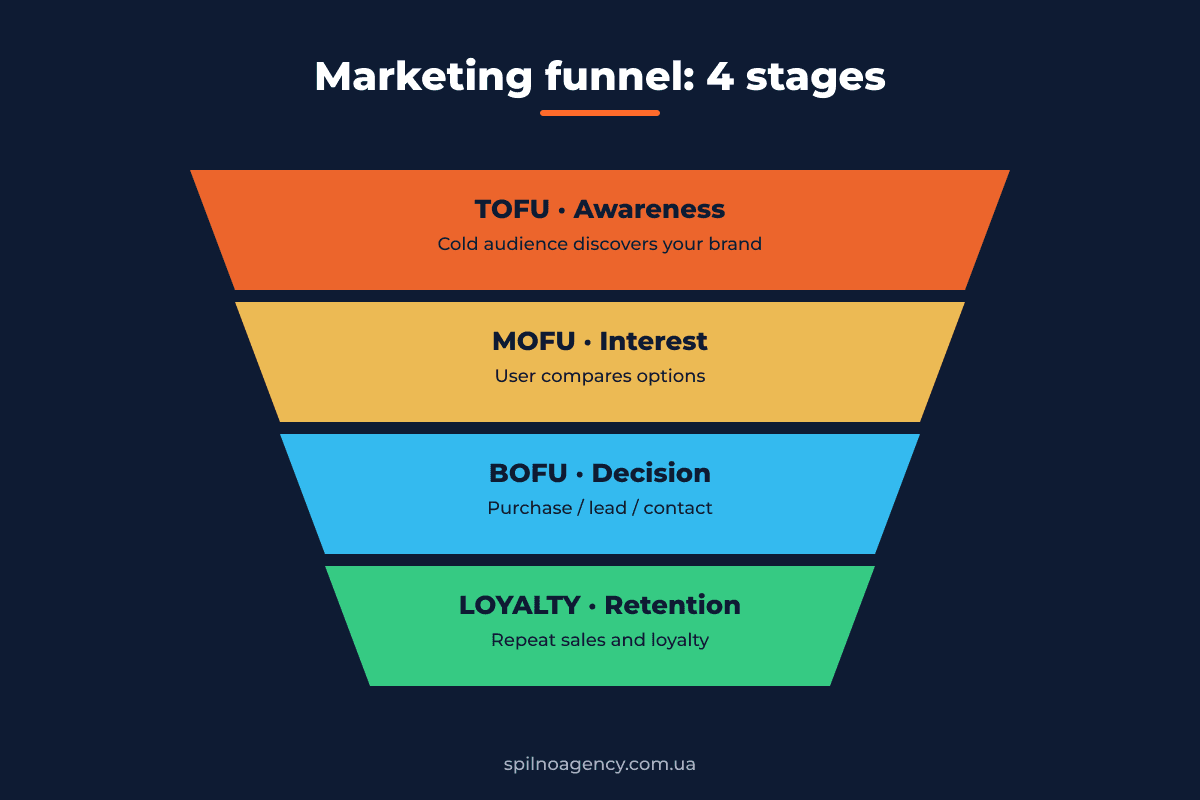
TOFU (Top of the Funnel — Awareness). Cold audience. The user doesn’t know your brand and often isn’t even aware of the need. The marketer’s task is to get into the field of view: deliver useful content, show the product in a native format, hit the pain. Metrics: Reach, Impressions, CPM, video views, brand search lift.
MOFU (Middle of the Funnel — Interest / Consideration). The user has identified the need and is looking for a solution. They read reviews, compare options, watch testimonials, land on your site, scroll product cards. Metrics: CTR, CPC, time on page, scroll depth, wishlist adds, add-to-cart.
BOFU (Bottom of the Funnel — Decision / Action). The user is ready to buy — they just have to choose “where”. They check prices on Hotline, search your brand on Google, evaluate shipping and returns. Metrics: CR%, CPA / CPL, ROAS, AOV, cart abandonment.
LOYALTY (Retention + Referral). The customer has already purchased. Now the goal is to bring them back, sell again, get reviews and referrals. Metrics: LTV, repeat rate, NPS, churn, share of traffic from email and direct.
Digital marketing tools by funnel stage
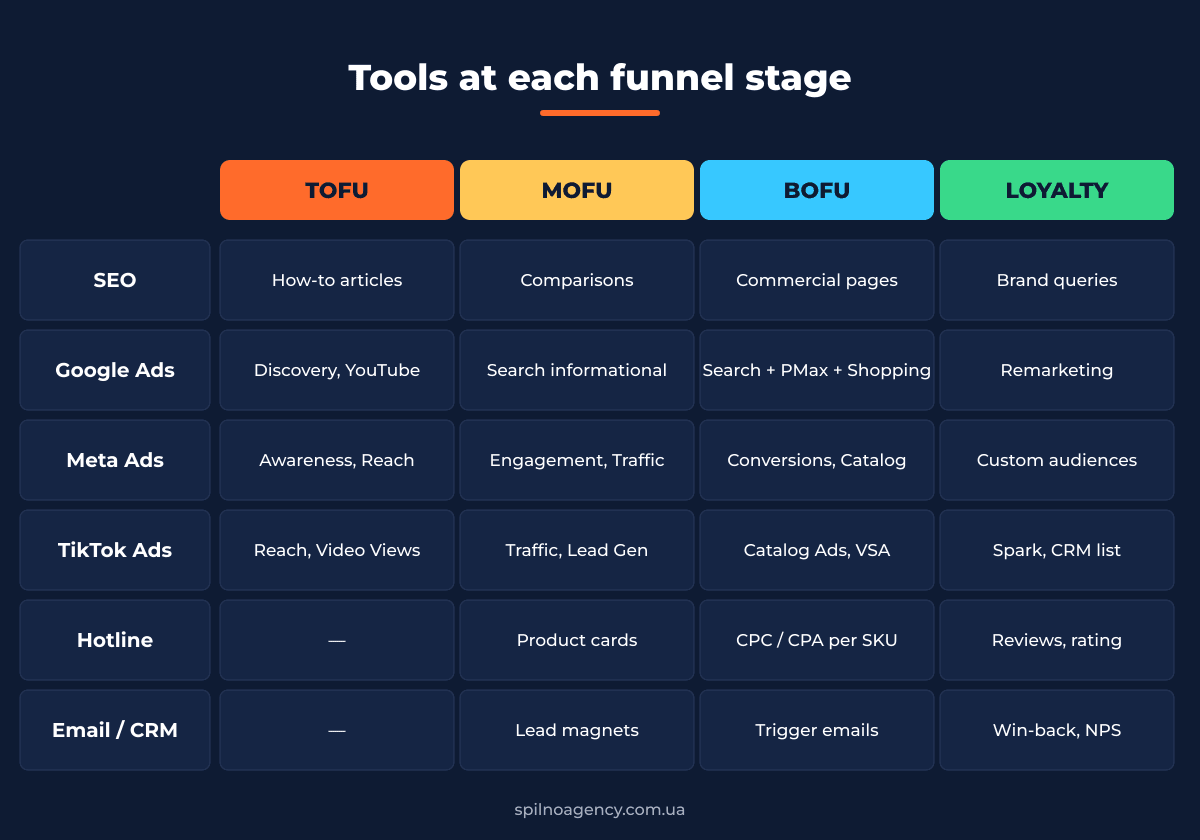
Every channel can work on 2–3 stages at once, but it does so using different formats. Below is a practical breakdown by stage, oriented towards the Ukrainian and CEE market.
SEO — the foundation of the entire funnel
SEO is the only channel that works on all four funnel levels at once, while delivering the best long-term ROI. Informational queries (“what is a marketing funnel”, “how to choose a laptop”) work on TOFU. Comparison and review queries (“iPhone 15 vs Samsung S24”, “best CRM for Ukraine”) — on MOFU. Commercial queries (“buy iPhone 15 Kyiv”, “Lenovo laptop price”) — on BOFU. Branded queries (“Spilno Agency reviews”, “MOYO store”) — on LOYALTY: they signal that the brand is recognised and is keeping a loyal audience.
What an SEO marketer actually does: builds a semantic core across stages, clusters queries, designs a content map (informational articles → comparisons → commercial pages), handles technical optimisation (Core Web Vitals, schema, mobile), grows the link profile. A separate big topic — SEO for e-commerce: categories, filters, product cards, reviews.
Important: in 2026 a new layer has emerged — GEO (Generative Engine Optimization): optimization for ChatGPT, Perplexity, Google AI Overviews. Brands actively publishing structured expert content with strong Domain Rating start appearing in AI answers as recommendations.
Google Ads: Search, PMax, Discovery, YouTube
Google Ads is the most flexible channel — it covers the entire funnel through different campaign types.
- Search informational queries (TOFU / MOFU) — ads on broad queries like “how to choose running shoes”. Don’t expect instant sales — this is brand introduction.
- Search commercial queries (BOFU) — ads on “buy Nike Pegasus 41 Kyiv”. The most expensive CPC, but the best CR. A mandatory baseline format for any e-commerce.
- Performance Max (PMax) (MOFU + BOFU) — a hybrid campaign running simultaneously on Search, Display, YouTube, Discover, Maps and Gmail. With Merchant Center connected, PMax becomes the #1 sales driver for e-commerce: the algorithm distributes impressions between products and audiences automatically. Running PMax without Merchant Center in 2026 is a strategic mistake for any online store.
- Shopping campaigns / Merchant Center (BOFU) — product ads with image, price and store name right in Google search. Targets users who know exactly what they want. High competition but excellent ROAS with a well-structured feed.
- Discovery / Demand Gen (TOFU + MOFU) — ads in YouTube Shorts, Gmail Promotions, Discover feed. Format looks like an organic post. Great for launch campaigns.
- YouTube Ads (TOFU) — bumper (6 sec), skippable in-stream, in-feed video. The best channel for storytelling to a cold audience.
- Remarketing / RLSA (BOFU + LOYALTY) — bringing back people who have already interacted with the site. Separate strategies for abandoned carts, viewed products and repeat purchases.
Meta Ads: Facebook, Instagram, Threads, Catalog
Meta Ads (Facebook Ads Manager) in 2026 is essentially “one dashboard for four platforms”: Facebook, Instagram, Messenger and Threads. Plus Reels, Stories and Marketplace placements.
- Awareness / Reach campaigns (TOFU) — optimization for reach and CPM. Works well for launching a new brand or product.
- Traffic / Engagement (MOFU) — driving traffic to a blog post, landing page or Instagram profile. Cheap CPC, good for warming up.
- Conversions (BOFU) — the main BOFU campaign. Pixel + Conversion API send events (add-to-cart, purchase) into Meta; the algorithm optimises for users likely to buy.
- Catalog Ads / Advantage+ Shopping (BOFU) — dynamic remarketing from your product feed. A user views a product on your site → sees it in Instagram Stories 30 minutes later. Works as a magnet for abandoned carts.
- Custom Audiences + Lookalike (TOFU + LOYALTY) — ads on lookalikes (1–3%) of your buyers. For LOYALTY — uploading a CRM base and running win-back campaigns.
- Threads in 2026 appeared as a separate placement in Meta Ads Manager — still cheap CPM, especially effective for B2B and tech audiences.
TikTok Ads: Catalog, Spark, Video, Lead Gen
TikTok in Ukraine has grown from “a channel for teenagers” into a full-blown performance channel covering 18–44. Thanks to high engagement and a native video format, TikTok is especially efficient at TOFU+MOFU — and with Catalog Ads, also at BOFU.
- Reach / Video Views (TOFU) — the cheapest CPM among social networks in Ukraine (often $0.5–$2 vs $3–6 on Meta). The best channel for mass product discovery.
- Traffic / Lead Generation (MOFU) — site visits and in-app lead capture. Lead Gen Form fills in two taps.
- Catalog Ads / Video Shopping Ads (VSA) (BOFU) — product video ads tied to your feed. An analogue of Meta Catalog Ads, expanded to most EU markets and Ukraine in 2026.
- Spark Ads (TOFU + MOFU + LOYALTY) — promoting organic videos (yours or creator-made). They get better engagement than standard ads because they look like organic content.
- Custom Audiences — CRM upload, retargeting users who engaged with your videos or visited your site.
Hotline — the Ukrainian price comparison engine
Hotline is Ukraine’s #1 price comparison aggregator (around 20–25 M monthly visits). It’s a very specific BOFU channel: the user arrives at Hotline already knowing what to buy — they’re hunting for the cheapest price and the highest-rated store.
- Product cards (MOFU) — publishing your catalog with prices, descriptions and photos. A free-ish (CPC-only) way to appear in Hotline results.
- CPC / CPA ads (BOFU) — pay-per-click or pay-per-sale. Hotline is one of the few channels where you can run on a CPA model.
- Reviews and store rating (LOYALTY) — a critical trust factor. Stores with a 4.5+ rating get 2–3× more clicks.
For a deep dive into Hotline advertising, see our dedicated guide “Hotline advertising in 2026“.
Email marketing and CRM channels (MOFU + BOFU + LOYALTY)
Email and messengers (Viber, Telegram bots) deliver the cheapest cost per conversion — but only once you’ve built a base. Stages:
- Lead magnets (MOFU) — trading a valuable asset (checklist, first-purchase discount) for an email.
- Welcome series (MOFU → BOFU) — 3–5 emails that introduce the brand and lead to a first purchase.
- Trigger emails (BOFU) — abandoned cart, browse-abandonment, discount reminder.
- Win-back, NPS, retention series (LOYALTY) — recovering dormant customers, loyalty surveys, referral programs.
KPIs at each funnel level
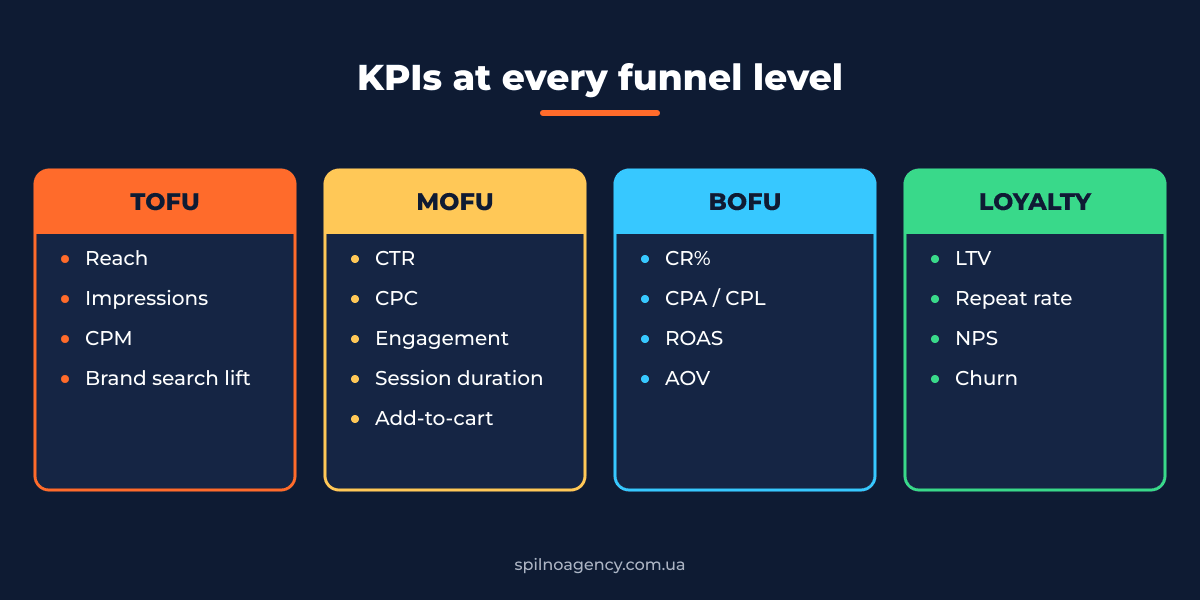
One of the most common mistakes is applying BOFU KPIs (ROAS, CPA) to TOFU campaigns. If you launched a YouTube bumper that reached 500,000 people for $300 and got zero sales — that’s fine. The KPI for this campaign is CPM (≤$1) and brand search lift (+10–25% branded queries in Google within 7–14 days).
TOFU: Reach, Impressions, CPM, video views, brand search lift, % new audience. MOFU: CTR, CPC, time on site, scroll depth, pages per session, add-to-cart, wishlist. BOFU: CR%, CPA / CPL, ROAS, AOV, cart-to-purchase ratio. LOYALTY: LTV, repeat purchase rate, share of repeat orders, NPS, churn, share of email + direct traffic, share of buyers using referral promo codes.
Customer journey: an e-commerce example
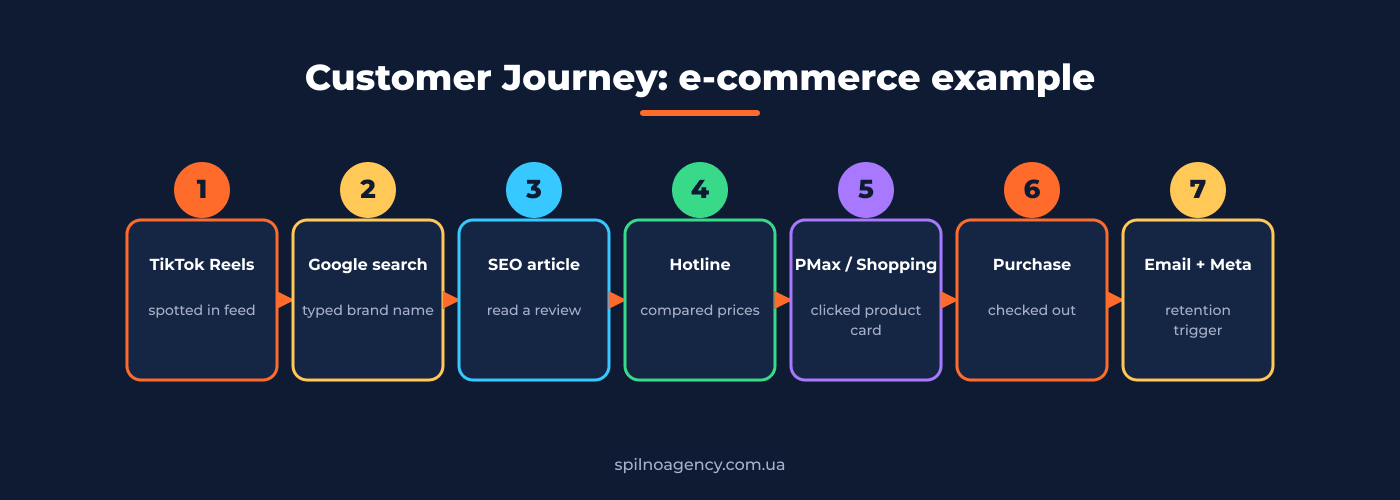
Let’s look at a real journey using the example of buying running shoes. Touchpoint 1 (TOFU): Anna scrolls TikTok and sees an influencer’s Reel about shoes from brand X. Touchpoint 2 (MOFU): two days later she types “brand X running shoes review” into Google and lands on an SEO review article. Touchpoint 3 (MOFU): she reads for 4 minutes and clicks through to the brand’s site. Touchpoint 4 (MOFU): a week later she searches “buy brand X shoes” — lands on Hotline and compares prices across 5 stores. Touchpoint 5 (BOFU): she goes back to Google, sees a PMax Shopping ad for the right model and clicks. Touchpoint 6 (BOFU): she completes checkout. Touchpoint 7 (LOYALTY): three weeks later she receives a trigger email with recommended socks plus a Meta Catalog Ads remarketing creative — she buys again.
That’s 7 touchpoints across 5 channels in 30 days. If you only had Google Ads Search enabled, you would see touchpoint 5 and conclude “Google ads pay off”. In reality, TikTok and SEO did the heavy lifting on awareness and consideration. That’s why attribution belongs in every marketing report (GA4 data-driven attribution, post-purchase survey “how did you hear about us”, UTMs on every source).
How to pick the right tools for your business
There’s no universal “everyone gets 5 channels” formula. The right mix depends on three things: business stage, margin, and product type.
New brand / startup (LTV still unknown). Start with two channels: SEO + one performance channel (Meta Ads or Google Ads, depending on the product). Minimum test budget — $1,500–3,000 per channel over 60 days. Until you have data, don’t fragment your spend.
Local business (services, physical store). Google Search + Google Maps + local SEO (Google Business Profile) are must-haves. Meta Ads for warming, Hotline only if you sell physical goods.
Broad-catalog e-commerce. Mandatory minimum: Merchant Center + PMax + Meta Catalog Ads + Hotline + SEO. Competing without Merchant Center in 2026 is essentially impossible.
B2B / services with long sales cycle. SEO (expert content) + Google Search + LinkedIn (if budget allows) + email marketing. TikTok and Meta are supplementary, not core.
D2C brand / fashion / lifestyle. TikTok + Instagram Reels + Meta Catalog + email is the core. SEO is built in parallel but pays off more slowly.
Common funnel mistakes
1. Running only BOFU channels. “We need sales, so we only do Search and PMax.” Within 2–3 months CPA climbs and the BOFU audience runs out — nobody is warming new people in TOFU/MOFU.
2. Applying sales KPIs to TOFU. Killing a reach campaign after two weeks “because no sales” is the textbook mistake that caps brand growth.
3. Ignoring retention. Acquiring a new customer costs 5–7× more than retaining one. Without email/CRM marketing, you hit a growth ceiling.
4. Skipping attribution. Crediting sales to the last-click channel means systematically underinvesting in TOFU and MOFU.
5. Letting the funnel get stale. PMax was an experiment in 2024 — it’s a standard in 2026. TikTok Shop, AI Overviews, GEO — a new layer appears every 6–12 months. The funnel has to evolve.
FAQ — frequent questions
Can I skip TOFU if I’m a local business?
If your brand is already recognised in your city — partly yes, BOFU channels (Google Maps, Search) can be enough. But as a new player, Search CPC quickly becomes unprofitable without TOFU/MOFU warming.
How much does it cost to build a full-funnel setup in Ukraine?
Minimum working e-commerce budget — $3,000–5,000/mo on performance + base SEO. For a brand with category-leader ambitions — $15,000+/mo.
Which channel works fastest?
Google Search BOFU + Meta Conversions — first sales typically appear in 7–14 days. The slowest is SEO (3–6 months to first rankings), but it has the best long-term ROI.
Does PMax replace all other Google campaigns?
No. PMax gives no per-query visibility and is weak on cold audiences. Branded queries, competitor bidding, expert Search campaigns still require dedicated campaigns.
How many touchpoints does an average purchase need?
Per Google and Meta data — 7–13 touchpoints for e-commerce, 20+ for complex B2B.
Conclusion
The marketing funnel in 2026 isn’t a “PowerPoint diagram” — it’s a working checklist to verify whether every stage of the customer’s journey is covered by the right tool. SEO covers the entire funnel as a foundation. Google Ads provides flexibility through 6+ campaign types. Meta and TikTok are the backbone for cold-audience work and remarketing. Hotline is mandatory BOFU for Ukrainian e-commerce. Email + CRM close LOYALTY.
You don’t have to launch everything at once. But you do need a map showing which stages are running and which are gaps. Most businesses in Ukraine live with an empty TOFU and one or two BOFU channels — then wonder why growth has stalled. Build the full funnel and you’ll get both short-term results (sales) and long-term ones (brand and loyalty).
If you need help building a full-funnel strategy, Spilno Agency works end-to-end — from SEO and content to performance campaigns in Google Ads, Meta, TikTok and Hotline. Request a consultation.

Read also
Google Tag Manager Workspaces: Why You Need Them and How to Use Them in 2026
A workspace in Google Tag Manager is a “draft” of a container — a place to safely edit…
How to Track Revenue, Transactions and Purchases in Google Analytics 4 from WordPress WooCommerce
Introduction WooCommerce store owners are often convinced that Google Analytics 4 already shows them revenue, transaction counts and…
How to Analyze Hourly Statistics in Google Analytics 4
Google Analytics 4 has no dedicated “hourly statistics” menu item, but you can get that exact breakdown in…