Case Study: Auto Parts Store Advertising in Google Ads — +17% Orders, -21% CPL

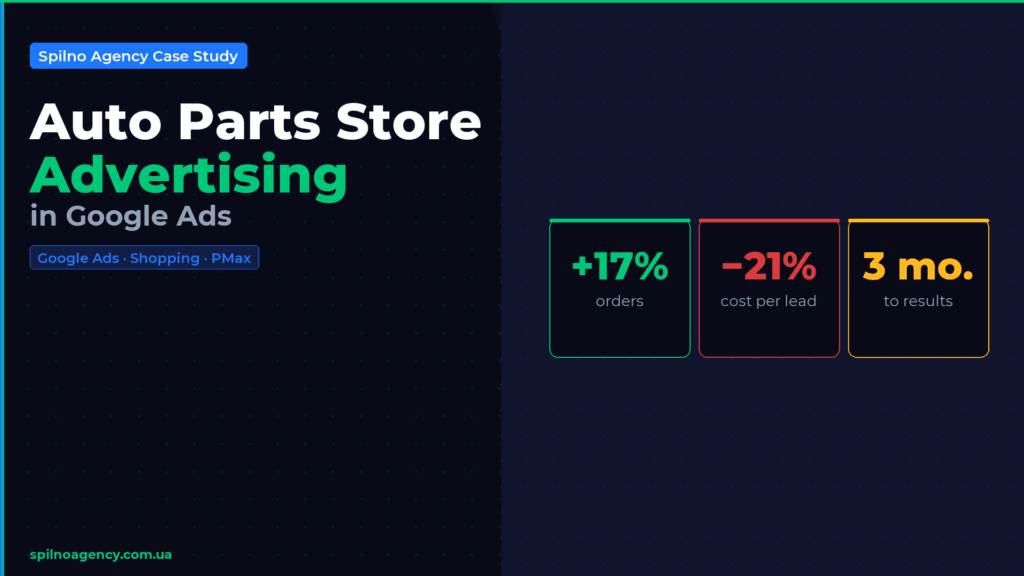
Spilno Agency case study: managing Google Ads for an auto parts e-commerce store — Search, Google Shopping and Performance Max. In 3 months we grew leads by 17% and cut cost per lead from 315 to 249 UAH (-21%). Here is exactly how we did it.
About the Client
The client is an online auto parts store with nationwide delivery across Ukraine. Core product categories include car turbines, high-pressure fuel pumps, fuel injectors and related components. The store primarily serves popular passenger car brands: Toyota, BMW, Mercedes, Volkswagen and Ford.
Before contacting Spilno Agency, the client was already running Google Ads through another agency. Sales were acceptable, but the client wanted more. The core problem was not ad performance — it was communication speed.
The Challenge
At the initial meeting the client was direct: “The ads are working fine. But when I want to add a new campaign or change something in an existing one, it takes a week to get a response. For an e-commerce business that is simply too slow.”
Beyond the communication issue, our initial account audit uncovered several technical problems:
- GA4 conversion tracking was incomplete — phone calls and live-chat leads were not being recorded.
- Budget was split evenly across all campaigns regardless of performance.
- Search ad CTR was below the category benchmark.
- Performance Max was running without any audience signals configured.
Solution: Structure and Communication
The first step was resolving the communication issue. At Spilno Agency every client receives a dedicated project team of three specialists:
- Project Manager — handles all client communication, logs tasks and tracks deadlines. The client always knows the status of any request.
- Internet Marketer — manages campaigns: launches, optimisation and A/B testing.
- Team Leader — owns overall strategy and team quality.
This structure allows account work and client communication to run in parallel — the PM and the marketer operate independently without blocking each other. Tasks are tracked in a CRM with deadlines and statuses, so the client has real-time visibility.
Google Ads Strategy for the Auto Parts Store
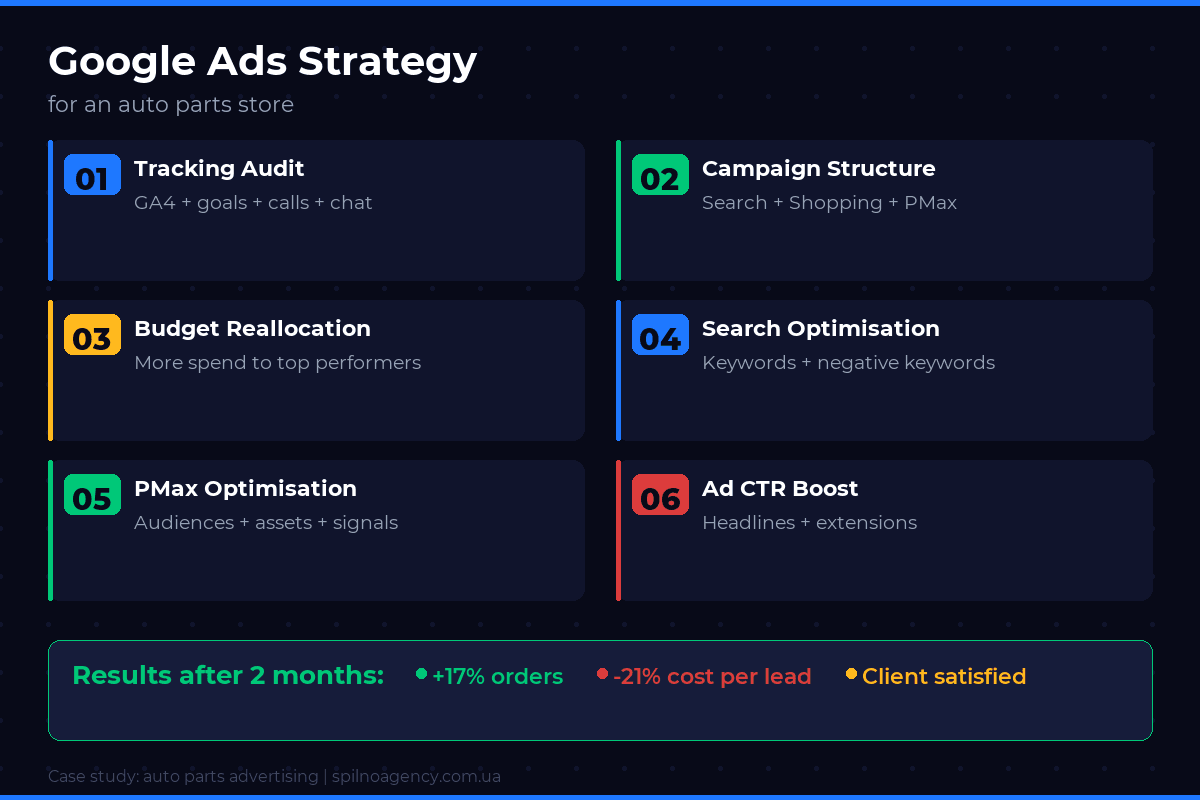
With communication resolved, we moved on to the technical work. Our strategy followed six steps.
Step 1. Conversion Tracking Audit
We never begin optimisation without complete tracking. We audited and fixed:
- All contact form submissions (GA4 + Google Ads conversions)
- Phone call tracking via dynamic number insertion
- Live chat conversions
- Micro-conversions: catalogue browsing and add-to-cart events
It turned out that only 60% of actual leads were being recorded. This had been distorting all reports and optimisation decisions.
Step 2. Campaign Audit and Restructuring
We analysed all active campaigns by CPL, ROAS and conversion rate, then sorted them into three groups:
- High performers (low CPL, steady leads) — budget increased by 30–40%
- Average performers — keywords and ads optimised
- Poor performers (CPL above target) — paused or fully rebuilt
Step 3. Search Campaign Optimisation
Keyword structure for auto parts has its own logic. We rebuilt it around three tiers:
- High-intent queries: part name + car make + model (e.g. “Toyota Land Cruiser 200 turbo”)
- OEM part numbers: customers searching by part number are the warmest audience
- Parts brand searches: Bosch, NGK, Denso, Gates — brand + part type
- Negative keywords: excluded DIY/repair content (how to fix, video, forum, diagram)
Step 4. Performance Max Optimisation
The PMax campaign needed significant rework:
- Configured audience signals: remarketing lists (30-day and 90-day site visitors), similar audiences, in-market auto parts buyers
- Refreshed campaign assets: keyword-rich headlines, video assets, quality product images
- Connected the Google Merchant Center feed — PMax began serving Shopping ads
- Added competitor brand exclusions to filter low-quality traffic
Step 5. Ad CTR Improvement
Low CTR means expensive traffic. We rewrote ads focusing on:
- Competitive advantages in headlines (fast delivery, warranty, genuine parts)
- Dynamic keyword insertion (DKI) in headlines
- Structured descriptions listing brands and categories
- Extensions: pricing for popular products, promotions, sitelinks to category pages
Step 6. Regular Optimisation and Reporting
Every two weeks we held a call with the client to review the previous period, set new tasks and adjust budgets. Transparent reporting: a weekly Google Sheets dashboard with all key metrics.
Results
We started in September. For comparison we used August — the last full month run by the previous agency.
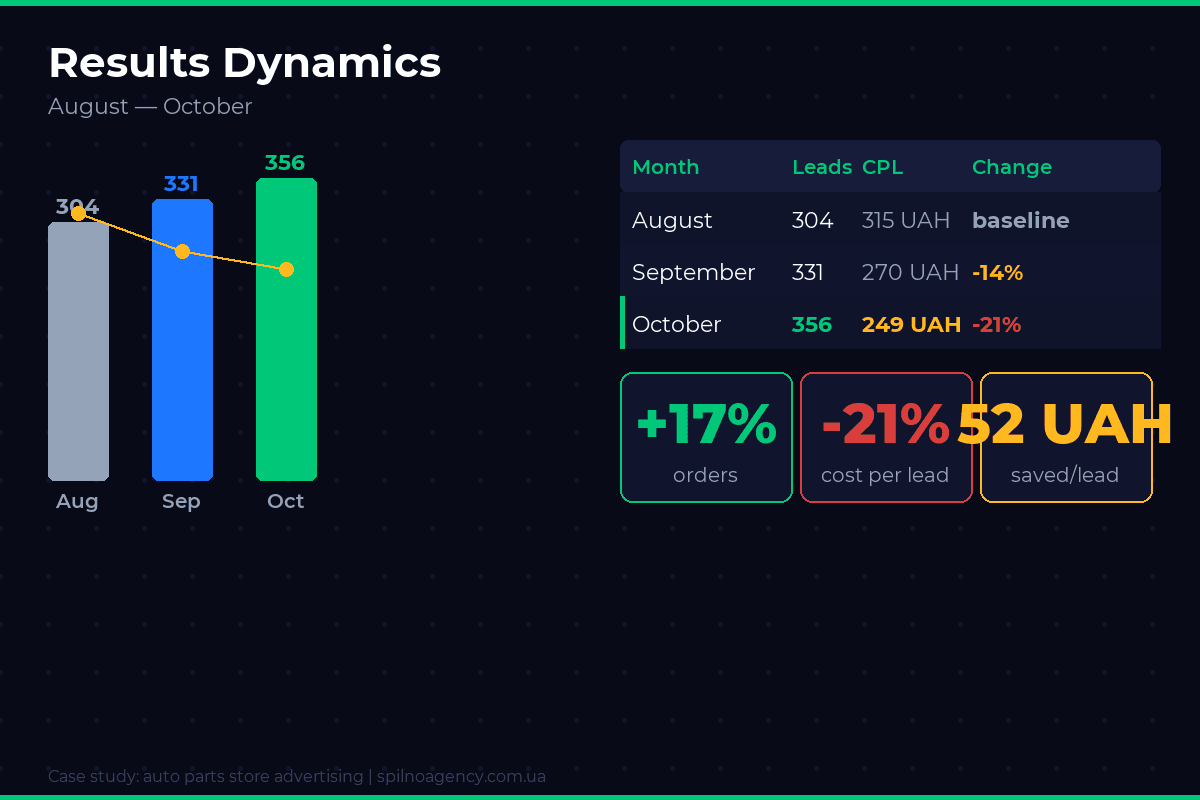
| Month | Leads | Cost per Lead | CPL Change |
|---|---|---|---|
| August (before us) | 304 | 315 UAH | — |
| September (month 1) | 331 | 270 UAH | −14% |
| October (month 2) | 356 | 249 UAH | −21% |
Overall results after 2 months:
- Leads grew by 17% (304 → 356)
- Cost per lead fell by 21% (315 → 249 UAH)
- Saving per lead: 66 UAH
- At 356 leads/month this equals a monthly budget saving of 23,496 UAH
A lead is a qualified enquiry from a potential customer: a phone call, a completed contact form or a live-chat message.
Strategy Step by Step
Key Takeaways
What this case study taught us — and what applies to any auto parts store:
- Tracking comes first. If not all conversions are recorded, every optimisation decision is based on incomplete data. Start with a GA4 audit.
- Not all campaigns perform equally. Shifting budget to high performers delivers fast results without increasing total spend.
- Auto parts keyword structure is unique. Part + make + model → OEM number → parts brand. Generic queries like “buy car parts” convert far worse.
- PMax requires proper setup. Without audience signals and a quality feed, PMax wastes budget. With the right configuration it scales your best-converting traffic.
- Communication speed = implementation speed. The faster the agency acts on new tasks, the more tests can be run each month — and the better the results.
Following these results, we planned the next phase with the client: expanding to Meta Ads and SEO for organic traffic growth.
Want similar results for your store? Request a free Google Ads audit.
Frequently Asked Questions
How to advertise an auto parts store with Google Ads?
The most effective combination: Google Shopping (product listing ads with photo, title and price), Search campaigns with structured keywords (part + make + model + year), and Performance Max for scaling. Always configure GA4 conversion tracking before launching any campaigns.
What is a realistic cost per lead for auto parts in Google Ads?
In this case study CPL reached 249 UAH after optimisation, down from 315 UAH. The actual figure depends on your niche, competition and website quality. A ROAS of 400–700% is a solid benchmark for the auto parts category.
How long does it take to see results from Google Ads for auto parts?
Early optimisation signs appear within the first month. Significant lead growth and CPL reduction typically follow after 2–3 months. Performance Max needs a 4–6 week learning period before delivering full results.
What is Performance Max for an auto parts store?
Performance Max (PMax) is an automated Google Ads campaign type that shows ads across all Google channels: Search, Shopping, YouTube, Display, Gmail and Maps. For auto parts it performs best with a quality Merchant Center product feed and properly configured audience signals.
How to reduce cost per lead in auto parts advertising?
Key tactics: shift budget to campaigns with the lowest CPL, add negative keywords to filter irrelevant traffic, improve ad CTR with stronger headlines and extensions, optimise landing pages for speed and clear CTAs, and set up remarketing for previous site visitors.

Read also
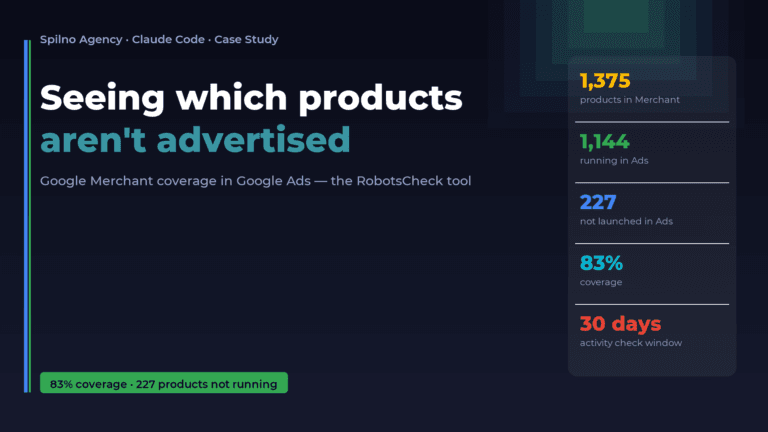
How Claude Helps Spilno Agency: Google Merchant Coverage in Google Ads
An online store lists 1,375 products in Google Merchant — but how many of them are actually running…
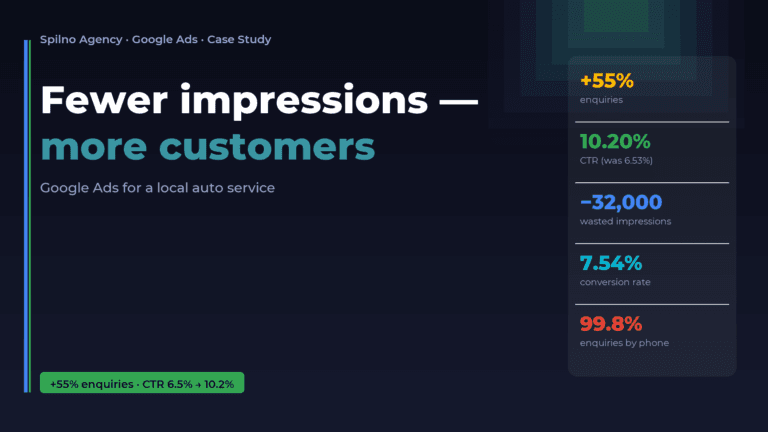
Google Ads for a Local Auto Service: Fewer Impressions, More Customers (Case Study)
A local auto service was spending its ad budget on tens of thousands of cheap impressions that barely…
Google Merchant API Changes: Migrate or Request an Extension by August 18, 2026
On August 18, 2026 Google sunsets the Content API for Shopping — migrate to the Merchant API or…