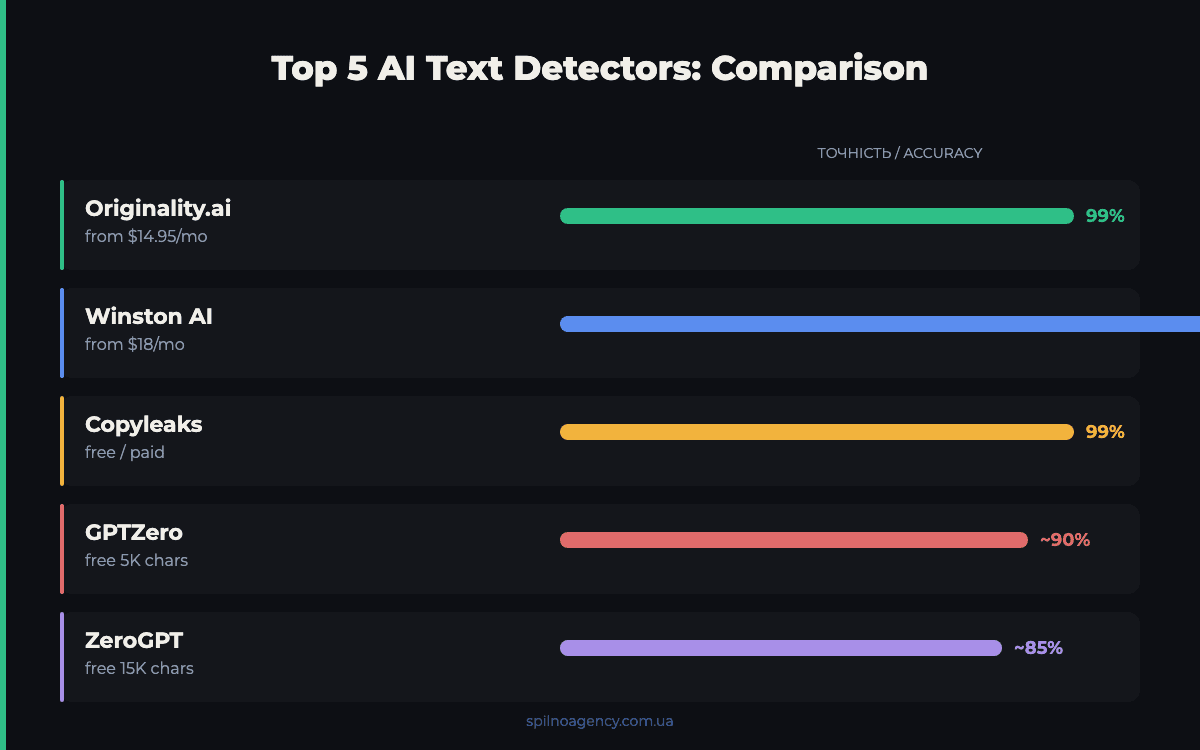
AI text detection is the process of analysing content with specialised tools that identify patterns typical of neural networks: word predictability, uniform sentence length, and the absence of human irregularities. The most accurate tools in 2026: Winston AI (99.6% accuracy), Originality.ai (99%, paid), Copyleaks AI Detector (30+ languages), GPTZero (free, 5,000 characters), ZeroGPT (free, 15,000 characters). No detector achieves 100% accuracy — experts recommend checking with 2–3 tools simultaneously.
What Is AI Text Detection and Why Does It Matter
Neural networks — ChatGPT, Gemini, Claude, Llama — are now accessible to millions. They’re used to write SEO articles, social media posts, academic papers, news stories and marketing materials. According to McKinsey’s State of AI 2025, 78% of organisations use AI in at least one business function, and content generation is among the most popular applications.
This creates new challenges. AI text detection is essential in these scenarios:
SEO and content marketing — unedited AI content weakens E-E-A-T signals and risks Helpful Content System penalties.
Journalism — verifying the authenticity of material before publication, guarding against disinformation.
Education and academia — universities check coursework and dissertations for AI authorship.
HR and recruitment — employers verify CVs, cover letters and test assignments from candidates.
Publishing — editorial teams and agencies control the quality of texts from contributors and freelancers.
How AI Text Detectors Work
AI detectors analyse two key parameters:
Perplexity — how predictable the words and phrases in a text are. Neural networks select the “most likely” next token, so their texts have low perplexity — they’re too predictable. Humans use unexpected turns of phrase, jokes and specific terminology that models rarely produce.
Burstiness — human texts have natural variation: short sentences alternate with long ones, complex paragraphs with simple ones. AI generates evenly — sentence after sentence of similar length and structure.
In plain terms: if a text reads “too smoothly” and every sentence is equally informative — the detector flags it as AI. Human text “breathes” unevenly.
Top 10 AI Text Detection Tools in 2026
Tool
Accuracy (EN)
Free limit
Price
Languages
Winston AI
99.6%
None
from $18/mo
Multilingual
Originality.ai
99%
None
from $14.95/mo or $0.01/100 words
EN + partial
Copyleaks AI Detector
99%
250 words/day
from $9.99/mo
30+ languages
Turnitin
98%
None (institutional)
For universities
30+ languages
GPTZero
~92%
5,000 characters
from $10/mo
EN, limited
ZeroGPT
~85%
15,000 characters
Free / Pro
Multilingual
Sapling AI Detector
~80%
Unlimited
Free / Pro
EN primarily
Writer.com
~82%
1,500 words
Free
EN
Hive Moderation
~88%
API demo
API-based
EN
Scribbr
~84%
1,000 words
Free
EN, DE, FR
Free AI Detectors: When and How to Use Them
ZeroGPT — most generous free limit
Analyses up to 15,000 characters for free with no registration. Simple interface: paste your text and get a percentage “AI probability” score with highlighted suspicious passages. Accuracy for non-English texts is roughly 70–75%. Ideal for quick preliminary checks.
GPTZero — best free AI detector
Built by Princeton student Edward Tian in 2023, GPTZero now has over 6 million users. Free tier analyses 5,000 characters and shows sentence-by-sentence analysis (which sentences are most likely AI-written). Accuracy for English: ~92%; for non-Latin scripts: ~70–75%.
Sapling AI Detector — no character limit
The only free detector with no character limit. Highlights each sentence: green for human, red for AI. Accuracy is lower (~80%), but it’s solid for a basic content audit. No registration required. Note: accuracy for non-native English writers can be lower — a 2024 Stanford study found false-positive rates were significantly higher for texts written by non-native speakers.
Paid AI Detectors: When to Invest
Originality.ai — the content agency standard
The most popular paid detector for SEO agencies and publishers. Checks for both AI and plagiarism simultaneously. Stores check history and supports team members. Cost: $14.95/month (unlimited) or $0.01 per 100 words (pay-as-you-go). API available for automated workflows.
Winston AI — highest accuracy on the market
Winston AI claims 99.6% accuracy in independent 2025 tests, including detection of “humanised” texts (content processed through AI-bypass services). Supports PDF, DOCX and Google Docs uploads. From $18/month. Particularly effective at detecting Gemini and Claude-generated content.
Turnitin — the academic standard
Turnitin is the most widely used tool in universities globally. Since 2023 it includes an AI detection module. Access is through an institution rather than a personal subscription. Accuracy ~98%, 30+ languages. In 2025, partial AI detection was added — identifying texts where AI assisted but didn’t write the entire piece.
Why AI Detectors Make Mistakes
False positives — formal documents, legal texts, technical manuals written by humans can be flagged as AI due to their predictable structure.
Non-English languages — most detectors were trained on English data. Accuracy for other languages drops by 15–25%.
AI humanisation services — tools like Undetectable.ai or manual editing significantly lower the “AI percentage” detected.
New model versions — each new release of GPT-4o, Claude 3.5 or Gemini 1.5 requires detector retraining.
How to Spot AI Text Without Tools: 7 Signs
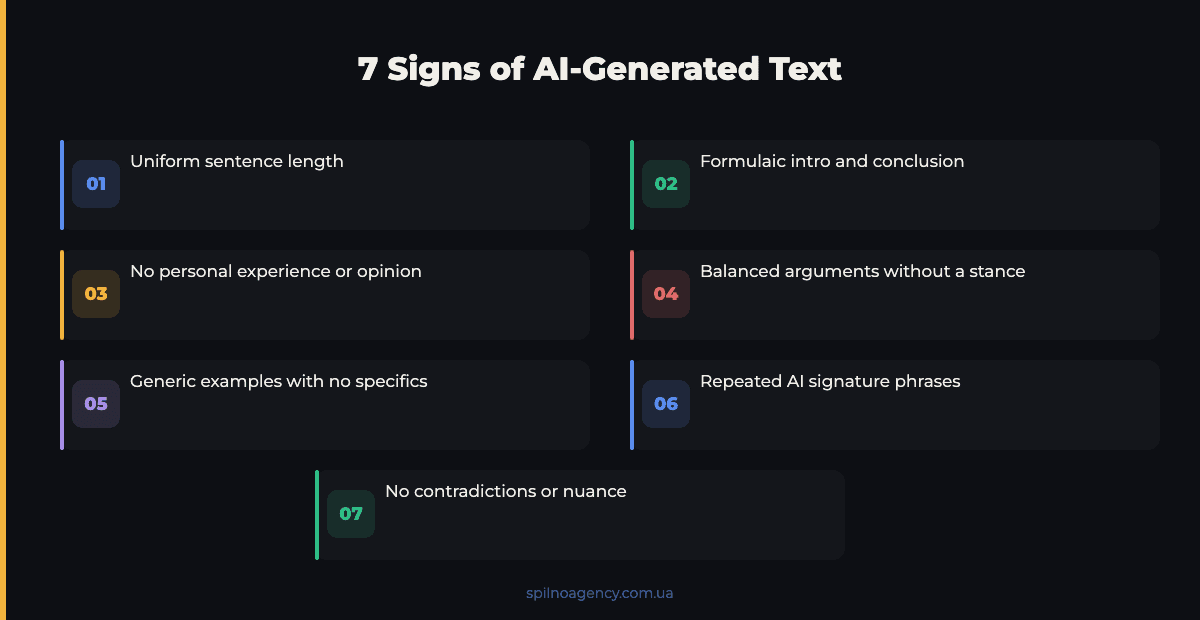
Uniform sentence length — every sentence is approximately the same size, with no dramatic alternation between short and long.
Formulaic openings — “In today’s world…”, “Artificial intelligence is rapidly developing…”, “In this article, we will explore…”
No personal experience — no specific case studies, “in our practice”, or real examples with names and numbers.
Overly balanced arguments — “on one hand… on the other hand…” with no clear authorial position. AI avoids controversial claims.
Generic examples — “for example, company X” or “studies show” without specific citations.
AI marker phrases — “it is worth noting”, “furthermore”, “in conclusion”, “it is important to understand” — too frequent repetition.
Flawless grammar without natural variation — human texts carry stylistic quirks, favourite turns of phrase, even characteristic mistakes.
AI Content and SEO: What Google Says in 2026
E-E-A-T above all — Experience, Expertise, Authoritativeness, Trust. Mass-generated AI content without genuine author expertise carries none of these signals.
Helpful Content System — demotes sites where most content is “written for search engines, not people”. Unedited AI content fits precisely this description.
GEO (Generative Engine Optimisation) — Google AI Overviews, ChatGPT Search and Perplexity actively cite content. To appear in citations, you need structured answers, specific facts and named entities — not vague AI filler.
How to Improve AI-Written Text: 5 Steps
Add personal experience — insert specific case studies from your own work, real data from your projects, or observations not available in the public domain.
Vary sentence structure — consciously alternate short and long sentences. Sometimes very short. One word. This raises burstiness and makes the text feel alive.
Add specific data and citations — replace generalisations with concrete figures and link to primary sources — a direct E-E-A-T signal.
Add brand voice — AI produces neutral text. Your brand has its own tone — add signature phrases, direct audience address, or humour appropriate to your communication style.
Fact-check everything — AI models hallucinate: they invent non-existent studies, wrong dates, fabricated quotes from real people. Verify every fact before publishing.
Conclusion
AI text detection has become part of the daily workflow for SEO specialists, editors, academics and recruiters across Europe. The most accurate paid tools — Originality.ai (99%) and Winston AI (99.6%) — are ideal for agencies and publishers. For one-off checks, ZeroGPT or GPTZero are sufficient. Remember: no detector is absolute — especially for non-English content. Use them as one quality-control tool, not the only criterion.
Frequently Asked Questions
Which AI detector is the most accurate?
Winston AI (99.6%), Originality.ai (99%), Copyleaks AI Detector (99%) for English. For non-English content, accuracy drops 10–20%.
Does Google penalise AI content?
No direct penalty for using AI. Penalties apply to low-quality, unoriginal or manipulative content — the key criterion is usefulness to the reader.
How can I check text for AI for free?
ZeroGPT (15,000 chars, no registration), GPTZero (5,000 chars), Sapling AI Detector (unlimited). ZeroGPT is the best starting point.
Can AI detectors make mistakes?
Yes. False positives are common with formal and technical texts. Always cross-check with 2–3 detectors before drawing conclusions.
How do I spot AI text without tools?
Uniform sentence length, formulaic openings, no personal experience, overly balanced arguments, generic examples, repeated AI marker phrases, flawlessly even grammar.
Your comments will appear here
Join the discussion — sign up, it only takes a minute.