Who is a Targetologist and What Are Their Responsibilities

A targetologist is a paid social advertising specialist who runs campaigns on Meta Ads, TikTok Ads, LinkedIn, and other social platforms to deliver the right message to the right audience at a profitable cost. This guide covers what a targetologist actually does, which channels they must know, why Google Ads specialists are not called targetologists, and how to build a career in paid social in 2026.
Who is a targetologist: definition
A targetologist (from the English word “targeting”) is a digital marketing specialist who manages paid advertising on social media and messaging platforms. Their core responsibility is to show an ad not to everyone, but to a specific audience segment most likely to take a desired action — submit a lead form, make a purchase, or install an app.
The term “targetologist” is predominantly used in Ukrainian and Russian-speaking markets. In international digital marketing, the same role goes by different names: Paid Social Manager, Media Buyer, Social Ads Specialist, or Performance Marketing Manager. The substance is identical: a professional who manages paid social campaigns and is accountable for their results in measurable metrics.
A targeting specialist is not simply someone who “boosts posts”. They analyse audiences, form hypotheses, allocate budgets between campaigns, run structured A/B tests, and make data-driven optimisation decisions daily. Without analytics, there is no targetologist — only someone pressing a button and hoping for the best.
The profession sits at the intersection of psychology (understanding audience behaviour and motivations), data analysis (reading campaign metrics and drawing conclusions), and creative thinking (knowing what message and format will resonate). This combination is what makes strong targeting specialists rare and in demand across European markets.
Duties and responsibilities of a targeting specialist
Before exploring channels and tools, it is important to understand what a targetologist actually does on a daily basis. The responsibilities go far beyond “launching ads”.
Strategy and planning
- Audience research: who the target customers are, what problems they have, which platforms they use
- Platform and format selection based on business objectives and audience demographics
- Media plan development: budget allocation across channels, campaigns, and audience segments
- Hypothesis formulation for A/B tests: which offer, creative, or message will perform better
- Funnel mapping: understanding at which stage each audience segment sits (cold, warm, retargeting)
Campaign setup and launch
- Technical setup of ad accounts (Meta Ads Manager, TikTok Business Center, LinkedIn Campaign Manager)
- Pixel and tracking installation and verification (Meta Pixel, TikTok Pixel, Conversions API)
- Audience segmentation: cold, warm, lookalike, and retargeting audiences
- Writing ad copy or briefing the creative team on headlines, body text, and CTAs
- Launching controlled test campaigns with limited budgets before scaling
Optimisation and analytics
- Daily monitoring of key metrics: CTR, CPM, CPC, CPL, ROAS, frequency
- Pausing underperforming ad sets and scaling winning ones
- Structured creative and audience A/B testing
- Regular reporting to clients or internal stakeholders
- Competitor research using Facebook Ad Library and TikTok Creative Center
Technical responsibilities
- Setting up Meta Conversions API (CAPI) for accurate server-side conversion tracking
- UTM tagging of all ad links for correct attribution in GA4
- Landing page quality assessment: identifying where the funnel is leaking
- Collaboration with development teams to resolve tracking issues
Which traffic channels a targetologist must know
A targetologist is a specialist in social platforms. But “social media” in 2026 encompasses dozens of platforms with very different mechanics, audiences, and ad formats. Here are the key channels every modern targeting professional should understand.
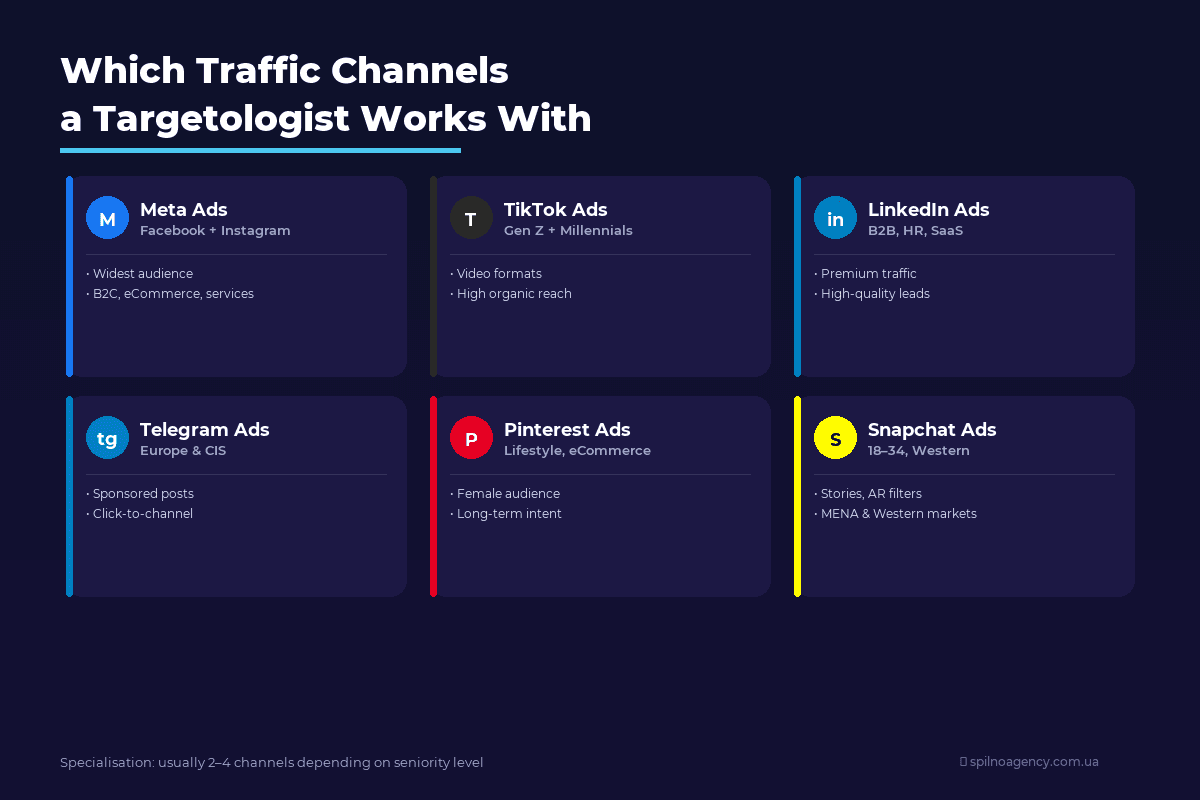
Meta Ads (Facebook + Instagram) — the foundational channel
Meta Ads is the entry point for the vast majority of targeting specialists and businesses worldwide. The Facebook Ads Manager brings together advertising across Facebook, Instagram, Messenger, and Audience Network in one ecosystem. Its interest-based, behavioural, demographic, and lookalike targeting capabilities are the most mature of any social platform.
Why Meta is the first channel to master: the largest global audience (3+ billion monthly active users), a sophisticated optimisation algorithm that learns from conversion signals, and the richest learning ecosystem (Meta Blueprint, thousands of documented case studies). A targeting specialist without strong Meta Ads experience will simply not be competitive on the job market.
Best suited for: B2C businesses (products, services, eCommerce), local businesses, info products, real estate, healthcare, and education. Effectively any business whose audience is adults aged 18–55+.
TikTok Ads — video-first and younger audiences
TikTok Ads is the second-priority channel for most targeting specialists in 2026. The platform has grown from a Gen Z entertainment app into a full-scale advertising tool with over one billion monthly active users. Its key differentiator: the algorithm prioritises content quality, not just targeting parameters — a compelling video can break out beyond its targeted audience and generate organic reach on top of paid.
Core audience: Gen Z (18–24) and younger Millennials (25–34). Primary formats: In-Feed video (9–15 seconds), TopView, Branded Hashtag Challenges, Spark Ads. Critical rule: TikTok demands native content — videos designed for the platform, not repurposed Facebook banners. A targetologist running static images on TikTok is simply burning budget.
Best suited for: mass-market B2C products, fashion and beauty, entertainment, eCommerce targeting younger demographics, mobile apps and games, food and beverage brands.
LinkedIn Ads — B2B and professional audiences
LinkedIn Ads is the most expensive platform of all (CPM and CPL are typically 3–5× higher than Meta), but it offers the most precise B2B targeting available. Here you can target by job title, industry, company size, seniority level, specific skills, and years of experience — a level of professional segmentation impossible on any other social network.
Audience: senior decision-makers, mid-to-upper management, HR directors, B2B buyers. Formats: Sponsored Content (in-feed posts), Message Ads (LinkedIn InMail), Lead Gen Forms, Dynamic Ads. Minimum effective daily budget: $50–100 for the algorithm to learn and optimise properly.
Best suited for: SaaS products, IT services, B2B sales with long deal cycles, enterprise recruitment, corporate training, consulting, and professional services firms operating across Europe.
Telegram Ads — essential for Ukrainian and CIS markets
Telegram Ads (the platform’s official advertising product) is relatively young but critically important for the Ukrainian market. Ukraine has over 10 million active Telegram users, and a significant share of news and media consumption happens on this platform. Ads are shown inside public channels relevant to the ad’s topic category.
Platform specifics: minimum CPM entry point of €2 (accessible after the 2024 pricing update), targeting by channel topic category and geolocation, ad format is short text up to 160 characters. Unlike Meta, there is no interest-graph targeting — ads reach the audience of topically relevant channels. This makes channel selection and creative messaging even more important.
Best suited for: news and media products, cryptocurrency, online education, FinTech, B2B in Ukrainian and Eastern European markets, info products and subscription communities.
Pinterest Ads — lifestyle and high-purchase-intent audiences
Pinterest is a visual search platform with a distinctive audience profile: 70%+ female, middle-to-upper income, with high purchase intent in categories like home décor, fashion, cooking, DIY, and beauty. Ads on Pinterest are integrated into the “inspiration search” experience, making them feel less intrusive than on other platforms.
Key formats: Static Pins, Video Pins, Shopping Ads, Carousel, and Collections. Unique advantage: Pinterest has a long “content tail” — a quality promoted pin can continue driving traffic for months or even years after publication, unlike Meta content which peaks within 48 hours.
Best suited for: eCommerce (home goods, fashion, beauty, children’s products), wedding industry, food and recipes, DIY and home improvement, travel. It performs poorly for B2B, IT services, and local service businesses with a general audience.
Snapchat Ads — youth audiences in Western and MENA markets
Snapchat remains a significant platform for the 18–34 demographic in the United States, United Kingdom, Australia, and across the Middle East and North Africa in 2026. In Ukraine and Poland it is a niche channel. But if your client or product targets these Western or MENA markets, Snapchat Ads is a channel worth learning.
Formats: Snap Ads (10-second vertical video), Story Ads, Collection Ads, Dynamic Ads. Key advantage: high engagement from a young audience and lower advertiser competition compared to Meta, which translates to a lower CPM for comparable reach. For European businesses expanding into Western markets, Snapchat is often an underutilised opportunity.
How many channels should a targetologist handle
This question comes up regularly in job interviews and career planning conversations. The answer is nuanced, but there is a clear logic to it.
Junior: 1–2 channels — depth over breadth
If you are starting out, do not try to cover everything at once. Choose Meta Ads as your primary platform and master it deeply: the account structure, campaign objectives (Awareness, Traffic, Engagement, Leads, Sales), how the learning algorithm works, audience types, and Ads Manager analytics. Add Pinterest or TikTok as a second platform once you are genuinely confident in the first.
The classic junior mistake: launching ads across five platforms simultaneously without deep understanding of any. Surface-level knowledge does not sell. Clients want results, and results come from understanding the specific mechanics of each platform thoroughly.
Mid-level: 2–3 channels
A mid-level targeting specialist is confident in Meta Ads and adds 1–2 more platforms based on their niche and client base. The most common combinations: Meta + TikTok (for eCommerce and B2C clients), Meta + LinkedIn (for B2B accounts), Meta + Telegram (for Ukrainian market clients).
At this level, cross-channel analytics becomes important: understanding how platforms complement each other within the funnel rather than competing for the same budget. A mid-level specialist can explain why Meta Ads works as a demand-generation engine while retargeting on a second channel closes the conversion.
Senior / Lead: 3–5 channels + strategic thinking
A senior targeting specialist or Media Buying Lead is confident across 3–5 channels and can build a multi-channel strategy from scratch: how to allocate budget across platforms based on funnel stage, where to acquire cold audiences, where to nurture warm ones, and where retargeting delivers the best ROAS.
At this level, channels are tools rather than destinations. A senior specialist understands when LinkedIn costs three times more per lead than Meta but produces a significantly higher quality prospect — and can demonstrate this to a client with data, not intuition.
The 6+ channels red flag
If a candidate in an interview claims equal, deep expertise across Meta, TikTok, LinkedIn, Telegram, Pinterest, Snapchat, and Reddit simultaneously — treat this as a signal requiring deeper questioning. Each platform updates its algorithms, ad products, and attribution models multiple times per year. Maintaining genuine depth across 6+ platforms simultaneously is physically impossible for one person — that requires a team.
What a strong candidate’s honest answer sounds like: “My primary expertise is Meta Ads. I run TikTok and LinkedIn confidently. I can independently launch campaigns on Pinterest and Snapchat, but my deep optimisation experience is thinner there — I’d want another few months of focused work to call those truly strong.”
Why Google Ads specialists are not called targetologists
This is one of the most common points of confusion in digital marketing hiring — and it matters whether you are a business owner looking to hire or a specialist defining your own positioning.
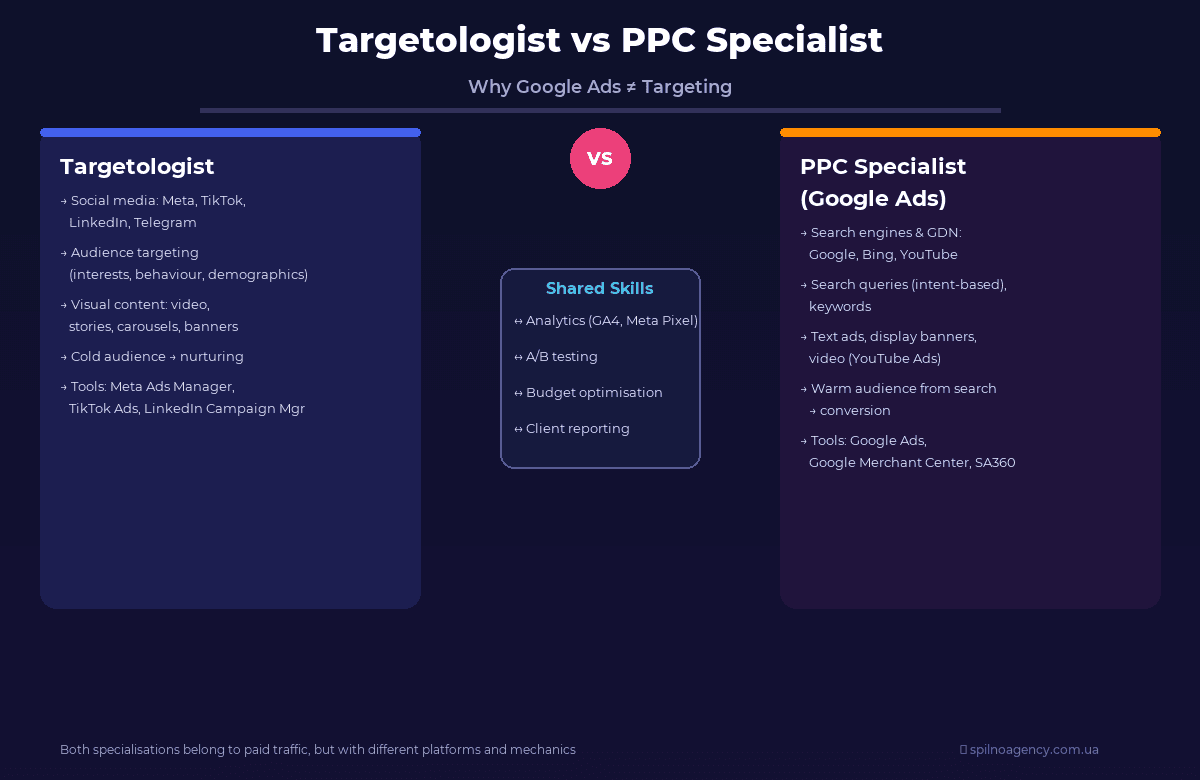
Different audience logic: cold social vs. hot search intent
A targetologist works with cold and warm audiences — people who have not yet searched for your product but match the description of your target customer based on interests, behaviour, and demographics. The task is to create awareness, generate interest, and move the audience toward a conversion decision. You are interrupting their social feed with a relevant message.
A Google Ads specialist (also called a PPC specialist) works with hot demand — people who are actively typing “buy laptop Kyiv” or “window repair near me” into a search engine right now. These people have already made a decision to look for something specific. Search advertising captures that existing, formed demand rather than creating new demand.
This is a fundamentally different psychology of ad interaction. A social media platform is a leisure environment. A search engine is an intentional, task-oriented action. The creative approach, bidding strategies, success metrics, and optimisation logic are entirely different between these two disciplines.
Different auction mechanics and targeting parameters
- Meta Ads: targeting by interests, behaviours, demographics, lookalike audiences, and retargeting based on engagement signals
- TikTok / LinkedIn: targeting by demographics, interests, professional attributes, and platform activity
- Google Ads Search: keyword-based targeting — the user themselves arrives with a specific query
- Google Display Network (GDN): visual ads on third-party websites, but still fundamentally different from social targeting — no social graph algorithm, no lookalike modelling, and a completely different consumption context
Different performance metrics
A targeting specialist primarily tracks: CPM (cost per thousand impressions), CTR (click-through rate), CPL (cost per lead), ROAS from the social channel, frequency, and reach. A Google Ads specialist focuses on: Impression Share, Quality Score, CPC by keyword, landing page conversion rate, average position, and search term relevance.
These are not just different numbers — they reflect entirely different levers for optimisation. Improving a Meta Ads campaign means testing creative and audience. Improving a Google Search campaign means refining keyword match types, bids, and Quality Score. The skill sets, while both analytical, are distinct.
How these roles are named in international markets
The word “targetologist” does not exist in Western digital marketing. The equivalent roles are named by their actual function:
- Paid Social Manager / Social Ads Specialist — what the Ukrainian market calls a targetologist
- PPC Specialist / Google Ads Specialist — search advertising professional
- Media Buyer — a targetologist at mid-to-senior level managing significant budgets
- Performance Marketing Manager — a broader role that may encompass both paid social and PPC
In Ukrainian market practice, there is a widespread (and incorrect) habit of calling any paid traffic specialist a “targetologist” — even those who exclusively run Google Ads. This blurs role requirements during hiring and leads to mismatched expectations. If you are looking to hire, specify: paid social (Meta, TikTok, LinkedIn) or search/PPC (Google Ads). They require different people with different skill sets.
Required skills and tools
Core skills
- Analytical thinking — reading data, identifying patterns, and making decisions based on numbers rather than gut feeling
- Audience understanding — customer avatar development, Jobs-to-be-Done framework, segmentation, pain points and objections
- Ad copywriting — writing concise, high-conversion ad texts (hook, body, CTA) that work within tight character limits
- Technical literacy — understanding pixels, Conversions API, UTM parameters, basic HTML structure, and URL construction
- A/B testing methodology — knowing what to test, how to isolate variables, and how to read statistical significance in results
- Budget management — allocating spend across campaigns, understanding ROAS, CPL, and customer lifetime value (LTV)
Essential tools
- Meta Ads Manager — the primary interface for Facebook and Instagram advertising
- TikTok Ads Manager / TikTok Business Center — TikTok campaign management
- LinkedIn Campaign Manager — LinkedIn advertising
- Telegram Ads Platform — official Telegram advertising interface
- Google Analytics 4 — attribution and conversion analysis from social channels
- Meta Business Suite — page and asset management
- Canva / Figma — basic creative review or simple asset preparation
- Facebook Ad Library — competitor ad research and creative benchmarking
- TikTok Creative Center — trend analysis and format performance benchmarks
- Google Sheets / Looker Studio — consolidated reporting and client dashboards
Adjacent knowledge that separates good from great
The strongest targeting specialists also understand: the basics of content strategy (organic social quality directly impacts the efficiency of paid amplification), UX fundamentals (does the landing page actually convert?), core GA4 concepts (where do conversion data come from?), and sales funnel structure (which audience segment needs which message at which stage).
The dividing line between a junior and a mid-level targeting specialist is often not platform knowledge — it is whether the specialist sees the ad as part of a broader customer journey or as an isolated action. Ads do not exist in a vacuum: they drive people to landing pages, into funnels, toward lifetime value.
Where targetologists work and how much they earn
Work formats
- Digital agency — high volume of work, exposure to many different industries (accelerates experience growth), less flexible schedule. The classic starting point for junior specialists: you will work on more accounts in one year than most in-house specialists see in three.
- In-house (staff position) — deep knowledge of one business and product, stable income, ability to build long-term strategies. Better suited for mid-level and above specialists who have the foundations in place.
- Freelance — flexibility and higher income potential, but inconsistent workload and full responsibility for results. Recommended after 1–2 years of agency or in-house experience — do not start your career as a freelancer with no portfolio.
Salary ranges
- Junior targeting specialist: UAH 15,000–25,000/month (approximately $400–650)
- Mid-level targeting specialist: UAH 30,000–55,000/month (approximately $800–1,400)
- Senior targeting specialist / Media Buyer: UAH 60,000+/month (approximately $1,500–3,000+)
- Freelancers on European client projects: $1,000–4,000+/month depending on portfolio and managed budget volume
Freelance targeting specialists typically charge either a fixed management fee or a percentage of client ad spend (usually 10–20%). The percentage model is more lucrative with large budgets but carries higher accountability for results. European clients increasingly expect transparent performance reporting tied to agreed KPIs before any retainer renewal.
Pros and cons of the targeting specialist profession
Advantages
- High demand: every business advertising on social media needs a targeting specialist
- Remote-first work: the vast majority of targeting roles can be done from anywhere, including for European clients in EUR
- Measurable results: your value is visible in numbers (CPL, ROAS), not subjective performance reviews
- Fast entry: core skills can be acquired in 3–6 months and generate income before the year is out
- Continuous evolution: algorithm updates and new platform features keep the work genuinely engaging
Challenges
- Budget dependency: without ad spend there is nothing to optimise — your income is tied to clients maintaining their budgets
- Burnout risk: repeated hypothesis testing that fails, combined with client pressure for instant results, is a real challenge in the profession
- Constant algorithm changes: Meta and TikTok update their systems regularly, requiring continuous self-education to stay current
- Ad account bans: one of the most painful realities in targeting — unexpected account suspension without a clear reason can disrupt client campaigns overnight
- Expectation management: explaining to a client that meaningful results require 4–8 weeks of algorithm learning, not 48 hours, is a soft skill that takes real effort to develop
How to become a targeting specialist: a step-by-step plan
- Build the theoretical foundation. Start with Meta Blueprint (Meta’s free official learning platform). Complete the Meta Certified Digital Marketing Associate certification — it demonstrates baseline seriousness to any employer. Supplement with TikTok Business Center Academy and YouTube channels focused on Meta Ads strategy and case studies.
- Get real campaign experience. Theory without practice is worthless. Run a campaign for your own project, help a friend or local business (in exchange for a testimonial and a case study). Your first $100–200 of ad spend is your practical education — treat it as tuition, not waste.
- Build a portfolio with documented results. Clients and employers do not want certificates — they want case studies: what you ran, which audience, what budget, what result. Even one case study with a CPL below the market average is already a meaningful argument for hiring you.
- Join an agency or take a junior position. The first year in a team gives invaluable experience: you will see dozens of different clients, industries, and budget sizes. An agency is the fastest accelerator for a junior targeting specialist that exists — nothing else compares for breadth of exposure.
- Learn systematically, not reactively. Follow the official blogs and changelogs of Meta, TikTok, and LinkedIn. Join targeting professional communities on Telegram and Facebook. Read competitor ads in the Facebook Ad Library. Treat platform updates as an ongoing professional responsibility, not an interruption.
- Add channels progressively. Once you have mastered Meta Ads, add TikTok or LinkedIn depending on your target niche. Do not attempt to learn all platforms simultaneously — you will master none of them.
If you want to drive traffic from social media for your business or need an audit of your existing ad accounts, contact Spilno Agency for a consultation. We will give you an honest assessment of which strategy fits your business and what results are realistic to expect.
FAQ: frequently asked questions about targetologists
Who is a targetologist and what do they do?
A targetologist is a paid social advertising specialist who sets up and optimises campaigns on social media platforms — primarily Meta Ads (Facebook and Instagram), TikTok Ads, LinkedIn Ads, and Telegram. They analyse target audiences, develop campaign strategies, allocate budgets, and optimise for measurable business results: leads, sales, and ROAS.
How many ad channels should a targetologist know?
Junior: 1–2 channels (typically Meta Ads). Mid-level: 2–3 (Meta plus TikTok or LinkedIn). Senior/lead: 3–5. A specialist claiming equal deep expertise across 6+ platforms is likely surface-level on all of them. Depth beats breadth, especially at the start of a career.
Why isn’t a Google Ads specialist called a targetologist?
A targetologist works with social media platforms and cold audiences (interests, behaviour, demographics). Google Ads captures already-formed hot search demand. These are fundamentally different mechanics, metrics, and mindsets. A Google Ads specialist is a PPC specialist. Internationally: Paid Social Manager (targeting) vs. PPC Specialist (Google Ads).
Which social platforms does a targeting specialist work with?
The core platforms: Meta Ads (Facebook + Instagram), TikTok Ads, LinkedIn Ads, Telegram Ads, Pinterest Ads, Snapchat Ads. Priority depends on the client’s target audience and geographic market. Most businesses start with Meta Ads as the baseline channel before expanding.
How much does a targeting specialist earn?
Junior: UAH 15,000–25,000/month (~$400–650). Mid-level: UAH 30,000–55,000/month (~$800–1,400). Senior/lead: UAH 60,000+/month (~$1,500–3,000+). Freelancers working with European clients in EUR/USD: $1,000–4,000+ per month.
Can you become a targetologist without formal education?
Yes. Meta Blueprint and TikTok Business Center Academy are free official platforms covering the fundamentals. But theory alone is not enough — you need real hands-on campaign experience with an actual budget. The first 3–6 months of working on real accounts is what builds genuine competence.
What is the difference between a targetologist and an SMM manager?
An SMM manager is responsible for organic social presence: content, posting, community management, and brand communication. A targeting specialist focuses on paid advertising: campaign setup, audience segmentation, bid strategies, and ROAS. In small teams these roles are often combined in one person, but in mature marketing teams they are distinct positions with separate KPIs.

Read also
Spilno Agency’s Experience: How We Verify Events Before Starting Work
Before launching a campaign in Google Ads or Meta Ads, or starting SEO work, Spilno Agency always checks…
GA4 DebugView: How to Verify Google Analytics Events in Real Time
DebugView is the section of Google Analytics 4 that shows your site’s events in real time, seconds after…
Top Claude Skills for TikTok Ads Specialists (2026)
9 verified Claude skills and MCP servers for TikTok Ads: Pixel/Smart+ audits, Spark Ads hook/hold rate, creator sourcing,…