AI Text Writing: Benefits, Risks, and a Complete Guide

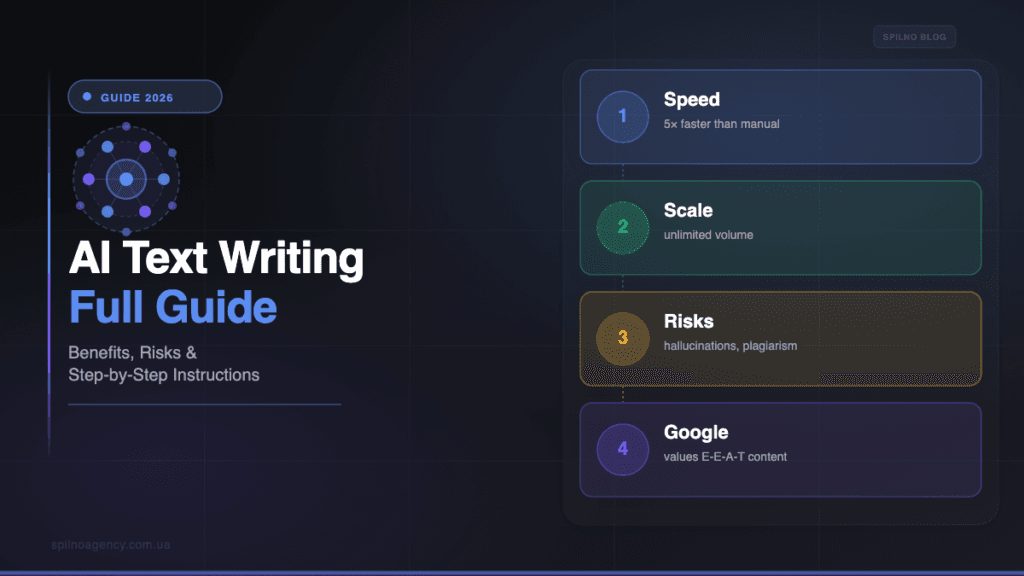
Artificial intelligence for text writing is the reality of 2026 — not a future promise. ChatGPT, Claude and Gemini write billions of words every day. This guide covers how AI generates text, which tools to choose, how to prompt effectively, and why Google rewards quality AI content rather than penalising it.
What Is AI for Text Writing
AI for text writing refers to large language models (LLMs) trained on billions of text documents. They analyse a user’s prompt and generate coherent, grammatically correct text in any genre — from advertising copy to long-form editorial articles.
Today’s leading AI writers — ChatGPT (OpenAI), Claude (Anthropic) and Gemini (Google) — are built on transformer architecture. They don’t “understand” text the way humans do, but they predict the most likely next token with an accuracy that outpaces the average copywriter in speed and consistency.
Evolution: From Autocomplete to GPT-4o
Before 2020, automated text generation was limited to template responses and autocomplete. GPT-3 (2020) changed everything: for the first time a model could write coherent paragraphs on any topic. GPT-4o (2024–2026) now competes with specialists in copywriting, translation, and editorial tasks across European markets.
How AI Generates Text: The Mechanics
AI text generation is a statistical tokenisation and prediction process. Every prompt is broken into tokens (word fragments), the model calculates the probability of the next token based on its training data, and outputs the most likely sequence.
- Tokenisation: text is split into tokens — words or sub-word fragments.
- Attention mechanism: the model weighs all previous tokens within its context window (up to 200,000 tokens in Claude).
- Sampling: the next token is chosen via temperature and top-p parameters — this is the source of output variety.
- RLHF fine-tuning: reinforcement learning from human feedback ensures safety and helpfulness.
Benefits of AI-Assisted Text Writing
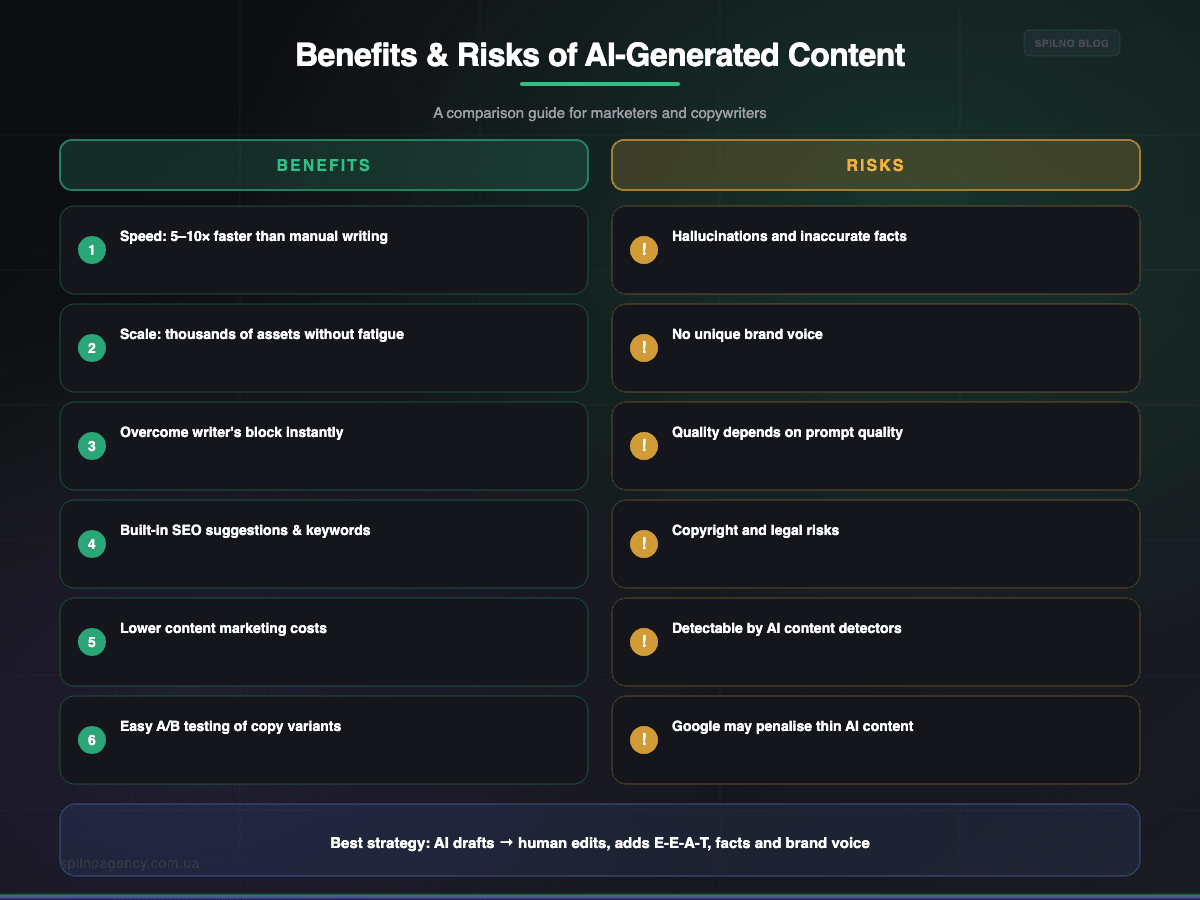
European businesses that have integrated AI into content marketing report up to 60% lower copywriting costs and a 5–10× increase in content volume. Here are the core benefits.
1. Speed
A copywriter takes 3–4 hours to write a 1,500-word article. AI generates a draft in 30–60 seconds. Even factoring in editing time, the total production cycle shrinks by 3–5×.
2. Scale
One editor with AI tools can produce as much content as a team of 5–10 people used to. This is critical for e-commerce projects with thousands of product descriptions or multilingual SEO campaigns across European markets.
3. Overcoming Writer’s Block
AI instantly generates 10 headline variants, 5 intro options or 3 different angles for an article. This is an excellent way to break the blank-page barrier, even if all variants end up being rewritten.
4. SEO Assistance and Keyword Research
Modern AI tools (ChatGPT with plugins, Perplexity) help identify semantic clusters, craft keyword-optimised headings and balance keyword density without over-optimisation.
5. Multi-Format Content
From one brief, AI generates: a full article → social posts → an email newsletter → presentation bullet points → a video script. One content piece — five formats at no extra cost.
6. Lower Costs
ChatGPT Plus and Claude Pro cost $20/month each. Even accounting for editing time, the cost per word drops 5–10× compared to freelance rates across European markets.
Risks and Limitations of AI-Generated Text
AI writing is no silver bullet. Without the right approach, you risk publishing content that damages your reputation and hurts SEO rankings.
Hallucinations and Inaccurate Facts
LLMs invent facts when they don’t know the answer. They confidently cite non-existent research, fabricate dates and statistics. Every AI-generated text requires fact-checking before publication.
No Unique Brand Voice
Without a detailed system prompt, AI writes “generically” — in the same neutral style as millions of other AI texts. Brand voice requires careful configuration or significant editing.
Prompt Dependency
“Garbage in, garbage out” — the GIGO principle applies fully to AI. A vague, non-specific prompt delivers a mediocre result. Prompt engineering is a separate skill that requires practice.
Legal and Copyright Risks
Legislation on AI content ownership is still evolving. The EU AI Act (2024) introduces transparency requirements for AI-generated content. There is also a risk of inadvertently reproducing copyright-protected fragments from training data.
Google’s Position on AI Content
Google officially does not penalise AI content as such. What gets penalised is low-quality, thin content — regardless of how it was produced. The requirement remains unchanged: E-E-A-T (experience, expertise, authoritativeness, trustworthiness).
Top 5 AI Writing Tools for 2026
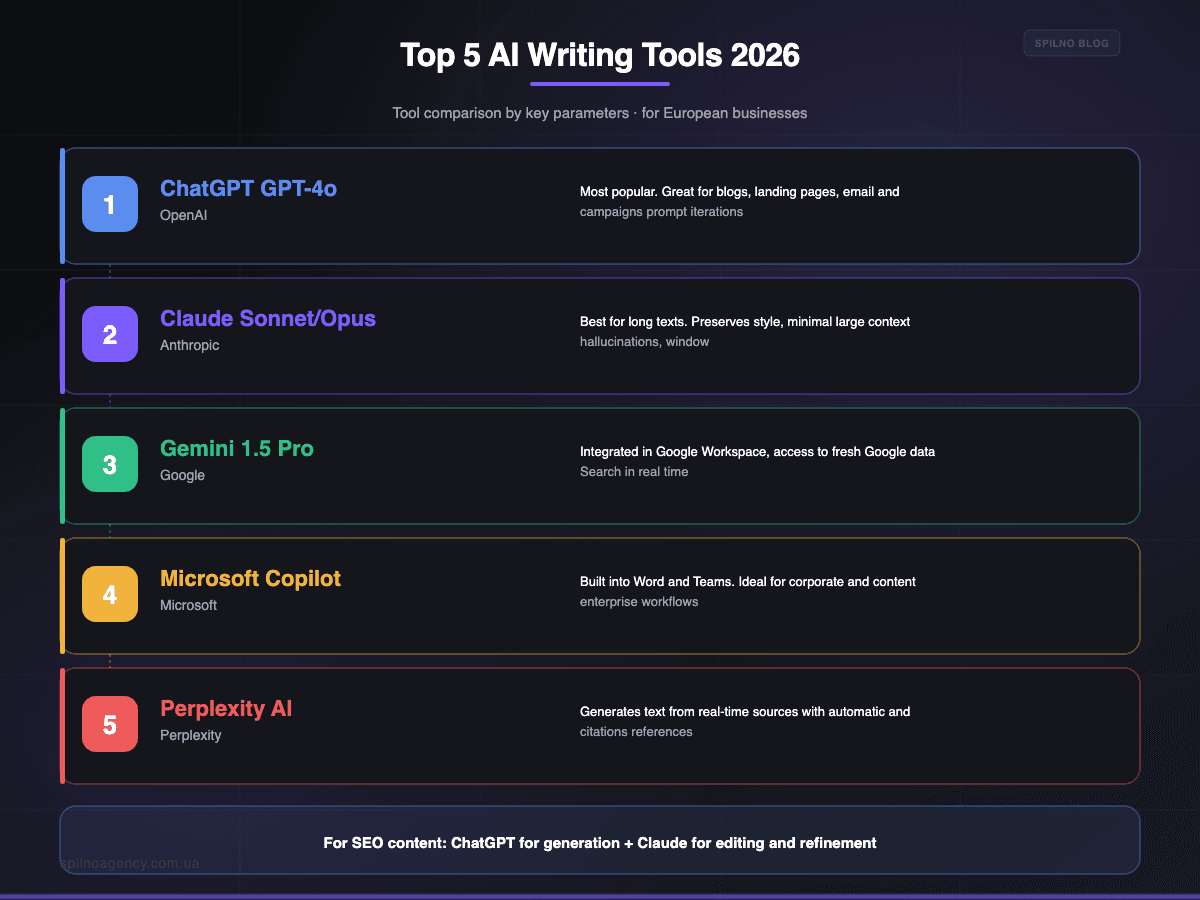
1. ChatGPT (GPT-4o) — OpenAI
The world’s most popular AI assistant. GPT-4o (2024) supports multimodality: it analyses images and generates text in a single conversation. For European content teams: broad functionality, a large plugin ecosystem, and excellent multilingual support.
Price: free plan (GPT-4o mini) + Plus at $20/month. Limitation: data has a training cutoff; the free plan has message limits.
2. Claude (Sonnet / Opus) — Anthropic
Claude stands out with a 200,000-token context window and the ability to maintain authorial style across long documents. Fewer hallucinations, honest about uncertainty — it says “I don’t know” rather than fabricating. Best choice for editing and restructuring large documents.
3. Gemini 1.5 Pro — Google
Integrated into Google Workspace (Docs, Gmail, Sheets) with direct access to Google Search. Key advantage: real-time access to current information. Ideal for writing content based on fresh data and breaking news.
4. Microsoft Copilot
Built into Microsoft 365: Word, Teams, Outlook, PowerPoint. For corporate teams already using the Microsoft ecosystem, it’s the most seamless AI integration without changing tools.
5. Perplexity AI
Unique advantage: automatic source citations. Perplexity generates text based on live web search and instantly cites its sources. Invaluable for analytical content, market overviews and news articles with minimal hallucination risk.
Step-by-Step Guide: Writing Text With AI
- Define your goal and audience. Who is the reader? What action should they take after reading? The more specific the answer, the better the output.
- Prepare a system prompt. Specify the role (“You are a B2B copywriter”), tone (professional/conversational) and constraints (no jargon, target word count).
- Give a concrete task. Not “write an article about AI”, but “write an 800-word article for marketing managers about 5 AI content tools in 2026, with a comparison table”.
- Review the draft. Focus on facts, logic, and unique brand voice. The AI draft is a starting point, not a final product.
- Fact-check. Verify all dates, numbers, names and links. Use Perplexity or Google Search to confirm.
- Optimise for SEO. Add keywords naturally, check heading structure, write a meta description, and add image alt texts.
Effective Prompting Rules for Quality Content
The quality of AI content directly depends on prompt quality. Here are the core principles:
The RACE Framework for Prompts
- R — Role: “You are an experienced SEO copywriter specialising in digital marketing for European SMEs”
- A — Action: “Write a 1,200-word long-read article”
- C — Context: “for audience: small business owners in Europe, topic: Facebook Ads for local businesses”
- E — Expected output: “format: intro + 5 sections with H2 headings + FAQ with 5 questions + CTA”
System Prompt Template for an SEO Article
You are an SEO copywriter for a digital agency targeting European businesses.
Write naturally, avoid jargon. Use active voice, concrete examples and data.
Target audience: [business type].

Task: write a [N]-word article on the topic "[topic]".
Structure: intro paragraph → [N] H2 sections → FAQ → CTA.
Tone: [professional/friendly/authoritative].
Keywords: [list]. Avoid keyword stuffing.
Language: English (British spelling, no Americanisms).
Google’s Position on AI Content in 2026
Google’s official position (Search Central Blog, 2023–2026): the search engine evaluates content by quality, not production method. AI content that meets E-E-A-T criteria receives the same rankings as human-written content.
What is actually penalised:
- Mass spammy content — hundreds of pages with minimal value generated automatically
- Thin content — articles with no real informational value for the reader
- Cloaking — showing different content to bots and users
- Anchor manipulation — artificial link schemes regardless of how the text was generated
Recommendation for 2026: use AI as an acceleration tool, not an editor replacement. Add real experience, original insights, current case studies and quotes. That is what separates E-E-A-T content from “AI spam”.
Frequently Asked Questions
Does Google penalise websites for using AI content?
Google does not penalise AI content as such. What gets penalised is low-quality, thin content with no real value — regardless of production method. Quality AI content with E-E-A-T signals ranks on a par with human-written content.
What is the best AI writing tool in 2026?
For most tasks — ChatGPT GPT-4o. For long documents — Claude Sonnet/Opus. For real-time data — Perplexity AI. For Google Workspace — Gemini 1.5 Pro.
Can Google detect AI-generated content?
Google has not announced AI detectors in its ranking algorithms. Edit AI texts and add unique experience and brand voice — this improves both quality and rankings.
How much does AI text writing cost?
ChatGPT Plus and Claude Pro cost $20/month each. The total cost per piece is 5–10× lower than freelance rates, even factoring in editing time.
How do I write an effective AI prompt?
Use the RACE formula: Role + Action + Context + Expected output. Specify the audience, tone, word count and structure. The more specific the prompt, the better the result.
Can AI completely replace a copywriter?
No. AI excels at drafting and structuring. Unique brand voice, deep industry expertise and creative thinking remain human territory. Best results: AI draft + experienced editor.
How can I tell if a text was written by AI?
Use GPTZero (free), Originality.ai or Copyleaks. Accuracy is around 85–90%. Editing and adding first-hand experience reduces the “AI fingerprint” in the text.
What is the minimum prompt quality for an acceptable result?
A prompt must include: topic, audience, tone, word count and structure. An ideal prompt is 100–300 words with a sample of the desired style. Without these elements, AI generates generic content.

Read also
Spilno Agency’s Experience: How We Verify Events Before Starting Work
Before launching a campaign in Google Ads or Meta Ads, or starting SEO work, Spilno Agency always checks…
GA4 DebugView: How to Verify Google Analytics Events in Real Time
DebugView is the section of Google Analytics 4 that shows your site’s events in real time, seconds after…
Top Claude Skills for TikTok Ads Specialists (2026)
9 verified Claude skills and MCP servers for TikTok Ads: Pixel/Smart+ audits, Spark Ads hook/hold rate, creator sourcing,…