How to Choose a Digital Marketing Contractor — Guide 2026

Marketing agency, freelancer, or in-house team — each option makes sense in a different context. This guide will help you evaluate each model, ask the right questions, and avoid costly mistakes when choosing a digital marketing contractor.
Why choosing a contractor is a strategic decision
Most businesses lose budget not because they chose the wrong channel — but because they chose the wrong contractor. An agency with no experience in your segment, a freelancer without an analytics foundation, or an in-house employee without strategic support — each of these scenarios ends the same way: wasted money and frustration.
In 2026, the digital marketing market is flooded with offers. Every “specialist” promises results. That’s why, before signing a contract, you need to know what to look for, what to verify, and what questions to ask.
Three collaboration models: agency, freelancer, in-house
Marketing agency
An agency is a team of specialists — strategists, analysts, media planners, copywriters, designers — under one roof. You pay for access to an entire ecosystem of competencies, not for a single person.
Freelancer
A freelancer is one person with a specific specialisation: for example, a Google Ads specialist, SEO copywriter, or social media manager. Flexible, cheaper upfront, but limited to the competencies of a single person.
In-house marketing
A salaried employee or an entire marketing department. Full control, deep brand knowledge, but high fixed costs and the risk of a single point of failure when a key employee leaves.
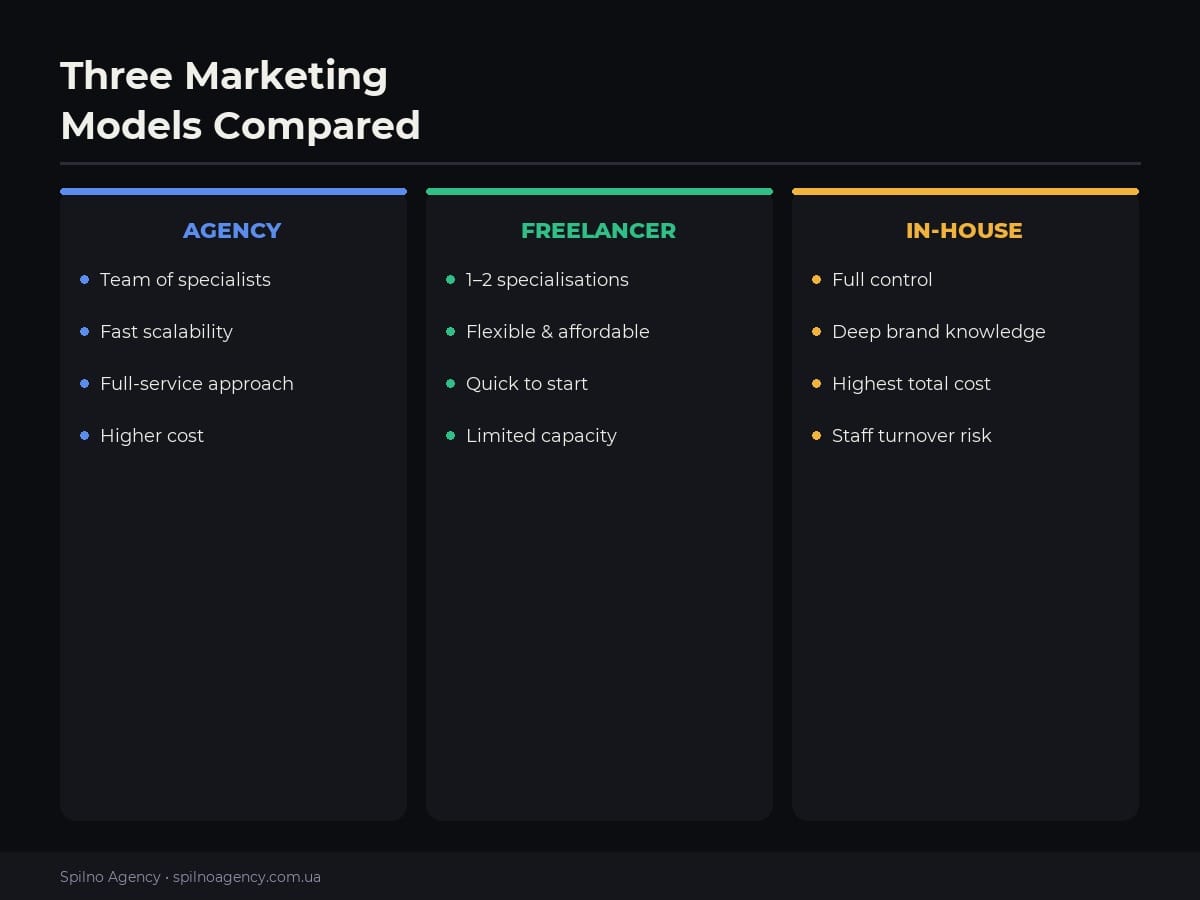
SWOT comparison: agency vs freelancer vs in-house
| Criterion | Agency | Freelancer | In-house |
|---|---|---|---|
| Breadth of competencies | Wide — strategy, performance, creative, analytics | Narrow — typically 1–2 specialisations | Depends on hiring; often narrow at the start |
| Time to launch | 1–2 weeks for onboarding | 2–5 days | 1–3 months (recruitment + onboarding) |
| Monthly cost | Higher, but covers the entire team | Lower, but limited scope of tasks | Highest total (salary + taxes + tools) |
| Scalability | High — fast expansion of services | Limited — one person has a time limit | Low — requires new hires |
| Brand knowledge | Medium — built over the first months | Medium — depends on engagement | High — employee lives the brand daily |
| Process control | Indirect — through reports and meetings | Direct, but requires coordination | Full — employee available on-site |
| Risk of knowledge loss | Low — knowledge stays in the agency | High — freelancer leaving = reset to zero | High — staff turnover |
| Access to tools | Full — agency invests in premium tools | Limited — freelancer pays themselves | Requires purchasing licences by the company |
When to choose an agency, a freelancer, or build in-house
Choose an agency if:
- You need comprehensive support — strategy, campaigns, creative, and analytics simultaneously.
- You don’t have time to manage multiple freelancers.
- You want to scale activities quickly without expanding headcount.
- Your market is niche or requires specialist knowledge (e.g. e-commerce, B2B SaaS).
- Reporting, transparency, and regular performance reviews matter to you.
Choose a freelancer if:
- You have a clearly defined, narrow task: for example, a Google Ads campaign for a single product.
- You have an internal team that is missing one specific competency.
- You work on a project basis and don’t need ongoing support.
- You have a limited budget and want to test a channel before a larger investment.
Choose in-house if:
- Marketing is a core business competency, not a supporting function.
- The company is ready to invest in the long-term development of internal specialists.
- There is sufficient volume of work for full-time specialists.
- The work requires deep integration with product, sales, and customer data.
6 criteria for evaluating a digital marketing contractor
1. Experience in your industry or business model
Ask for at least 2–3 case studies from projects similar to yours: same segment (B2B, B2C, e-commerce), comparable budget scale, similar goal (leads, sales, traffic). Generic testimonials and a client list without results mean nothing.
2. Approach to analytics and measuring results
Check whether the contractor asks about data at the first meeting: what tracking you have set up, whether GA4 is configured, how conversions are measured. If they start with creative ideas instead of data — that’s a bad sign.
3. Process transparency and reporting
Ask what reporting looks like: how often, in what format, what it covers. A good contractor shows not just results, but also what’s working, what isn’t, and what they plan to change.
4. Team composition working on your project
At agencies, a senior often sells and a junior delivers. Ask directly: who will manage your account day-to-day? What is their experience? Will you have direct contact with them?
5. Communication and response time
Assess already during the prospecting stage: how quickly they reply to emails, whether they come to meetings prepared, whether they ask questions about your business. The speed and quality of communication during the sales process is a preview of what the entire engagement will look like.
6. Billing model and cost structure
Understand clearly what you’re paying for: management fee, percentage of budget, retainer, hourly rate? What’s included, what’s extra? Does the media budget go directly to the platform or through the agency? Don’t sign a contract if the cost structure is unclear.
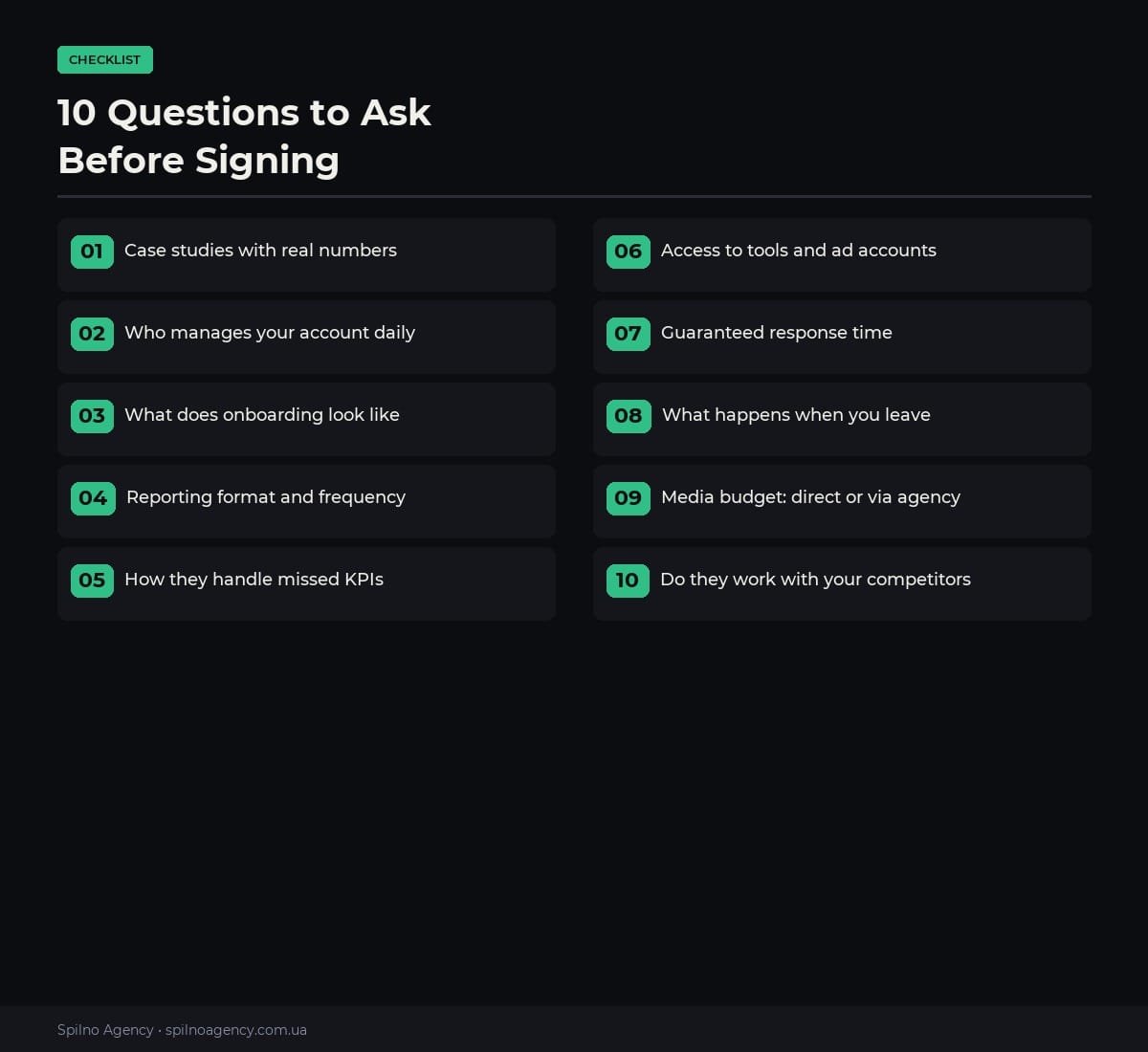
10 questions to ask a contractor before signing a contract
- What results have you achieved for a client with a profile similar to ours? Ask for specific numbers: ROAS, CPL, organic traffic growth.
- Who will manage our account day-to-day and what is their experience? You want to meet the person, not the company.
- What does the onboarding process look like and how long does it take? A good agency has a structured account handover process.
- How do you measure success and what does reporting look like? Ask for a specific report format — request an example.
- How do you respond when results are below expectations? You’re looking for accountability and a concrete action plan, not excuses.
- What tools do you use and will we have access to them? Data and ad accounts should belong to you, not the agency.
- What does communication look like and what is our guaranteed response time? Settle this before signing the contract, not after.
- What happens to our data and accounts if we end the partnership? You should retain access to everything.
- How is the media budget managed — directly through the platform or through the agency? The preferred model is when you pay directly to Google/Meta.
- Do you work simultaneously with our direct competitors? This isn’t automatically disqualifying, but you should know.
Red flags — when to say no
- Guaranteed results without an audit. No reputable agency can guarantee a specific ROAS, Google rankings, or a number of leads before analysing your business and historical data.
- No case studies with specific numbers. “We grew a client’s sales” without data is not proof. Ask for numbers — and if there aren’t any, ask why.
- Pressure to sign quickly. “Offer valid only until Friday” is a sales tactic, not a sign of a good agency.
- Unclear cost structure. If after two questions you still don’t understand what you’re paying for — that’s an intentional strategy, not a misunderstanding.
- Ad accounts on the agency’s account, not yours. Your data, your account. An agency that refuses to hand over access after the engagement ends is holding you hostage.
- No questions about your business at the first meeting. If the agency arrived with a ready-made presentation and immediately proposes solutions — they don’t understand your needs.
- Reporting only on vanity metrics. “Reach”, “impressions”, and “engagement” without connection to business results are vanity metrics, not proof of effectiveness.
- No clear point of contact and escalation procedure. If the contract doesn’t name a specific account manager — you have no one to talk to when something goes wrong.
What to check in a contract with a marketing agency
- Scope of services — exactly what’s included, how many campaigns, how many creatives, how many consultation hours per month.
- KPIs and goals — which metrics will be measured and how success is defined.
- Ownership of data and accounts — an explicit clause that Google Ads, Meta Ads, GA4 accounts, and all data belong to the client.
- Termination conditions — what the notice period is, what happens to active campaigns, how account handover works.
- Confidentiality — an NDA protecting your business data and client data.
- Media budget management model — whether the media budget is managed through your account or the agency’s.
- Reporting schedule — frequency, format, and recipients of reports.
- Escalation procedure — what to do if you’re dissatisfied with results or communication.
How to set KPIs for a marketing contractor
- Start with business goals, not media metrics. The goal is “150 leads per month with CPL below X”, not “CTR above 2%”.
- Set a benchmark before launch. Without historical data, you can’t evaluate whether results are good or bad.
- Divide KPIs by level. Primary KPIs (e.g. ROAS 4, 100 leads/month) + secondary (CPL, CTR, session quality) that help diagnose problems.
- Account for seasonality. KPIs for December in e-commerce and January KPIs are two different things.
- Review KPIs every quarter. The market changes, algorithms change, your business changes.
Checklist: what to verify before choosing a contractor
- Defined my collaboration model (agency / freelancer / in-house) that matches my situation.
- Have at least 3 proposals to compare.
- Asked for case studies with specific results from a similar industry.
- Know who will manage my account day-to-day.
- Understand the cost structure and what’s included in the fee.
- Asked about access to ad accounts and analytics data.
- Checked the contract against the 8 elements listed above.
- Set specific KPIs and a benchmark before launch.
- Agreed on a reporting schedule and communication format.
- Verified reviews about the contractor: Google, LinkedIn, references from former clients.
Summary: choosing a contractor is a process, not an event
Don’t choose a marketing agency based on the prettiest presentation or the lowest price. Choose based on evidence: specific results, a transparent process, and quality communication.
A good contractor will ask you more questions than you ask them — because they want to understand your business before proposing a solution. If you’re looking for an agency that treats marketing as an investment and reports results in business language — get in touch. We’ll show you how we work and what we can achieve together.
Request for marketing consultation

Read also
Spilno Agency’s Experience: How We Verify Events Before Starting Work
Before launching a campaign in Google Ads or Meta Ads, or starting SEO work, Spilno Agency always checks…
GA4 DebugView: How to Verify Google Analytics Events in Real Time
DebugView is the section of Google Analytics 4 that shows your site’s events in real time, seconds after…
Top Claude Skills for TikTok Ads Specialists (2026)
9 verified Claude skills and MCP servers for TikTok Ads: Pixel/Smart+ audits, Spark Ads hook/hold rate, creator sourcing,…