Lead Generation: What It Is and How It Works in 2026

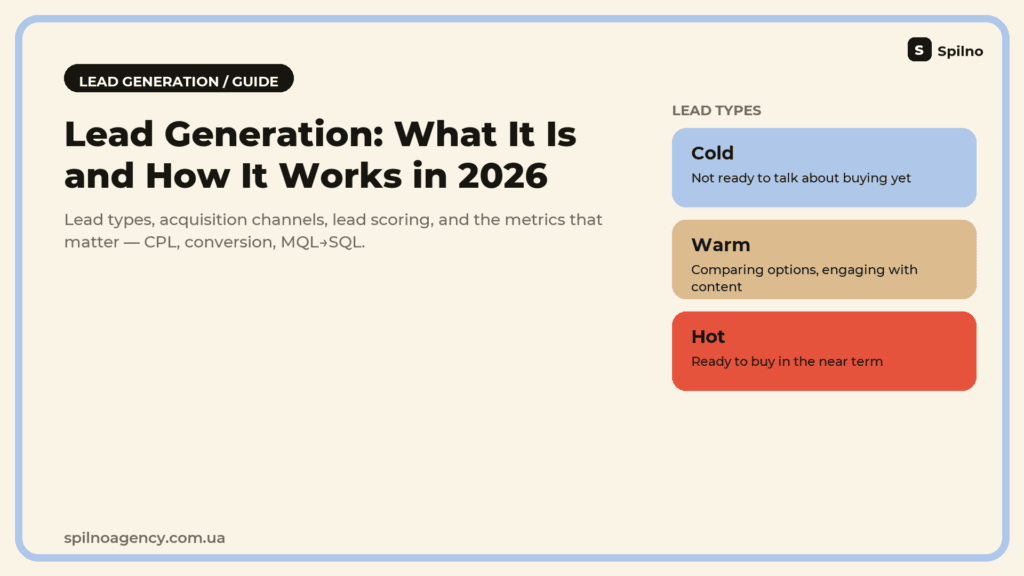
Lead generation is the process of attracting potential customers (leads) who’ve left their contact details and shown interest in a product or service. In 2026, lead generation goes well beyond a contact form on a website: alongside classic SEO, paid ads, and email campaigns, companies now rely on AI chatbots, personalized outreach, and brand visibility inside AI answers (GEO). Here’s what a lead actually is, how MQL and SQL differ, which channels perform best, and how to calculate cost per lead (CPL).
What is lead generation
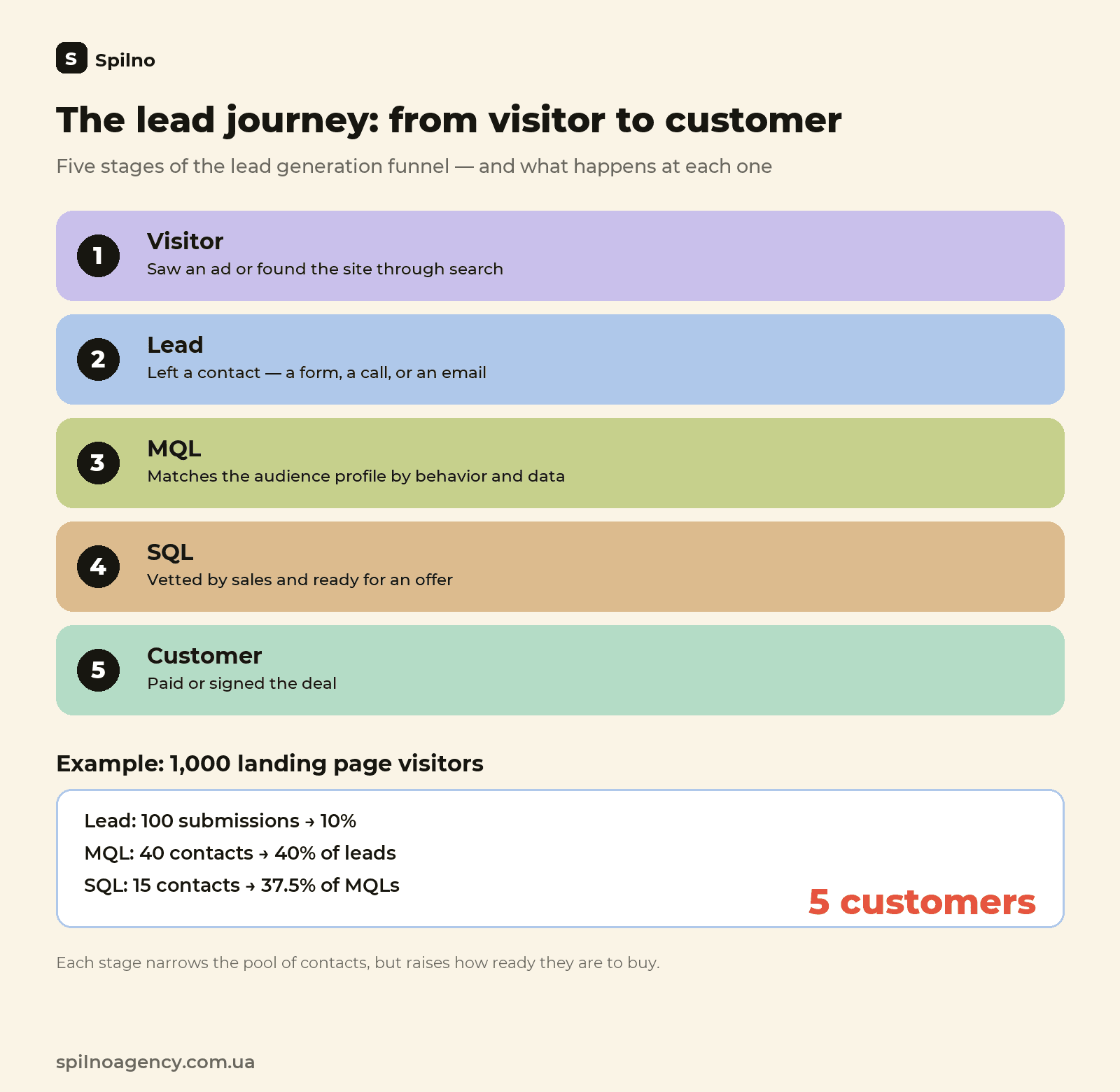
Lead generation is the marketing process of identifying and attracting people or companies who are potentially interested in a product or service, and capturing their contact information. The result of lead generation is a lead — a form submission, a call, an email, or a message from someone who has deliberately shared their contact details and is open to further communication.
The key difference between lead generation and plain traffic or reach is a measurable outcome. A campaign can rack up a million impressions, but only the portion of that activity that turns into an actual contact — a completed form, a chat inquiry, a call to a hotline, or a newsletter signup with buying intent — counts as lead generation.
What is a lead, and what types of leads exist
A lead is a prospect’s contact captured through a marketing or sales activity. Not every lead is equally ready to buy, so leads are typically grouped by how “warm” they are and by their qualification stage.
| Lead type | What it means |
|---|---|
| Cold lead | Contact captured, but the person isn’t ready to talk about buying yet — needs nurturing |
| Warm lead | Shows interest, compares options, engages with content or ads |
| Hot lead | Ready to buy soon, often initiates contact with sales directly |
| MQL (Marketing Qualified Lead) | Matches the target audience profile by behavior or data, but not yet vetted by sales |
| SQL (Sales Qualified Lead) | Vetted by the sales team and confirmed ready for a commercial offer |
Confusion between MQL and SQL is a common source of friction between marketing and sales teams: marketing reports on lead volume, while sales complains about lead quality. Clearly defined MQL→SQL criteria (lead scoring) resolve this — see the lead scoring section below.
Inbound vs outbound lead generation
Based on who initiates contact, lead generation splits into two opposite models.
| Inbound | Outbound | |
|---|---|---|
| Who initiates contact | The prospect finds the company on their own | The company reaches out first |
| Example channels | SEO, blog, content marketing, ads linking to the site | Cold calls, email outreach, LinkedIn prospecting |
| Speed of results | Slower, but cheaper and more stable long-term | Faster, but a more expensive contact and more manual work |
| Typical industry | B2C, self-service SaaS, content-driven niches | High-ticket B2B, complex enterprise sales |
In 2026 the line between inbound and outbound keeps blurring: companies increasingly combine both — for example, attracting a warm audience through content (inbound) and then personally following up on the most valuable contacts through outreach (outbound).
B2B vs B2C lead generation: what’s different
In B2C lead generation, the purchase decision is often made by one person, quickly — so the emotional trigger, price, and the ease of the form matter most: a one-click form, a messenger button, installment payment. In B2B, a buying committee is involved, the sales cycle is longer, and a lead usually passes through several qualification stages before becoming a customer. That’s why lead scoring, funnel-stage-specific content, and account-based marketing (ABM) — targeted, personalized work with a defined list of companies instead of mass reach — matter far more in B2B.
Lead generation channels in 2026
Effective lead generation rarely relies on a single channel — companies combine several sources depending on budget, speed of results, and product type.
- SEO and content marketing. Articles, guides, and case studies that answer real search queries from the audience. Slower, but the cheapest channel per lead over the long run.
- Paid search and social ads. Google Ads, Meta Ads, TikTok Ads — a fast, scalable flow of leads, though cost per lead rises with auction competition.
- Email marketing and nurture sequences. Automated email flows that warm up cold leads until they’re ready to talk to sales.
- Social media and influencer marketing. Organic content and creator collaborations build brand trust before the first sales contact even happens.
- Webinars and offline events. Produce high-quality leads with clear expertise — a webinar attendee has already received value and is more receptive to the next offer.
- Referral programs. Recommendations from existing customers carry the highest trust and close rate of any channel.
- AI chatbots and conversational marketing. A chatbot on the website or in a messenger qualifies the visitor and captures a contact in real time, without a human agent.
- GEO — visibility in AI assistant answers. ChatGPT, Perplexity, and Google’s AI Overviews increasingly recommend companies directly in the answer, bypassing classic search results — a new, still-underrated lead generation channel for 2026.
Lead scoring: how to evaluate lead quality
Lead scoring is a points-based system that evaluates a lead against defined criteria to determine how ready they are to buy and whether they should be handed off to sales. Without scoring, the sales team wastes time on leads that all look equally “warm,” even though only a few are actually deal-ready.
The most common qualification model is BANT:
- Budget — does the company or person have budget for the purchase.
- Authority — does the contact make (or influence) the buying decision.
- Need — is there a real need the product solves.
- Timeline — when is the purchase planned: now, next quarter, or unknown.
Beyond BANT, companies build their own scoring models: by lead source (a referral is worth more than cold traffic), by behavior (viewed the pricing page — extra points), by demographic data (job title, company size). Leads scoring above a set threshold are automatically routed to the CRM as SQLs.
Lead nurturing and CRM automation
Most leads aren’t ready to buy right after the first contact — they need nurturing: regular, useful touchpoints through content, case studies, and personalized offers. In 2026, this is almost always automated through a CRM (HubSpot, Pipedrive, Bitrix24) and email automation tools: the system sends the next email or creates a task for a rep based on lead behavior — opened an email, visited the site, downloaded a price list.
The key benefit of automated nurturing is that no lead falls through the cracks due to human error: the CRM logs every touchpoint and reminds the rep of the next step, even if the deal stretches over several months.
Lead generation metrics that matter
Lead volume alone says little without the context of cost and quality. The key metrics used to evaluate lead generation performance:
| Metric | What it shows |
|---|---|
| CPL (Cost Per Lead) | How much it costs to acquire one lead |
| Conversion Rate | What share of visitors or contacts turns into a lead |
| MQL → SQL Rate | What share of marketing leads passes the sales team’s check |
| CAC (Customer Acquisition Cost) | The total cost of acquiring one customer, across the whole funnel |
| LTV (Lifetime Value) | How much revenue a customer generates over the entire relationship |
The CPL formula is the simplest — and one of the most important:
CPL = Ad spend ÷ Number of leads generatedFor example, a €2,000 budget that produces 100 leads gives a CPL of €20. But CPL means nothing on its own without comparing it to LTV: if a customer generates €1,000 over the lifetime of the relationship, a €20 CPL is excellent — but if the average order value is €30, that same CPL makes the channel unprofitable.
Lead generation trends for 2026
- AI agents for lead qualification. LLM-based chatbots hold a full conversation with a visitor, ask clarifying questions, and pass an already-qualified lead into the CRM — not just a name and phone number.
- GEO alongside SEO. Companies now optimize content not only for Google Search, but also to get cited by ChatGPT, Perplexity, and AI Overviews — people increasingly ask AI directly for recommendations, bypassing classic search.
- First-party data over third-party. With restrictions on third-party cookies, companies build their own contact databases through lead magnets, subscriptions, and customer accounts.
- ABM (account-based marketing) in B2B. Instead of mass lead generation, companies pick a specific list of target accounts and build a personalized campaign for each one.
- Short-form video content. Reels, Shorts, and TikTok are becoming a genuine lead generation channel, not just a brand-awareness play.
Common lead generation mistakes
- Chasing lead volume without accounting for quality. Cheap but off-target leads overload sales and drag down the overall lead-to-customer conversion rate.
- No clear MQL and SQL definitions. Without agreed criteria, marketing and sales define a “good lead” differently, which keeps causing friction.
- Slow response to a hot lead. Studies show that calling within the first 5 minutes after a form submission dramatically raises the odds of closing, compared to calling an hour later.
- No nurturing for cold leads. If a lead isn’t ready to buy now and the company simply forgets about them, that’s wasted acquisition budget.
- Relying on a single channel. Depending on one lead source (say, only Google Ads) leaves the business exposed to rising click costs or algorithm changes.
- Ignoring landing page and form quality. Even good traffic gets wasted if the form is confusing or the landing page doesn’t match the user’s search intent.
Lead generation tools
Companies use several categories of tools to capture and process leads: a CRM to store and move leads through the funnel (HubSpot, Pipedrive, Bitrix24), form and landing page builders (Forminator, Typeform), email automation platforms (SendPulse, ActiveCampaign), AI chatbots for the website and messengers, and Google Ads and Meta Ads native lead forms that skip the site entirely. For B2B and ABM, companies also rely on contact-finding tools such as LinkedIn Sales Navigator, Apollo, and Clay.
Frequently asked questions about lead generation
What is lead generation in simple terms?
Lead generation is the process of attracting people or companies who have shown interest in a product or service and left their contact details (phone, email, a form submission). That contact is called a lead — a potential customer that a sales or marketing team can follow up with.
What’s the difference between a lead and a customer?
A lead is a person or company that has only shown interest and left a contact, but hasn’t purchased anything yet. A lead becomes a customer only after payment or a signed deal. In between, a lead usually goes through qualification stages (MQL, SQL) and nurturing.
What are MQL and SQL?
MQL (Marketing Qualified Lead) is a lead who matches the target audience profile based on behavior or data, but isn’t ready for a sales conversation yet. SQL (Sales Qualified Lead) is a lead that the sales team has vetted and confirmed as ready for a commercial offer.
How much does a lead cost (CPL) and how do you calculate it?
CPL (Cost Per Lead) is calculated as: ad spend divided by the number of leads generated. For example, a €2,000 budget that produces 100 leads gives a CPL of €20. An acceptable CPL depends heavily on the niche, average order value, and the length of the sales cycle.
What’s the difference between inbound and outbound lead generation?
Inbound lead generation is when a prospect finds the company on their own through content, SEO, or ads and submits a form. Outbound lead generation is when the company reaches out first: cold calls, email outreach, LinkedIn prospecting. In 2026 most companies combine both approaches.
Which lead generation channels work best in 2026?
The best results come from combining channels suited to the business: SEO and content marketing for a long-term flow of inquiries, paid search and social ads for fast results, email nurturing and AI chatbots to warm up leads. In B2B, account-based marketing (ABM) and personalized outreach are playing a growing role.

Read also
Google Data Studio (Looker Studio): What It Is and What It Can Do
Looker Studio (formerly Google Data Studio) is Google's free BI tool. We break down connectors, dashboards, and use…
Instagram: What Are Reels and How to Use Them
Reels are short vertical videos on Instagram that the algorithm shows even to non-followers. Technical specs, how Reels…
UGC Content: What It Is and How to Use It in 2026
UGC content is reviews, unboxings, and videos made by real people. Types of UGC, what a UGC creator…