UGC Content: What It Is and How to Use It in 2026

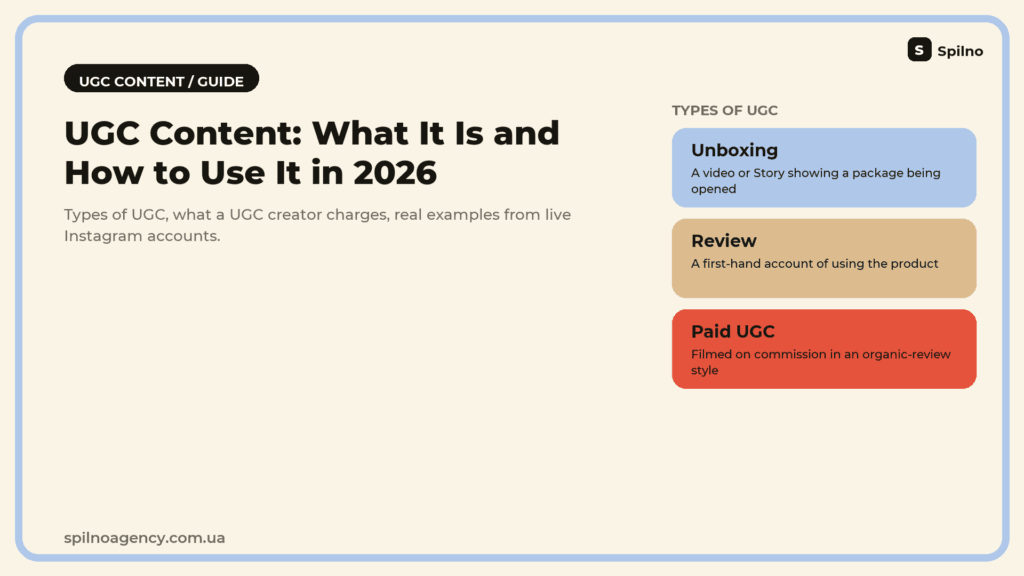
UGC (user-generated content) is reviews, unboxings, photos, and videos about a brand made by real people instead of the brand itself. In 2026, UGC is one of the cheapest and most trusted advertising formats: 85% of users trust content made by real people more than content from the brand. We break down the types of UGC, how a UGC creator differs from an influencer, what UGC content costs, and show real examples from live Instagram accounts — Aurora Multimarket, UNICO, and SOLMAR.
What is UGC content
UGC (user-generated content) is any content about a product or brand created by people rather than the company itself: buyers, followers, or hired UGC creators. It can be a photo with the product in Stories, an unboxing video, a short Reels review, a screenshot of a support chat, or a text review under a post.
The key difference between UGC and classic advertising is the format. An ad is filmed by the brand and openly presents the product’s benefits. UGC looks like one person’s personal experience, so the viewer perceives it as a genuine recommendation rather than marketing — even when the content is actually paid for by the brand.
UGC creator: who they are and what they charge
A UGC creator is a content contractor hired by a brand to film a video or photo set in the style of a “genuine review”: an unboxing, a product test, a “day in the life” featuring the product. Unlike an influencer, a UGC creator doesn’t publish the finished material on their own page — they deliver the file to the brand, and the brand decides where to publish it: on its own account, in an ad account, or on its website.
Rates for a single UGC video vary widely by market and experience — from roughly €10-20 for beginner creators without a portfolio, up to several hundred euros for experienced creators with real reach and editing skills. Price depends on the number of edit variations, whether multiple shooting angles are needed, and — most importantly — whether paid-advertising usage rights (whitelisting) are included, which is usually billed separately.
Types of UGC content
UGC isn’t a single format — it’s a whole category of content. The most common types differ by purpose and where they get published.
| UGC type | What it is |
|---|---|
| Unboxing | A video or Story showing the process of opening a package or product |
| Review | A first-hand account of using the product, often with a “before/after” demo |
| Reaction | An emotional reaction to a product or unusual purchase — a popular Reels/TikTok format |
| Tutorial | A step-by-step demo of how to use the product (makeup, a recipe, a setup) |
| Tagged photo | A regular photo in Stories or the feed tagging or mentioning the brand |
| Shared screenshot | A publicly shared positive review or a support-chat exchange |
| Paid creator content | A video filmed on commission in the style of organic UGC, made for ads |
Why UGC outperforms traditional advertising
According to an Adweek survey, 85% of users trust content created by real people more than content published by the brand itself. The reason is simple: brand advertising is perceived as biased by default — the company is praising its own product. UGC looks like an independent opinion from someone with no obvious financial stake in praising the item, even when the content is actually paid.
A second factor is production cost. A professional ad shoot costs far more than a UGC video, and often converts worse: a polished ad is subconsciously read as “a sales pitch,” while a “raw,” phone-shot UGC video feels authentic and stops the scroll precisely because it doesn’t look like an ad.
UGC vs influencer marketing vs branded content
These three formats are often confused, even though they follow different logic and different pricing.
| UGC | Influencer marketing | Branded content | |
|---|---|---|---|
| Who publishes | The brand (own page or ads) | The influencer on their own page | The brand, produced professionally |
| What you pay for | Finished content and usage rights | Access to the influencer’s audience | Production and creative work |
| Feel for the viewer | Personal, “raw” experience | A recommendation from someone trusted | Clearly promotional, polished |
| Typical cost | Low to medium per piece of content | Depends on audience size | Highest (production, location, crew) |
In practice, brands increasingly combine formats: they hire a UGC creator, then run that same clip as paid advertising — getting UGC’s authentic look with an ad’s controlled reach.
Real UGC examples from Instagram
UGC is easiest to understand on real brand accounts. Here are three Ukrainian retail brands with very different approaches, all active on Instagram today.
- Aurora Multimarket (@avrora.multimarket) — a home-goods retail chain. Customers organically film reactions to unusual products and unboxings — “haul” videos go viral without a formal campaign, and the brand reposts the best examples in its own Reels and Stories.
- UNICO (@unico.ukraine) — a cosmetics brand built around a 3-in-1 “multitasker” flagship product. In its feed and Reels the brand leans heavily on UGC tutorials showing how the product looks on different skin types and tones, letting a potential buyer see a realistic result before purchasing.
- SOLMAR (@solmar_official) — a basics clothing brand with over a million followers, one of the biggest retail accounts on Instagram in its market. Its communication runs on light, casual Reels — the brand treats views and reshares as the success metric, not immediate sales: if a clip gets watched and shared, it did its job of sparking interest.
Below are the actual videos: three real Reels from these brands, shot as collaborations with a UGC creator. Click a card to open the video on Instagram.
Aurora Multimarket — an in-store creator collab

▶ Watch the video on Instagram
UNICO — a UGC application tutorial

▶ Watch the video on Instagram
SOLMAR — a style-creator collab

▶ Watch the video on Instagram
How to launch a UGC campaign, step by step
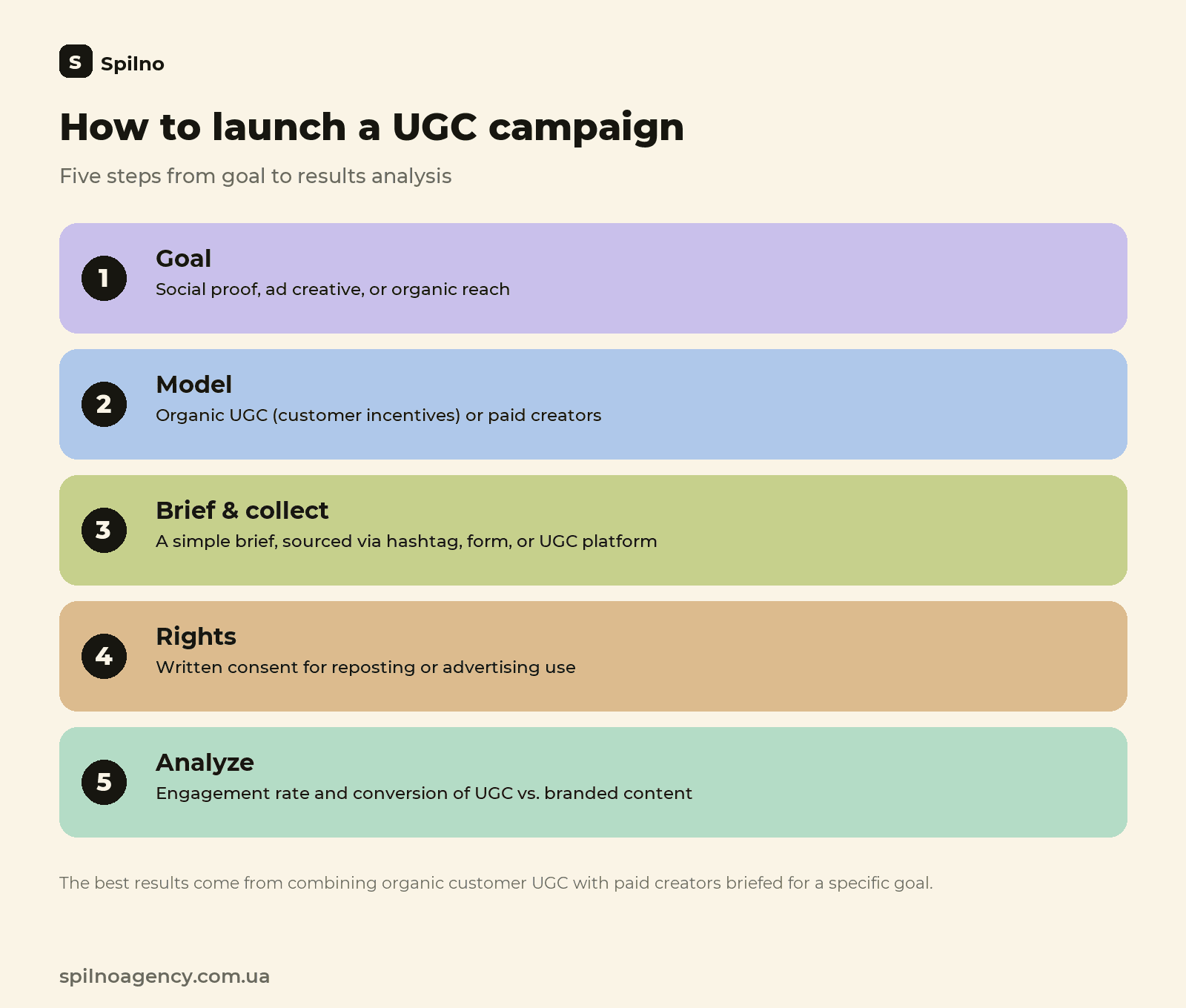
- Define the goal. Social proof for the website, ad creative, or organic reach — the goal determines which UGC format you need and where you’ll use it afterward.
- Choose a model: organic or paid UGC. Incentivize existing customers to share content (a discount, a giveaway, a feature on the brand account), or hire UGC creators against a clear brief and deadline.
- Write a simple brief. Key message, examples of tone and format, and what to avoid — an overly rigid script kills the natural feel that makes UGC work.
- Collect and curate the content. Through a hashtag, an account tag, an entry form, or a UGC platform — pick the strongest, most on-brand examples.
- Secure usage rights. Written consent for reposting or advertising use is a required step before anything goes beyond an organic Stories repost.
- Publish and measure. Compare the engagement rate and conversion of UGC content against branded creative — that tells you whether it’s worth scaling the format.
Content rights and paying UGC creators
Reposting an organic customer review to Stories with a credit to the author is standard practice and usually doesn’t need separate payment. But as soon as content goes beyond an organic repost — used in paid advertising, on a website, or in a promotional Reels carousel — you need the author’s explicit consent, ideally in writing (even a DM confirmation counts), and for paid UGC creators, advertising usage rights (whitelisting) must be written into the brief or contract upfront, specifying duration and the channels where it can be used.
Metrics for measuring UGC performance
| Metric | What it shows |
|---|---|
| Engagement Rate | Likes, comments, and shares relative to a post’s reach |
| UGC Conversion Lift | How much higher an ad’s conversion rate is with UGC creative vs. branded creative |
| Cost Per UGC Asset | The cost of one piece of UGC content — creator fee or customer-incentive budget |
| Frequency Decay | How much more slowly a UGC creative “burns out” in ads compared to branded creative |
| Time to First Response | How fast the brand reacts to and reposts new mentions — affects whether people keep sharing |
UGC trends for 2026
- AI-generated UGC. AI-avatar tools let brands scale the “unboxing on camera” format without a real shoot — the blurred line between real and generated UGC is becoming a trust challenge for audiences.
- UGC as a source for GEO. AI assistants (ChatGPT, Perplexity, AI Overviews) cite real reviews and discussions more often than branded pages — a strong UGC footprint raises the odds a brand gets mentioned in an AI answer.
- Dedicated UGC platforms. Marketplaces for finding and hiring UGC creators make sourcing and briefing faster and more scalable.
- Short video as the default. Reels and TikTok remain the primary UGC format — long-form reviews keep losing ground to 15-30 second clips with a strong hook in the first few seconds.
- Brand-made content styled as UGC. Brands increasingly shoot their own content to look “UGC-style” — deliberately unpolished, so it doesn’t read as an ad.
Common UGC mistakes
- Using content without the author’s permission. Even a public post doesn’t automatically grant the right to repost it in paid ads — that’s a copyright violation.
- An overly rigid script for a UGC creator. If a clip sounds like a memorized ad script, the audience notices the fakeness instantly — and the “authenticity” effect disappears.
- Ignoring negative UGC. Deleting or ignoring uncomfortable reviews is worse than responding to them calmly and publicly — audiences value transparency over a perfect image.
- No system for collecting content. Without a hashtag, an entry form, or regular mention monitoring, a brand loses most of the organic UGC it could otherwise use.
- Relying only on paid creators. Paid UGC scales faster, but genuine customer reviews carry more trust — it’s worth building both sources.
Tools for working with UGC
To find creators and manage UGC content, brands use dedicated UGC-creator marketplaces (such as Billo or Insense), social listening tools for monitoring mentions and hashtags, tools for collecting content usage rights, and website or Google Forms entry forms for contests and giveaways. Meta Ads and TikTok Ads with creative-type breakdowns are the standard way to measure how UGC creative performs in paid campaigns.
Frequently asked questions about UGC content
What is UGC in simple terms?
UGC (user-generated content) is any content about a brand or product made by real people rather than the brand itself: reviews, unboxings, photos with the product, video reviews, story reposts. The defining feature of UGC is that it looks like an honest personal experience, not an ad.
What is a UGC creator and how is it different from an influencer?
A UGC creator is a contractor who films content in the style of a “genuine review” for a brand, for payment — but the brand publishes it, not the creator. An influencer publishes content under their own name on their own page and sells access to their audience. A UGC creator sells finished content and usage rights, not reach.
How much does a UGC creator charge?
Rates for a single UGC video vary widely by market and experience — from roughly €10-20 for beginner creators without a portfolio, up to several hundred euros for experienced creators, depending on the complexity of the shoot, the number of revisions, and whether paid-advertising usage rights (whitelisting) are included in the price.
Do you have to pay for UGC if you just repost it to your Stories?
Reposting an organic customer review to Stories with a credit to the author is standard practice and usually doesn’t require separate payment. But using someone else’s content in paid advertising, on a website, or in a promotional Reels carousel requires their explicit permission — and often separate payment for commercial usage rights.
How do you get rights to use UGC content in advertising?
You need the author’s written consent — even a simple confirmation via DM or comments counts. For paid UGC creators, advertising usage rights (whitelisting) are written into the brief or contract upfront, specifying the duration and the channels where the material can be used.
How is UGC different from a review or influencer marketing?
A review is a text-based product rating on a marketplace or Google Business Profile, usually without visual content. Influencer marketing is paid promotion on the page of a person with an audience they’ve built. UGC is a broader category: any visual or text content from a user or a hired creator that looks like an organic experience, whether it’s paid or not.

Read also
Google Data Studio (Looker Studio): What It Is and What It Can Do
Looker Studio (formerly Google Data Studio) is Google's free BI tool. We break down connectors, dashboards, and use…
Instagram: What Are Reels and How to Use Them
Reels are short vertical videos on Instagram that the algorithm shows even to non-followers. Technical specs, how Reels…
Lead Generation: What It Is and How It Works in 2026
Lead generation is how businesses attract potential customers. Lead types, inbound vs outbound, 2026 channels, lead scoring, and…