Do Meta Tag Length Rules for Title and Description Actually Apply?

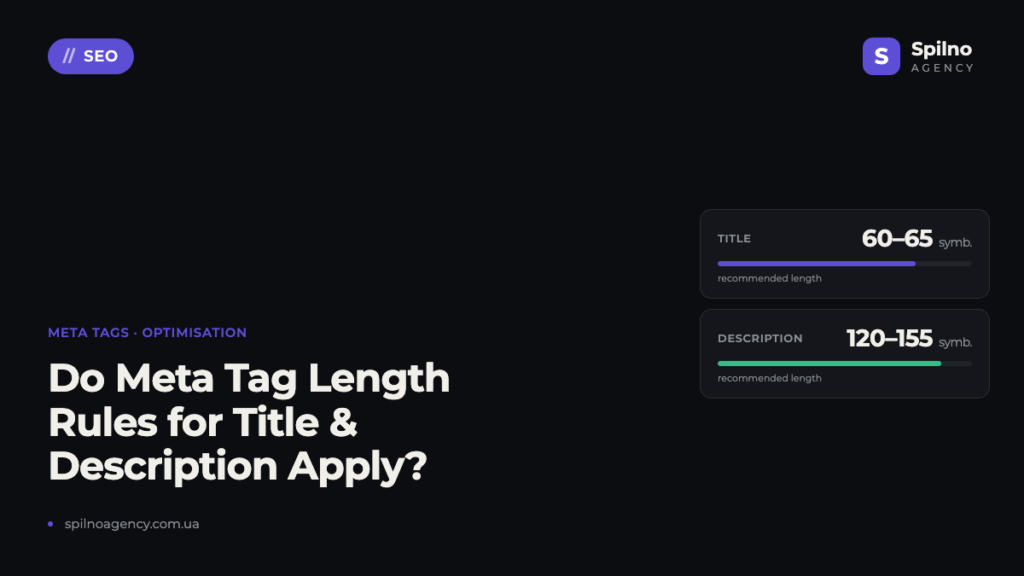
Title under 60 characters, description under 160 — every SEO professional knows these numbers. But are they actual rules? No. These are best-practice recommendations that Google has never officially mandated. This guide explains where these numbers came from, how they affect CTR, and when it makes sense to break them.
Where did the 60/160 character rule come from?
Meta tag length limits didn’t emerge from nowhere — they grew out of a technical decision by Google. Between 2009 and 2012, the search engine standardised the snippet width in search results: the title container was approximately 600 pixels wide, and the description container around 920 pixels.
That’s what created the “character rule”: with typical fonts like Arial or Montserrat, a title fits roughly 60–70 characters and a description fits around 150–160 characters. The SEO community rounded these figures and turned them into a standard.
An important nuance: Google measures pixels, not characters. The letter “W” takes twice as much space as “i”. So a title with 65 narrow letters may fit perfectly, while one with 55 wide characters gets truncated.
Key milestones in the evolution of title and description
- 2009–2012 — Google standardises snippet width; the SEO community develops its first practical guidelines;
- 2016 — Google temporarily expands title display to ~70 characters due to font changes;
- 2017 — A/B test with longer descriptions (up to 320 characters), then a return to 155–160 in 2018;
- 2020–2025 — Google increasingly rewrites titles and descriptions at its own discretion, ignoring the provided tags.
Why 60/160 is considered the “golden standard”
These numbers became entrenched for good reason. Research from platforms like Moz, Portent, and Semrush confirms: titles in the range of 50–60 characters tend to have higher CTRs, because Google displays them without truncation across most devices and browsers.
For meta descriptions, 140–160 characters allows you to:
- Include a clear call to action (CTA);
- Incorporate keywords that Google bolds in the snippet when they match the search query;
- Keep the description readable and complete — without the feeling of cut-off text.
Technically, the “golden standard” means your snippet will look clean on 90%+ of devices — from desktop browsers to mobile phones and tablets.
Is it a rule or a recommendation?
It is not a strict rule. Google has never published an official length limit for meta tags. The official Google Search Central documentation simply states: “Write accurate and concise titles that describe the page’s content.”
What actually happens if you exceed the limit:
- Title gets truncated in SERP — Google adds “…” and shows only part of it. But the full text stays in the page code and doesn’t negatively affect rankings;
- Description may be ignored — Google independently selects a text snippet from the page that it considers more relevant to the user’s query;
- No penalty exists — the algorithm does not lower rankings for a “long” title or description.
This is a recommendation born from practical experience — not a technical limitation. Following it matters for UX, not for the algorithm.
Shorter or longer title — what happens?
Title shorter than 50 characters
A short title isn’t a mistake. It works well for:
- Brand pages — “Spilno Agency | Digital Marketing” (36 characters) looks clean and professional;
- Homepages — where the brand name is the primary keyword;
- Concise niches — when the target keyword is inherently short (“buy iPhone 15”).
The downside of short titles: they can look “underdeveloped” and may not carry enough semantic signals for Google.
Title longer than 70 characters
If the title exceeds 70 characters:
- Google truncates it in SERP — users see only the beginning;
- The end of the title (where brands or secondary keywords often appear) may be hidden;
- CTR may drop — truncated titles look incomplete.
When a long title is appropriate: in structured articles like “Guide: X Steps to Y — Full Walkthrough for Z” — if the first 60 characters already convey the core value, the rest still adds semantic weight for Google’s understanding.
Shorter or longer description — what happens?
Description shorter than 100 characters
A very short description isn’t an error, but it’s a missed opportunity. Google may display it in full, but users receive too little information to confidently decide to click.
Appropriate for: contact pages, “About Us” pages, short landing pages with a single CTA.
Description longer than 160 characters
Google truncates descriptions at approximately 155–160 characters on desktop and even shorter on mobile. Text beyond the cut-off isn’t shown in SERP but stays in the code.
The core issue: Google often ignores the provided description and replaces it with a passage from the page it deems more relevant to the query. This happens in over 60% of cases (according to Portent research).
“Fewer words in title = more ranking power”: did this rule ever exist?
In the early years of SEO (roughly 2003–2012), there was a widespread belief among optimisers: the fewer words in a title, the more “weight” each word receives in Google’s eyes. The logic was simple — the algorithm supposedly divided the total ranking potential of a title equally among all its words. Two words — each gets 50% of the power. Ten words — each gets only 10%.
This led to practices such as: removing stop words (“and”, “or”, “for”), ultra-short titles like “Buy iPhone”, and dropping the brand name from the title entirely to “concentrate” keyword power.
Was there any basis for this?
Partially — yes. In Google’s early TF-IDF (Term Frequency–Inverse Document Frequency) algorithms, word frequency within a document genuinely mattered. A short title with a precise keyword produced a higher relative frequency — and could indeed rank better for that specific query.
But even then, it was an oversimplification. Google never confirmed the “weight distributed between words” mechanic — it was a folk theory from the SEO community, not an officially documented algorithmic fact.
Does this rule still hold today?
No — not in the form it once existed. After the introduction of BERT (2019) and MUM (2021), Google stopped analysing text as a collection of individual words with separate weights. The algorithm now understands context, synonyms, semantic relationships, and user intent.
What this means in practice:
- Stop words are back. Removing “and”, “how”, “for” from titles is unnecessary — Google understands their role in a sentence and doesn’t penalise their presence;
- A longer title doesn’t “dilute” the keyword. “How to Buy iPhone 15 at the Best Price in Europe” is not weaker than “Buy iPhone” if it better matches the user’s query;
- Focus matters more than word count. What remains relevant today is that the title should clearly reflect the page’s main topic. But this is a question of relevance — not “weight concentration”;
- One keyword vs a semantic field. The modern approach is to build a title around intent, not around a single keyword. “Meta title and description length rules” ranks just as well as “meta title rules”.
In short: “fewer words = more power” is an artefact of the pre-BERT era of SEO. Today Google evaluates relevance and intent match — not mathematical keyword density. A good title is accurate and useful for the user, not deliberately short.
When is it acceptable to deviate from standard recommendations?
- Branded search — for pages ranking primarily on branded queries, length matters less than precision;
- Rich results — if the page has structured Schema and gets an enhanced snippet, the standard description becomes secondary;
- Local SEO — for local pages, fitting a geo-signal (“London”, “Europe”, “Poland”) is more important, even if it lengthens the title;
- E-commerce categories — a longer description with key filters and product attributes can increase CTR among shoppers;
- AI Overviews / GEO — for Google’s generative responses, page content matters more than meta tag length.
SEO flexibility: hypothesis testing
SEO is not a legal code — it’s continuous testing. Any recommendation, including meta tag length, is a hypothesis worth verifying on your specific site.
How to test meta tags:
- Choose 10–20 similar pages — same page type and traffic level;
- Change title/description for half of them — for example, shorten from 70 to 55 characters or change the structure;
- Track CTR in Google Search Console — monitor for at least 4–6 weeks after changes;
- Compare CTR and rankings — rising CTR with stable positions = positive result;
- Scale the winner — apply the proven pattern to similar pages.
Other things worth testing in meta tags:
- Numbers at the start of titles (“7 ways to…” vs “How to…”);
- Question-style titles vs statement-style titles;
- Brand name included vs omitted in title;
- Emoji in descriptions (mobile-only, not all are displayed);
- CTA in description (“Read”, “Learn more”, “Explore”).
The core principle of SEO flexibility: a rule holds until your own data proves otherwise. If longer titles drive better CTR on your site, that’s your rule — not the general recommendation.
Key takeaways: what actually matters in meta title and description
- Length is a guideline, not a law. Think in pixels, not characters;
- Title between 50 and 65 characters — the safe zone for most pages;
- Description between 120 and 155 characters — optimal for desktop and mobile SERP;
- No penalty for exceeding limits — but there’s a risk of truncation and lower CTR;
- Test hypotheses via GSC and scale what works for your specific site.
FAQ: common questions about meta tag length
What is the maximum title length for Google?
There is no official maximum. Technically, Google displays the title in a SERP container approximately 600 pixels wide. The practical recommendation is up to 60–65 characters. A longer title will be truncated in the snippet, but this does not affect rankings.
How many characters should a meta description be?
The recommended range is 120–160 characters. Google truncates descriptions at approximately 155–160 characters on desktop and around 120 on mobile. However, even a perfectly written description may be replaced by a passage from the page’s content.
Does title length affect Google rankings?
Directly — no. Title length is not a ranking factor. But the title affects CTR, and CTR influences behavioural signals that Google indirectly considers. So optimal length matters for snippet attractiveness, not for the algorithm itself.
What happens if meta description is missing?
Google will automatically generate a snippet from the page’s text that is most relevant to the user’s query. This isn’t catastrophic, but you lose control over what users see in search results.
Does Google use keywords in meta description for ranking?
For ranking — no, Google officially confirmed this in 2009. However, keywords in the description are displayed in bold in SERP when they match the user’s query. This increases snippet visibility and can improve CTR.
Are the rules the same for mobile and desktop?
No. On mobile devices, the title and description containers are narrower. Descriptions on mobile are often truncated at just 100–120 characters. Keep this in mind when writing: the most important content should be in the first part of the text.

Read also
How to Build a LinkedIn Ads Strategy: A Step-by-Step Plan Based on a Real Case
How to build a LinkedIn Ads strategy for B2B: ICP brief, audiences, Campaign Manager forecast, budget and funnel.…

How Long Does Google Take to See Changes on Your Website: Google’s Data on Crawling, Indexing and Serving
We break down Google's slides from Search Central Live: how long crawling, indexing and serving of changes take,…
How to Transfer (Move) a Google Analytics 4 Property to Another Account: Step-by-Step Guide
A step-by-step guide with screenshots: how to move a Google Analytics 4 property to another account without losing…