How Spilno Agency Does On-Page SEO Optimization with Claude

Spilno Agency runs on-page SEO optimization together with the AI agent Claude — following one document standard that covers a GSC audit, technical Schema markup, content edits, and a live verification of every single change on the actual live site. This article breaks down what that standard includes, with a real example document you can download.
Why “updating meta tags” isn’t on-page optimization
When clients hear “on-page SEO optimization,” they often picture something simple: rewrite the Title, sprinkle in a few keywords, and wait for results. In practice this rarely works, because a page doesn’t rank on isolated elements — it ranks on a combination of signals: technical correctness (canonical, hreflang, Schema), how well the content matches real search intent, and trust signals (E-E-A-T).
At Spilno Agency we formalized this process into a single document standard we use for every page — whether it’s a service page, a case study, or a guide. The document is driven by the AI agent Claude, while the agency team reviews every step and approves any change before it goes live.
What the on-page optimization document standard includes
Every optimization document goes through seven mandatory steps. None gets skipped — if a section isn’t relevant for a specific page, we mark that explicitly instead of just leaving it out.
- Step 0. Preparation — WP IDs for every language version, hreflang check, access to Google Search Console and WP Admin.
- Step 1. GSC — target query cluster — we pull real Search Console data for 90–180 days: impressions, clicks, CTR, and average position per query, per language version.
- Step 2. Technical audit — Schema markup, Title/Meta, H1/H2 structure, reciprocal hreflang, alt text, internal linking.
- Step 3. Change plan — concrete before/after for Title, Meta, H1, new content blocks, and Schema — no vague recommendations.
- Step 4. Change log — priority, type (bug/feature/other), and status for every fix.
- Step 5. Language versions — a separate checklist per locale (UA/EN/PL/RU), since content and queries differ by language.
- Step 6. Expected results — a forecast for each specific change with timeframes (2–4 and 6–8 weeks) and the risks that could keep the forecast from coming true.
The cycle closes with Step 7 — a post-implementation checklist: verifying Title/Meta/Schema on the live site, requesting reindexing in Google Search Console, and logging a date to compare the forecast against the actual result.
The core principle: never trust a “✅” status
During one audit we made an important discovery: a previous optimization document for a client page listed Title, Meta, and Schema markup as “✅ implemented.” Technically, the request to write that data had returned a server response code of 200 — seemingly successful.
But a direct check of the live page’s code (no intermediate caches, no admin panel) showed that none of the changes had actually reached the site. The cause: separate systems (the WordPress REST API and Yoast SEO) don’t always sync data the way you’d expect — the server confirms it received the request, but the actual write to the “live” fields may silently fail.
Since then, every step of our standard includes a mandatory live check: after any write, we fetch the page’s HTML directly and verify that the Title, Meta, and Schema markup actually changed (by parsing the JSON-LD), rather than trusting the server’s response code. That rule is now part of the standard for every page we optimize.
What this looks like in practice
An example from a real audit of a car-repair-shop service page. Google Search Console data showed one language version pulling in over 5,000 impressions over 180 days, and for its main target query the page was already sitting in the top 10 (position 6.9) — yet only 0.19% of viewers clicked through. The reason turned out to be simple: the title and description shown in search results didn’t match what people were actually looking for.
At the same time, the technical audit revealed no Schema markup at all (the markup that helps Google display rich results — like a “Frequently Asked Questions” block right in the search results) on any of the language versions, even though visible FAQ content already existed on the pages. One locale also had a language bug: questions were in one language, answers in another.
The result after fixes: an updated title and description matched to what users actually search for, Schema markup added based on content that already existed on the page (no invented data), a corrected translation, and the removal of a pricing block that shouldn’t have been there per the agency’s internal policy. Every change comes with a forecast of the expected effect and a date to check it against reality.
Download the example document
We’ve prepared an anonymized example of the full on-page optimization document — the exact same standard we use for every client page. This is the real structure we work with daily, with no invented sections.
FAQ
Does AI fully replace an SEO specialist in this process?
No. Claude runs the audit, analyzes GSC data, and makes technical fixes following an approved standard, but every change to a client’s live site is overseen by the agency team, and decisions about content or publishing are always confirmed by a person.
Why is it so important to verify changes live instead of trusting the server response?
Because a 200 response code only means the server accepted the request — not that the data was actually written to the right field. We’ve run into a real situation where a previous optimization looked “done” in the documentation, but nothing on the site had actually changed.
Does Schema markup guarantee higher Google rankings?
No, Schema isn’t a direct ranking factor, but it helps Google better understand a page’s content and can unlock rich result formats in search — which raises CTR even without a position change.
How soon do you see optimization results?
Google typically reindexes the first technical changes (Schema, an updated snippet) within 1–3 weeks. A noticeable effect on rankings and traffic is usually assessed after 2–8 weeks, depending on competition in the niche.
Can this standard be applied to my site?
Yes, the document is universal for any page, with or without language versions — the structure (query audit, technical audit, plan, forecast) doesn’t depend on the niche.
Want a similar audit for your site? Get in touch — and we’ll show you which pages on your site have the most growth potential.

Read also
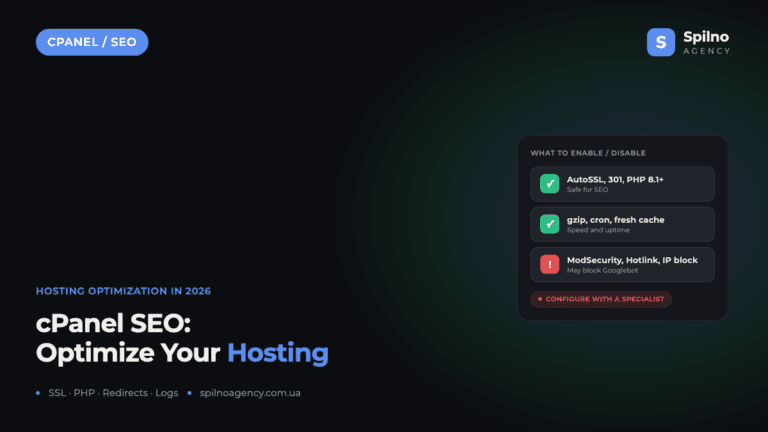
cPanel SEO: How to Optimize Your Hosting for Search in 2026 (Enable & Disable)
cPanel is a hosting control panel that packs dozens of features with a direct impact on SEO: HTTPS…

Cloudflare for SEO: How to Configure It to Improve Search Performance in 2026
Cloudflare works as a proxy and CDN between the visitor and your website, and it can noticeably affect…

How Much Does a Google Ads Specialist Earn in 2026 — Salary Research
A Google Ads specialist (PPC expert) in 2026 earns anywhere from $500/mo as a Junior in Central and…