References: What Are They, Why Are They Important, and Where to Find Them?

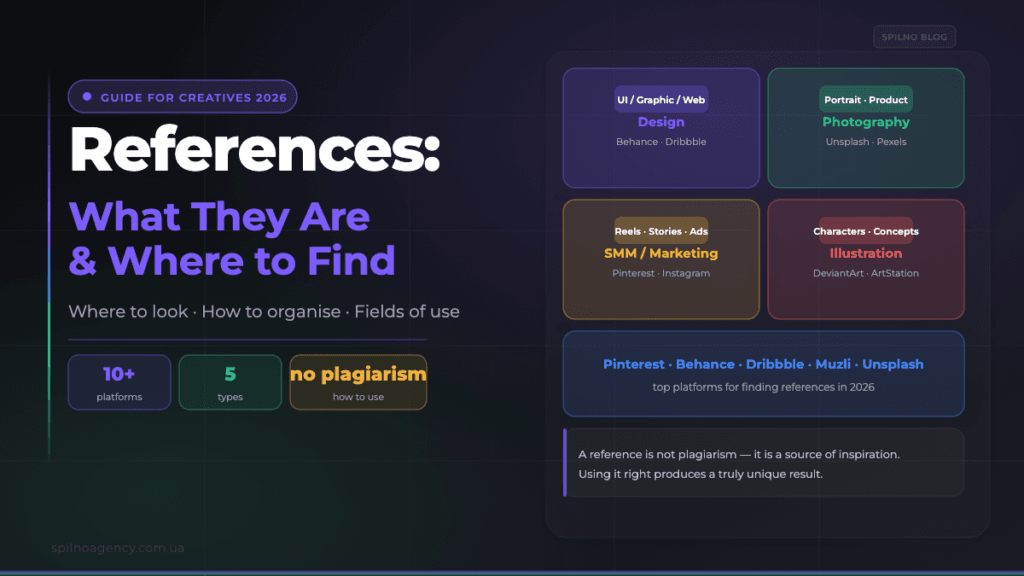
A reference is any material (photo, text, sound, video) that serves as an example or source of inspiration for creative work. Designers, SMM specialists, photographers and marketers across Europe use references every day to align results with clients faster and create truly unique outputs.
What is a reference?
A reference is any material (image, text, audio, video or physical object) that serves as an example or benchmark for creative work. It provides a starting point for defining the style, mood, colour palette or structure of a future project.
Using references is not plagiarism. You draw on them as a basis for your own ideas rather than copying someone else’s work. References help European designers and creative professionals to:
- define and agree on a brief with the client more quickly;
- save time on revisions and iterations;
- avoid misunderstandings about the expected outcome between team and client;
- discover new solutions by combining ideas from different sources.
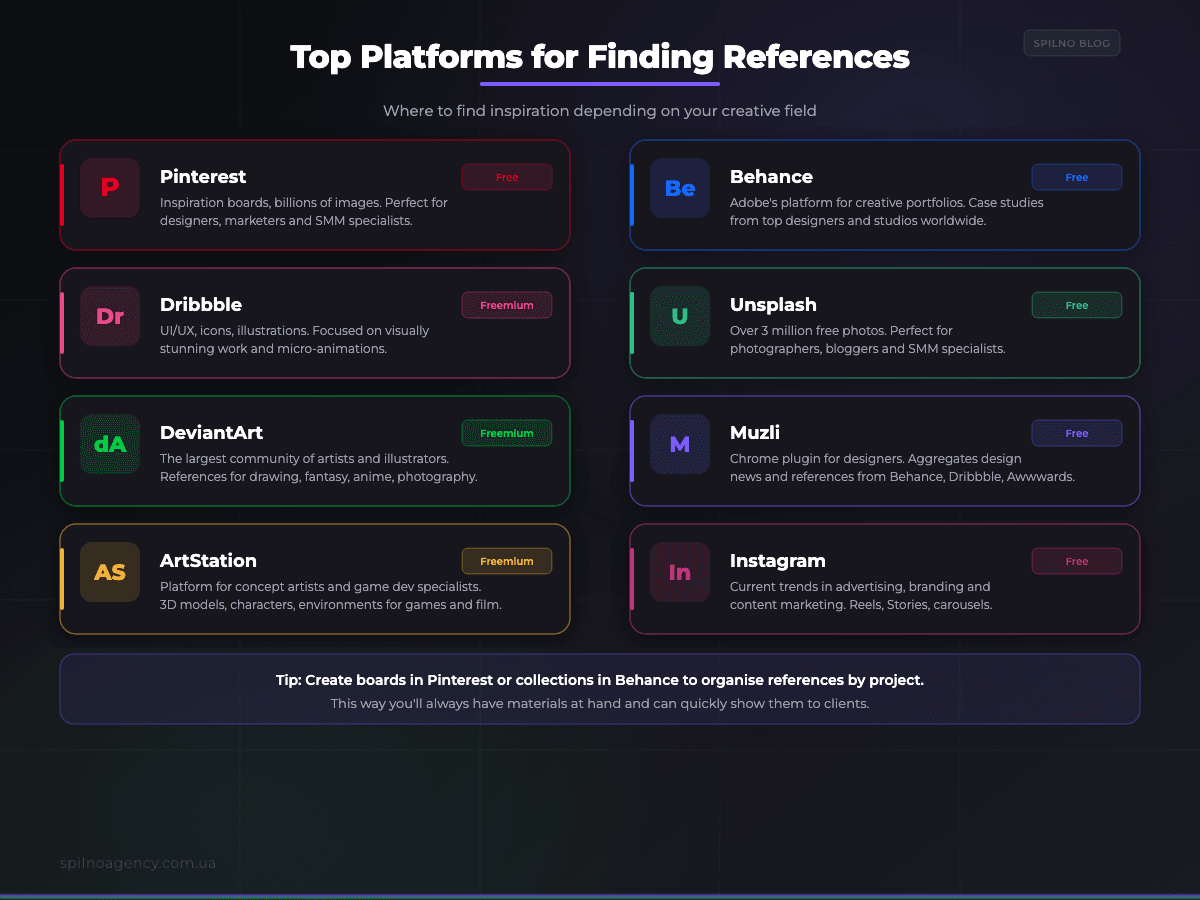
Why references matter: 5 key reasons
Any creative professional — designer, photographer, SMM manager, copywriter — regularly faces situations where it is difficult to describe the desired outcome in words. A reference solves this problem visually.
- Shared understanding of the result. The client shows a reference for a website design — and the contractor immediately sees the required style without lengthy explanations.
- Faster workflow. With clear benchmarks, the specialist spends less time searching for direction and more time on quality execution.
- Inspiration and new ideas. Analysing others’ work sparks your own solutions that might not have emerged otherwise.
- Staying on top of trends. Regularly reviewing references helps you track current tendencies in design, marketing and photography across Europe and globally.
- Team communication. A shared reference board helps synchronise the vision between designer, copywriter and art director.
Types of references
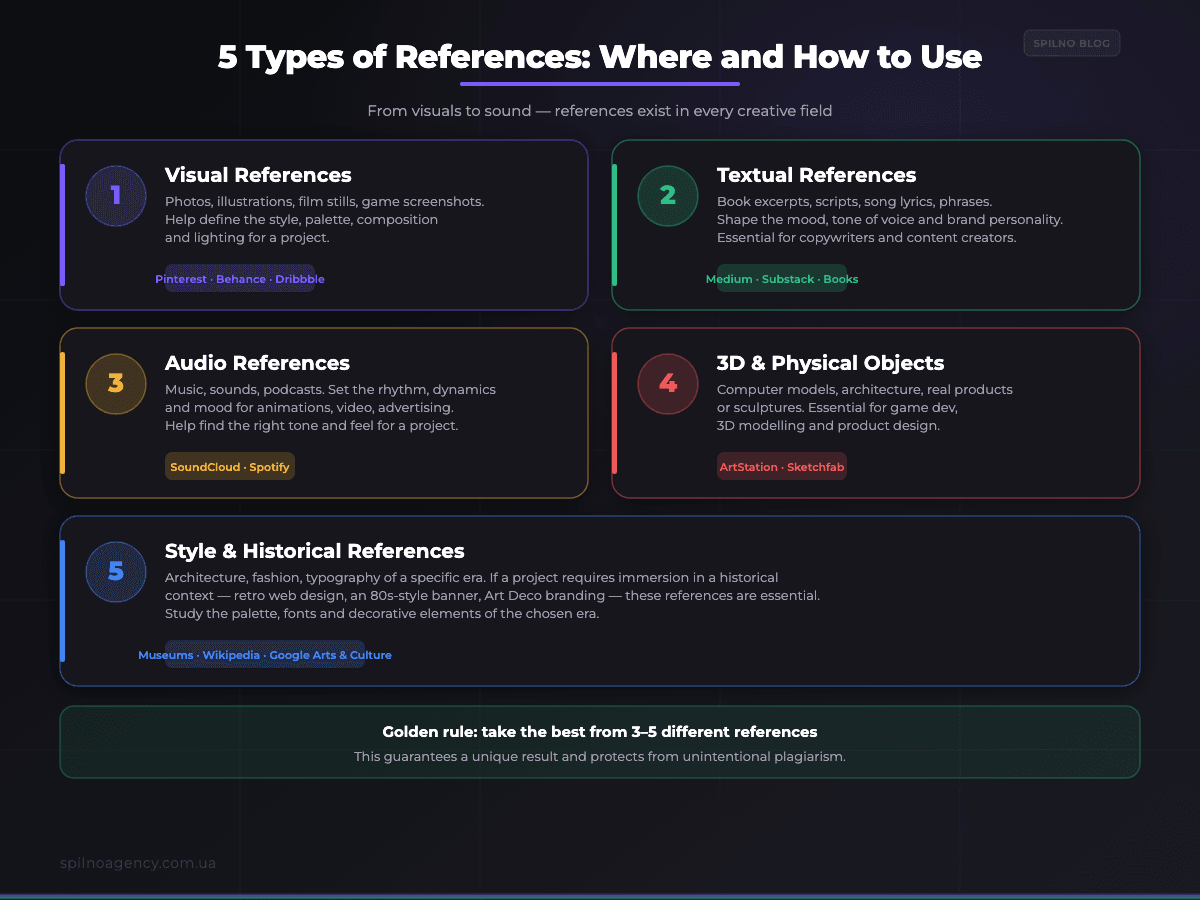
There are five main types of references depending on format and field of application:
- Visual. Photos, illustrations, film stills, game screenshots, type samples. Define style, palette, composition and lighting.
- Textual. Book excerpts, scripts, song lyrics, advertising slogans. Shape the tone and brand voice for copywriters and content creators.
- Audio. Music, sound effects, podcasts. Set the rhythm and dynamics for animations, advertising videos and motion graphics.
- 3D and physical objects. Computer models, architectural solutions, real products or sculptures. Essential for game development, product design and 3D modelling.
- Style and historical. Architecture, fashion, typography of a specific era. Important when a project requires immersion in a particular period — retro style, Art Deco, 1990s minimalism.
Where to find references: top 10 platforms in 2026
The choice of platform depends on your field. Here are the best resources for different types of creative tasks:
- Pinterest. A treasure trove for designers, marketers and photographers. Billions of images, a convenient board system and algorithms that surface similar content.
- Behance. Adobe’s platform with portfolios from millions of creative professionals. Ideal for web design, branding and illustration.
- Dribbble. Focused on UI/UX, icons and micro-animations. A more selective community — the top tier of the industry publishes here.
- Unsplash / Pexels / Pixabay. Free stock photo libraries with commercial-use licences.
- DeviantArt. The largest community of artists and illustrators. Ideal for drawing references, fantasy, anime.
- ArtStation. Platform for concept artists and game development specialists. 3D models, characters and environments for games and film.
- Muzli. Chrome plugin: aggregates design news and references from Behance, Dribbble and Awwwards directly in each new tab.
- Instagram. Current trends in advertising, branding and content marketing. Follow specialists and brands in your niche.
- Google Images / Google Arts & Culture. For style and historical references — architecture, painting, fashion from different eras.
- Awwwards / CSS Design Awards. The world’s best websites — for web designers and front-end developers.
How to organise references: mood boards and storage systems
Collecting references is only the first step. Organising them properly so that the right material is always easy to find is equally important.
A mood board is a curated board containing images, colours, fonts and textures that convey the overall mood and style of an upcoming project. It is the first step towards a shared vision between client and creative team.
Tools for organising references:
- Pinterest Boards. A free and convenient way to group images by theme and project.
- Figma / FigJam. Designer boards: gather screenshots, images and notes in one place.
- Notion. A flexible knowledge base: store references alongside the brief and comments.
- Are.na. A content curation platform popular among designers and art directors across Europe.
- Google Drive / Folders. A simple option: folders named after projects with subfolders by reference type.
References across creative fields
References are used across virtually all creative and marketing disciplines, though the approach to selecting them varies:
- Web design. References help define UX structure, button styles, typography and colour scheme. Key sources: Behance, Dribbble, Awwwards.
- SMM and content marketing. Trending post formats, Reels and Stories styles, video advertising approaches. Sources: Instagram, TikTok, Pinterest.
- Photography. Poses, lighting, colour grading, retouching style. References for a shoot simplify communication with models and clients.
- Illustration and concept art. Anatomy, drawing styles, colour palettes, perspective techniques. Sources: DeviantArt, ArtStation, Pinterest.
- Video production and motion design. Editing techniques, animations, effects. Sources: Vimeo, YouTube, Motionographer.
- Marketing and advertising. Competitor campaign analysis, positioning approaches, ad formats. Sources: Ads of the World, Facebook Ad Library.
How to use references correctly: avoiding plagiarism
The core principle when working with references is transformation, not copying. Here is a step-by-step approach:
- Draw from multiple sources. The optimal number is 3–5 different references. This way you synthesise a unique solution rather than copying a single work.
- Analyse what specifically appeals to you. The colour? The composition? The font? The atmosphere? Once you understand this, you know exactly what to take.
- Do not copy the structure 1-to-1. Take the colour palette from one reference, the typography style from another, and come up with the overall composition yourself.
- Share references with the client at the brief stage. “Here is what I like about this work” is more effective than a verbal description.
- Store and organise systematically. A good reference board is part of the professional workflow of any creative.
Common mistakes when working with references
- Copying instead of drawing inspiration. Reproducing someone else’s work verbatim is plagiarism. Always transform and adapt.
- Using only a single reference. The result will be too similar to the original. Draw ideas from at least 3 different sources.
- Ignoring relevance. A reference from ten years ago may lead you towards an outdated style. Keep track of trends.
- No storage system. Without an organised reference board you will spend time searching for the same materials from scratch every time.
- Sharing a reference without commentary. The client or colleague may not understand what specifically you like about a given work. Always explain: “I like the colour here” or “I need this exact animation rhythm”.
Frequently asked questions
What is a reference in design?
A reference in design is any visual, textual or audio material that serves as an example or benchmark for creative work. It is not plagiarism — it is a source of inspiration that helps define the style, mood and direction of a project before work begins.
Are references plagiarism?
No, provided you use them correctly. Plagiarism is direct copying without modification. A reference is a source of inspiration: you analyse others’ work, synthesise ideas and create something new and original.
What is the difference between a reference and a mood board?
A reference is a single example material. A mood board is a curated collection of references on a single board that conveys the overall mood and style of a project. A mood board = an organised set of references.
How many references do I need for a project?
The optimal number is 3–5 references from different sources. One reference is too few (the result will resemble the original). More than ten makes it difficult to synthesise into a coherent vision. The sweet spot is 3–5 materials from which you take the best elements.

Read also
Spilno Agency’s Experience: How We Verify Events Before Starting Work
Before launching a campaign in Google Ads or Meta Ads, or starting SEO work, Spilno Agency always checks…

GA4 DebugView: How to Verify Google Analytics Events in Real Time
DebugView is the section of Google Analytics 4 that shows your site’s events in real time, seconds after…
Top Claude Skills for TikTok Ads Specialists (2026)
9 verified Claude skills and MCP servers for TikTok Ads: Pixel/Smart+ audits, Spark Ads hook/hold rate, creator sourcing,…