Snapchat Ads: what it is and which formats exist in 2026

Snapchat Ads is the paid advertising platform from Snap Inc. that reaches 800+ million monthly active users in 2026 — 75% of whom belong to Gen Z and Millennials. For European DTC brands, beauty and fashion labels, mobile gaming studios, and entertainment apps, Snapchat is one of the most efficient channels to reach young audiences across the UK, France, Germany, Scandinavia, the Netherlands, Spain, Italy, and the MENA region. In this guide — no fluff: every Snap Ad format available in 2026, how targeting and bidding work, who Snapchat actually fits, how to launch your first campaign through Snapchat Ads Manager, and how much budget you realistically need.
What Snapchat Ads is, in plain English
Snapchat Ads is the in-app advertising system that lets brands surface ads natively inside Snapchat — full-screen vertical video between friends’ Stories, AR-powered Lenses, branded Filters, ads inside the Discover feed, and short-form video ads inside Spotlight. Everything is managed through one console — Snapchat Ads Manager.
Snapchat is not “just another social network.” Two characteristics make the platform unique for advertisers. First, an exceptionally young audience: 75% of Snapchatters are under 35, and roughly half are 13–24. Second, an AR-first interface — Snapchat leads the augmented reality advertising market and is the only large platform where AR Try-On Lenses are a standard, productionised ad product for beauty, fashion, and retail.
In 2026 Snap Inc. reports 800+ million monthly active users and 460+ million daily. The audience concentrates in the United Kingdom, France, Germany, the Netherlands, Scandinavia, Spain, Italy, Saudi Arabia, the UAE, Australia, Canada, and India. For European businesses targeting Gen Z, Snapchat offers one of the lowest CPM rates per attentive impression in the paid-social mix.
How Snapchat Ads differs from TikTok, Instagram and YouTube
- TikTok is a leisure-scroll feed of short video. Snapchat is a messenger with content — users come there to talk to friends, and the ad sits between their Stories.
- Instagram Reels is a feed where you compete with polished influencer content. Snap content is raw, intimate, unretouched — and ads work only when they look the same.
- YouTube handles mid- and long-form video. Snapchat handles 3–6 seconds of full-screen vertical, then a swipe to a site or app.
- Snapchat’s unique edge is AR advertising. No other platform delivers the same engagement levels with branded Lenses and AR Try-On.
Who Snapchat Ads is right for in 2026
Snapchat Ads isn’t a universal channel. If your customer doesn’t open the app, you’ll burn the budget. An honest list of verticals where the platform actually performs:
- Beauty / cosmetics — AR Try-On Lenses for lipsticks, eye shadow, hair colour. Snapchat is the conversion leader in the beauty vertical.
- Fashion / streetwear / eyewear — sunglasses, apparel, sneakers, accessories. AR-powered eyewear try-on lifts CTR 2–4× versus standard video.
- Mobile gaming — hyper-casual, mid-core, console launches. Snap delivers some of the lowest install costs in the vertical.
- QSR and delivery — McDonald’s, Starbucks, Just Eat, Deliveroo, Uber Eats are repeat advertisers on the platform.
- DTC e-commerce — especially in beauty, fashion, wellness, accessories. Works against cold 16–34 audiences.
- Music, streaming, entertainment — Spotify, Netflix, label launches. Snap’s young audience is the early-adopter cohort for media trends.
- App install campaigns — any app aimed at younger users.
Where Snapchat does not fit: B2B services, fintech aimed at older audiences, real estate, healthcare for 45+, local services without a young European customer base, and any product with a 6+ month purchase cycle. The money leaves the account faster than the leads come in.
Snapchat ad formats in 2026
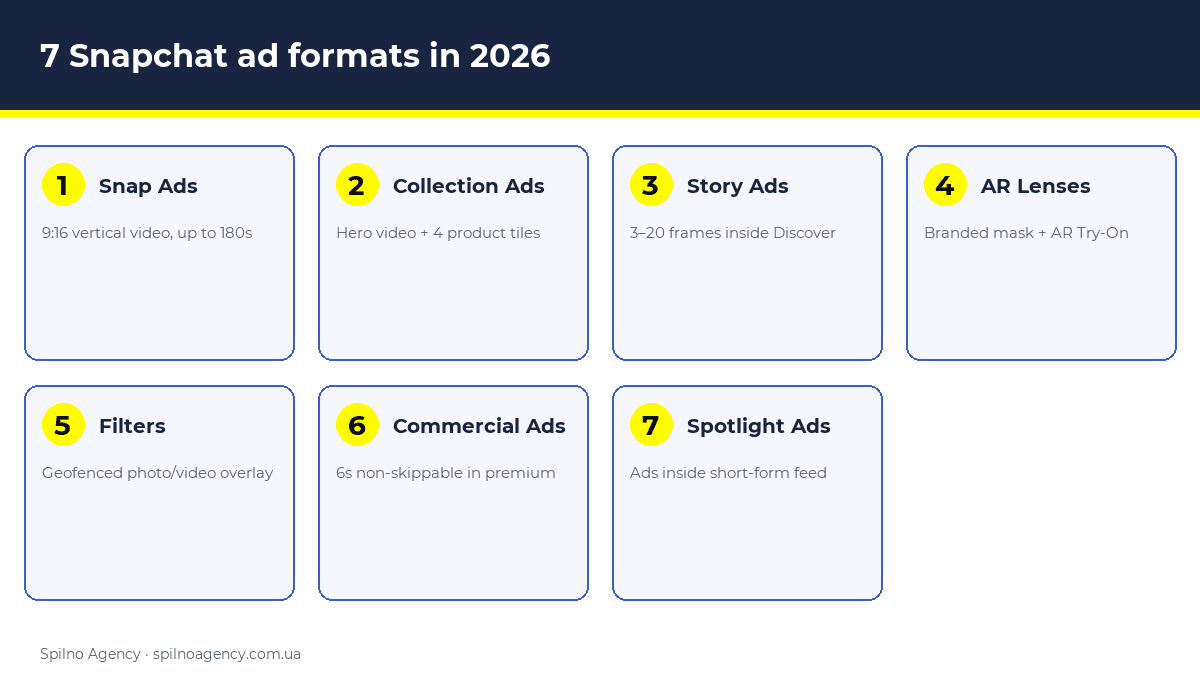
In 2026 Snapchat Ads Manager offers 7 core ad formats. Each has its own mechanic, technical spec, and the campaign objective it is built for. Below — every format, in detail.
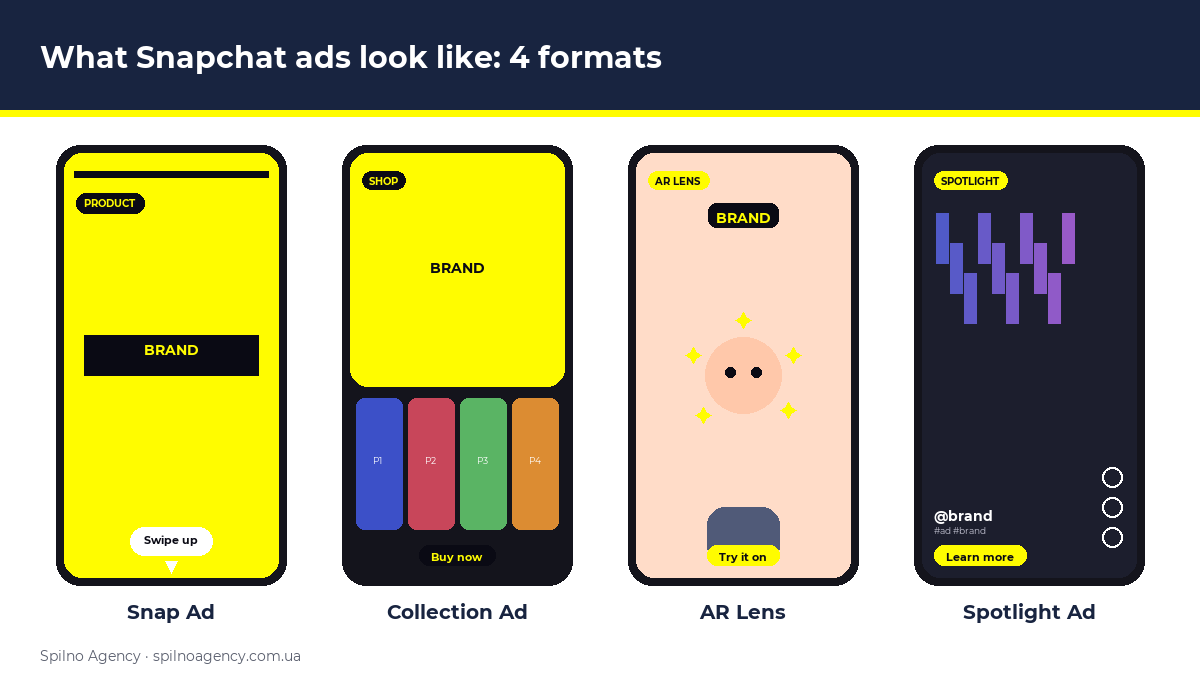
What Snapchat ads actually look like — mockups of 4 key formats
Below — simplified mockups of the four key Snapchat ad formats as they appear inside the app. The mockups show which visual slot each format owns on the user’s screen and where the call-to-action lives.
1. Snap Ads (Single Image & Video Ads)
The baseline format: a full-screen vertical 9:16 video that surfaces between friends’ Stories or inside Discover. Length up to 180 seconds, with 3–6 seconds for top-of-funnel and 10–15 seconds for conversion ad sets being the sweet spot. A swipe-up takes the user to a website, App Store listing, Lead Gen form, or a long-form companion video.
Technical spec: 1080×1920 px, MP4 or MOV, up to 1 GB, safe zone 250 px top / 450 px bottom (that’s where Snapchat’s UI sits). Audio is mandatory — 60%+ of users watch with sound on, so a muted creative under-performs.
2. Collection Ads
An e-commerce shoppable format: one hero video plus four product tiles below it. A tap on a tile sends the user to a product detail page or to the Snapchat shopping catalogue. Critical for DTC brands — average CTR runs 30–50% higher than Single Image Ads because the catalogue is visible from the first impression.
3. Story Ads
Branded Stories inside Discover: 3–20 sequential frames that build a mini narrative. Good for brand storytelling, multi-step product launches, and progressive warm-up sequences. In 2026 Story Ads are the optimal format for retargeting audiences — you can tell a longer story per impression.
4. AR Lenses (Sponsored Lenses)
This is the format where Snapchat owns the market. A branded AR mask the user puts on their face, environment, or body. AR Try-On for beauty (lipstick, shadow, hair colour) and fashion (eyewear, jewellery, headwear) is a separate product with elevated conversion economics.
Lenses are built in Lens Studio — Snap Inc.’s free authoring tool (in-house, or commissioned from an AR studio). The average dwell time on a Lens is 20–25 seconds — 5–7× longer than a standard Snap Ad view. Lenses with a UGC mechanic (the user wants to save or send the result to friends) generate organic reach “above quota” — users share the lens at no further cost.
5. Filters (Sponsored Filters)
A branded static overlay applied to a photo or video, anchored to a geofence or event. Unlike a Lens it doesn’t react to faces or use AR tracking — it works as a frame or stamp. Classic use case: a filter inside a specific mall, stadium, or festival. For the brand — a way to “be present” in a moment; for the user — a snackable sticker for their swap.
6. Commercial Ads (non-skippable)
A 6-second non-skippable ad inside premium Discover content (publishers like ESPN, NBC, BBC, Sky). In terms of guaranteed viewability it’s the closest Snap format to TV. Best for top-of-funnel awareness campaigns from large brands — not for direct-response objectives.
7. Spotlight Ads
The newest format, fully rolled out across 2024–2025. Spotlight is Snapchat’s short-form vertical feed — the platform’s answer to TikTok For You. Spotlight Ads sit between organic user clips. Best for creator-style content: the ad has to look organic, not “produced.” In 2026 Spotlight Ads are the fastest-growing format inside Ads Manager.
How targeting works on Snapchat
Snapchat targeting is built around Snap Audience Match. The available levels:
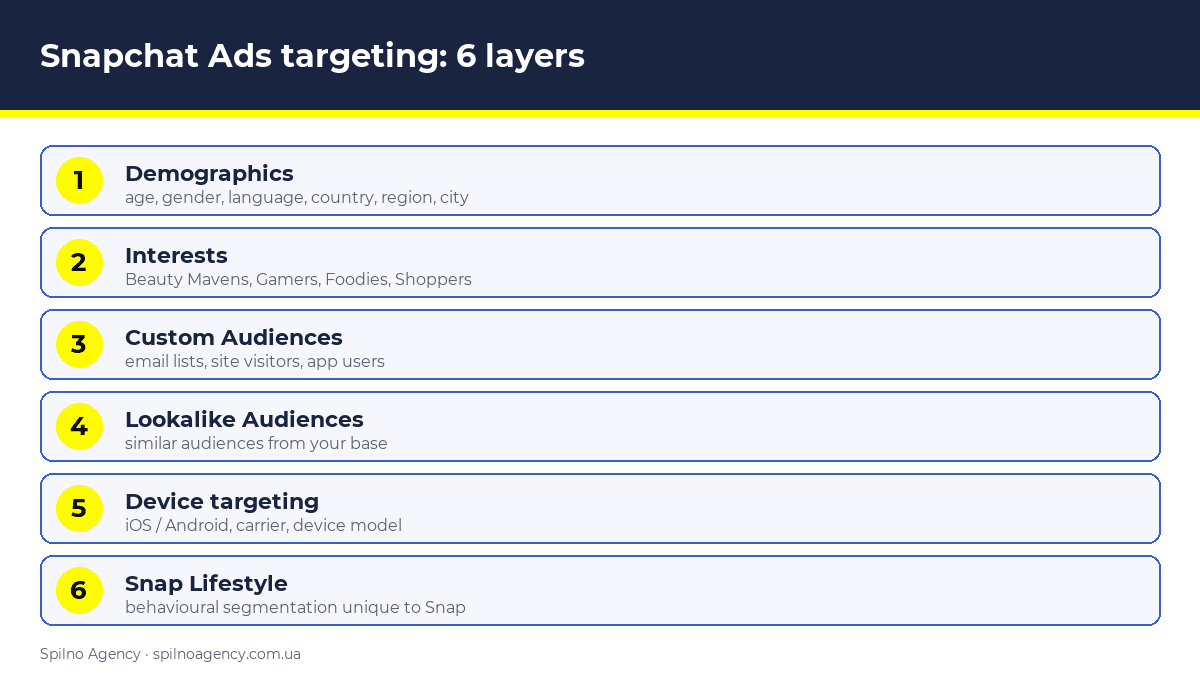
- Demographics — age, gender, language, country, region, city. In the US, Canada, and the UK you can narrow down to specific postal codes.
- Interests (Predefined Audiences) — Snap groups users by in-app behaviour: Lifestyle & Interests (Beauty Mavens, Sports Fans, Gamers, Foodies, etc.) and Shoppers (Beauty Shoppers, Fashion Shoppers).
- Custom Audiences — uploaded customer email/phone lists, site visitors (via Snap Pixel), app users (via Snap App SDK).
- Lookalike Audiences — Snap builds a similar audience from your customer base. In 2026 Lookalikes are the fastest way to scale on Snap.
- Device targeting — iOS / Android, carrier, device model. Critical for gaming campaigns and platform-restricted apps.
- Snap Lifestyle Categories — a behavioural segmentation unique to Snapchat and unavailable in Meta.
Important: since iOS 14.5 and ATT (App Tracking Transparency), attribution precision on iOS dropped across every ad platform, Snap included. Snap rolled out Advanced Conversions — a server-side API for passing offline conversions and on-site events (Snap’s equivalent of Meta CAPI). Without it, conversion campaigns on iOS work materially worse in 2026.
Snapchat Ads Manager structure: campaigns, ad sets, creatives
As in Meta Ads, Snap Ads Manager is built on three levels:
- Campaign — the objective level. Choose what you want: awareness, traffic, app installs, video views, lead generation, conversions, sales, store visits, catalogue sales.
- Ad Set — the targeting, placement, budget, schedule, and bid level. This is where you decide who sees the ad, where, and when.
- Ad — the creative level. Upload the video/image/Lens, add the call-to-action, point to the landing page or app deeplink.
The Snap funnel structure we recommend at Spilno Agency for European campaigns:
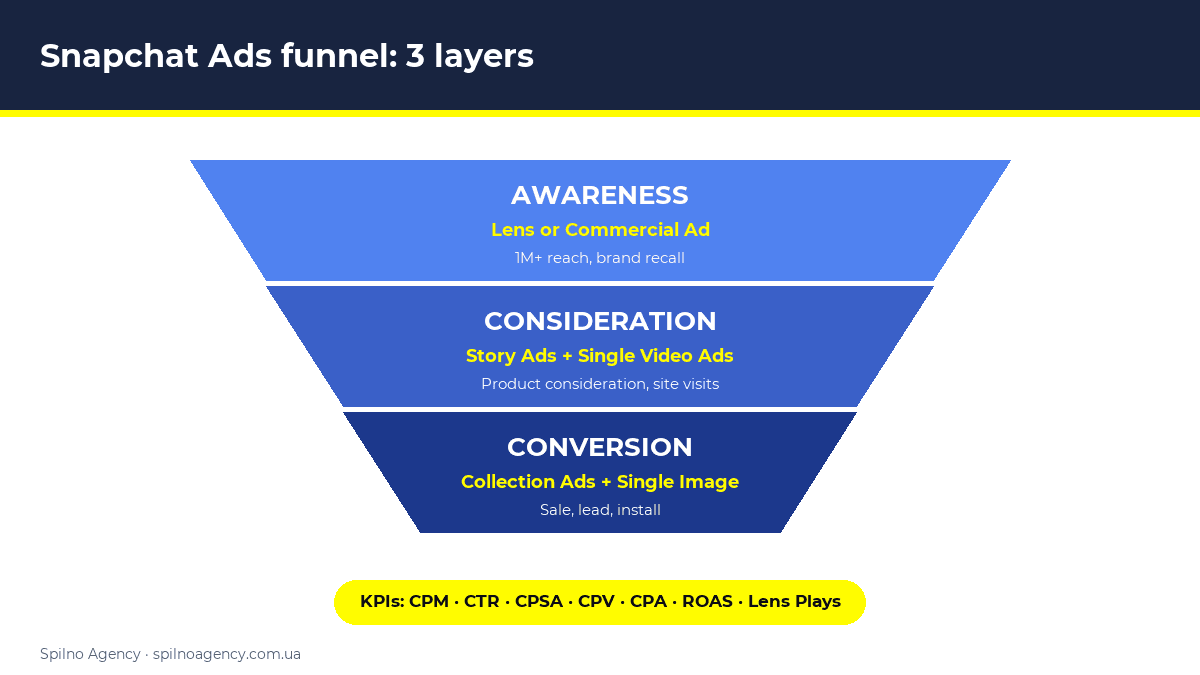
- Awareness layer (top of funnel) — Lens or Commercial Ad to a broad audience. Goal: 1M+ unique reach, brand recall.
- Consideration layer (middle) — Story Ads + Single Video Ads to people who saw the first touch (via a Custom Audience of “video viewers 50%+”). Goal: product consideration, site visits.
- Conversion layer (bottom) — Collection Ads + Single Image Ads to people who hit the site, added to cart, or abandoned purchase. Goal: sale, signup, install.
How to launch your first Snapchat campaign: 7 steps
- Set up a Business Account at ads.snapchat.com. You’ll need a registered legal entity (Ltd in the UK, sp. z o.o. in Poland, GmbH in Germany, S.r.l. in Italy, LLC in the US) and a payment card from a supported region.
- Install Snap Pixel on the site — a JS script or tags deployed via Google Tag Manager. Pixel sends events to Snap: PageView, AddToCart, Purchase, Lead. Without it, conversion campaigns can’t launch.
- Connect Conversions API (CAPI) — server-side event passing. In 2026 this is mandatory for credible iOS attribution.
- Define a concrete objective — “400 add-to-carts per week from the UK, focus on Gen Z 18–24” — not “give Snapchat a try.”
- Build creative in 9:16, with sound on, the key message in the first 3 seconds, CTA inside the first 5. Avoid heavily “produced” looks — they convert worse than org-style content.
- Run a 7-day test with a budget that produces statistically meaningful data. Snap’s algorithm needs 50+ conversions per week per ad set to exit the learning phase — plan around that number.
- Read the result in Snap Ads Manager: CPM, CPC, CTR, CVR, CPA, ROAS. If the creative is outside the top-30% benchmarks, swap the creative — don’t keep tweaking the targeting.
How much Snapchat advertising costs in 2026
Snapchat runs on an auction model: you pay per impression (CPM), swipe-up (CPC/CPSA), video view (CPV — 2 or 15 seconds), or conversion (CPA) depending on the objective. The pricing logic mirrors Meta Ads: the more competitive the vertical and the narrower the audience, the higher the bid.
The general pattern: UK and Western Europe sit at the top of the CPM curve. Poland, Spain, Italy trade at 3–4× cheaper on average. Saudi Arabia and the UAE compare to the UK because of high purchasing power. India and Brazil have the cheapest CPM, but proportionally lower per-user value.
The minimum daily budget per ad set is $5. The realistic floor for testing a single European market is $50–100/day across 7 days — roughly $350–700 for the launch test. That’s enough to collect 50+ conversions and exit the learning phase. Below that the statistics are noise and you can’t make a decision either way. At Spilno Agency we work on a management fee + ad budget model — exact numbers come after we’ve audited the business and the market you’re entering.
Snapchat Ads KPIs and metrics
- Impressions — total number of ad views.
- Reach (Unique Reach) — unique users who saw the ad.
- CPM — cost per 1 000 impressions.
- Swipe Ups — Snapchat’s equivalent of a click (swipe up to the landing).
- CPSA (Cost per Swipe Up) — price per swipe.
- Video Views (2s / 15s) — viewers who watched 2 or 15 seconds.
- View Completion Rate — share of viewers who watched to the end.
- Conversions — target actions logged via Snap Pixel or CAPI: Purchase, Lead, Sign-up, AddToCart.
- CPA (Cost per Acquisition) — price per conversion.
- ROAS — return on ad spend (for e-commerce).
- Lens Plays / Lens Shares — Lens activations and onward shares. Unique Snap metric.
2026 benchmarks for Western European markets (UK/DE/FR/ES/IT aggregate): average CPM $7–14, average CTR (swipe-up rate) 0.8–2.5%, 2-second video view rate 30–50%, conversion rate from Snap traffic to site 1–3%. Beauty and Fashion verticals with AR Try-On Lenses run at 2–3× higher metrics across the board.
Common mistakes in Snapchat Ads
- Creative in 16:9 or square. Snapchat is a vertical 9:16 full-screen interface. Anything else looks broken and cuts metrics by a third.
- Launching without Snap Pixel and CAPI. On iOS in 2026, without Conversions API you’re essentially running campaigns blind.
- Muted creative. This isn’t Facebook — most of the audience watches with sound on. A silent ad loses.
- Porting creative from Meta or TikTok without adaptation. Different platform, different consumption culture. What slays on Reels often misses on Snap, and vice versa.
- Underfunded budgets ($10–20/day). The algorithm never exits the learning phase, metrics are noise. If you can’t afford a clean test, don’t start.
- Targeting “everyone 18+.” The platform costs money — narrow to a specific lookalike or interest cluster.
- One creative for 30 days. Snap audiences burn through repeated creative fast. Rotate variants every 7–10 days.
Snapchat Ads in a European brand’s paid-social mix
If you’re a European DTC brand, fashion label, beauty startup, or gaming studio targeting the UK, France, Germany, Scandinavia, Spain, Italy, or MENA — Snapchat belongs in the consideration set as a complement to Meta and TikTok, not as the primary channel.
For a brand running a paid-social test, 10–20% of total paid-social budget on Snapchat is a sensible starting share. If beauty/fashion/gaming metrics come back with a CPA below Meta’s, scale Snap to 30–40%. If not, keep Snap as a retargeting and unique-reach channel.
At Spilno Agency we build paid-social strategy in stages: launch the core (Meta + Google), then test auxiliary channels — TikTok, Snapchat, Pinterest — against the same audiences to compare CPA and find genuine ROAS uplift. If you’re planning that kind of test, book a strategy call — we’ll tell you whether Snap actually makes sense for your business in 2026.
FAQ — frequent questions about Snapchat Ads
Which countries does Snapchat advertising cover?
Snap accepts advertisers from and serves ads in: the UK, France, Germany, the Netherlands, Spain, Italy, Sweden, Norway, Denmark, Poland (limited), the US, Canada, Australia, Saudi Arabia, the UAE, India, Brazil, Mexico, Argentina, and others. Always confirm the exact country list inside Ads Manager before planning the campaign.
Snapchat or TikTok — which to test first?
If you’re entering the UK or Western Europe with a beauty / fashion / gaming offer — TikTok first, because audience scale and ad tooling are larger. Layer Snap on top once Meta and TikTok hit stable metrics — for unique-reach uplift and AR mechanics.
Do I need a custom AR Lens, or can I run without one?
You can run on Snap without a Lens — Single Video Ads, Story Ads, and Collection Ads all work. But if you’re a beauty or fashion brand, AR Try-On is your structural advantage on the platform, plus organic reach “above quota.” Skipping it leaves 30–50% of the platform’s value on the table.
What budget do I really need for a credible test?
A realistic floor per single European market is $500–1 000 over 7–14 days. That’s enough to gather 50+ conversions per ad set and decide whether to scale or kill. $200 “to try it out” is a coin flip.
Can I run Snap Ads without Snap Pixel?
Technically yes — for awareness or video view objectives. But without Pixel you can’t run conversion campaigns (which is where the sales sit), can’t build Lookalikes, can’t retarget. So Pixel installation is task #1, alongside opening the account.
Will AI replace manual Snap campaign management in 2026?
Snap has shipped Goal-Based Bidding with AI optimisation and automated Smart Targeting Suggestions. But strategy, creative, vertical selection, and funnel design still sit with a human. AI accelerates setup; it doesn’t replace the marketer.
How do I measure ROAS for a mobile game on Snapchat?
Snap App SDK + an MMP (AppsFlyer or Adjust) + Conversions API. Snap sends install events, the MMP tracks in-game purchases, you see LTV/ROAS inside Ads Manager under the Mobile App tab. Without MMP integration iOS accuracy drops sharply.
What creative works best on Snap in 2026?
Org-style content — shot in the moment, with a face on camera, no over-produced look. Strong hook in the first 1–2 seconds. UGC-style creative delivers around 40% lower CPA than studio production on average. On-screen text is non-negotiable — not everyone watches with sound, despite the high share of sound-on viewers.

Read also
cPanel SEO: How to Optimize Your Hosting for Search in 2026 (Enable & Disable)
cPanel is a hosting control panel that packs dozens of features with a direct impact on SEO: HTTPS…

Cloudflare for SEO: How to Configure It to Improve Search Performance in 2026
Cloudflare works as a proxy and CDN between the visitor and your website, and it can noticeably affect…

How Spilno Agency Does On-Page SEO Optimization with Claude
Spilno Agency runs on-page SEO optimization together with the AI agent Claude — following one document standard that…