Email Marketing in 2026: What It Is and How to Make It Work

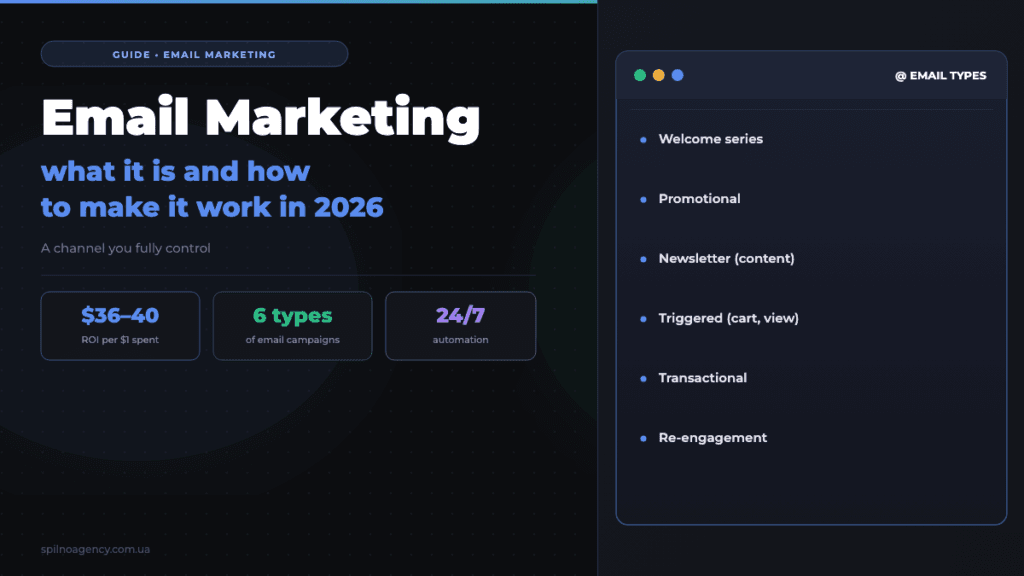
Email marketing is the practice of promoting products, services and your brand through emails sent to people who have agreed to receive them. It’s one of the few channels you fully control: your subscriber list belongs to you, not to a social media algorithm. Below — what it is in plain words, the types of campaigns, how to measure performance and a step-by-step guide to launching email marketing from scratch in 2026.
What is email marketing in plain words
Email marketing is a direct communication channel with customers via email. A company builds a list of subscribers — people who left their email and consented to receive messages — and sends them newsletters, offers, useful content, abandoned-cart reminders or personalised recommendations.
The key difference from social ads or Google Ads is that you don’t rent access to the audience — you own it. If Instagram’s algorithm changes tomorrow or click prices rise, your email list stays with you. That’s why email marketing is treated as an asset, not a cost.
- Owned audience — the subscriber list belongs to the business and can’t be lost to an algorithm change
- Consent (opt-in) — only people who subscribed receive the emails
- Personalisation — each subscriber can get content relevant specifically to them
- Measurability — you see who opened, clicked and purchased
Why email marketing works in 2026
Despite messengers, chatbots and social media, email remains the channel with the highest return. Industry studies put the average ROI of email marketing at around $36–40 for every dollar invested — well above most paid channels.
The reason is simple: you address people who already showed interest in your brand. This is a warm audience you don’t need to convince from scratch. Add automation, and the channel starts generating sales without daily manual work.
- Almost every internet user has an email address and checks it daily
- An email doesn’t vanish in a feed — it waits in the inbox until opened
- The channel doesn’t depend on ad budgets: sending to your own list costs very little
- It works at every funnel stage — from first contact to repeat purchases
Types of email campaigns
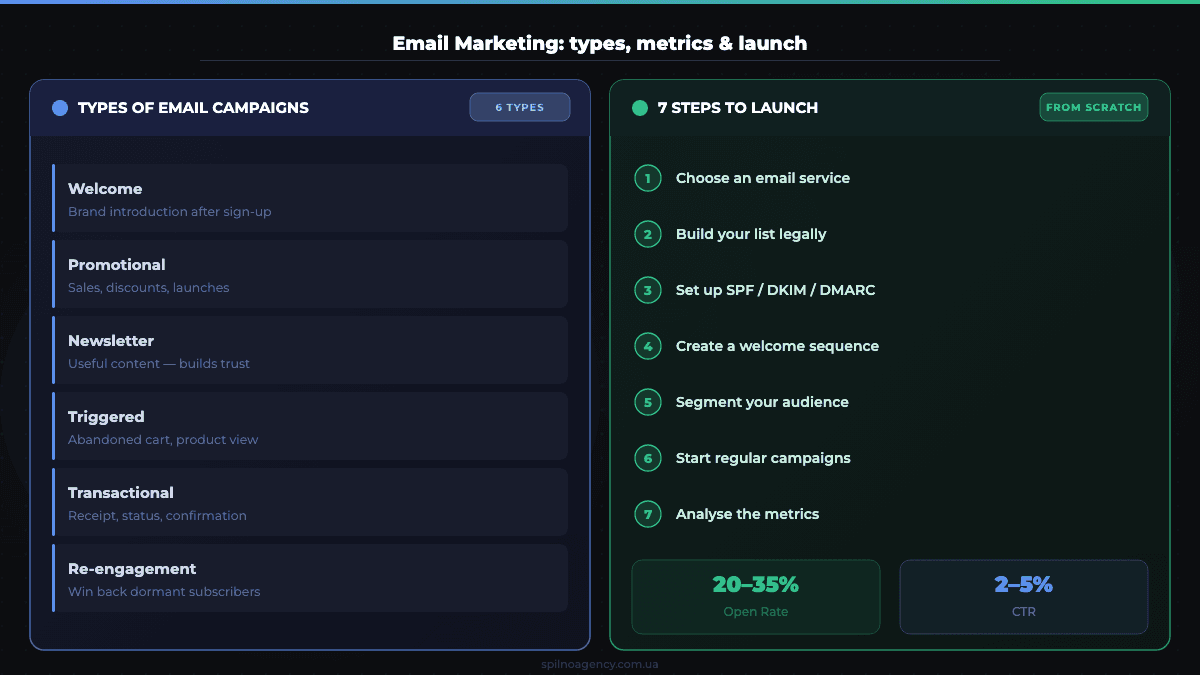
For email marketing to work, sending the odd promo isn’t enough. There are several campaign types, each solving its own task:
- Welcome — the first sequence after sign-up. Introduces the brand and delivers a first bonus
- Promotional — sales, discounts, new product launches. Drive purchases directly
- Newsletter (content) — useful articles, tips, cases. Build trust and authority
- Triggered — sent automatically in response to an action: abandoned cart, product view, birthday
- Transactional — order confirmations, receipts, delivery status. Technical, but with very high open rates
- Re-engagement — win back dormant subscribers who haven’t opened emails in a while
In a mature strategy all of these work together: the welcome flow warms up a newcomer, content keeps interest alive, triggers catch the buying moment, and re-engagement saves the list from fatigue.
How email marketing works: the subscriber lifecycle
Email marketing isn’t a set of isolated emails — it’s guiding a person along the whole journey from first contact to loyal customer. That journey is called the subscriber lifecycle:
- Acquisition — the person leaves their email via a site form, a lead magnet (checklist, discount) or at checkout
- Onboarding — a welcome series introduces the product and removes first objections
- Activation — the subscriber makes a first purchase or key action
- Retention — regular content and personal offers keep them engaged
- Loyalty — programmes, exclusive terms and referral emails turn a customer into a brand advocate
Each stage has its own email type and message. That’s why segmentation — splitting subscribers into groups — is the foundation of effective campaigns.
Step-by-step: how to launch email marketing from scratch
If you’re just starting, here’s a clear seven-step plan:
- Choose an email service — a platform that stores your list and sends emails (examples below)
- Build your list legally — add a sign-up form, a lead magnet or a consent checkbox at checkout. Buying lists is prohibited
- Set up the technical side — verify your domain and add
SPF,DKIMandDMARCrecords so emails don’t land in spam - Create a welcome sequence — 2–3 automated emails every new subscriber receives
- Segment your audience — split the list by interests, activity or purchase history
- Start regular communication — plan a month of campaigns ahead
- Analyse and improve — track metrics, test subject lines and send times
The golden rule at launch: don’t try to make everything perfect at once. Launch a welcome flow and one regular campaign, then add complexity.
Email marketing services and tools
An email service provider (ESP) is the platform where you store your list, build emails in a visual editor, set up automation and view stats. Popular options across Europe:
- Mailchimp — a global leader with powerful automation and templates
- GetResponse — a European platform combining email, webinars and landing pages
- Brevo (Sendinblue) — email and SMS billed per email sent rather than by list size
- Klaviyo — specialised in ecommerce with deep store integrations
- SendPulse — email, SMS and chatbots with a free starter plan
A free plan from any provider is enough to start. Choose based on editor convenience, automation features and integrations with your site or CRM.
Email marketing metrics
Email marketing is fully measurable. The core metrics that show your result:
- Open Rate — the share of subscribers who opened the email. Benchmark: 20–35%
- CTR (click-through rate) — the share who clicked a link. Norm: 2–5%
- Conversion Rate — how many completed a target action (purchase, sign-up)
- Deliverability — the share of emails that reached the inbox, not spam
- Bounce Rate — the share of undelivered emails (invalid addresses)
- Unsubscribe Rate — how many opted out. Above 0.5% per campaign signals a content review
Don’t chase open rate alone. The headline metric is revenue per campaign: an email with a lower open rate but higher conversion beats good stats with no sales.
Automation and triggered flows
Automation is what turns email marketing from a chore into a system that works 24/7. You set up a scenario once, and emails send themselves in response to user behaviour.
The highest-performing automated scenarios:
- Abandoned cart — a reminder 1–3 hours after someone leaves an order unfinished
- Welcome series — brand introduction for new subscribers
- Post-purchase — emails after a purchase: instructions, upsell, review request
- Re-engagement — a special offer for those who haven’t opened in a while
- Date triggers — birthday or subscription-anniversary emails with a discount
Automation is precisely what delivers that high ROI: a single abandoned-cart flow can recover tens of percent of unfinished orders for years.
Email marketing trends in 2026
The channel is mature, but not static. What defines email marketing in 2026:
- AI personalisation — AI selects content, send time and even the subject line for each subscriber
- Hyper-segmentation — splitting the list into dozens of micro-segments by behaviour, not just 3–4 groups
- Interactive emails (AMP) — buying or filling a form right inside the email
- Privacy — stricter consent rules (GDPR) and protecting open rate from Apple Mail Privacy distortion
- Omnichannel integration — email working alongside SMS, push and messengers as one system
AI is no longer the future but a working tool: generating subject-line variants, predicting the best send time and auto-cleaning the list are now standard.
Common email marketing mistakes
Most failures repeat themselves. Avoid these mistakes:
- Buying a list — it breaks the law and goes straight to spam. Build your list only with consent
- No segmentation — one email to everyone gives weak results and high unsubscribes
- Selling only — if every email is a promo, subscribers tire of it. Alternate with useful content
- Ignoring mobile — over half of emails open on a phone; layouts must be responsive
- Neglecting technical setup — without
SPF/DKIM/DMARC, emails go to spam - No analytics — without measuring metrics you can’t improve results
FAQ: common questions about email marketing
What is email marketing in plain words?
Email marketing is promoting a business through emails sent to people who agreed to receive them. A company builds a subscriber list and sends newsletters, offers, useful content and personal recommendations, turning subscribers into customers.
How do I start email marketing?
Choose an email service, build your list legally via a sign-up form, set up the technical side (SPF, DKIM, DMARC), create a 2–3 email welcome sequence and launch a regular campaign. Then segment the list and analyse your metrics.
What is a good open rate?
A typical benchmark is 20–35% depending on the niche. But what matters more than open rate is revenue per campaign: an email with a lower open rate but higher conversion is more effective.
Can I buy a ready-made email list?
No. Buying lists breaks the law and provider rules, leads to blocks and lands you in spam. You must build the list yourself — only from people who consented to receive your emails.
How much does email marketing cost?
A free plan from an email service is enough to start. Cost depends on list size and email volume. Thanks to its high ROI, email marketing is one of the cheapest channels per sale acquired.
Email marketing or social media — which is better?
They’re different channels that complement each other. Social media reaches new audiences; email works deeply with those already interested. Email’s advantage is that the list belongs to you and doesn’t depend on algorithms.

Read also
Spilno Agency’s Experience: How We Verify Events Before Starting Work
Before launching a campaign in Google Ads or Meta Ads, or starting SEO work, Spilno Agency always checks…
GA4 DebugView: How to Verify Google Analytics Events in Real Time
DebugView is the section of Google Analytics 4 that shows your site’s events in real time, seconds after…

Top Claude Skills for TikTok Ads Specialists (2026)
9 verified Claude skills and MCP servers for TikTok Ads: Pixel/Smart+ audits, Spark Ads hook/hold rate, creator sourcing,…