Promotion of an Online Store for Auto Paints and Accessories for Car Service Stations

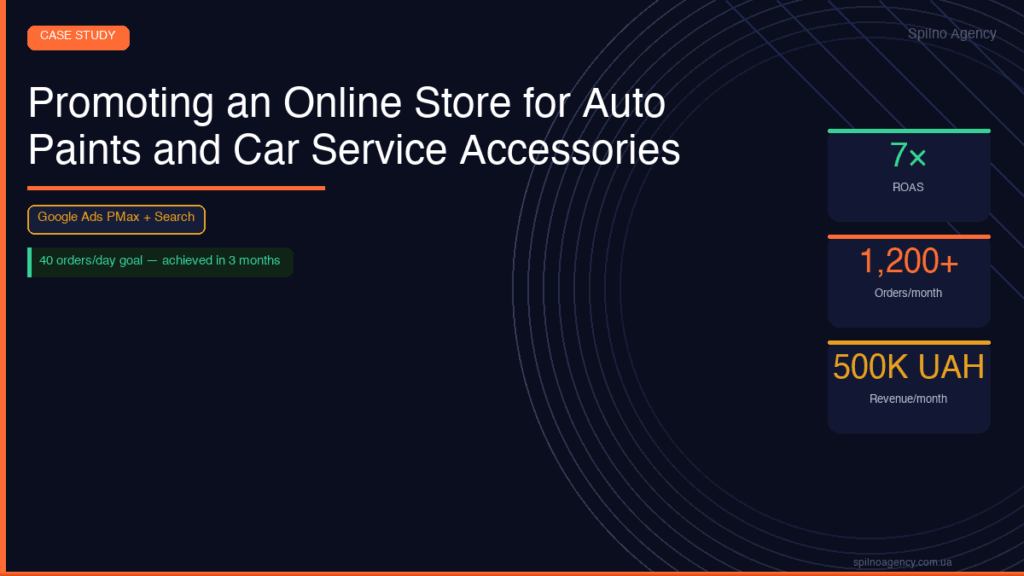
An online auto paint store was generating 15–20 orders per day. The previous agency failed to hit the 40-order goal in 3 months. Spilno Agency reached 40–60 orders/day and 1,200+ orders/month with ROAS 7 — using only Google Ads PMax and Search.
About the Client and the Challenge
The client runs an online store selling automotive paints, varnishes, and accessories for car service stations (STO) and auto repair shops. The niche is specific: buyers include both individual car owners doing DIY repairs and B2B customers such as body shops, detailing centres, and service stations. The wide product range and seasonal demand make campaign management more complex than a typical eCommerce store.
When the client approached Spilno Agency, they were receiving 15–20 orders per day. Their goal was 40 orders per day. The previous agency had worked with the client for 3 months without getting close to this target. The advertising budget was unlimited, which provided excellent scaling opportunities.
Audit: What Went Wrong with the Previous Agency
Before making any changes, we conducted a detailed audit of the active campaigns to answer the key question: is the goal achievable with the right approach?
The audit revealed two critical problems:
- Meta Ads were completely unprofitable. Facebook and Instagram campaigns were running at a loss. The previous agency did not see this because they measured performance through the Meta Ads internal dashboard using a “7 days after click + 1 day after view” attribution model. This attribution significantly inflates conversions and credits Meta with sales actually generated by other channels.
- Google Ads lacked economic rationale. Google Ads campaigns were launched without a break-even analysis or a target ROAS. Budgets were distributed across campaigns without considering the real profitability of each product category.
Conclusion: the issue was not a lack of budget or an unprofitable niche — it was incorrect measurement and poor budget allocation strategy.
Analytics Setup: One Measurement System
Before launching new campaigns, we completed two mandatory steps:
- GA4 eCommerce verification. Without accurate eCommerce tracking in Google Analytics 4, it’s impossible to objectively evaluate campaign performance. We verified that all
purchase,add_to_cart, andbegin_checkoutevents were firing correctly and matched the client’s CRM data. - Unified attribution model. All channels — Google Ads, Meta Ads, organic traffic — are measured exclusively through GA4 under the same attribution model. Only this approach allows fair comparison of channel performance and data-driven budget decisions.
After switching to GA4 as the single measurement source, it became clear: Meta Ads was delivering three times fewer orders than the Facebook dashboard claimed.
Strategy
Based on the audit and data analysis, Spilno Agency developed a clear two-track strategy:
Meta Ads
Test the channel for 1–2 more months with correct attribution and optimisation. If the channel cannot reach profitability (ROAS below the client’s break-even point of 3.5), shut it down and reallocate the budget.
Google Ads
- Budget reallocation: remove spend from campaigns with ROAS below 3.5, increase spend where it is above.
- Launch Performance Max campaigns (via Google Merchant Center) separately for each product category.
- Scale campaigns with ROAS above 5 aggressively while maintaining profitability.
- Run parallel Search campaigns for branded and category keywords.
Implementation: Performance Max and Search
The primary scaling tool was Performance Max campaigns powered by Google Merchant Center. We set up separate PMax campaigns for each major product category: automotive paints, varnishes, primers, fillers, and body repair tools.
Why separate campaigns per category rather than one combined campaign? Different categories have different margins and different levels of competition. Separate campaigns allow setting distinct target ROAS for each product group and avoid mixing profitable and unprofitable items.
Search campaigns covered branded queries and high-intent commercial keywords: “buy car paint,” “automotive paint price,” “car body paint,” “match car paint by code.” These campaigns delivered lower volume but a steady stream of ready-to-buy customers.
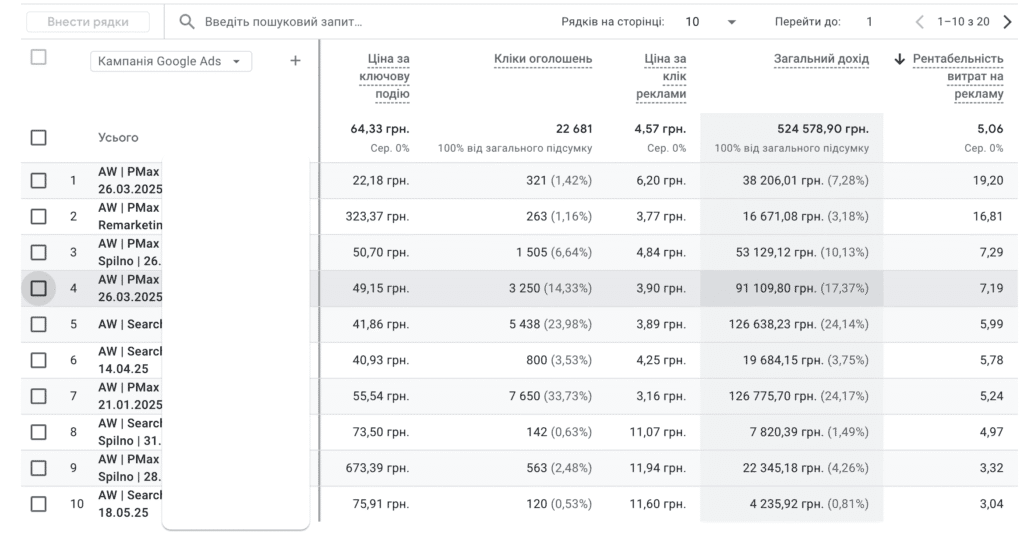
Month-by-Month Results
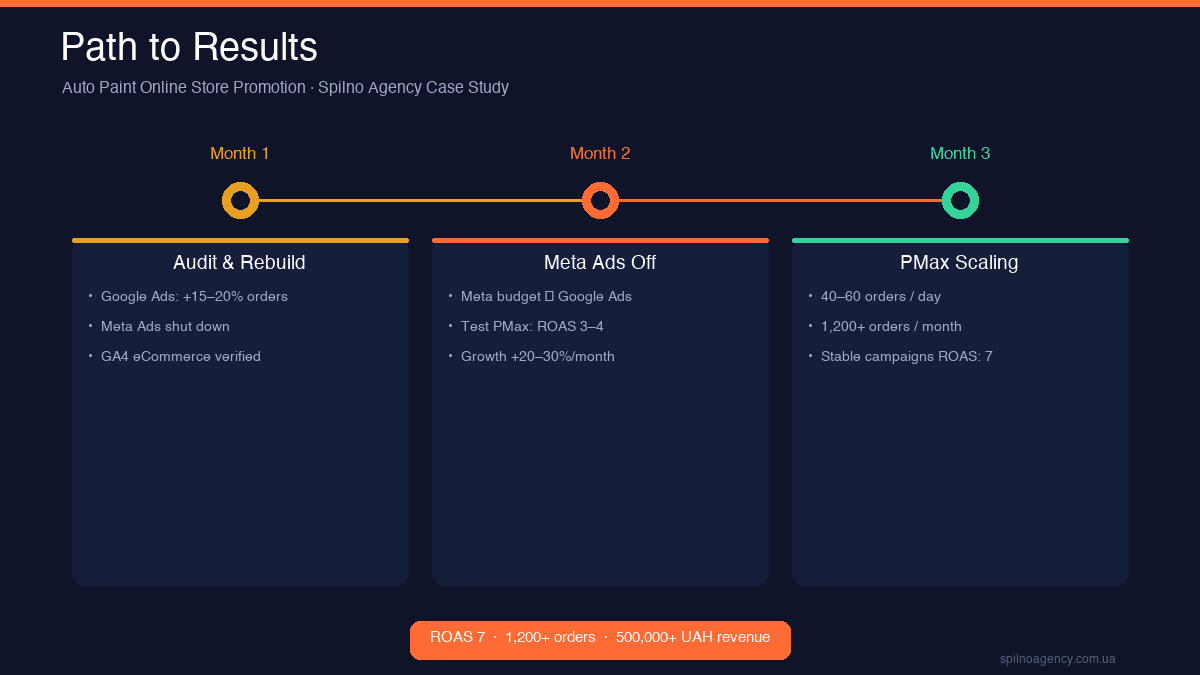
| Month | Key Actions | Results |
|---|---|---|
| Month 1 | Audit, Google Ads restructure, GA4 eCommerce setup | +15–20% in orders. Meta Ads still active but not growing. |
| Month 2 | Meta Ads shut down, full budget moved to Google Ads | Google Ads growing 20–30% month-over-month. Test PMax campaigns show ROAS 3–4. |
| Month 3 | Scaling profitable PMax campaigns | 40–60 orders/day. Monthly total: 1,200+ orders. ROAS on stable campaigns: 7. |
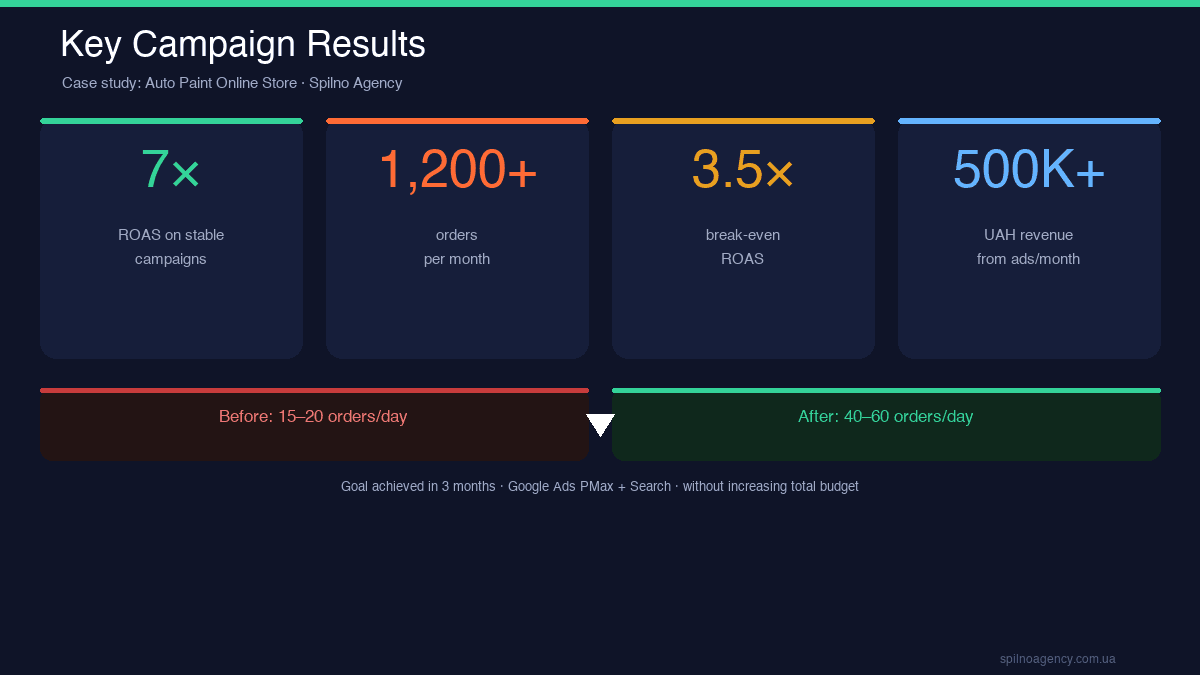
Final metrics (Month 3):
- Monthly orders: 1,200+
- ROAS on stable campaigns: 7 (break-even at 3.5)
- ROAS on test campaigns: 3–4
- Monthly ad-attributed revenue: 500,000+ UAH
- Goal of 40 orders/day: achieved and exceeded
Key Takeaways
- Correct attribution is the foundation of everything. Without a unified measurement system via GA4, you will spend on channels that do not work and fail to scale those that actually drive sales.
- Meta Ads is not always right for B2B-oriented eCommerce. For stores where a large share of customers are service stations and workshops, Meta typically underperforms compared to Google Shopping and Search.
- Performance Max + category structure = controllable growth. A single combined PMax campaign does not allow managing profitability by category. Separate campaigns do.
- An unlimited budget does not guarantee results. The client’s problem was not the budget — it was strategy and measurement. The right structure delivered results without increasing total spend.
Frequently Asked Questions
How long does it take to make an auto paint store profitable through Google Ads?
Based on Spilno Agency’s experience — 1 to 3 months with the right campaign structure and accurate analytics. In this case study, results were visible after the first month, and the 40-orders/day goal was reached by month three.
Should I use Meta Ads for promoting automotive paints and accessories?
It depends on your target audience. If your customers are primarily B2B buyers (service stations, workshops), Meta Ads is often less effective than Google Shopping. For B2C audiences, Meta can work, but always measure through GA4 rather than the Facebook internal dashboard.
What ROAS is considered good for an auto paint eCommerce store?
The break-even ROAS depends on your specific margin. In this case, the client breaks even at ROAS 3.5. Stable campaigns reached ROAS 7 — twice the break-even point. We recommend setting an initial target ROAS of 4–5 and scaling up once results are stable.
Why does Performance Max outperform standard Shopping campaigns for auto parts stores?
Performance Max uses Google’s machine learning to find buyers across all platforms simultaneously: Search, Shopping, YouTube, Gmail, and Display. With a high-quality product feed and a correctly set target ROAS, the algorithm independently finds the most effective placements and audiences.
Is Google Merchant Center required for advertising auto paints?
Yes, Google Merchant Center is required to run Shopping and Performance Max campaigns. A high-quality product feed — with accurate titles, descriptions, prices, and images — is a key success factor for PMax campaigns in any automotive products store.

Read also
How to Track Revenue, Transactions and Purchases in Google Analytics 4 from WordPress WooCommerce
Introduction WooCommerce store owners are often convinced that Google Analytics 4 already shows them revenue, transaction counts and…
How Claude Helps Spilno Agency: Google Merchant Coverage in Google Ads
An online store lists 1,375 products in Google Merchant — but how many of them are actually running…
Google Ads for a Local Auto Service: Fewer Impressions, More Customers (Case Study)
A local auto service was spending its ad budget on tens of thousands of cheap impressions that barely…