Google Ads for a Local Auto Service: Fewer Impressions, More Customers (Case Study)

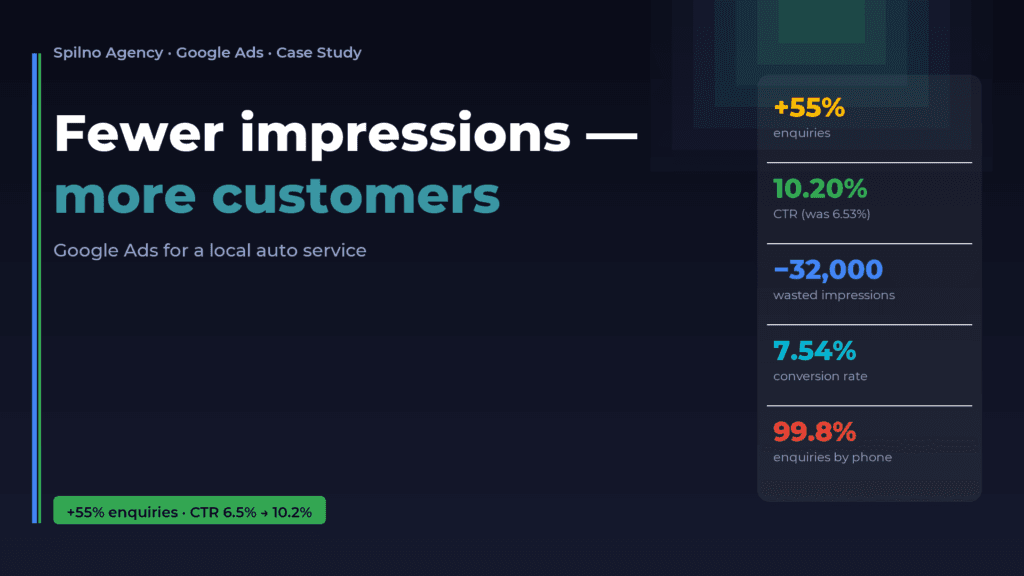
A local auto service was spending its ad budget on tens of thousands of cheap impressions that barely produced customers. We rebuilt its Google Ads around one fact — 99.8% of enquiries here come by phone, not through a form. We added call tracking, tightened targeting, and split the account into three campaigns. The result: 32,000 fewer impressions, exactly the same number of clicks, and +55% more enquiries. CTR rose from 6.53% to 10.20%, and the core campaign hit a 7.54% conversion rate. Below is how we got to these numbers (the domain and business name are deliberately omitted — the focus is on results).
About the client
The client is a local auto service (car repair station). It handles general car repair, suspension work, oil changes, timing-belt replacement and air-conditioning recharging. This is a classic local service business: the customer arrives with a specific problem, lives nearby and almost never fills in a website form — they call. That single trait shaped the entire advertising build. We deliberately omit the domain and company name — what matters in this case is the approach and the result, not the brand.
The task
Increase the number of enquiries from search within the city and the nearest 30 km — and make the ad budget’s result measurable. Behind that brief sat two non-obvious challenges.
Challenge one: a lead invisible in analytics
A typical mistake in advertising a service business is optimising for form submissions. This client’s numbers show how wrong that path is: in the first half of 2026, of 406 enquiries only one came through the form. The other 405 — 99.8% — were phone calls: direct calls and callback requests. A campaign optimised for forms would tune itself to 0.2% of real demand, and the algorithm would learn on an empty sample.
Challenge two: many impressions, little meaning
Before the rebuild, the ads ran on cheap, broad traffic. Impressions numbered in the tens of thousands and clicks were cheap, but a large share of those impressions never turned into an enquiry. The budget was buying reach, not customers.
What we did
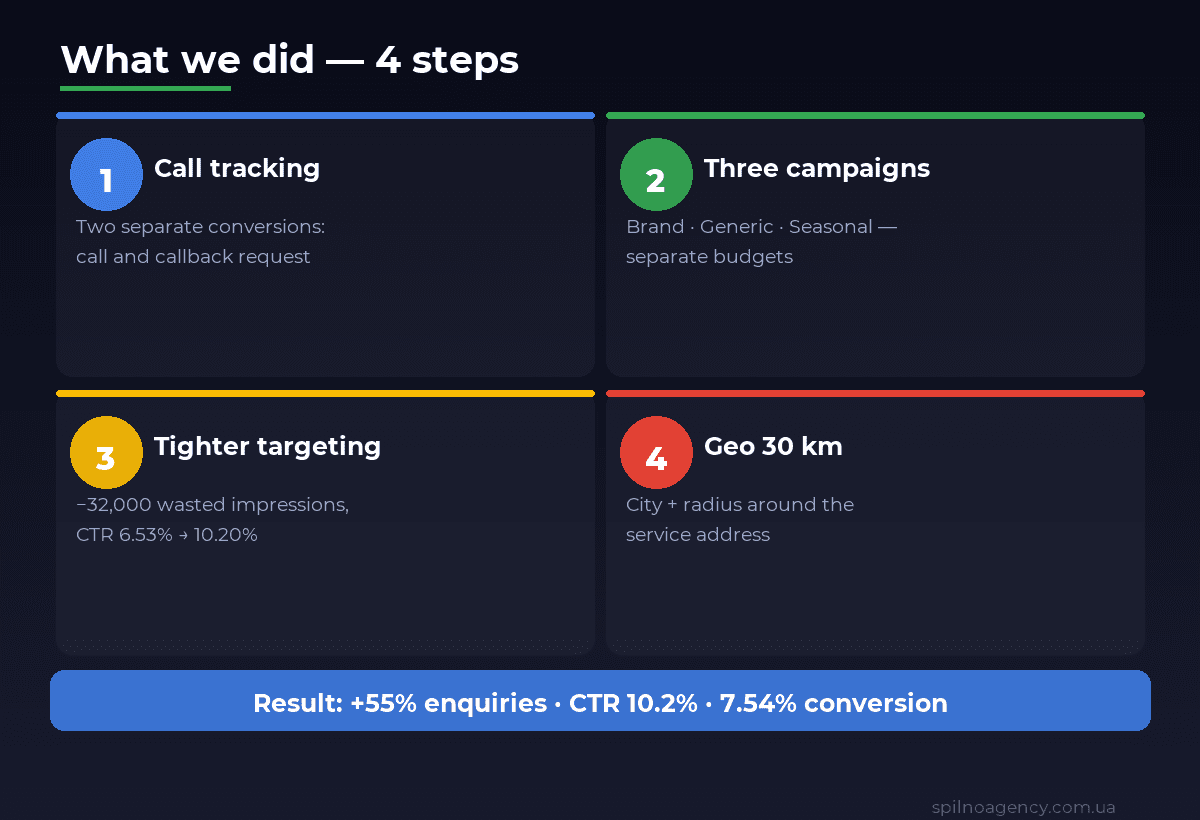
1. Enquiry measurement: call tracking with two separate events
We connected call tracking and set up two separate events instead of one generic one: an answered call and a callback request. Both were passed into Google Ads as conversions. The Maximise Conversions strategy finally got a real training signal — hundreds of phone conversions instead of a handful of form submissions. Splitting into two events matters: an answered call and a callback request differ in quality, and merging them would hide which traffic delivers a customer who is ready to talk.
2. Account structure: three campaigns with separate budgets
We split traffic into three search campaigns with separate budgets, so branded queries would not compete with generic ones and a seasonal service would not blur the statistics.
| Campaign | Daily budget share | Purpose |
|---|---|---|
| Brand | Small (~6%) | Protect branded demand, cheapest enquiries |
| Generic queries | Main (~65%) | Primary volume driver |
| AC recharging | Medium (~20%) | Seasonal summer demand |
3. Tighter targeting — the key move of the period
Instead of maximum reach, we moved the campaigns to narrow, relevant traffic: reworked the keyword set, split broad queries into service-level ad groups, and enforced tighter keyword match. The effect is visible in the traffic structure: impressions fell by 32,000 while clicks stayed almost unchanged — a difference of just 17. The impressions that never earned a click disappeared, and CTR rose from 6.53% to 10.20%.
4. Ad-group segmentation
We split the branded campaign into Exact and Phrase ad groups to control the cost of the exact branded query separately from near-brand terms. In the generic campaign, the broad group was supplemented with narrow service groups: suspension repair, oil change, timing-belt replacement. The query “oil change [city]” and the query “car service [city]” carry different intent and need different ads and different landing pages.
5. Ads and landing pages
For each group we built responsive search ads (RSA) with city insertion in the headlines. Google rated the seasonal campaign’s ad strength as “Excellent” and the rest as “Good”. Traffic was split across landing pages: generic queries lead to the city service page, branded queries to a dedicated brand page.
6. Geography: the city plus a 30 km radius
Instead of a whole region, we set targeting to the city and a 30 km radius around the service address. For an auto service this is essential: a customer 100 km away will not drive over for an oil change, yet the budget is still spent on them. A tight radius removes wasted impressions and directs money to people who can actually reach the workshop.
Comment from a Spilno Agency specialist

Results
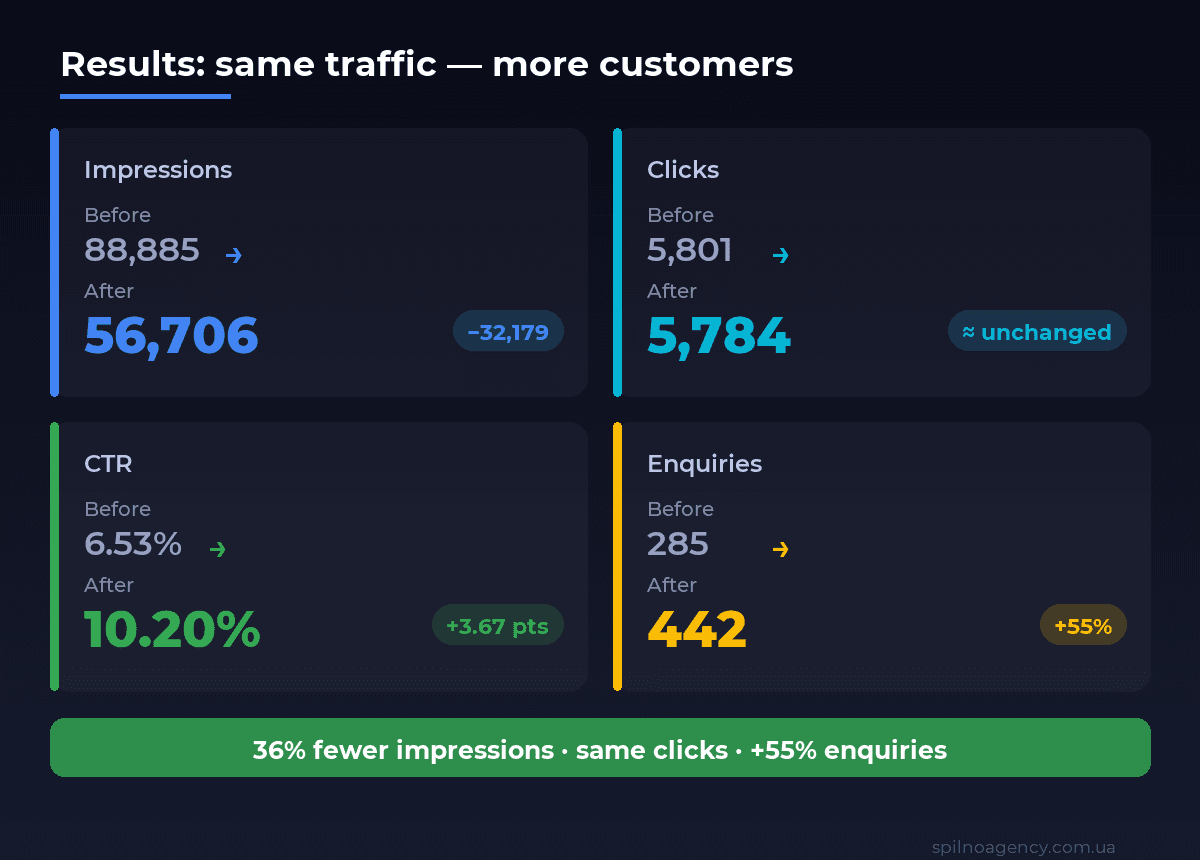
The heart of this case is not the absolute figures but the change in traffic quality. The ads showed 36% less often, earned exactly the same number of clicks, and brought in 55% more enquiries. The same volume of traffic started working noticeably harder.
| Metric | Previous period | Case period | Change |
|---|---|---|---|
| Impressions | 88,885 | 56,706 | −32,179 |
| Clicks | 5,801 | 5,784 | −17 |
| CTR | 6.53% | 10.20% | +3.67 pts |
| Enquiries | 285 | 442 | +55% |
| Cost per click | ×1 | ×2.5 | +147% |
| Cost per enquiry | base | +59% | +59% |
Cost per click grew 2.5× over the period — a more expensive auction, not worse advertising. That pushed cost per enquiry up by 59%. The client chose to scale deliberately: extra enquiry volume to fill the service bays mattered more than holding the cost per lead.
Month-by-month: February as the turning point
February was the pivotal month: the budget doubled, yet cost per enquiry held at January’s level — index 99 vs 100. The first scaling step passed without any loss of efficiency.
| Month | Enquiries | Cost per enquiry (index, Jan=100) |
|---|---|---|
| January | 43 | 100 |
| February | 81 | 99 |
| March | 74 | 153 |
| April | 74 | 136 |
| May | 71 | 177 |
| June | 63 | 166 |
| July (10 days) | 37 | 104 |
Campaign performance: the branded campaign pays off best
| Campaign | Enquiries | CTR | Conversion rate | Cost per enquiry |
|---|---|---|---|---|
| Generic queries | 395 | 9.75% | 7.54% | base |
| Brand | 40 | 19.78% | 11.08% | −31% |
| AC recharging | 7 | — | — | +214% |
The core campaign reached a 7.54% conversion rate — high for a local service’s search ads, and direct proof of the effect of tighter targeting. The branded campaign, on a tiny daily budget, delivers the cheapest enquiries in the account — 31% below the generic campaign, with an 11.08% conversion rate and a CTR of nearly 20%. That is the argument against the belief that paying for your own brand is a waste.
The paid channel’s contribution in GA4
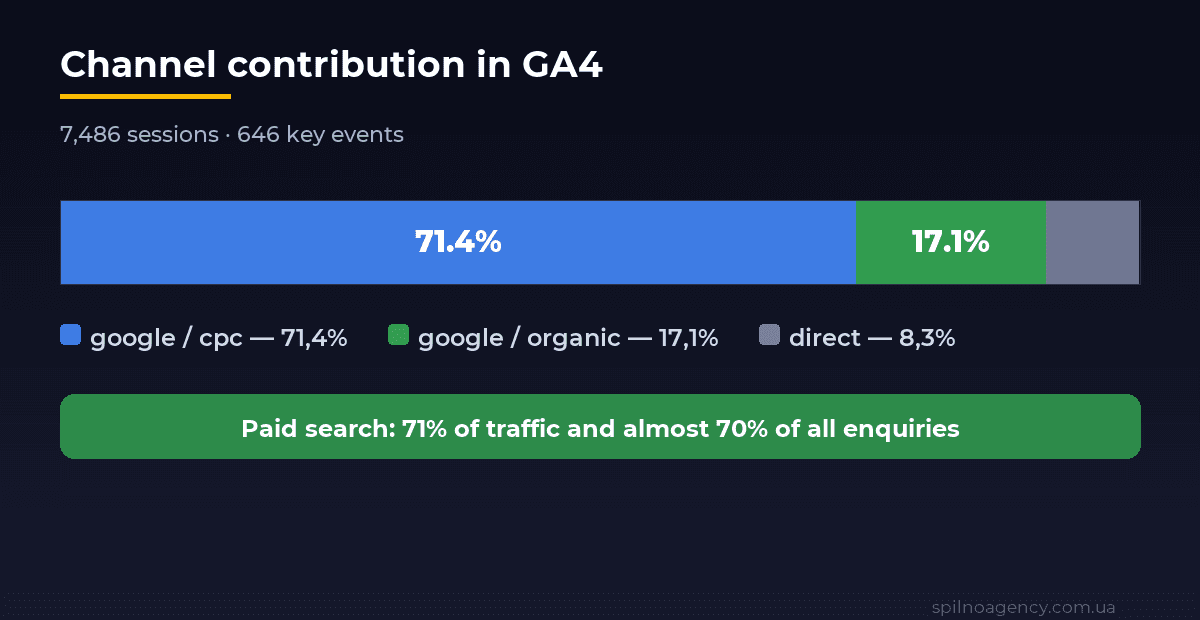
Over the same period the site received 7,486 sessions and 646 key events. The channel breakdown shows just how central paid search is as a source of customers for this auto service.
| Channel | Sessions | Share | Key events | Conversion rate |
|---|---|---|---|---|
| google / cpc | 5,345 | 71.4% | 449 (69.5%) | 7.13% |
| google / organic | 1,281 | 17.1% | 64 (9.9%) | 4.29% |
| direct | 624 | 8.3% | 31 (4.8%) | 2.08% |
Paid search delivers 71% of the site’s traffic and almost 70% of all enquiries. At the same time, the paid traffic’s engagement rate (61.61%) is even slightly above organic (59.56%) — so traffic from ads is no worse in quality than natural search.
Key takeaways
- In a service business, the lead lives in the phone. 99.8% of enquiries are calls. Without call tracking and passing calls into Google Ads as conversions, optimisation runs blind.
- Separate events beat one generic conversion. An answered call and a callback request differ in quality — you need to see them separately to make bid decisions.
- Fewer impressions does not mean fewer customers. Cutting 32,000 impressions while CTR rose from 6.53% to 10.20% delivered +55% enquiries at the same click volume.
- The branded campaign pays off. On 6% of the budget it brings about 9% of all enquiries and the lowest cost per lead in the account.
- Rising cost per click must be planned for. A 2.5× more expensive auction ate part of the quality gain — scaling has to be a conscious decision.
What’s next
- Expanding the pool of narrow service ad groups and shifting budget from the broad group to them.
- Working on lost impressions due to rank: the Lost IS (Rank) figure reached 55.94% — a direct volume reserve.
- Holding cost per enquiry at February’s level as the budget grows further.
- Developing seasonal campaigns by analogy with the AC-recharging one.
Conclusion
This case shows that in advertising a local service, what wins is not the volume of impressions but their relevance and the correct measurement of enquiries. The moment we taught Google Ads to count phone calls and removed impressions that never converted, the ads started delivering 55% more customers at the same click volume. If your auto service, workshop or other local business wins customers mostly by phone — get in touch, and we’ll review your ad account and propose a plan to rebuild Google Ads around real enquiries.
FAQ — Google Ads for a local auto service
Why did fewer impressions produce more enquiries?
The “empty” impressions that never earned a click disappeared. We tightened targeting and reworked the keyword set: 32,000 fewer impressions, the same clicks, CTR up from 6.53% to 10.20%, and 55% more enquiries. Relevance of impressions matters, not their count.
How do you track conversions when customers call instead of using a form?
You need call tracking. Here 99.8% of enquiries were calls. We passed two conversions into Google Ads — an answered call and a callback request. Only then did the Maximise Conversions strategy get a real training signal.
Is a branded campaign worth it for a local business?
Yes. On 6% of the budget the branded campaign delivered about 9% of enquiries and the cheapest leads in the account (31% below generic), with ~20% CTR and 11.08% conversion. Brand protection is cheap and competitors can intercept your branded traffic.
Why did cost per enquiry rise even though the ads improved?
Auction cost per click grew 2.5×, pushing cost per enquiry up 59%. That is a more expensive auction, not worse advertising. Scaling was a deliberate choice to gain enquiry volume.
How should you set geo-targeting for a local auto service?
Do not target a whole region. Here we kept the city plus a 30 km radius around the service address. A customer 100 km away won’t drive over for an oil change, yet the budget is spent on them. A tight radius removes wasted impressions.


Read also
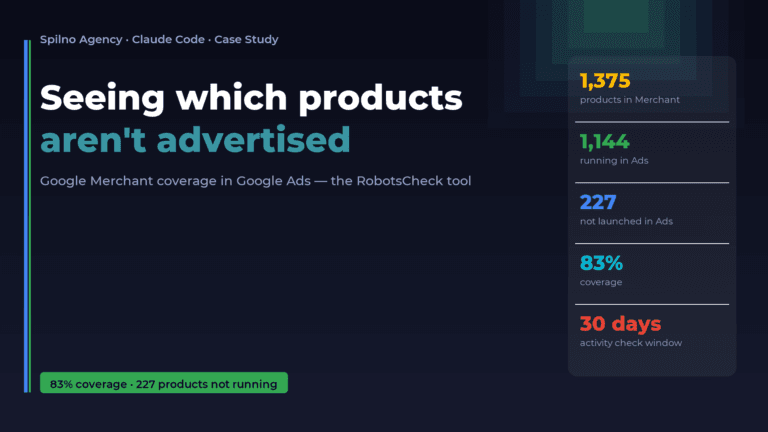
How Claude Helps Spilno Agency: Google Merchant Coverage in Google Ads
An online store lists 1,375 products in Google Merchant — but how many of them are actually running…
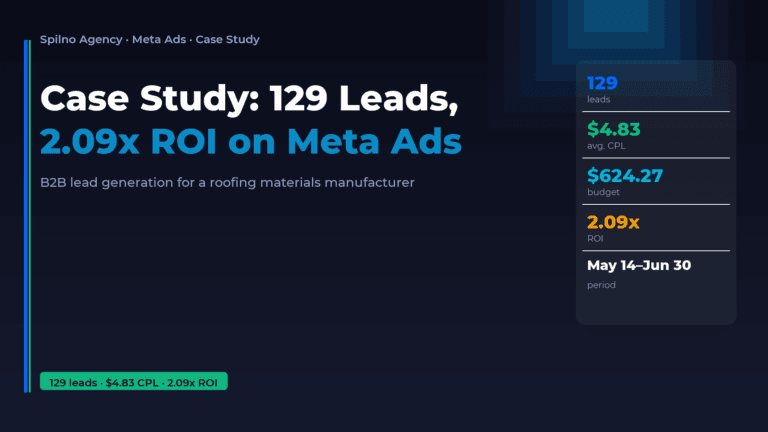
B2B Manufacturer Case Study: 129 Leads and 2.09x ROI with Meta Ads
A European roofing and facade materials manufacturer approached Spilno Agency with a clear goal — build a B2B…
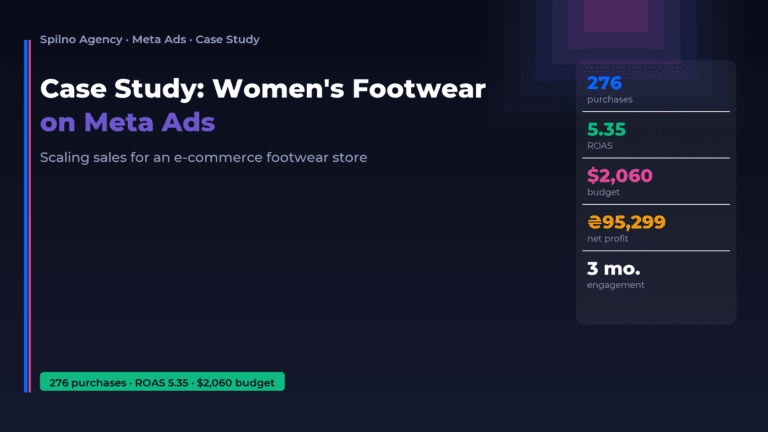
Case Study: Scaling Sales for a Women’s Footwear Brand with Meta Ads — 276 Purchases, ROAS 5.35
Our client is a mid-range women’s footwear retailer with an offline store network and its own e-commerce shop.…