Digital Marketing Strategy for Auto Repair Shops and Service Stations in 2026

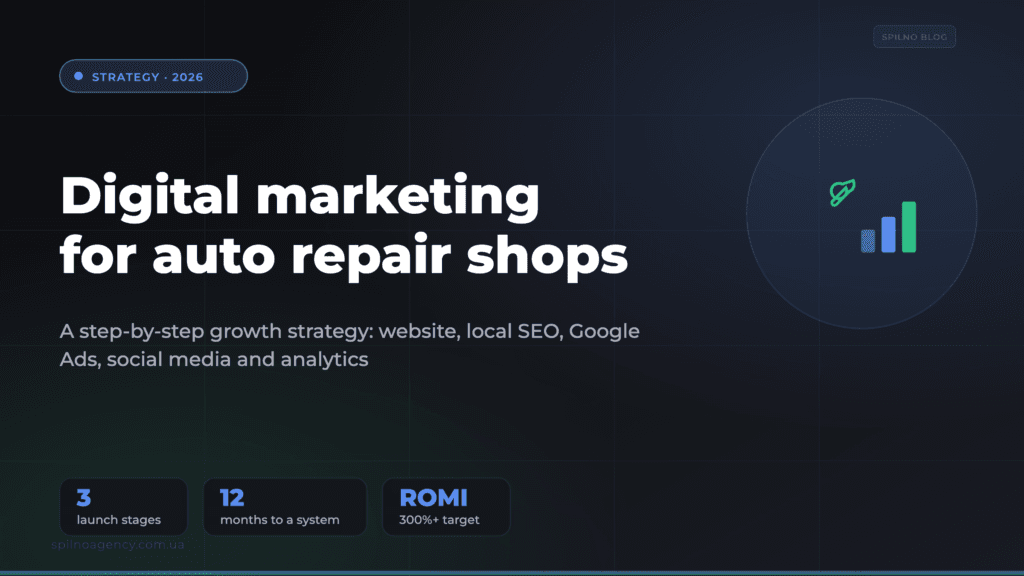
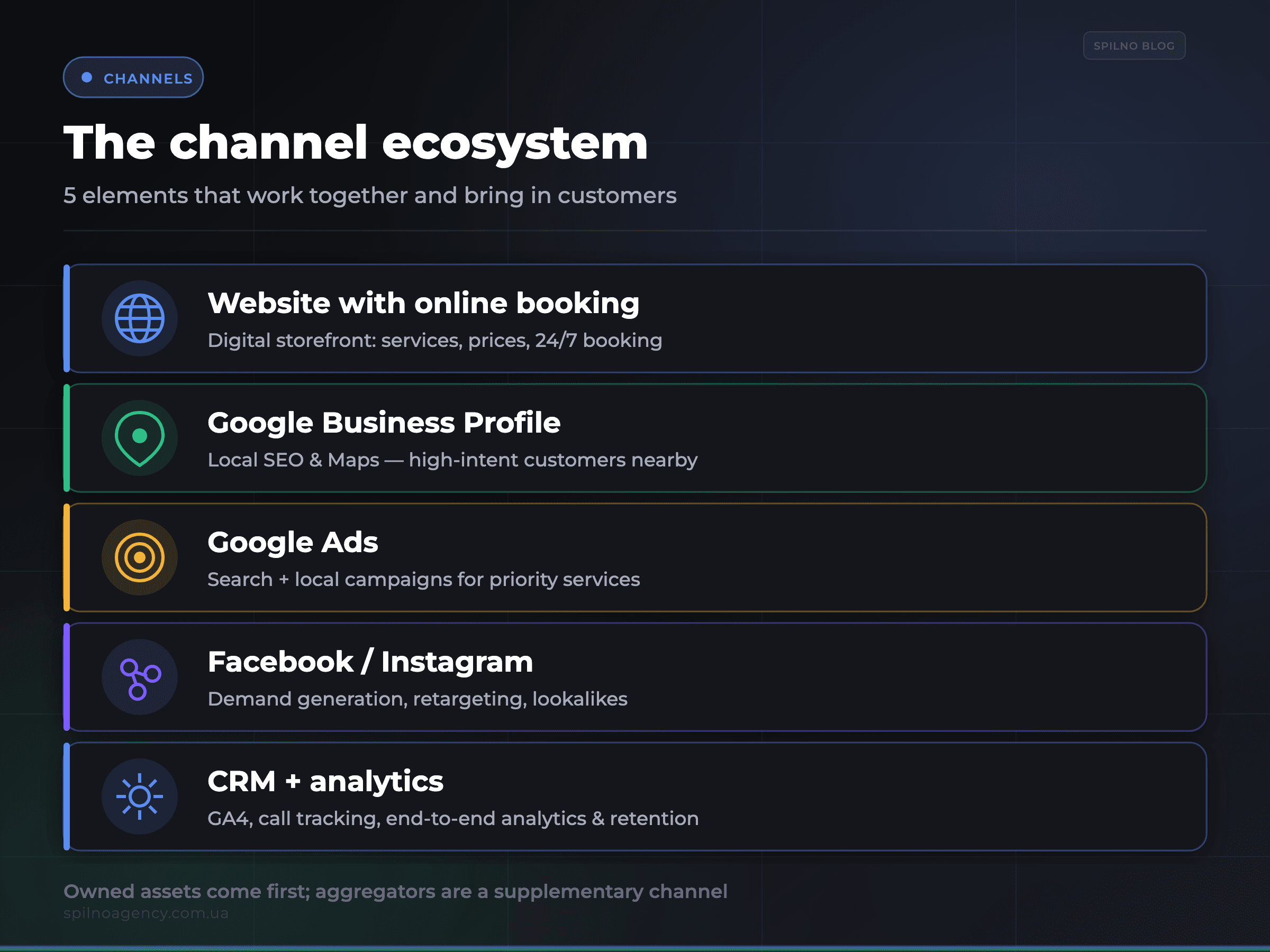
A digital marketing strategy for an auto repair shop or service station is a systematic plan to attract customers: a website with online booking, local SEO and a Google Business Profile, Google Ads, Facebook/Instagram targeting and end-to-end analytics. Below is a step-by-step 12-month roadmap — from the foundation to a predictable flow of leads, with KPIs (CPL, ROMI) and budget benchmarks for auto businesses across Europe.
This article was written by digital agency Spilno Agency, specializing in promoting auto repair shops and service centers online.
Contents
- Section 1: Analysis of the Auto Service Market in Ukraine (2024-2025): Navigating Uncertainty and New Opportunities
- Section 2: Developing the Foundation for Digital Presence (Stage 1: Months 1-3)
- Section 3: Active Client Engagement and Scaling (Stage 2: Months 3-9)
- Section 4: Analytics, Optimization, and Client Retention (Stage 3: 9+ months)
- Section 5: Step-by-Step Implementation Plan and Budgeting
- Order a digital strategy for an auto repair shop or service center
Section 1: Analysis of the Auto Service Market in Ukraine (2024-2025): Navigating Uncertainty and New Opportunities
1.1. Current State and Key Challenges: An “Ideal Storm” for the Auto Business
The Ukrainian auto service market in 2024-2025 operates in a unique combination of challenges and opportunities. On one hand, the general economic situation and declining purchasing power of the population force car owners to limit themselves to the most essential repairs.1 On the other hand, analytical data for 2024 shows a paradoxical trend: the auto service sector itself demonstrated the highest demand growth among all service categories.3 This indicates a significant pent-up demand and the objective necessity to maintain the vehicle fleet, the average age of which is increasing.4
The most acute problem defining the market’s competitive dynamics is the labor shortage. According to a survey of industry representatives, 54% of respondents consider military mobilization and the lack of qualified personnel to be the key challenge for their business.1 This workforce deficit directly impacts operational costs due to the rapid increase in wages. As of July 2025, the average salary for an auto mechanic across Ukraine reached UAH 40,000, and in Kyiv – UAH 50,000, showing an annual increase of 18% and 25% respectively.5
This situation fundamentally shifts priorities for auto service shop owners. Business success now depends not only on the ability to attract clients but also on the skill to find, train, and retain qualified specialists. A service station that can boast a stable and experienced team gains a fundamental competitive advantage: the ability to provide higher quality services, perform more complex repairs (e.g., for electric vehicles), and ensure higher throughput. Thus, any marketing strategy must have a dual purpose: attracting clients and attracting talent. The website and social media become not just a sales channel but also a strategic HR asset, where it’s necessary to showcase the benefits of working in the company, opportunities for training, and professional growth.
Despite all the difficulties, the market shows remarkable resilience. Approximately 57% of companies continue to operate as usual, and 52% of surveyed entrepreneurs assessed 2024 as successful. Moreover, two-thirds of auto business representatives plan expansion in 2026, indicating a high level of adaptability and optimism in the industry.1
1.2. Market Structure and Competitive Landscape: Who is Fighting for the Customer?
The auto service market in Ukraine is highly fragmented, creating an intense competitive environment. According to data preceding the full-scale invasion, but remaining structurally relevant, the market is predominantly controlled by independent players. Independent service stations (30.8%) and narrowly specialized individual workshops (62.6%) together occupy over 93% of the market. Official dealers account for only 6.6%.4 This structure provides significant advantages to flexible independent services that can adapt more quickly to demand changes and offer more competitive prices.
At the same time, large network players play a significant role in shaping quality standards and brand recognition. Networks such as ATL, with 40 locations in 19 Ukrainian cities 6, and Bosch Car Service, with branches in almost every region of the country 7, set a high bar for the market. The franchise models offered by these companies allow new players to enter the market with a ready-made business model and a recognizable brand, reducing their initial marketing costs, but simultaneously increasing competitive pressure on existing independent service stations.8
An important channel for attracting clients, especially in the body repair segment, is partnership with insurance companies. This area is gaining particular relevance due to the new law on mandatory third-party liability insurance (MTPL), which comes into effect on January 1, 2025.9 Insurance companies, such as Express Insurance Company, are actively expanding their partner networks of service stations (the number of partners increased to 84 stations as of August 2024) to provide clients with quality and prompt settlement of insurance claims across the country.9 For service stations, this is a stable source of orders for repair work.
1.3. Trends and Promising Directions: Where is the Money Hiding?
Market analysis reveals several key trends that will shape the development vector of the auto service business in the coming years. Ignoring these trends can lead to a loss of competitiveness, while timely adaptation opens up new high-margin niches.
Trend #1: Electrification of the Vehicle Fleet. This is the most significant and long-term trend. The share of electric vehicles (EVs) in the new car market in Ukraine in 2026 is projected to be 15–18%.12 In June 2025, a record number of new electric car registrations was recorded 13, and the total EV fleet in the country already exceeds 171,000 units.14 This creates a huge and growing demand for new competencies and services that most traditional service stations cannot currently provide. The most in-demand services for electric vehicles include diagnostics and repair of high-voltage batteries, troubleshooting charging issues, diagnosing complex electronic systems, as well as specific maintenance of the braking system (due to regeneration) and suspension (due to the higher weight of EVs).15
Trend #2: Growing Demand for Complex and Specialized Services. In 2024, the demand for auto electrician services increased by 102%, and for engine and chassis repair – by over 100%.3 Simultaneously, the profession of auto mechanic became one of the most popular among vocational school entrants.19 This indicates a shift in demand from basic maintenance to complex diagnostic and repair work requiring deep expertise and specialized equipment.
Trend #3: Constant Flow of Cars from the USA. The import of cars from American auctions remains a stable source for replenishing the Ukrainian vehicle fleet. These cars typically require restoration after accidents, as well as adaptation to Ukrainian and European standards, which includes replacing optics, reprogramming radio frequencies, and other electronic systems.20 This creates a stable demand for comprehensive body repair and auto electronics services.
Trend #4: Technological Evolution and OTA (Over-the-Air) Updates. Modern cars increasingly update their software “over the air,” without a visit to the service center.24 For owners, this is convenience, but for independent service stations, it’s a long-term threat. Manufacturers gain the ability to remotely diagnose and fix software errors, which could deprive service stations of a significant portion of their diagnostic service revenue in the future.26
The combination of these trends indicates an inevitable market polarization. Service stations trying to remain “all-rounders” risk being squeezed out from all directions: EV customers will be captured by specialized EV services, complex internal combustion engine (ICE) repairs will be taken by niche workshops, and some diagnostic work will simply disappear thanks to OTA updates. Survival and prosperity in the new environment require a clear strategic choice: specialization. A service station must define its development vector, becoming either an “EV and Hybrid Expert,” a “Complex ICE Repair Center,” or a “US Car Restoration Hub.” Considering the highest potential for long-term growth and profitability, the further strategy will be developed with a focus on the priority development of the repair and maintenance of electric vehicles and hybrids.
Section 2: Developing the Foundation for Digital Presence (Stage 1: Months 1-3)
2.1. Creating a High-Converting Website: Your Digital Showcase
In the first stage, the key task is to create a solid digital foundation. The central element of this foundation is the website, which should function not as a static business card but as an active tool for attracting clients and generating orders.
Key elements of an effective auto service website:
- Clear structure and intuitive navigation: The site must have a logical structure that allows the user to easily find the information they need. Essential sections include: “Home,” “Services” (with separate, detailed pages for priority areas like “EV Repair,” “High-Voltage Battery Diagnostics,” “Chassis Repair”), “Prices,” “About Us,” “Blog/Our Work,” and “Contacts.”
- Integrated online booking module: The ability to book an appointment 24/7 is a standard of modern service. Integration with a CRM system automates this process, prevents scheduling conflicts, and reduces the workload on the administrator.28
- Flawless mobile adaptation: Given that over 75% of search queries in Ukraine are made from mobile devices, the site must be perfectly optimized for viewing on smartphones.29 This includes fast page loading, easy-to-tap buttons, and readable fonts.
- Powerful Calls-to-Action (CTAs): Every page should prompt the user to take the next step. Using prominent buttons with clear calls like “Book a Diagnostic,” “Calculate Repair Cost,” or “Get a Consultation” is mandatory.
Budgeting: The cost of website development in Ukraine in 2026 can vary significantly. A simple template-based website might cost from UAH 8,000 30 to $1900 31, while developing a unique multi-page website with custom design and functionality would cost $2000–$5000.31 To create a high-quality, effective, and ready-to-promote website “turnkey,” it is recommended to allocate a budget in the range of
UAH 40,000 to 80,000 ($1000–$2000).
2.2. Local SEO and Google Business Profile: Attracting “Hot” Clients
Local SEO is the #1 tool for auto service shops, as it targets clients actively searching for services nearby. Queries like “СТО Оболонь” (Auto Service Obolon) or “ремонт Tesla Київ” (Tesla repair Kyiv) have the highest conversion rate, as the user is already ready to act.
Optimizing your Google Business Profile (GBP): This is a free and extremely powerful tool that serves as the company’s face in local search and on Google Maps. The profile must be 100% complete:
- Accurate information (NAP): Name, address, and phone number must be identical on the website, in GBP, and in all other online directories.
- Correct categories: The primary category (“Auto Service”) and secondary categories (“EV Repair,” “Tire Service”) must be specified.
- Visual content: Regularly adding high-quality photos of the premises, equipment, work process, team, and examples of completed work (“before/after”) significantly increases trust and engagement.
- Posts and promotions: Using the “Posts” feature to inform about special offers, new services, or useful tips.
- Review management: Actively managing reviews is critically important (more details in section 2.3).
Local Citations: To strengthen authority in Google’s eyes, it’s necessary to register the service station in key Ukrainian online catalogs, directories, and maps, ensuring NAP data consistency.29
On-Page SEO for the website: Texts on service pages must be optimized for local search queries. For example, a page about chassis repair should include phrases like “chassis diagnostics in Podil,” “suspension replacement Kyiv,” etc.
2.3. Reputation and Review Management: Building Trust
In the digital age, reviews are one of the most important factors influencing a potential client’s decision.34 A positive online reputation not only attracts clients but also directly impacts a service station’s ranking in local Google search results.
Review collection strategy:
- Proactive approach: Don’t wait for clients to leave reviews themselves. Systematically ask satisfied clients to share their experiences.
- Simplifying the process: Provide the client with a direct link to the Google reviews page via a QR code at the reception desk, an SMS message, or an email after service completion.
- Automation: Integrating the review request process with the CRM system makes it automatic and regular.
Review management:
- Gratitude for positive feedback: Responding to every positive review shows appreciation and strengthens client loyalty.
- Professional response to negative feedback: A public, constructive, and unemotional response to negative feedback is mandatory. It’s important to acknowledge the issue, offer a solution, and move the communication offline. This shows potential clients that the company doesn’t ignore problems and cares about service quality.
2.4. Implementing CRM Systems and Online Booking: Automation and Control
Implementing a Customer Relationship Management (CRM) system from the outset is a strategic investment in business efficiency and scalability. CRM allows for centralized management of the client base, storing the complete service history for each vehicle, planning the workload of service bays and technicians, and automating communications such as appointment reminders or review requests.36
There are several specialized CRM solutions for auto service shops on the Ukrainian market, including RemOnline and FixIQ Pro. The choice of a specific platform depends on the size of the service station, budget, and specific business needs.36
Table 1: Comparative Analysis of CRM Systems for Auto Service Shops in Ukraine
| Criterion | RemOnline | FixIQ Pro |
| Core Functionality | Client and vehicle database, appointment calendar, inventory and financial accounting, payroll calculation, mobile apps for management and employees.37 | Client and vehicle database, work calendar, standard hour directory, digital document flow, client chat, promotion within the client app.36 |
| Online Booking | Integrated scheduler for 24/7 client booking.28 | Integrated, with the ability to attract new clients through the FixIQ platform.38 |
| Pricing Policy | 7-day free trial. “Hobby” plan from €15/month, “Startup” from €29/month (includes 3 employees). Additional employee from €5/month.40 | Free trial with limited functionality. Pricing is customized; minimum tariff is not publicly disclosed.42 |
| Ideal for | Small, medium, and large chain service stations due to flexible pricing plans and scalability.37 | Small and medium service stations seeking a comprehensive solution with an additional client acquisition channel via the platform.36 |
Section 3: Active Client Engagement and Scaling (Stage 2: Months 3-9)
3.1. Contextual Advertising (Google Ads): Quick Results for Priority Services
After establishing a solid digital foundation, the next step is to launch paid traffic to quickly attract clients. Google Ads is the most effective tool for this purpose, as it allows displaying ads to users who are already actively searching for specific services.
Strategy:
- Focus on priority areas: Advertising campaigns should concentrate on the most profitable and in-demand services identified during market analysis. For an EV-specialized service station, these would include: “high-voltage battery repair,” “Tesla/Nissan Leaf diagnostics,” “Tesla Model 3 control arm replacement,” “EV auto electrician services.”
- Campaign types:
- Search campaigns: Targeted at “hot” keywords when a user is looking for a solution to a specific problem (e.g., “nissan leaf battery repair Kyiv price”).
- Local campaigns (Performance Max for store goals): This campaign type uses Google’s artificial intelligence to maximize reach to relevant users near the service station. Ads are automatically shown in Search, Maps, YouTube, and the Display Network, encouraging users to get directions or call.
Budget and expected cost:
The average cost per click (CPC) in the “Automotive Parts & Services” niche is relatively low.43 However, in the highly competitive Kyiv market, especially for queries related to premium brands like Tesla, the CPC will be higher. Practical case studies from Ukraine show that the average cost per acquisition (CPA) can be around $3.07.44 A recommended starting monthly budget for Google Ads to achieve visible results is
from UAH 12,000.45
3.2. Targeted Advertising on Social Media (Facebook/Instagram): Shaping Demand and Audience Engagement
Unlike Google Ads, where we work with existing demand, social media advertising allows us to shape that demand by showcasing expertise and offers to an audience that may not yet be actively searching for service station services but is a potential client.
Strategy and targeting setup:
- Geographic targeting: A key parameter for local businesses. Ads should be targeted at residents of specific districts of Kyiv or an audience within a 5-10 km radius of the service station.
- Interest-based targeting: Facebook Ads allows targeting users interested in topics such as “Electric Vehicles,” “Tesla,” “Nissan Leaf,” “Car Tuning,” “Auto Parts.”46
- Special audiences:
- Retargeting: Showing ads to users who have previously visited the website but did not complete a target action (e.g., book a service).
- Lookalike audiences: Using the existing client database from CRM to create “similar” audiences. Facebook analyzes the characteristics of your best clients and finds new users with similar profiles, which is an extremely effective tool.47
Advertising creatives:
Effective creatives must be visually appealing and provide value. These can include short video reviews of complex repairs, demonstrations of unique diagnostic equipment for EVs, and special offers, such as “Free chassis diagnostics for EV owners on their first visit.”
3.3. Content Marketing and SMM: Building Expert Status
Content marketing is a long-term strategy aimed at transforming a service station from “one of many” into a trusted expert that people turn to for advice and quality services. This is particularly important in the EV repair niche, where the level of trust in the mechanic plays a crucial role.
Content formats:
- Video content: Short videos in Reels (Instagram) and Shorts (YouTube) formats are the most in-demand. Topics can include: diagnosing common faults (e.g., Nissan Leaf battery degradation), reviewing new equipment, tips for operating EVs in winter. Video is the most visual and convincing format.48
- “Before/After” Case Studies: Detailed photo and video reports of completed work, especially complex ones like restoring cars from the USA or repacking high-voltage batteries. Such cases demonstrate real competence.
- Expert articles in the website blog: SEO-optimized publications that answer common car owner questions: “How to extend the life of an electric car battery?”, “Top 5 problems of Tesla Model 3 in Ukraine,” “When to replace suspension arms?”.
- Meet the Team: Posts and videos introducing the mechanics, their qualifications, certifications, and experience. This “humanizes” the business and increases trust.
To systematize the work, a monthly content plan should be created, including various sections: “Tip of the Week from Our Expert,” “Our Repair in Detail,” “EV FAQ.”49
3.4. Placement on Aggregators and Specialized Platforms
Aggregator platforms like Autobooking.com 51, TurboSTO 52, and the FixIQ client app 38 can serve as an additional source of client acquisition. Placement on such resources increases the service station’s online visibility.
Usage strategy:
Aggregators should be considered a supplementary, not primary, channel. The main focus should remain on developing your own digital assets (website, social media), where the service station has full control over communication and doesn’t compete with dozens of other services on the same page. It’s important to set up analytics (e.g., using call tracking) to monitor the effectiveness of each aggregator, to understand the quantity and quality of clients it brings.
Section 4: Analytics, Optimization, and Client Retention (Stage 3: 9+ months)
4.1. Setting Up Comprehensive Analytics: What Isn’t Measured Can’t Be Improved
Effective digital marketing is impossible without accurate measurement of results. At this stage, it’s necessary to implement tools that allow tracking the effectiveness of each channel and optimizing the marketing budget.
Key analytics tools:
- Google Analytics 4 (GA4): This is the basic tool for analyzing website traffic. It’s necessary to set up tracking for key target actions (conversions), such as:
- Successful submission of the online booking form.
- Clicking on the phone number on the website.
- Interaction with the online chat widget.Setting up events and conversions in GA4 allows you to clearly see which traffic sources (organic search, paid advertising, social media) bring real leads.53
- Call Tracking: For businesses where a significant portion of clients call, this tool is critically important. Call tracking allows assigning a unique phone number to each advertising channel (e.g., a specific Google Ads campaign, an OLX ad, an Instagram profile). When a client calls, the system records exactly which source they came from. This allows for accurate evaluation of offline conversion effectiveness.
- Ukrainian services and prices: Several reliable services are available on the market, such as Phonet, Binotel, UniTalk, Zadarma. The cost of services is affordable: Phonet offers numbers from UAH 75/month 57, Binotel – from UAH 50/month for a mobile number 58, and Zadarma – from $2/month.59
Combining data from GA4 (online leads) and a call tracking system (calls) creates a unified end-to-end analytics system. The auto service shop owner stops operating with abstract concepts like “clicks” or “reach” and starts seeing the full picture: “investments in Google Ads of UAH 10,000 brought 15 calls and 5 online leads, of which 8 became actual clients with an average check of UAH 5,000, generating UAH 40,000 in revenue.” This data-driven approach allows for rational budget allocation, scaling of effective channels, and discontinuation of ineffective ones, transforming marketing from a cost center into a predictable growth engine.
4.2. Email Marketing and Loyalty Programs: Turning a One-Time Customer into a Regular
Acquiring a new client is always more expensive than retaining an existing one. Therefore, once the client base starts growing thanks to active marketing, it’s necessary to implement tools for increasing loyalty and repeat sales.
Retention strategy:
- Utilizing CRM data: The client base with service history is a goldmine for personalized marketing.
- Automated email and SMS sequences:
- Scheduled maintenance reminders: The system can automatically send reminders to the client a few weeks before the recommended date for the next service, based on the date of the last visit or mileage.
- Seasonal offers: Automated mailings with offers like “Prepare your air conditioner for summer!” or “Time to change tires!”.
- Reactivating “dormant” clients: A special offer (e.g., a discount or free diagnostics) for clients who haven’t visited the service station in over a year to win them back.
- Loyalty program: Implementing a simple and clear loyalty program, such as cumulative discounts, bonuses for referring a friend, or special club prices for regular clients. This encourages clients to return specifically to your service.
Section 5: Step-by-Step Implementation Plan and Budgeting
5.1. Prioritizing Actions: A 12-Month Roadmap
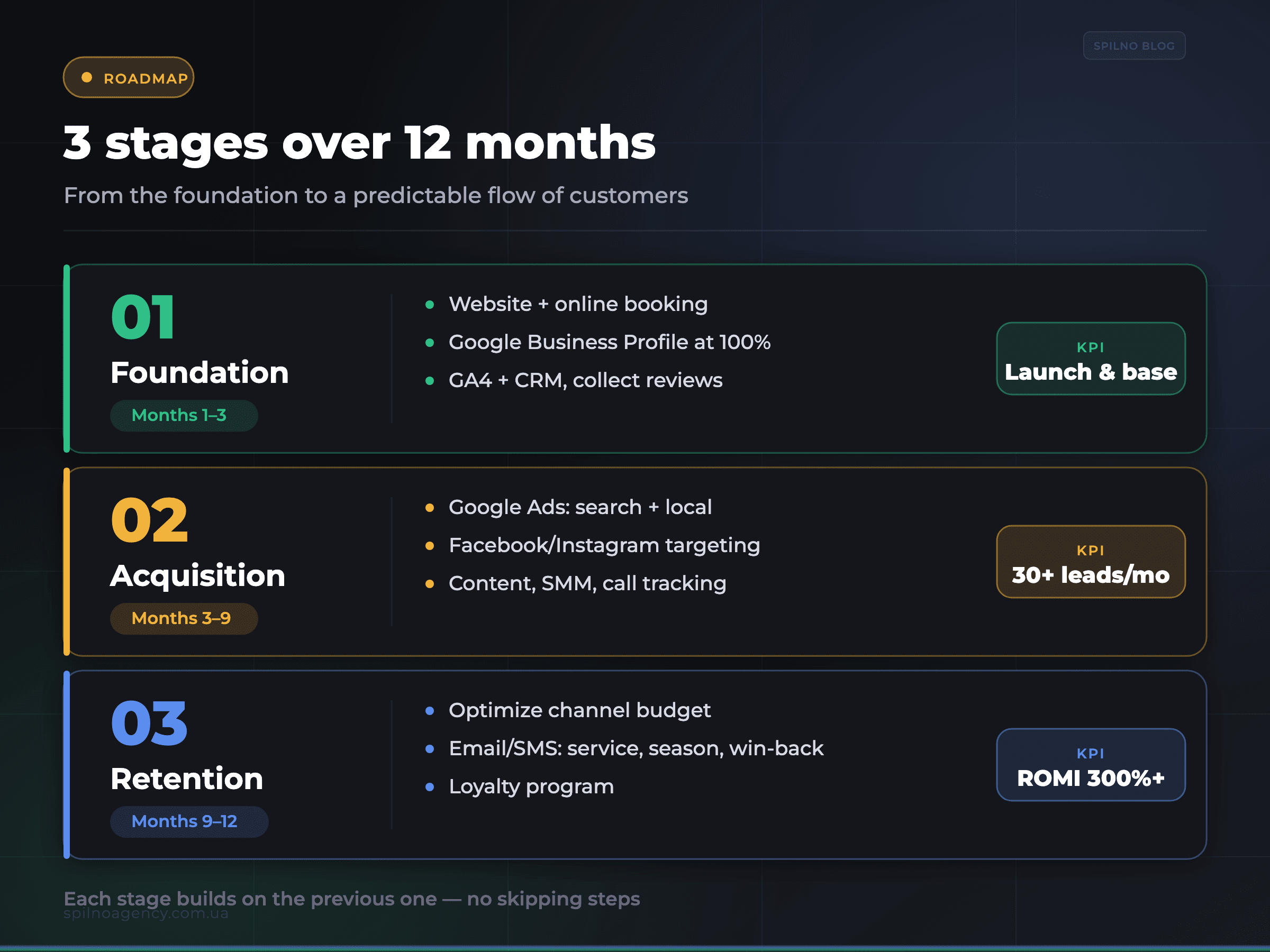
Successful implementation of a comprehensive digital strategy requires a clear, phased action plan. Below is a roadmap for the first 12 months, transforming strategic goals into concrete, manageable tasks.
Table 2: Phased Strategy Implementation Plan
| Stage / Months | Key Actions | Responsible | Key Performance Indicators (KPIs) |
| Stage 1: Foundation (1-3 mos.) | – Develop and launch website with online booking. – Create and fully optimize Google Business profile. – Set up basic analytics (Google Analytics 4). – Implement and configure CRM system. – Develop review collection strategy. | Owner / Contractor | – Website launch. – 100% GBP profile completion. – Collect first 10+ positive reviews. – Migrate existing client base to CRM. |
| Stage 2: Active Engagement (3-9 mos.) | – Launch Google Ads search and local campaigns. – Launch targeted advertising on Facebook/Instagram. – Regular social media management (2-3 posts/week). – Write first 4-5 SEO articles for the blog. – Set up and launch call tracking. | Marketer / Contractor | – Achieve top 10 Google Maps rankings for 5 key queries. – Generate 30+ leads/month from paid advertising. – Cost Per Lead (CPL) < UAH 500. – 20% increase in organic traffic. |
| Stage 3: Optimization and Retention (9-12 mos.) | – Monthly analysis of advertising channel performance and budget reallocation. – Set up automated email sequences (maintenance reminders, seasonal promotions). – A/B testing of ad creatives and copy. – Develop and launch loyalty program. | Owner / Marketer | – 15% reduction in CPL through optimization. – Repeat visits rate > 30% of total. – Return on Marketing Investment (ROMI) > 300%. |
5.2. Budgeting Recommendations and Performance Evaluation (KPI)
Implementing the strategy described above requires appropriate financial investment. Below is an estimated budget for the first year, including both one-time costs for infrastructure creation and regular promotion expenses.
Table 3: Estimated Digital Marketing Budget and KPIs (First Year)
| Expense Item | One-Time Costs (Stage 1), UAH | Monthly Costs (Stages 2-3), UAH | Total Annual Budget, UAH |
| Turnkey Website Development | 50,000 | – | 50,000 |
| CRM System Subscription (e.g., RemOnline) | – | 1,200 | 14,400 |
| Google Ads and Analytics Setup (one-time) | 10,000 | – | 10,000 |
| Google Ads Advertising Budget | – | 15,000 | 135,000 |
| Facebook/Instagram Advertising Budget | – | 5,000 | 45,000 |
| Marketer/Agency Services (support) | – | 10,000 | 90,000 |
| Call Tracking Service Subscription | – | 500 | 4,500 |
| TOTAL | 60,000 | 31,700 | 348,900 |
Key KPIs for tracking investment effectiveness:
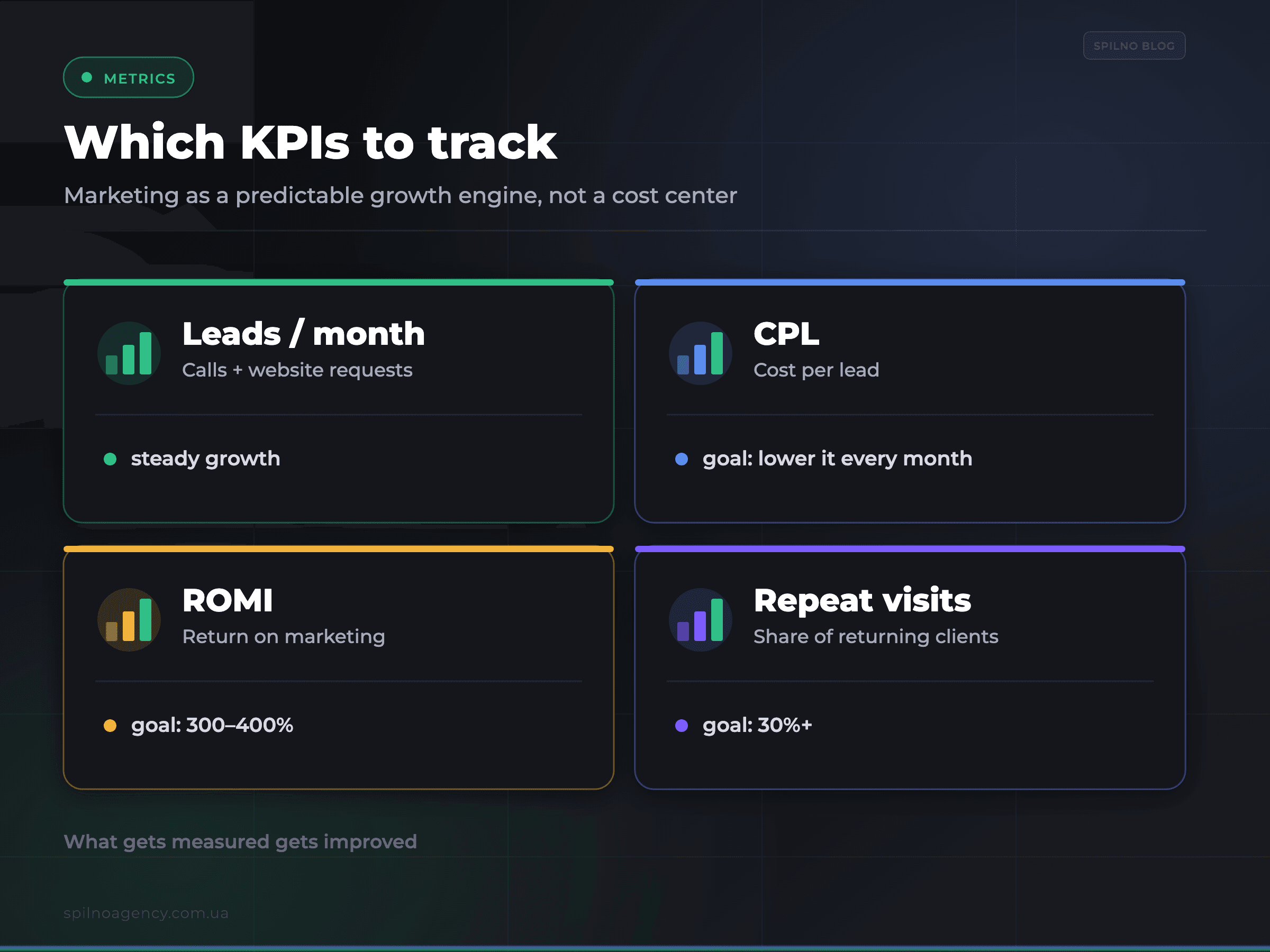
- Number of Leads (calls + website form submissions): The key indicator of potential client volume. Goal: stable monthly growth.
- Customer Acquisition Cost (CAC): Calculated as total marketing expenses for a period divided by the number of new clients. Goal: gradual reduction of this indicator.
- Return on Marketing Investment (ROMI): The most important business indicator. Calculated using the formula:
((Дохід від маркетингу - Витрати на маркетинг) / Витрати на маркетинг) * 100%. Goal: achieving a ROMI of at least 300-400% in the stable operation phase.
Order a digital strategy for an auto repair shop or service center
Frequently Asked Questions
Where do I start with marketing an auto repair shop online?
Start with the foundation: a high-converting website with online booking, a fully completed Google Business Profile, and basic analytics (Google Analytics 4 + a CRM). This is the base that paid advertising relies on. Running Google Ads to a raw site with no analytics simply burns budget.
Which advertising channels work best for an auto service?
Google Ads (search and local campaigns) delivers the fastest results because it captures high-intent demand — people already searching for the service. Local SEO and a Google Business Profile bring in nearby customers via Maps, while Facebook/Instagram targeting builds demand and re-engages visitors through retargeting.
How long until the first results?
Paid advertising (Google Ads, social targeting) brings the first leads within days of launch. Local SEO, content and reviews take 3–6 months to build a steady organic flow. That’s why the strategy combines both: fast leads now and cheaper traffic later.
How do I measure the effectiveness of auto repair marketing?
Set up Google Analytics 4 (website requests, phone clicks) together with call tracking for phone calls — this gives you end-to-end analytics. Key KPIs: leads per month, cost per lead (CPL) and return on marketing investment (ROMI), with a target of 300–400%.
Do I need a website if I already have Instagram and an aggregator profile?
Yes. A website is an asset you fully control: it powers online booking, serves as the landing page for ads, and is the base for remarketing. Aggregators and social profiles are supplementary channels where you compete with dozens of other shops on a single page.
How do I choose a specialization to stand out?
The market is polarizing: generalist shops lose to specialists. Promising niches include EV and hybrid servicing, complex engine and suspension repair, and reconditioning imported vehicles. The niche you choose shapes both your website positioning and your advertising keywords.

Read also
Spilno Agency’s Experience: How We Verify Events Before Starting Work
Before launching a campaign in Google Ads or Meta Ads, or starting SEO work, Spilno Agency always checks…
GA4 DebugView: How to Verify Google Analytics Events in Real Time
DebugView is the section of Google Analytics 4 that shows your site’s events in real time, seconds after…
Top Claude Skills for TikTok Ads Specialists (2026)
9 verified Claude skills and MCP servers for TikTok Ads: Pixel/Smart+ audits, Spark Ads hook/hold rate, creator sourcing,…