How a Service Business Can Track Advertising Campaign Quality: KPIs, Metrics & Checklists 2026

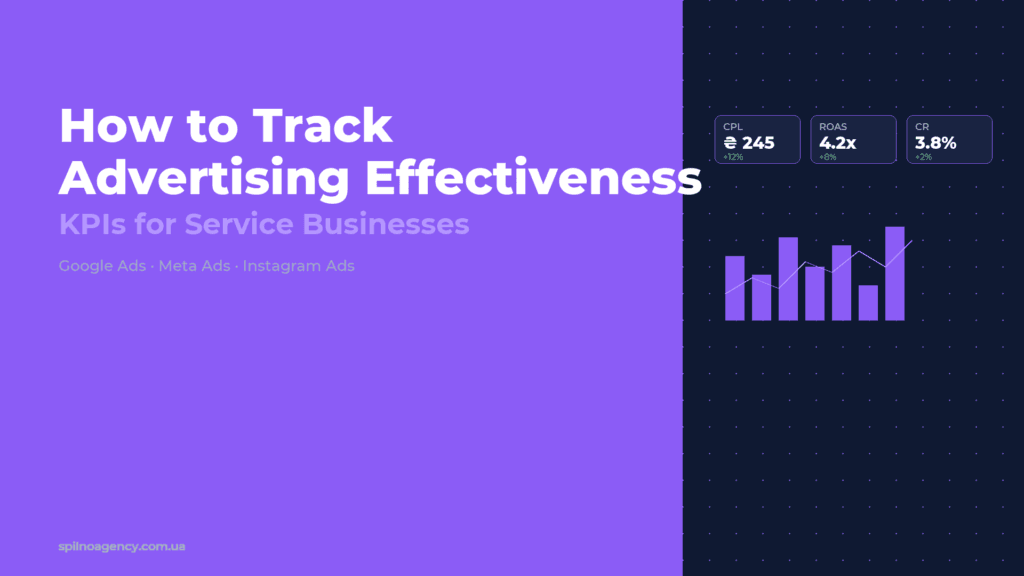
Tracking advertising effectiveness for service businesses is not about vanity metrics in a report. It’s about answering one critical question: is your ad budget bringing real clients? This guide covers a step-by-step KPI system, detailed checklists for Google Ads and Meta Ads, tracking setup, and common mistakes European service businesses make in 2026.
Why service businesses must track advertising performance
If you’ve launched an advertising campaign to attract potential clients, you need to clearly understand whether it’s actually bringing you clients — not clicks, not impressions, not “reach” — but real enquiries and calls.
How many potential clients does your advertising bring, and how much does each one cost?
If you don’t know the answer, that’s already a problem. Without this data, you can’t make budget decisions, evaluate your agency’s work, or scale what’s actually working.
Risks of running ads without proper tracking
- Increasing the budget of an unprofitable campaign only multiplies your losses
- Your agency can report impressive-looking numbers (clicks, CTR) that have nothing to do with your revenue
- You don’t know which channel works and end up paying for everything at once
- Competitors who track KPIs optimise their campaigns and acquire clients cheaper
Core KPIs for service businesses: where to start
Regardless of the channel (Google Ads, Meta Ads, Instagram, Bing), a service business must track at minimum two key metrics:
- Number of leads — how many potential clients (calls, form submissions, enquiries) your advertising brought
- Cost Per Lead (CPL) — how much of your ad budget was spent per potential client
Running advertising for a service business without tracking these two metrics is like investing money without counting it.
Google Ads KPI checklist: what to track and how
Google Ads is one of the most effective tools for service businesses across Europe. But evaluating a campaign by clicks alone is a serious mistake. Here is the complete checklist of metrics you need to monitor.
✅ Results KPIs (primary metrics)
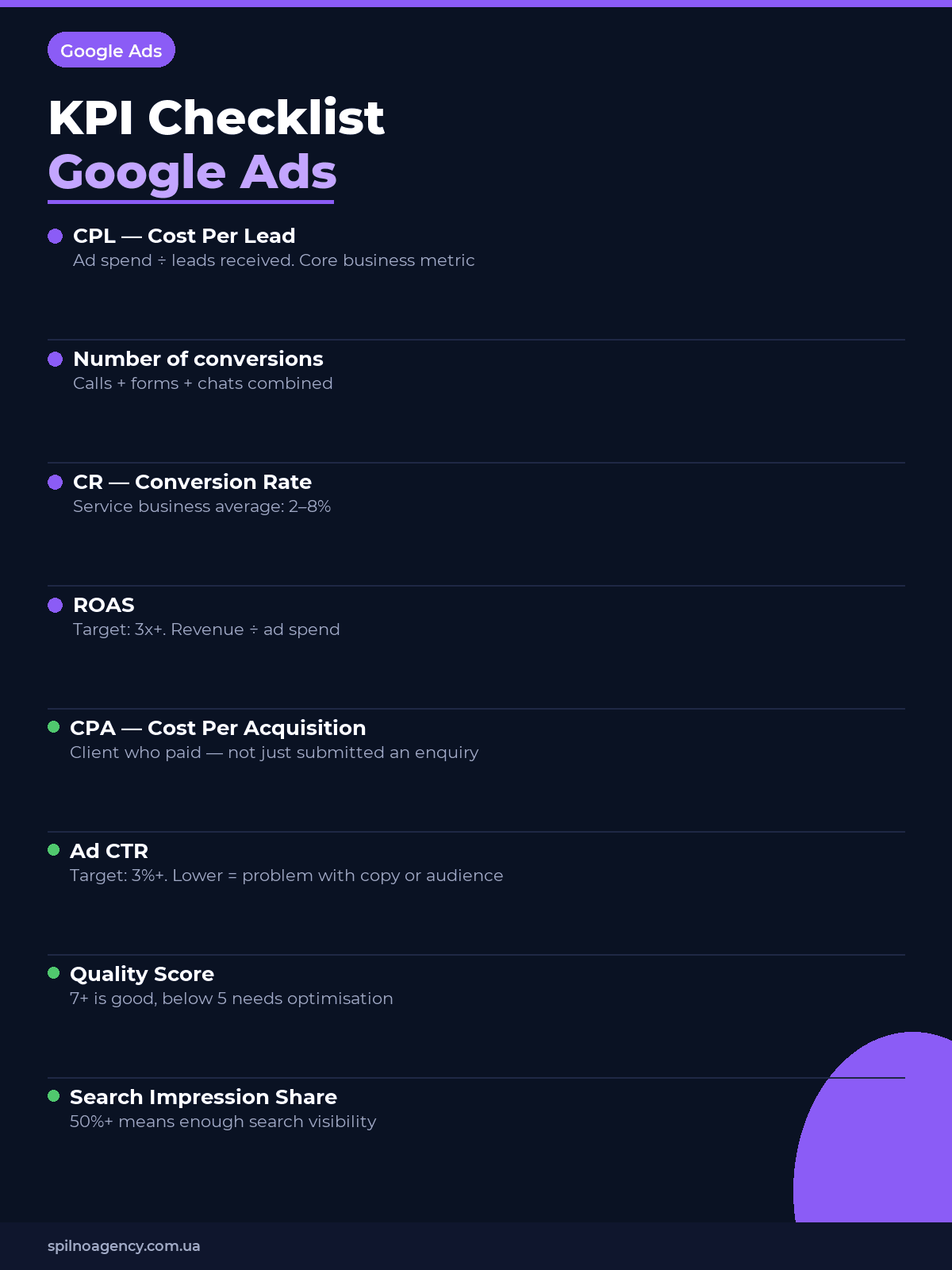
- CPL (Cost Per Lead) — the primary metric. Divide ad spend by the number of leads received. The benchmark depends on your niche and average service value
- Number of conversions — total count of form submissions, calls, enquiries via chat
- Conversion Rate (CR) — percentage of visitors who submitted an enquiry. Average CR for service businesses: 2–8%
- CPA (Cost Per Acquisition) — cost of acquiring a client who actually paid for the service (not just submitted an enquiry)
- Call volume — a separate metric via call tracking or Google Ads call reporting
📊 Ad performance KPIs
- CTR (Click-Through Rate) — percentage of clicks from impressions. Low CTR (<3%) signals a problem with ads or irrelevant audience
- Quality Score — Google’s keyword quality rating (1–10). Above 7 is good, below 5 needs optimisation
- Ad Strength — for Responsive Search Ads (RSA). Aim for “Excellent”
- Search Impression Share — percentage of impressions received vs. possible. Below 50% means growth potential or budget/bid issues
⚙️ Internal technical KPIs (for your specialist)
- CPC (Cost Per Click) — important for the specialist, but business owners shouldn’t interfere without understanding the context
- CPM (Cost Per Mille) — cost per 1,000 impressions. Relevant for display campaigns (GDN, Demand Gen)
- Top of page rate — whether your ads appear at the top of search results
- Search Terms Report — which exact queries trigger your ads. Needs regular negative keyword cleanup
Important: don’t adjust technical settings (bids, search terms) without understanding the algorithms. Reducing bids can halve your lead volume even if your CPL was acceptable.
Meta Ads KPI checklist (Facebook and Instagram)
Meta Ads is targeted advertising on Facebook and Instagram. Unlike Google, here you show ads to people who might be interested in the service — not to those already searching for it. So the metrics differ somewhat.
✅ Meta Ads results KPIs
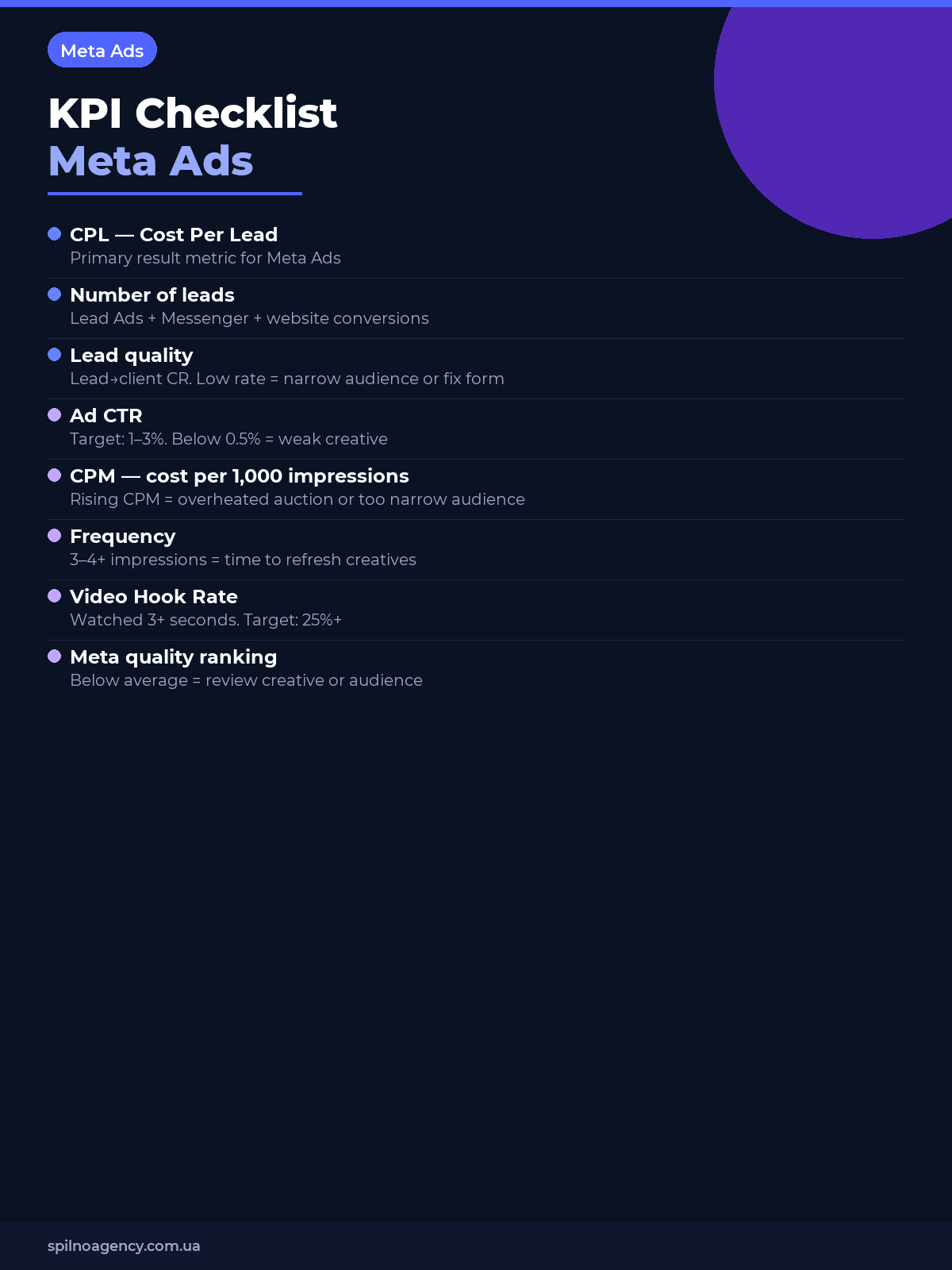
- CPL (Cost Per Lead) — lead cost from Lead Ads forms, messages, or website traffic with conversion
- Number of leads — via Lead Ads form, Instagram Direct, Messenger, or website conversion
- Lead Quality Rate — percentage of leads that became real clients. Many “junk” enquiries? Narrow your audience or improve the form
- Conversion Rate — percentage of people who saw the ad and took the target action
📊 Meta Ads ad performance KPIs
- CTR — for the news feed, benchmark: 1–3%. Below 0.5% means the creative isn’t resonating with the audience
- CPM (Cost Per Mille) — auction competitiveness indicator. Sharp increase means an overheated auction or too narrow an audience
- Frequency — how many times one person has seen your ad. Above 3–4 means audience “fatigue” — refresh creatives or expand audience
- Relevance Score / Quality Ranking — Meta rates your ad quality. Below average is a signal to review creative or audience
- Hook Rate (first 3 seconds of video) — percentage who paused and watched at least 3 seconds. Benchmark: 25%+
How to set up tracking: a step-by-step plan
Step 1. Google Analytics 4 (GA4)
- Connect GA4 to your website — it’s free
- Set up goals: form submission, phone number click, “Thank You” page visit
- Link GA4 to Google Ads for conversion import
- Verify conversions are counting correctly — submit a test enquiry
Step 2. Google Ads conversion tracking
- Set up conversion tags via Google Tag Manager or directly
- Track: form submissions, calls from website, phone number clicks (mobile)
- Enable Enhanced Conversions for more accurate measurement
- Check the Conversions report in Google Ads after 24–48 hours
Step 3. Meta Pixel and Conversions API
- Install Meta Pixel via GTM or a WordPress plugin
- Set up events: Lead, Contact, SubmitApplication
- Additionally connect Conversions API (server-side tracking) — improves accuracy by 20–40%
- Verify via Events Manager and test traffic
Step 4. Call tracking — if clients enquire by phone
If 15% or more of your clients call you (rather than submitting forms), call tracking is essential. This is a service that swaps the phone number shown depending on the traffic source and records which ad channel brought the call.
Checklist for evaluating your advertising agency
- ☐ Is conversion tracking set up (GA4 + Google Ads conversions)?
- ☐ Is there a regular report showing CPL and lead volume?
- ☐ Are leads broken down by advertising channel?
- ☐ Are calls tracked (call tracking) where relevant?
- ☐ Do you have access to the ad account to view independently?
- ☐ Is A/B testing of ads and landing pages being conducted?
- ☐ Is there an optimisation plan for next month?
- ☐ Does the agency report on lead quality, not just quantity?
Common mistakes business owners make when evaluating advertising
- Focusing only on clicks and CTR — these metrics aren’t directly linked to profit
- Judging performance after the first week — Google and Meta algorithms need 2–4 weeks to learn
- Comparing CPL across niches — CPL for a dental clinic vs. a shoe repair shop are incomparable
- Ignoring lead quality — 20 enquiries per month sounds good, but if 15 were irrelevant, real CPL is much higher
- Adjusting bids themselves — this can halve lead volume
- Not testing new audiences and creatives — ad fatigue reduces effectiveness after 4–8 weeks
How often to check KPIs: monitoring schedule
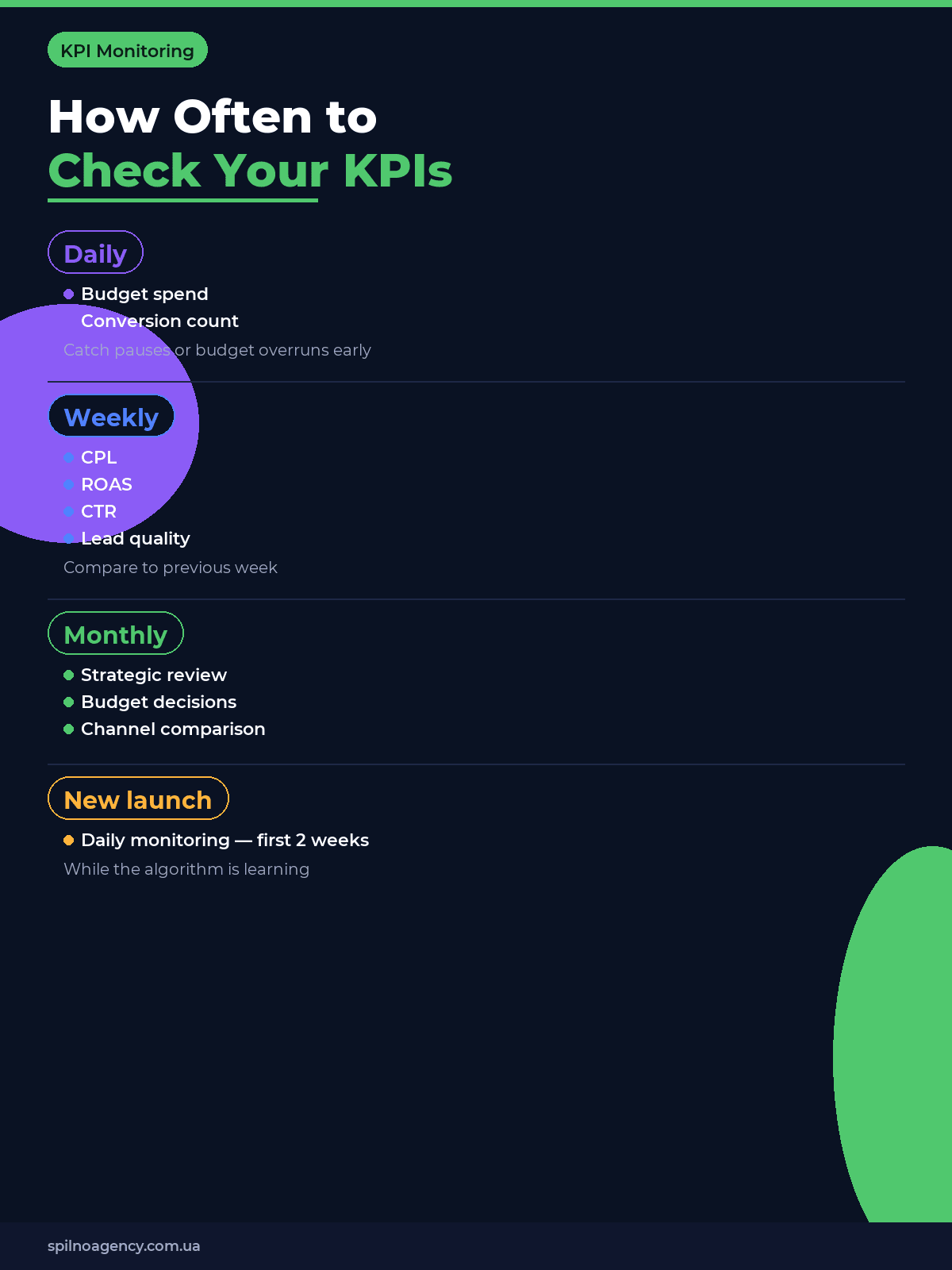
- Daily: budget spend and conversion count (to catch campaign pauses or budget overruns)
- Monthly: strategic review, comparison with previous months, budget and channel decisions
- At new campaign launch: daily monitoring for the first 2 weeks while the algorithm learns
Conclusion
Effective advertising for a service business isn’t about pretty numbers in a report. It’s a tracking system that answers a simple question: how much does one client from advertising cost, and is it profitable for the business?
Minimum starting set of metrics:
- Number of leads (calls + forms) — separately per channel
- CPL — cost per lead
- CR — website conversion rate
If you’re not tracking these metrics yet — start today. If your agency isn’t providing this information — ask the right questions or contact us for an advertising audit.
Frequently Asked Questions
What KPIs should a service business set for Google Ads?
How to track ad quality in Facebook Ads?
To evaluate Facebook Ads quality, track: CPM, ad CTR, CPL, lead quality (CR to sale), impression frequency, Hook Rate for video, and Meta’s relevance ranking.
What are KPIs in advertising and how to set them correctly?
KPIs (Key Performance Indicators) are the key performance metrics for advertising. Correct KPIs are tied to business goals — not just clicks, but calls, enquiries, and sales. Set KPIs using the SMART methodology with specific numbers based on average CPL and CR in your niche.
How to assess campaign effectiveness without an analytics system?
Without analytics you can track: weekly incoming call dynamics, form submissions, Google Business enquiry growth. However, setting up GA4 + call tracking is strongly recommended for accurate data — and it can be done for free.
How often should advertising campaigns be reviewed?
What if there are leads but few actual clients?
If lead volume is satisfactory but conversion to clients is low, the issue may lie in: speed and quality of lead handling, mismatch between the ad and the actual service, or an overly broad audience that doesn’t match your target client.

Read also
Spilno Agency’s Experience: How We Verify Events Before Starting Work
Before launching a campaign in Google Ads or Meta Ads, or starting SEO work, Spilno Agency always checks…
GA4 DebugView: How to Verify Google Analytics Events in Real Time
DebugView is the section of Google Analytics 4 that shows your site’s events in real time, seconds after…

Top Claude Skills for TikTok Ads Specialists (2026)
9 verified Claude skills and MCP servers for TikTok Ads: Pixel/Smart+ audits, Spark Ads hook/hold rate, creator sourcing,…