Search Intent in SEO: What It Is and How to Optimise for It in 2026

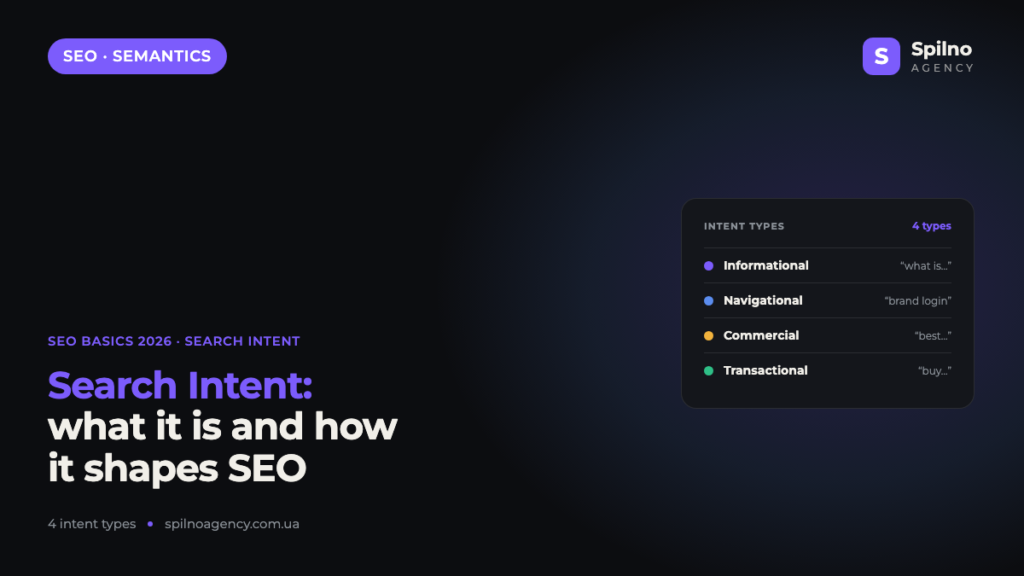
Search intent is the real goal behind a user’s query in Google: to learn, to find, to compare or to buy. Pages that precisely match the intent rank higher even without a link advantage, because intent is what Google puts at the centre of its algorithm. This guide covers the 4 intent types, how to read the intent of any query from the SERP, and how to optimise content for it in 2026.
What is search intent
Search intent (also called user intent) is the reason a person types a query into search. Two identical words can hide different goals: one person wants to understand a topic, another wants to reach a specific website, and a third wants to place an order right now. Google’s job is to show the result that best satisfies that exact goal — not simply the page that contains the right words.
A simple example. The query buy running shoes and the query how to choose running shoes share the word “shoes”, but the intents are opposite. In the first case the person is ready to pay — they need product pages and filters. In the second, they are still researching, and they need a guide. If you show a shop to someone looking for advice, they bounce back to the SERP — and Google records it.
Why intent is the foundation of modern SEO
Until 2013 Google ranked mostly by keyword match. After the Hummingbird update, and later RankBrain and BERT, search learned to understand the meaning of a query rather than just its form. Today, intent match is the filter every page passes through before it can compete for a position at all.
The practical consequence is simple: you can have flawless technical SEO and a powerful link profile and still not rank if the page type does not match the intent. Google literally hints at the intent in the SERP — through the format of the top results. If the entire top 10 consists of articles, a commercial page will rarely break in, and vice versa.
- Behavioural signals. If users quickly return to the SERP (pogo-sticking), Google treats the page as one that failed to satisfy the intent.
- Budget efficiency. Understanding intent means you don’t waste resources on pages that simply cannot rank for the chosen query.
- Conversion. A page built for the right intent not only ranks but also moves the user toward the target action.
The 4 types of search intent
The classic model defines four intent types. Knowing which type a query belongs to immediately tells you what page format you need.
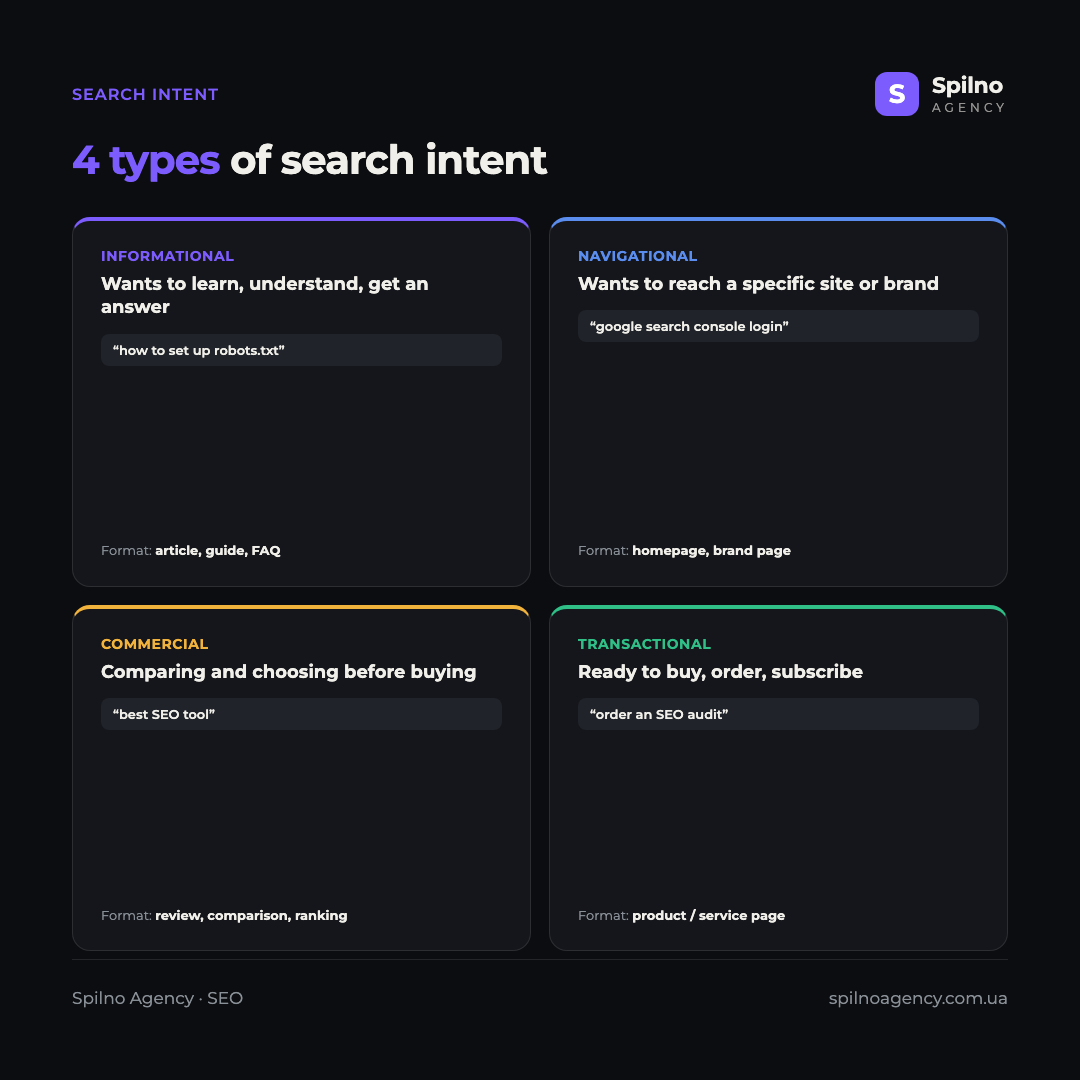
1. Informational intent
The person is looking for information, an answer or an explanation. This is the largest type of query by volume. Markers: what is, how to, why, guide, examples. The best format is an article, guide, FAQ or video. For example: what is a canonical tag or how to set up robots.txt.
2. Navigational intent
The user wants to reach a specific website or brand page. Markers: a brand, product or service name: google search console login, spilno agency blog. It is almost impossible to rank for these queries with someone else’s site — the brand itself owns the top. Optimisation here comes down to making your own navigational page flawless.
3. Commercial intent (research before purchase)
The person already wants to buy but is still choosing: comparing, reading reviews, looking for the “best”. Markers: best, review, comparison, reviews, top 10, vs. The format is review articles, comparison tables, rankings and case studies. For example: best link building tool or ahrefs vs semrush.
4. Transactional intent
The user is ready to act: buy, order, subscribe, download. Markers: buy, price, order, discount, delivery, a product name with a modifier. The format is a product page, service page, filtered category or form. For example: buy iphone 15 or order an SEO audit.
How to read the intent of any query
Don’t guess the intent — read it from the SERP. The search engine has already analysed the behaviour of millions of users and reflects the result in the format of the top. Here is a working algorithm.
- Enter the query in Google and look at the type of results. If the top 10 are articles and guides, the intent is informational. If they are product pages and categories — transactional. If comparisons and “top 10” lists — commercial.
- Assess the SERP features. A featured snippet, “People also ask”, videos — signs of informational intent. A shopping carousel, product ads, ratings with prices — transactional.
- Analyse the modifiers. Words like
how,what is,buy,price,bestpoint directly to the intent type. - Check the top for consistency. If the formats in the SERP are mixed, the intent is fuzzy, and you have a chance to enter with hybrid content.
Important: analyse the SERP for your own region and language. Intent for the same query can differ across countries — especially for multilingual sites.
The intent map and the sales funnel
Intent types line up into a logical funnel: from first contact with a topic to purchase. If you build content to satisfy intent at every stage, you guide the user from an informational query to a transactional one — and you do it with your own pages.
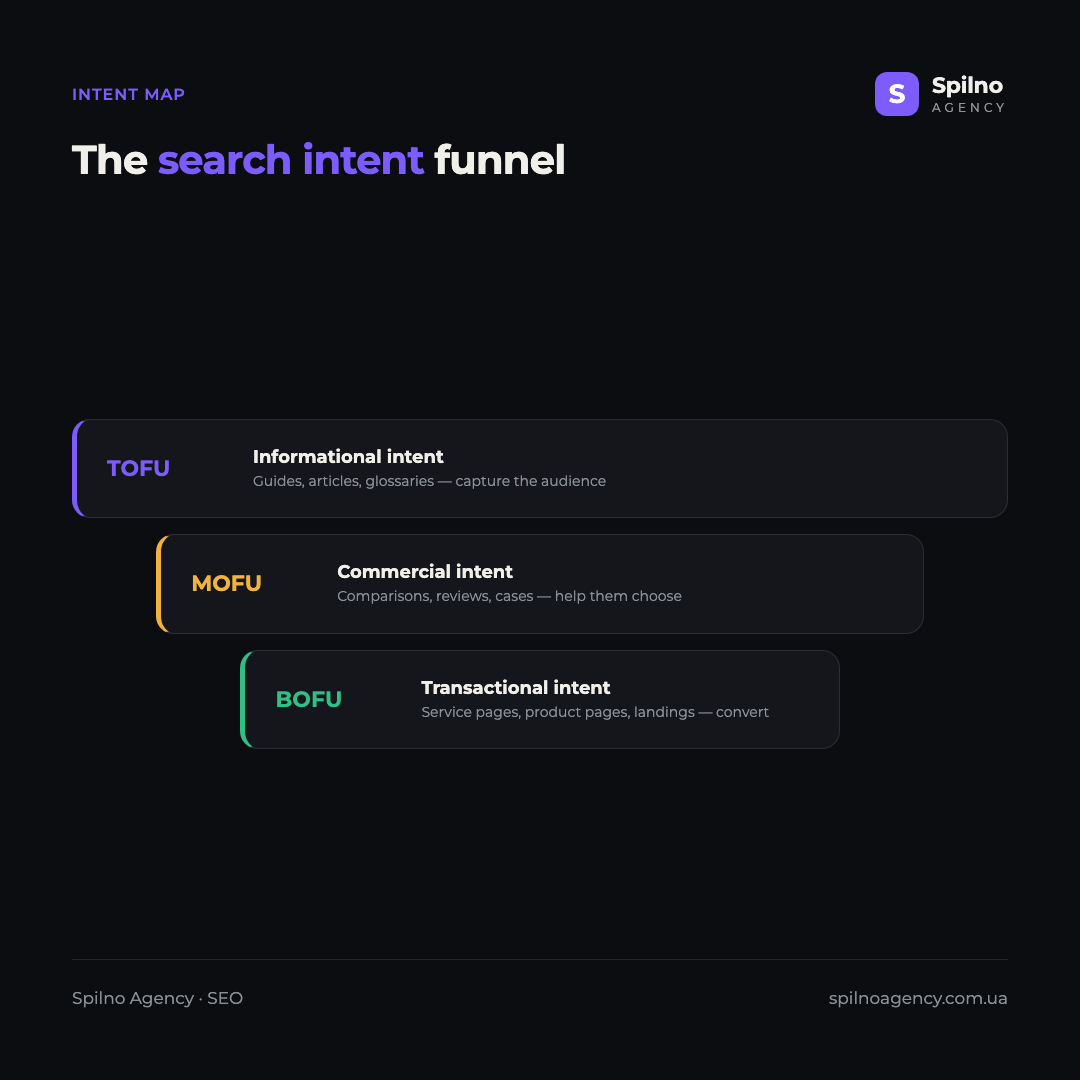
- Top of funnel (TOFU) — informational intent. Guides, articles, glossaries. The goal is to capture the audience and earn trust.
- Middle (MOFU) — commercial intent. Comparisons, reviews, case studies, roundups. The goal is to help them choose and lead toward your solution.
- Bottom (BOFU) — transactional intent. Service pages, product pages, landing pages. The goal is to convert into an order.
Internal linking ties these levels together: from a guide, link to a review page; from a review, link to a service page. This way you not only redistribute link equity but also walk the user down the funnel.
How to optimise a page for intent
- Choose the right page type. First determine the intent, and only then decide what to create: an article, a category or a product page.
- Tune Title and H1 to the intent. For informational — “How to…”, “What is…”; for transactional — “Buy…”, “Order…”, with price and location.
- Provide the format the user expects. If the top has tables, add a table; if it has video, add video; if short definitions, put a definition in the first paragraph.
- Cover adjacent questions. Look at the “People also ask” block and answer those questions — it strengthens intent match.
- Align the CTA with the funnel stage. On an informational page, pushing “Buy now” is out of place — better to offer the next step (a guide, a subscription, a consultation).
Common mistakes: intent mismatch
Intent mismatch is one of the most frequent reasons good content fails to rank. Typical situations:
- A product category for an informational query. You promote a catalogue page for
how to choose…— yet the top is all articles. - An article for a transactional query. You wrote a guide for
buy…— Google favours shops. - One URL for two intents. Trying to cover both “what is” and “buy” with a single page usually loses to two separate, focused pages.
- Ignoring intent shift. Intent for a query can change over time (seasonality, news). Re-check the SERP for your key queries periodically.
Search intent and AI search in 2026
With AI Overviews in Google and answers in ChatGPT, Perplexity and other systems, the role of intent has not shrunk — it has grown. AI systems try to immediately understand the user’s deeper goal and compose an answer from several sources. To appear in such answers (this is the field of GEO — Generative Engine Optimization), content must satisfy a specific intent clearly and in a structured way.
- Give a direct answer to the question in the first sentences of a block — AI cites concise fragments.
- Structure content around sub-questions (H2/H3) that match refinements of the intent.
- Use Schema markup (FAQPage, HowTo, Article) so the machine understands the page’s purpose more precisely.
Understanding search intent is the skill that separates an SEO specialist from someone who merely places keywords. If you want your content and site structure to serve users’ real goals and bring in leads, the Spilno Agency team can help you build semantics and a content strategy around your audience’s intent.

Read also
Meta Ads Library: How to Find Your Competitors’ Facebook & Instagram Ads (2026)
How to use the Meta Ads Library to see any competitor's Facebook, Instagram and Threads ads for free…
New Features in the ChatGPT Ads Manager: A Step-by-Step Setup Guide
oCPC for product feeds, URL macros, pixel diagnostics, Triple Whale and Hightouch, AAM from 17 August 2026. A…
How to See Your Competitors’ Ads in Google Ads (2026 Guide)
Step by step: find competitor ads in the Google Ads Transparency Center — filters, ad detail cards, archive…