SEO Text Writing: How to Write and Whether You Can Use AI

SEO writing means creating content for people and search engines at the same time. This guide covers what every SEO text must include, how to optimize for target keywords, how long your articles should be, and what Google officially says about using AI. All recommendations follow the Spilno Agency methodology.
What is an SEO text and how it differs from regular content
An SEO text is content optimized for two equally important goals: to satisfy the user’s search intent and to meet the technical requirements of search engines. Unlike regular copy, SEO writing accounts for keywords, heading hierarchy, internal links, meta tags and E-E-A-T signals (Experience, Expertise, Authoritativeness, Trustworthiness).
Before 2018, “SEO text” was associated with keyword-stuffed, low-value copy. Today Google penalizes that approach. Since the Helpful Content Update (2023–2024) one rule prevails: write for people first, not for robots. The difference between an SEO text and ordinary copy is not the number of keywords — it’s a systematic approach: research → structure → writing → optimization → monitoring.
Must-have elements of an SEO text
This is the baseline checklist without which a text won’t rank. Missing even one element reduces the effectiveness of the whole piece.
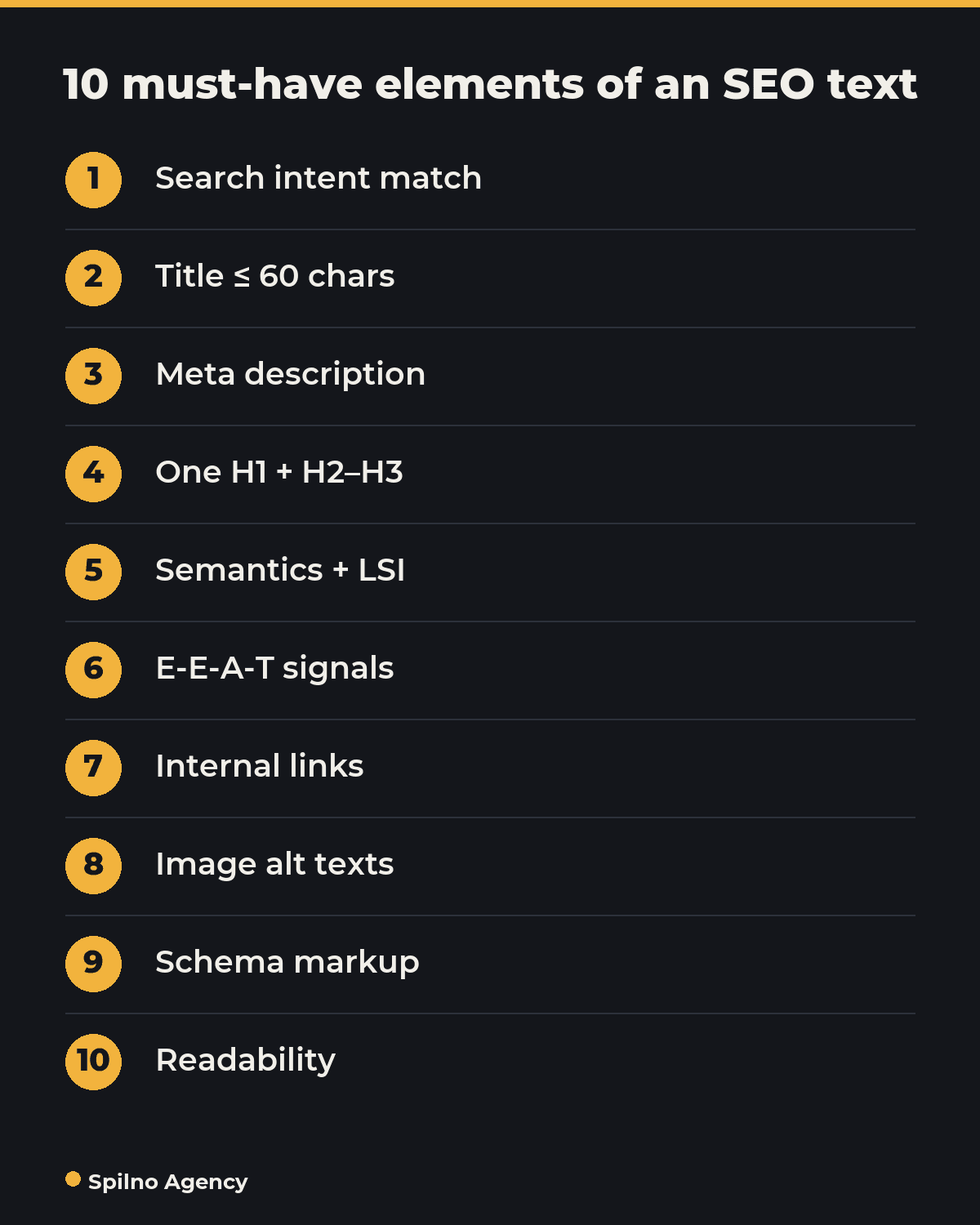
- Search intent match. Before writing, define what the user wants: to learn (informational), to buy (transactional), to compare (commercial) or to find a page (navigational). The wrong intent = zero traffic, even with perfect keywords.
- Title tag. Keyword near the start, up to 60 characters, unique for every page.
- Meta description. 140–160 characters, contains the keyword and a call to action.
- One H1 + logical H2–H3. H1 — title with the primary keyword (once), H2 — main sections, H3 — subsections. The structure must answer “what will I find on this page?”.
- Semantic core and LSI. The primary keyword + 15–30 semantically related concepts (synonyms, subtopics, adjacent queries). This signals topic completeness to Google.
- E-E-A-T signals. Author name, publish date, sources, expert quotes, first-hand experience — everything that proves trustworthiness.
- Internal links. 3–5 links to related pages — they pass authority and keep users engaged.
- Image alt texts. Every image has a descriptive
altwith the keyword where relevant. - Schema markup.
ArticleorHowTofor guides,FAQPagefor questions — structured data for rich snippets and AI citations. - Readability. Short paragraphs (2–4 sentences), active verbs, lists, tables, an image every 300–500 words.
📌 How these elements appear in this article. The intent for “seo content writing” is informational, so the format is a full guide. Semantics: SEO text, copywriting, content writing, GEO, E-E-A-T, keyword density, LSI. Structure: 1 H1, 8 H2, 9 H3. Title ≤60 characters, Meta 155, alt texts on all images, FAQPage Schema with 6 questions.
How to write an SEO text: step-by-step
The proven Spilno Agency workflow we apply for clients with organic traffic from 10,000 to 500,000 visitors per month.
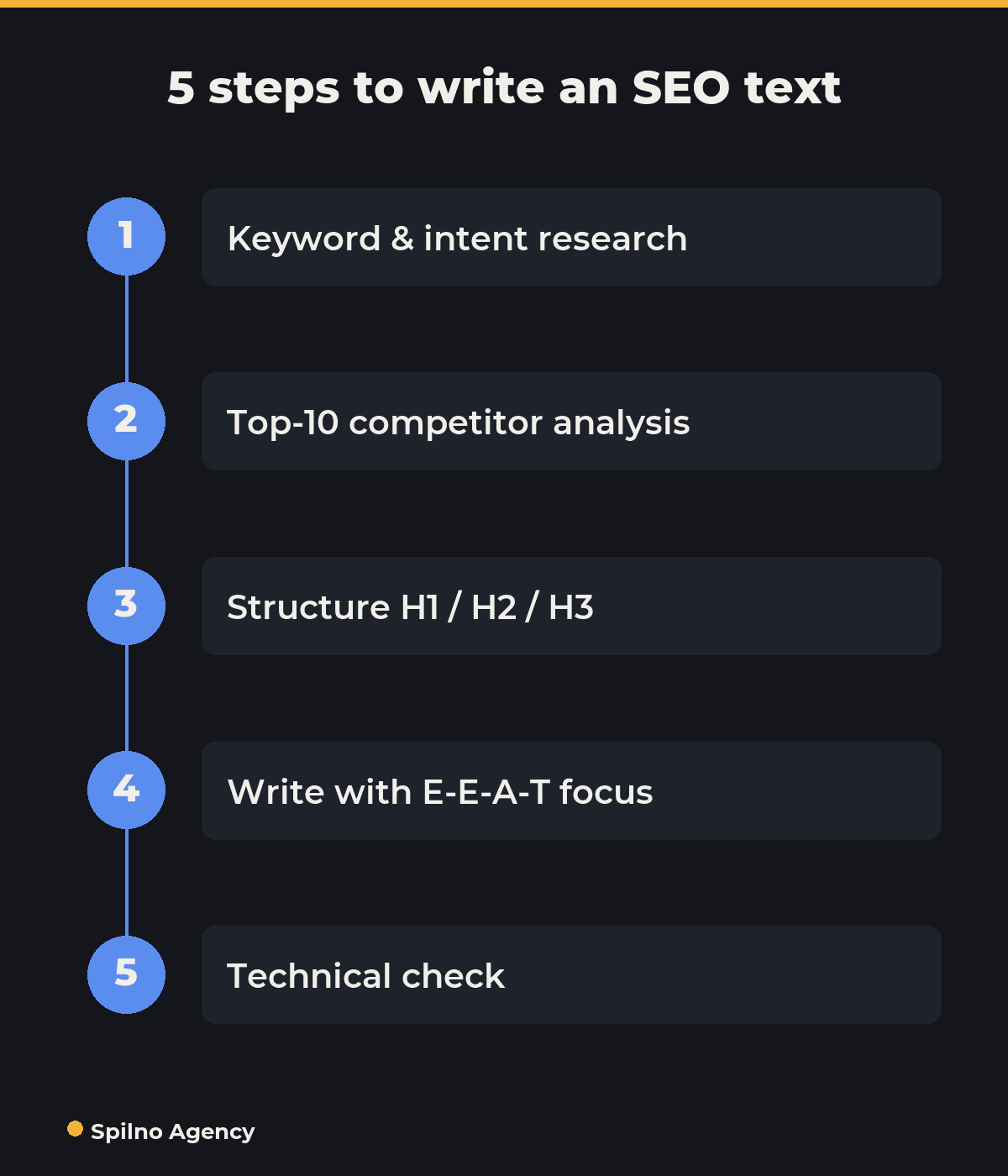
Step 1. Keyword and intent research
Open Google Search Console and Serpstat (or Ahrefs). Collect the query cluster around your topic and for each query check: the result type in the top 10 (articles or service pages), the average word count of leaders, the People Also Ask questions, and whether a Featured Snippet or AI Overview is present.
📌 Research for this article (Serpstat, g_us). Primary keyword “seo content writing” — ~2,400 searches/mo; “seo copywriting” — 1,900. LSI cluster: “seo writing”, “how to write seo content”, “what is seo writing”, “GEO”, “E-E-A-T”. PAA: “What must an SEO text include?”, “How long should an article be?”, “Can you write texts with AI?” — all included in the FAQ. The top 10 showed only how-to guides → intent confirmed.
Step 2. Top-10 competitor analysis
Open the first 5 results and build a topic map: which H2s the leaders use, which topics appear in all of them (must-haves), which topics nobody covers (your content gap), and the format they use. The goal is not to copy but to write a better piece: more complete, more current, with real examples.
Step 3. Structuring (H1, H2, H3)
Before writing, build a detailed outline: H1 with the primary keyword, 5–8 H2s (each a separate question), H3s for detail, a TL;DR snippet at the start and an FAQ block at the end. Rule: every H2 should be answerable in one sentence; if the answer takes 3 paragraphs, add an H3.
Step 4. Writing with an E-E-A-T focus
- First-hand experience. Instead of “some companies do…” — “at Spilno Agency we use…” or “based on our work with 50+ clients…”.
- Specific numbers. Not “significantly improves rankings”, but “+25% organic traffic in 3 months”.
- Authoritative sources. Google Search Essentials, studies by Ahrefs, Semrush, Moz.
- A named author with a bio. An author page with real credentials raises the E-E-A-T of the whole site.
Step 5. Technical check before publishing
Final checklist: Title ≤60 characters, Meta 140–160, one H1, filled alt texts, 3–5 internal links, a short URL slug with the keyword, Schema markup, mobile layout and Core Web Vitals check.
How to optimize text for target keywords
Keyword optimization isn’t “insert the keyword 20 times” — it’s distributing the primary query and its semantic surroundings correctly across the text.
- Keyword density: 1–2% of the volume. More risks keyword stuffing and a penalty.
- Primary keyword placement: first paragraph, first H2, several subheadings, conclusion and Title.
- LSI and synonyms: use query variations naturally. Google evaluates topic completeness, not exact phrase repetition.
- Exact match only where natural: forcing a keyword into an awkward sentence is worse than a synonym.
Where to find semantic terms: the People Also Ask block, search autocomplete, related searches at the bottom of the SERP, Serpstat (competitor keywords), Ahrefs (Also rank for). Collect 15–30 LSI concepts and distribute them naturally across sections.
How long should SEO texts be
There is no universal “magic” word count — Google has officially stated that length is not a ranking factor. Your benchmark is topic completeness and the volume of top-10 competitors. Practical ranges by page type, used by Spilno Agency:
| Page type / intent | Approximate length | Comment |
|---|---|---|
| Informational article / guide | 1,500–4,000 words | Must fully cover the topic and PAA |
| How-to article | 1,200–2,500 words | Clear steps, no fluff |
| Service page | 500–1,200 words | Focus on conversion, not volume |
| Product page | 300–600 words | Unique description + specs |
| E-commerce category | 300–800 words | SEO text below/above the listing |
| News / blog post | 500–1,000 words | Freshness beats length |
The main rule: write exactly as much as needed to fully answer the query. Padding the word count with fluff is harmful — it lowers readability and behavioral metrics.
Can you write SEO texts with AI: what Google says
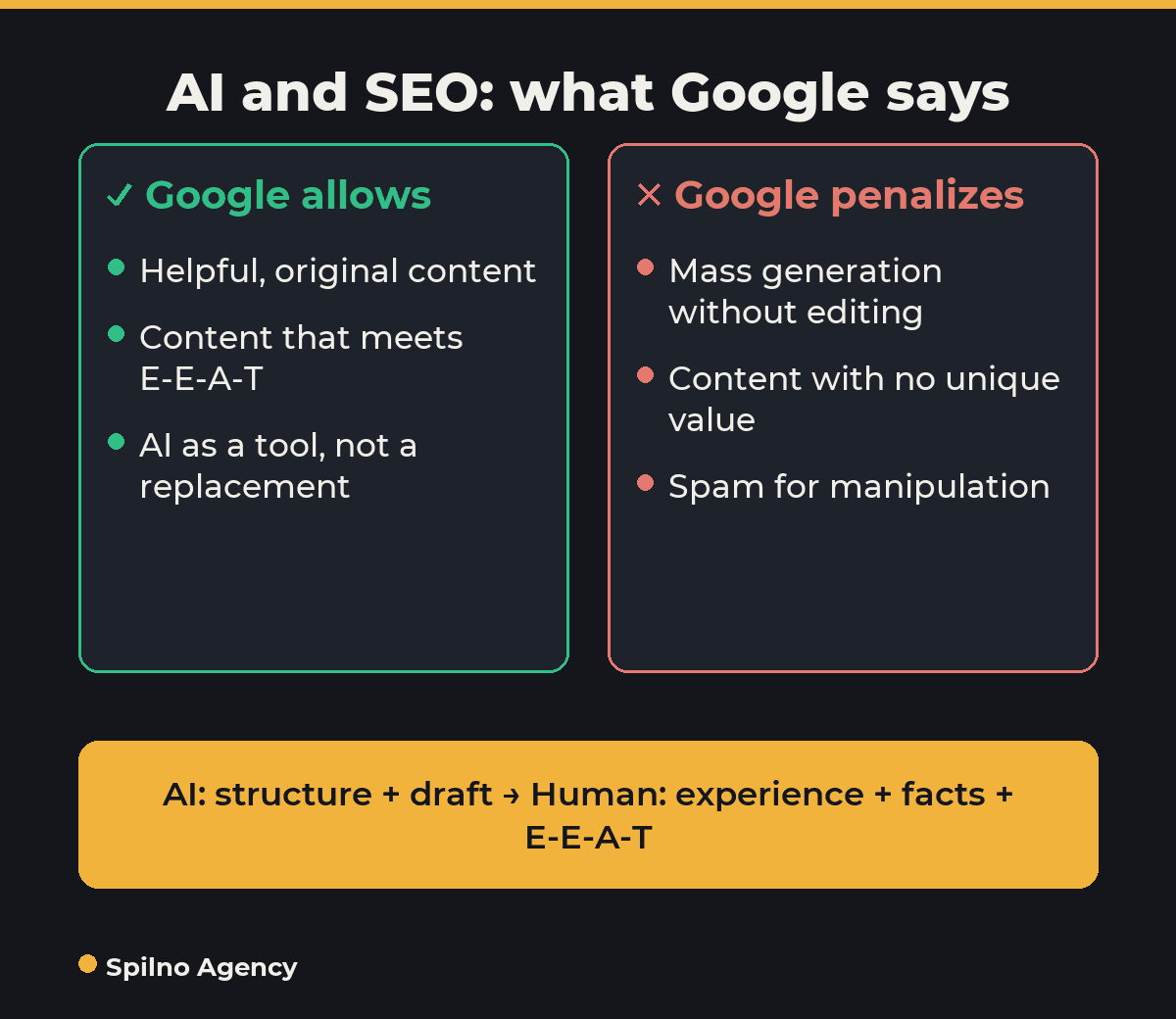
In February 2023 Google officially stated: “Using AI to generate content is not against our guidelines, as long as the content is helpful, original and meets E-E-A-T.” So Google does not ban AI content — it penalizes content created solely to manipulate rankings, regardless of whether a human or AI wrote it. The key criterion is usefulness to the user.
What Google penalizes:
- Mass generation of uniform content without editing
- AI text with no unique value (rephrased competitors)
- Content that misleads about authorship
- Spam pages with AI content for manipulation
Bing/Microsoft takes a similar stance: AI content is allowed if it’s high quality. Bing Webmaster Guidelines judge the result, not the tool. Bing integrated Copilot into search and actively indexes AI answers.
How to use AI correctly for SEO content
- Research and structure — AI. Ask ChatGPT or Claude to draft an outline, find content gaps, collect FAQs.
- First draft — AI. Generate the base text from your structure.
- Editing — human. Add your own experience, cases, unique data, expert opinion.
- Fact-checking — mandatory. AI confuses dates, numbers and sources.
- E-E-A-T signals — by hand. Author name, links to primary sources, your own data.
📌 How this article was written. The structure and draft were prepared with Claude (Anthropic); editing was done by the Spilno Agency team: general statements were replaced with cases, Serpstat data added, relevance updated for 2026. Fact-check: Google’s statement date (February 2023), the AI Overviews share (~47% of queries in the US). E-E-A-T: Spilno Agency authorship, internal links.
How to write for AI search (GEO)
GEO (Generative Engine Optimization) is optimizing content to be cited in AI search answers: Google AI Overviews, Bing Copilot, ChatGPT Search, Perplexity. As of 2026, AI Overviews appear for roughly 47% of queries in the US, and cited sites gain additional brand traffic. GEO principles for texts:
- A clear definition in the first sentence. AI “extracts” definitions — start the section with one.
- Question–answer format. An H2 phrased as a question + the answer in the first sentence of the subsection.
- Schema markup.
FAQPage,HowTo,Articlehelp AI understand the structure. - Authoritative links. Cite primary sources — AI search trusts such content.
- Unique data. Your own cases and statistics — this is what AI cites most.
- Regular updates. Fresh content has the edge — refresh at least quarterly.
Common mistakes when writing SEO texts
- ☐ Writing for robots, not people (keyword stuffing)
- ☐ Ignoring search intent
- ☐ No unique value — rephrased competitors
- ☐ Flat structure with no H3
- ☐ No internal links
- ☐ Empty alt texts
- ☐ Outdated content without updates
- ☐ No Schema markup
- ☐ A long intro with no value (the first 100 words are critical)
- ☐ Mobile readability not checked (60%+ of traffic is mobile)
Conclusion
Writing SEO texts in 2026 is not about keywords — it’s about usefulness. Google’s algorithms are smart enough to tell quality content from artificially optimized copy. The winner writes for people, includes every must-have element, optimizes for keywords properly, writes exactly as much as needed, follows E-E-A-T and structures the text for AI search.
If you need a content marketing strategy or SEO optimization for your site, get in touch with Spilno Agency. We build SEO strategies for e-commerce, SaaS and service businesses across Europe with transparent analytics and measurable results.

Read also
Google Tag Manager Workspaces: Why You Need Them and How to Use Them in 2026
A workspace in Google Tag Manager is a “draft” of a container — a place to safely edit…
How to Track Revenue, Transactions and Purchases in Google Analytics 4 from WordPress WooCommerce
Introduction WooCommerce store owners are often convinced that Google Analytics 4 already shows them revenue, transaction counts and…
How to Analyze Hourly Statistics in Google Analytics 4
Google Analytics 4 has no dedicated “hourly statistics” menu item, but you can get that exact breakdown in…