SMM: What It Is and When Your Business Needs It — 2026 Guide

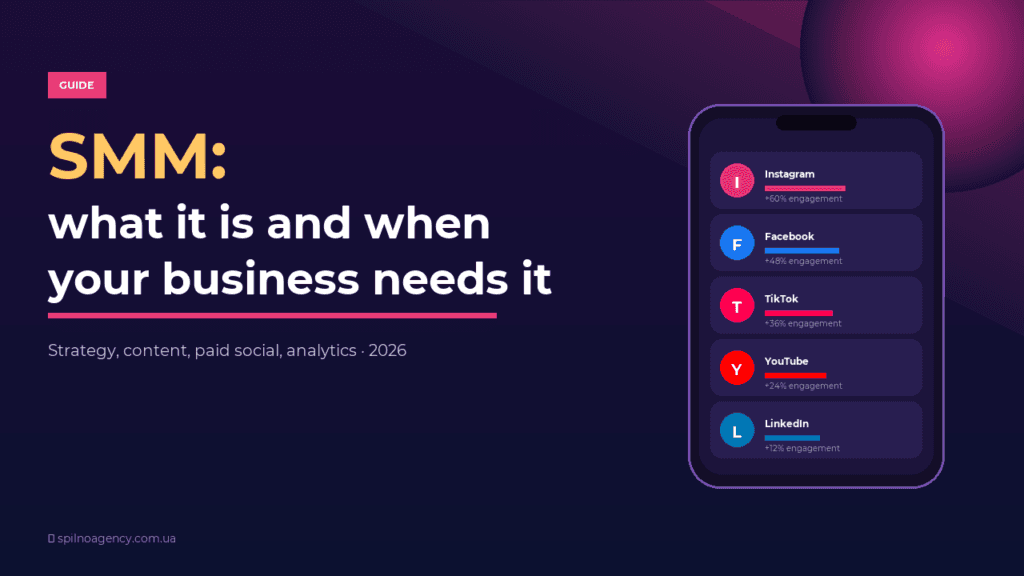
SMM is the systematic work of a brand across social media: strategy, content, community, paid ads and analytics. In 2026, a business needs SMM not “because everyone has it”, but when its target audience makes buying decisions inside Facebook, Instagram, TikTok or YouTube. This guide is the no-fluff version: what SMM is, what it consists of, when it actually pays off — and when you should put the budget into a different channel instead.
What SMM means in plain English
SMM (Social Media Marketing) is marketing inside social platforms. In one sentence: it is the systematic work of a brand across Instagram, Facebook, TikTok, YouTube, LinkedIn and similar platforms to deliver the product’s value to a specific audience and generate a measurable business outcome — followers, leads, sales, repeat purchases.
SMM is not “posting on Instagram three times a week”. Posting is just one tool out of many. On its own it does not produce sales, because without strategy, paid ads and analytics you are simply spending your team’s time on pretty pictures that nobody sees.
The simplest way to put it: SMM = the brand’s presence where your customer already spends time, plus a systematic way to convert that presence into money. In 2026, around 4.9 billion people worldwide use social platforms daily, with an average of 2 hours 23 minutes per day. If your customer is there — you have to be there too. If they are not — SMM is not your channel.
How SMM is different from SEO and Google Ads
- SEO works when the customer is searching for your product on Google. That is hot demand.
- Google Ads captures the same hot demand, only faster — for money.
- SMM creates demand where the customer is not actively searching for you. That is cold and warm audience that needs to be “warmed up” with content before it buys.
This is why SMM rarely works on its own. In a mature digital strategy it is one piece of the funnel: social creates demand → search and remarketing close it.
The 5 building blocks of SMM
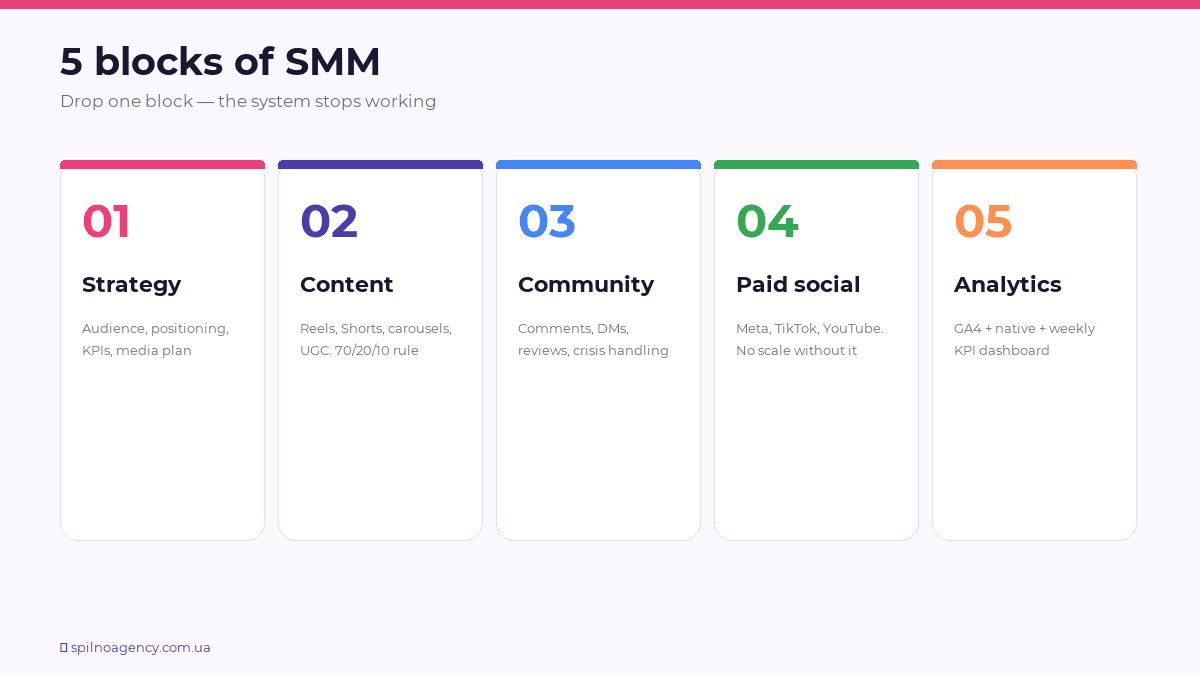
Any sane SMM is not one tool but 5 interconnected blocks. Drop one block and the whole system stops working.
1. Strategy
The foundation. Without strategy the remaining 4 blocks turn into chaotic work that is not worth the money. Strategy answers: who is the customer, where do they live online, what hurts them, which platforms we pick, which KPIs we set, what does the journey from first-seen post to purchase look like.
A proper strategy contains: audience portrait (jobs-to-be-done, pains, objections), brand positioning, tone of voice, content pillars (3-5 themes around which the entire content is built), chosen platforms with rationale, paid media plan, KPIs.
2. Content
This is what you publish: posts, videos, Reels, Shorts, Stories, live streams, articles. Content is the main carrier of brand value. In 2026 the winners are short vertical videos (Reels, TikTok, Shorts), educational carousels, UGC (user-generated content) and behind-the-scenes stories.
A good content plan follows the 70/20/10 rule: 70% useful or entertaining content (builds trust), 20% about the brand and team (builds loyalty), 10% sales-driven (closes the deal). If 100% of your content is sales — you are not running SMM, you are running an online catalogue.
3. Community management
Work with comments, DMs and reviews. In 2026 the algorithms of Instagram, TikTok and LinkedIn reward interaction quality: replies in comments, response time in DMs, repeat interactions. A brand that ignores comments gradually loses organic reach.
Community management also covers complaints and crisis situations. One badly handled negative comment can cost more than a month of paid ads.
4. Paid social
This block is mandatory. Organic reach on Facebook and Instagram in 2026 is 1-3% of your follower count. Meaning: with 10,000 followers your post is seen by 100-300 people. Without paid ads, SMM does not scale.
Paid social solves 4 jobs: reach (awareness), engagement and follower growth, lead generation, direct conversions. Each job uses its own campaign type and its own KPIs.
5. Analytics
Without analytics SMM becomes roulette. Each block (content, community, ads) produces data that has to be collected, interpreted and used to adjust the strategy. Otherwise you spend 6 months on things that don’t work and wonder why sales aren’t coming.
The minimum SMM analytics stack: native platform analytics (Instagram Insights, Meta Business Suite, TikTok Analytics, YouTube Studio), Google Analytics 4 for tracking traffic from social into your site, and a separate sheet/dashboard with weekly and monthly KPIs.
When your business actually needs SMM: 7 cases
SMM is not for everyone and not for every moment. Below are the 7 situations where SMM investment pays back the fastest.
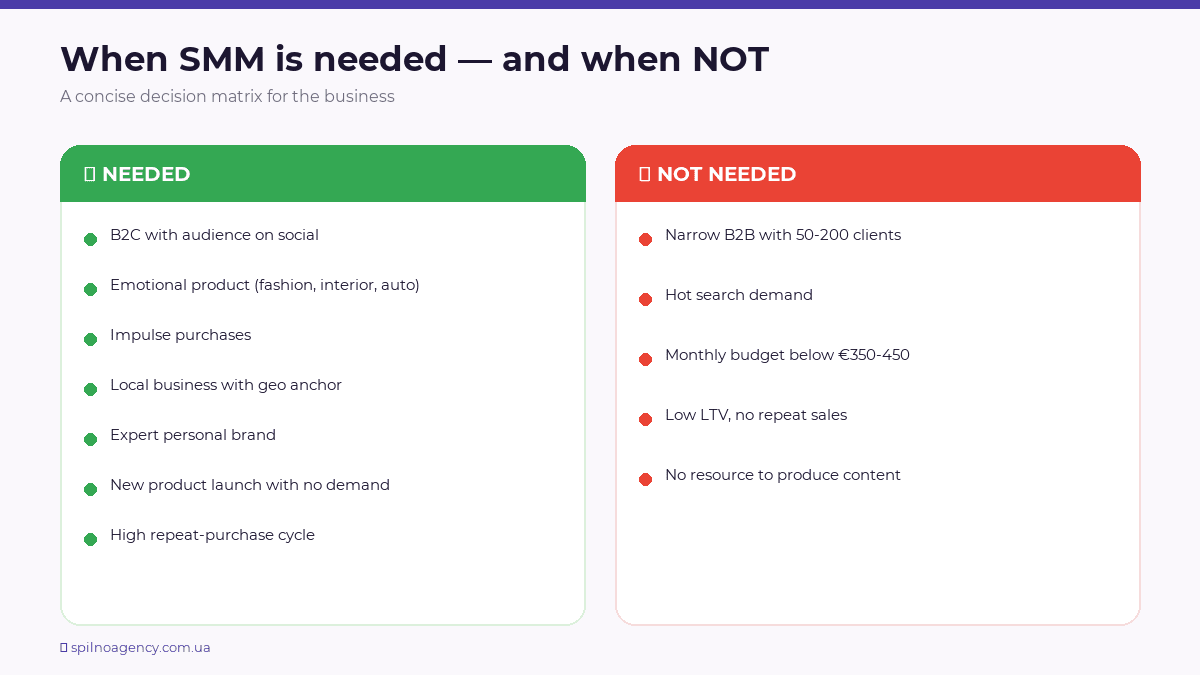
- You are B2C and your audience lives on social. Cosmetics, fashion, kids products, restaurants, home services, fitness, education, travel. If your customer scrolls Instagram 2 hours a day — you have to be there.
- Emotional product. Anything tied to visual, lifestyle or status sells through social better than through search. Furniture, interior, automotive, jewellery, design services.
- Impulse purchase. If the customer can buy “on emotion”, social is ideal. Small goods, accessories, food delivery, gifts.
- Local business with a geographic anchor. Cafés, barbershops, dental clinics, electronics repair. Geo-targeting in Meta Ads combined with local UGC delivers excellent results.
- Expert personal brand. Doctors, lawyers, financial advisors, coaches, marketers. Content marketing on LinkedIn, Instagram or YouTube builds trust faster than any direct advertising.
- Launching a new product or brand. If there is no existing demand (no one is searching for you on Google), SMM is the engine that creates this demand from scratch.
- High repeat-purchase cycle. Customers come back and recommend you — social helps you stay top of mind between purchases.
When SMM is NOT the right move
The other side of the coin. If any of the situations below describes your business — your budget will work harder in a different channel.
- Narrow B2B with only 50-200 potential customers in the country. Industrial equipment, enterprise b2b software, services for the public sector. The right play here is direct outreach, LinkedIn Sales Navigator, conferences — not mass SMM.
- Hot search demand. If the customer already knows they need to “buy a 12 kW air conditioner”, they go to Google, not to Instagram. The right channels are SEO and Google Ads, not SMM.
- Monthly budget below €350-450. Below this level SMM does not scale. Better build a solid website, run Google Ads on hot search queries and invest in SEO.
- No product that retains the customer. If you have a one-off cheap deal, low LTV and no repeat purchases — SMM will not pay back. You need a performance channel.
- Not ready to produce content. SMM equals content. If you cannot allocate a person/team to produce content or coordinate with an agency — nothing will work.
Honest advice from Spilno: if you already have SEO and Google Ads running, and you want to “add something extra”, first check whether those channels are paying off (ROAS, CPA). Often it is cheaper to scale the channel that already works than to launch a new one.
Platforms: where SMM works in 2026
In 2026 there is no “one correct platform for everyone”. The choice depends on where your audience actually lives. Below is a quick guide.
The core platform for European B2C. Ages 18-44, slightly skewed toward women. What works: Reels (short vertical video), carousel posts, Stories with polls and stickers, live sessions. In 2026 Instagram aggressively pushes original Reels — cross-posts from TikTok are penalised in reach.
TikTok
The number one platform for the 16-30 audience. What works here is not posting every day but spotting trends and producing “doomscroll-friendly” content. TikTok Shop is growing rapidly across Europe.
Not “dead”, contrary to what you read. Audience aged 30-55, especially strong for local services, real estate, automotive, education, marketplace models. The best ad manager in the world (Meta Ads) is the main reason to stay on Facebook.
YouTube + Shorts
Works in two formats: long video (10-30 min) to build expertise, and Shorts (up to 60 sec) for reach. In 2026 YouTube is the second largest search engine in the world, so content here has a long tail — it can keep bringing views a year later.
Mandatory for B2B, expert services, IT, recruitment, corporate consulting. In 2026 LinkedIn aggressively develops content formats (video, documents, live) and offers one of the highest organic reach rates of all platforms.
Threads, Telegram, Pinterest
Threads — Meta’s text-based network, still in audience-building mode across Europe. Telegram — a messenger/media hybrid; works well for news brands, B2B communities, education. Pinterest — a niche channel for design, interior, fashion, food; massively undervalued across Europe.
SMM KPIs and metrics that matter
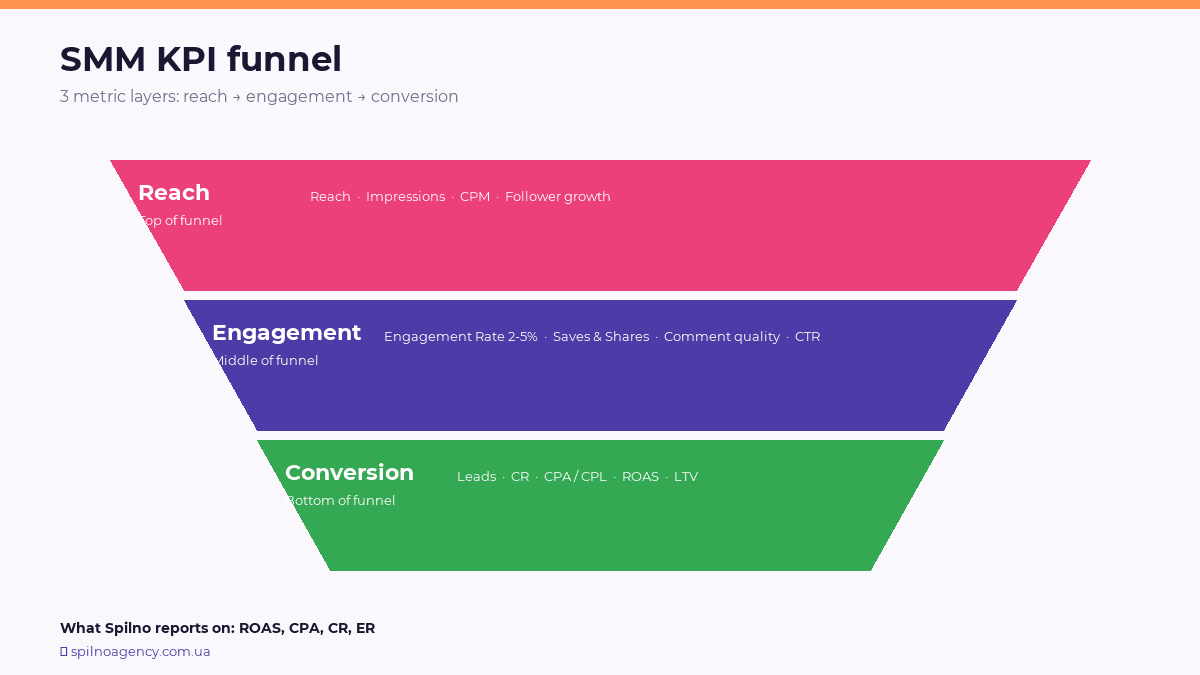
Without clear KPIs, SMM becomes “let’s make it look nice”. Metrics belong to 3 funnel layers: reach → engagement → conversion.
Reach metrics (top of funnel)
- Reach — unique people who saw the content
- Impressions — total times the content was shown (one person can see it multiple times)
- CPM (cost per mille) — cost per 1,000 ad impressions
- Follower growth — follower delta per period
Engagement metrics (middle)
- Engagement Rate (ER) — interactions (likes + comments + saves + shares) over reach. Normal ER on Instagram in 2026: 2-5% for brands, 5-10% for niche expert accounts.
- Saves & Shares — the most important “long-tail” signals for the algorithm
- Comment quality — not just volume, but the depth of conversation
- CTR — click-through rate on links in posts and ads
Conversion metrics (bottom)
- Leads — form submissions, DMs, chat enquiries
- CR (conversion rate) — % of visitors who left a request
- CPA / CPL — cost per action / cost per lead
- ROAS — return on ad spend (revenue / ad cost)
- LTV — lifetime value of a customer acquired through social
Spilno rule: do not measure SMM by followers alone. 10,000 “dead” followers are worth nothing without ER, CTR and real sales. The headline numbers on a report are: ROAS (if you run paid), CPA, CR, ER. Everything else is supporting.
In-house team vs SMM agency
The choice depends on three factors: budget, workload and business maturity.
In-house team
Pros: deep product knowledge, faster content iterations, full process control.
Cons: a full SMM team is an SMM manager + content creator (video/photo) + paid media specialist + designer. Plus, usually, an analyst. For most businesses the payroll for these people costs more than an agency delivering a comparable result.
When it makes sense: you are a large brand, you need lots of content fast, you have unique expertise that is hard to outsource (e.g. medical services).
SMM agency
Pros: you get a full team of specialists (strategist, copywriter, designer, paid media, analyst), cross-vertical experience, ready processes, no single-person burnout risk.
Cons: an agency will never know the product as well as you do. So on their side you need a strategist/account manager who collects context, and on your side a person who provides feedback, grants access and signs off content.
When it makes sense: you are early-stage, you do not have the resources to build a team, you need fast results, you need an outside view, you need a full strategy (not just posting).
Hybrid model
The most common setup in 2026: the agency owns strategy, paid and analytics — content and community sit in-house. Or the reverse: an in-house copywriter writes; the agency handles paid media and analytics.
Where to start: 4 steps to your first result
- Audit what you already have. Check existing profiles: is the bio set up correctly, is analytics in place, what KPIs are you tracking now. You may not be starting from zero.
- Frame a business task, not a vanity goal. Not “I want more followers” but “I want +30 leads on bathroom renovations per month from London”. Only a concrete task can be measured.
- Pick 1-2 platforms, not all at once. Classic mistake — launching Instagram + Facebook + TikTok + LinkedIn simultaneously and burning out in 2 months. Pick one platform and execute well.
- Plan a 90-day cycle. SMM does not deliver in a week. The minimum horizon is one quarter: 30 days to test, 60 days to scale what works.
If you want to figure out whether SMM is the right channel for your specific business and get a realistic assessment — book a consultation with Spilno Agency. We will tell you honestly where SMM will pay off and where you should put the money into SEO or Google Ads.
FAQ: common questions about SMM
How long does it take for SMM to start working?
The first paid result (leads from social ads) — 2-4 weeks after launch, because the algorithm needs time to learn. Organic results (reach growth without ads) — 3-6 months of consistent work. There is no “overnight” result.
Can you run SMM without a paid ads budget?
Technically yes, in practice it scales extremely slowly. Organic reach on Meta in 2026 is 1-3%. Without paid, your content is seen by a tiny fraction even of your existing followers, let alone new audiences.
How much does SMM cost?
It depends on scope and platforms. Spilno’s pricing model is a management fee plus a paid media budget you spend directly with the platforms (Meta, TikTok). The specific number is discussed after we audit your business: local SMB and a national brand are very different orders of magnitude.
What is the minimum paid media budget?
For Meta Ads to train its algorithm properly you need at least 50-70 conversions per week per ad set. In practice, a realistic minimum test budget is around €350-500 per month. You can go lower, but results become unpredictable.
Do we need to be on EVERY platform?
No. One or two platforms done well beat five accounts that publish once a month. With a limited resource, start with the platform where your audience actually lives.
Will AI replace SMM specialists in 2026?
AI is already changing SMM hard: copy generation, video, creatives, AI-targeting (Advantage+ on Meta), AI moderation of comments. But strategy, brand understanding, community building and crisis management still belong to humans. AI is a tool, not a replacement for the team.
How do we measure SMM result if we do not sell online?
Through leads: DMs, calls from the phone number in the profile, consultation sign-ups, clicks to the website with UTM tags from social. Track these as events in Google Analytics 4 and you can calculate CPL and ROAS even without an online checkout.

Read also
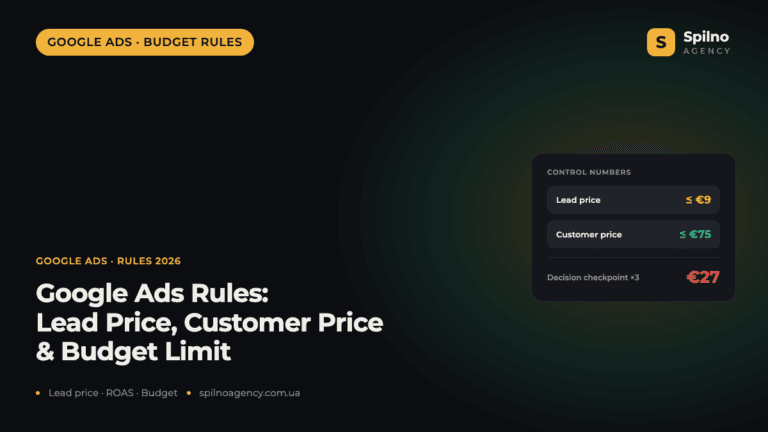
Google Ads Rules: Maximum Lead Price, Customer Price, and How Much to Spend Before a Campaign Fails
There is no such thing as a universal “good cost per lead” — €20 per lead can be…
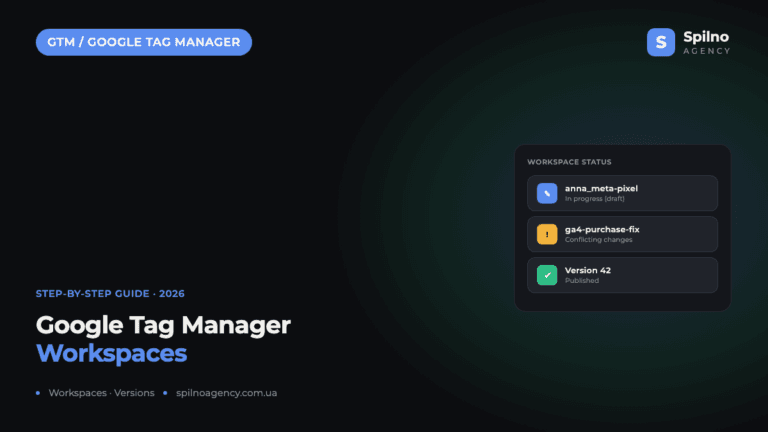
Google Tag Manager Workspaces: Why You Need Them and How to Use Them in 2026
A workspace in Google Tag Manager is a “draft” of a container — a place to safely edit…
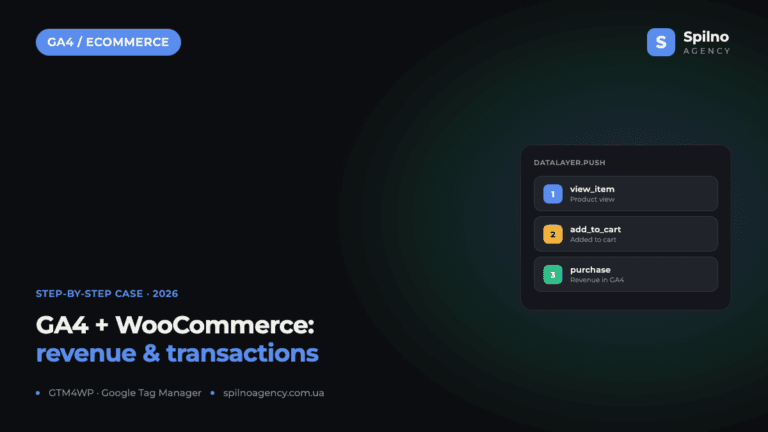
How to Track Revenue, Transactions and Purchases in Google Analytics 4 from WordPress WooCommerce
Introduction WooCommerce store owners are often convinced that Google Analytics 4 already shows them revenue, transaction counts and…