Key Stages of Website Creation: Step-by-Step Guide from Analysis to Launch

Building a website is not simply “order a design and get a finished product.” It’s a structured process consisting of clear stages, each affecting the final outcome. Skipping any step means planting a problem that will surface later—in the form of poor Google rankings, a confusing interface, or technical failures.
In this guide, we’ll walk through 8 key stages of web development—from the first meeting with the team to post-launch support. This material is useful for business owners, marketers, and anyone planning to create or redesign a company website.
What is Website Creation and Why Does It Matter
Website creation (web development) is a set of activities that includes business analysis, design, programming, SEO setup, and testing. A quality website is not an expense—it’s an investment: it works 24/7, attracts customers, and builds brand trust.
According to Google research, 53% of mobile users abandon a site if it takes more than 3 seconds to load. And 75% of consumers judge a company’s trustworthiness by its website quality. That’s why understanding each stage and investing in it properly is essential.
Main Stages of Website Creation
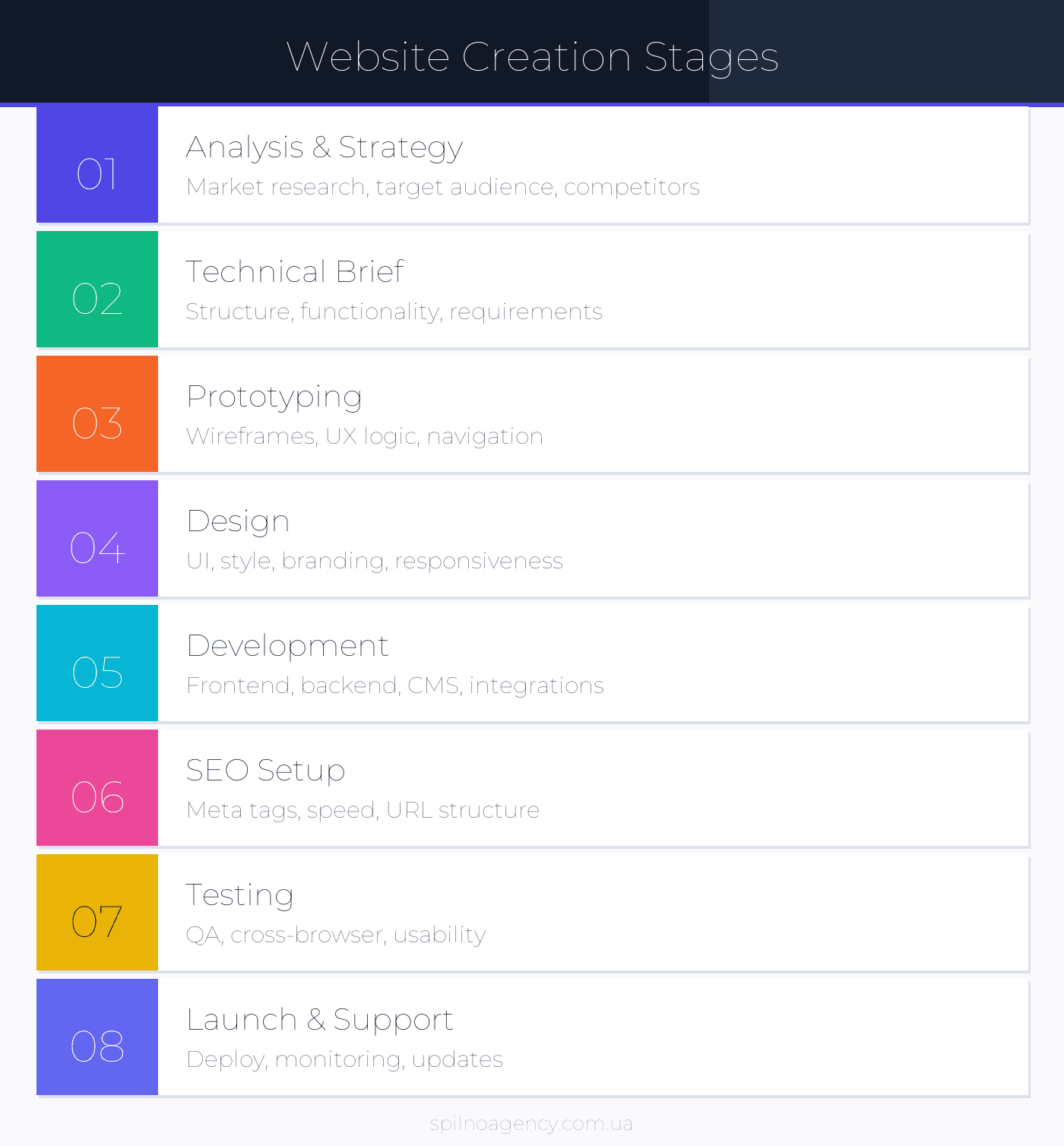
Below is a detailed infographic showing all 8 stages of website development:
Stage 1. Analysis & Strategy
Before opening Figma or writing the first line of code, the team conducts a business analysis: studying the market, target audience, competitors, and client’s business goals. At this stage, the type of site is determined—corporate, e-commerce, landing page, or B2B portal.
- Interviews with the owner and stakeholders
- Competitor and competitor website analysis
- Target audience profiling
- Defining project KPIs (traffic, conversions, leads)
Output: a strategic brief and a clear understanding of the site’s purpose.
Stage 2. Technical Brief
The technical brief is the “constitution” of the project. It documents all requirements for functionality, structure, integrations, and the technology stack. The brief protects both sides: the client knows what they’ll receive, and the team knows what needs to be done.
A solid brief includes: a sitemap, a list of pages, functionality descriptions for each page, security requirements, SEO requirements at the structural level, and technical constraints.
Stage 3. Prototyping & UX
A prototype is the “skeleton” of the site—without the design. Wireframes show block layouts, navigation logic, and user behavior scenarios. At this stage, usability (UX) is validated before spending resources on design and development.
Stage 4. Design
Based on the prototype, designers create the UI (User Interface)—the final look of the pages. Design includes choosing colors, fonts, icons, image styles, and overall brand identity. A responsive mobile version is always included.
Stage 5. Development (Frontend + Backend)
Developers transform design mockups into a live website. Frontend is what users see (HTML, CSS, JavaScript). Backend is the server logic, databases, and APIs. CMS choice (WordPress, Webflow, Next.js, etc.) depends on project needs.
Stage 6. SEO Setup During Development
One of the most important—and most ignored—stages. SEO during website development means laying the foundation for future organic growth. It’s far cheaper to configure everything correctly from the start than to fix technical errors later.
More details are covered in the dedicated section below.
Stage 7. Testing (QA)
Before launch, the site undergoes comprehensive testing: functionality testing, cross-browser compatibility (Chrome, Firefox, Safari, Edge), checks across devices and screen sizes, usability testing, and page speed testing.
Stage 8. Launch & Post-Launch Support
Deploying to production is a critical moment. After launch, monitoring is configured (Uptime Robot, Google Search Console), all forms and CTA buttons are verified, and Analytics is connected. Support includes regular updates, backups, and technical assistance.
SEO Optimization During Website Creation
Most business owners think about SEO only after launching their site—and that’s a critical mistake. SEO during the development of a new website is not an optional add-on but an essential part of the process that determines whether Google will find your site.
Why SEO Must Be Built Into Development
Technical SEO issues built into the site during development can cost you months or even years of promotion. For example, an improper URL structure (without clean URLs) or content duplication due to misconfigured canonicals—these issues directly affect Google rankings.
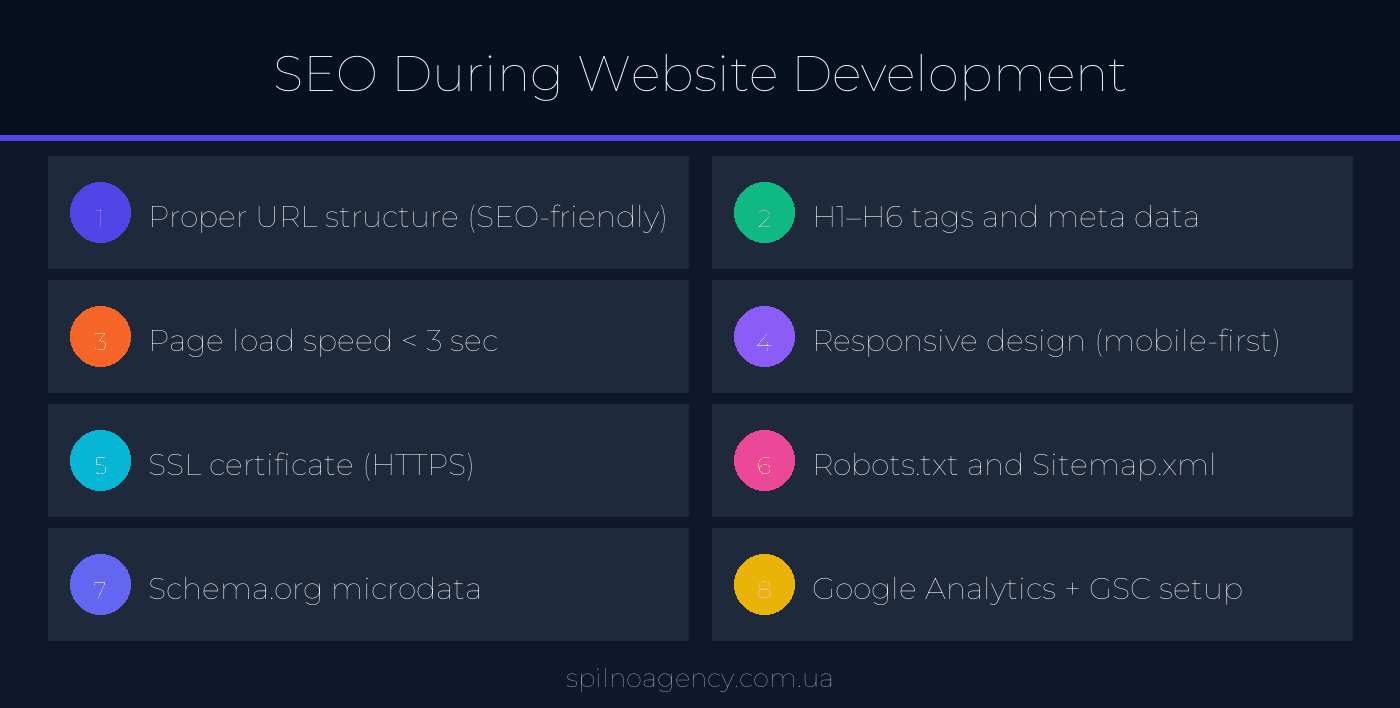
Key SEO Settings During Website Development
- URL Structure: URLs should be human-readable:
/blog/website-creation-stagesinstead of/?p=123 - Meta Tags: unique title and meta description for each page; H1–H6 headings in proper hierarchy
- Page Speed: Core Web Vitals — LCP < 2.5s, FID < 100ms, CLS < 0.1; image optimization, CSS/JS minification, caching
- Mobile Version: Google indexes sites by mobile version (Mobile-First Indexing); responsive design is not optional
- HTTPS: SSL certificate is a mandatory ranking factor; without HTTPS—browser warnings and lost trust
- Robots.txt & Sitemap.xml: configured during development to guide search engines on what to index
- Schema.org Microdata: helps Google understand content and display rich snippets (stars, prices, FAQ)
- Google Analytics 4 + Search Console: connected before launch to collect data from day one
Spilno Agency tip: include an SEO audit in your development brief. A dedicated “SEO Requirements” section in the technical specification protects you from future technical debt.
Cost and Timeline of Website Creation
| Website Type | Timeline | Estimated Cost |
|---|---|---|
| Landing page (1 page) | 1–2 weeks | from $300 |
| Corporate website (5–15 pages) | 4–8 weeks | from $800 |
| E-commerce store | 8–16 weeks | from $2,000 |
| Complex web project / portal | 4+ months | from $5,000 |
How to Choose a Website Development Partner
- Portfolio in a similar niche. Industry experience is a plus.
- Process and documentation. Do they have a brief, prototypes, a contract? Good studios always document requirements.
- SEO included in the process. If an agency doesn’t mention SEO when discussing development—that’s a red flag.
- Post-launch support. Who fixes bugs after handover? What’s the SLA?
- Reviews and case studies. Real results (traffic, conversions, rankings) are the best proof of competence.
Conclusion
Website creation is an investment in your business’s future. Understanding all 8 stages allows you to control the process, ask the right questions to your contractor, and receive a product that truly delivers results.
The golden rule: never ignore SEO during development. Technical optimization built in from the start saves you months and thousands of dollars in the future.
🚀 Planning to build a website? The Spilno Agency team supports clients through all 8 stages—from strategy to results. Contact us for a free consultation.

Read also
Google Tag Manager Workspaces: Why You Need Them and How to Use Them in 2026
A workspace in Google Tag Manager is a “draft” of a container — a place to safely edit…
How to Track Revenue, Transactions and Purchases in Google Analytics 4 from WordPress WooCommerce
Introduction WooCommerce store owners are often convinced that Google Analytics 4 already shows them revenue, transaction counts and…
How to Analyze Hourly Statistics in Google Analytics 4
Google Analytics 4 has no dedicated “hourly statistics” menu item, but you can get that exact breakdown in…