What are Quiz Websites


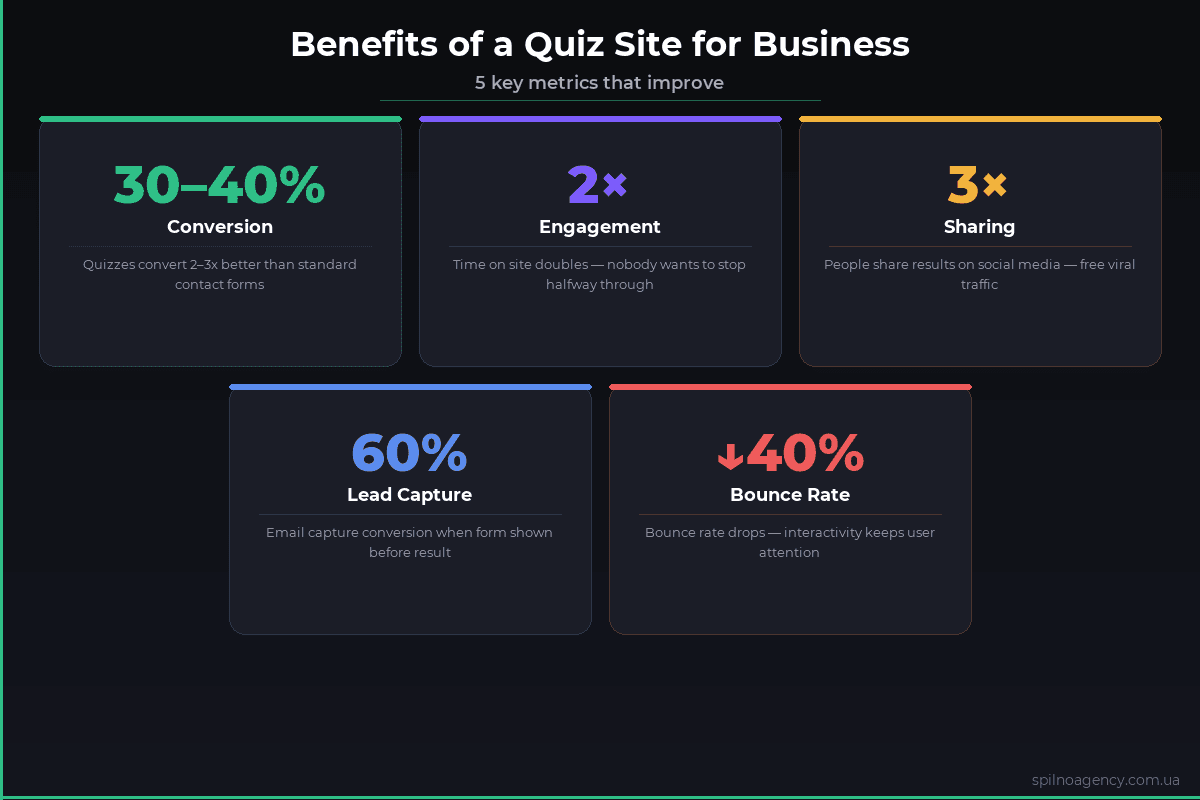
A quiz site is an interactive page that engages a potential customer through a series of questions and returns a personalised result. Thanks to the gamified format, quizzes convert 2–3× better than standard contact forms and become an effective lead generation tool for businesses across any niche.
What Is a Quiz Site
A quiz site is a web resource or standalone page built around a series of targeted questions. The visitor answers 5–8 questions and receives a personalised result — a recommendation, a product selection, a knowledge score, or a tailored offer from the business.
Unlike a traditional landing page that immediately pitches a finished product, a quiz site “listens” to the customer first. This is why trust and engagement levels are significantly higher. The psychological mechanism is simple: the person shares information about themselves and expects something valuable in return — and they get it.
A quiz site is not just a test. It is a dialogue with the customer, where the business asks the right questions and the customer reveals their real need.
Marketers use quizzes for three key objectives:
- Lead generation — collecting contacts (email, phone) in exchange for a valuable result or special offer.
- Segmentation — dividing the audience into groups by needs, budget, and purchase readiness.
- Nurturing — gradually guiding the customer towards recognising the product’s value through dialogue, not a monologue.
How Interactive Quiz Content Works
The quiz site mechanism is rooted in the psychological feedback loop. When a person answers questions, they invest time and attention. The further they progress through the test, the more they want to see the result — a phenomenon in psychology known as the Zeigarnik effect (the effect of incomplete action).
Quiz designers build in three levels of engagement:
- Attraction — an interesting topic, a compelling headline, and a first question push the user to begin.
- Retention — a progress bar and varied response options maintain attention through to the end.
- Conversion — a contact capture form appears before the result is revealed.
This approach delivers 30–40% conversion — compared with 2–5% for standard contact forms. The captured leads are higher quality because the customer is already “warmed up” and understands their own need.
Benefits for Marketers
- High conversion — 30–40% of visitors leave their contact details vs 2–5% on standard forms.
- Viral sharing — personalised results are actively shared on social media, generating free traffic.
- Effortless segmentation — answers automatically sort leads by needs, budget, and readiness to buy.
- SEO effect — quizzes increase time on site and reduce bounce rate, positively impacting Google rankings.
- Personalisation — the CRM system receives detailed client data before the first call.

Main Types of Quizzes
Quizzes are classified by goal and interaction format. Each type addresses different marketing objectives and suits different niches.
1. Personality Quiz
Answers “Who am I?” or “Which option suits me best?” Delivers one of several pre-prepared profiles or types. This is the most viral format — people love sharing results of quizzes like “Which renovation style suits you?” or “What learning system works best for you?”
Best for: real estate, renovation, education, cosmetics, SaaS, HR.
2. Assessment Quiz
Tests knowledge level or the maturity of the client’s business processes. Visitors receive a score or percentage with a recommendation based on their result. Works exceptionally well for B2B: “Check your company’s digital marketing maturity”, “How SEO-ready is your website?”
Best for: B2B services, education, consulting, IT products.
3. Trivia Quiz
An entertainment format with right and wrong answers. The focus is on an enjoyable experience and educational content. Great for increasing engagement on a blog or social media.
Best for: media, educational platforms, brands with a strong editorial voice.
4. Product Recommendation Quiz
Helps customers choose a product or service from a catalogue. Questions reveal key parameters: budget, use case, priorities. The result is a specific recommendation with a CTA. Highly effective for eCommerce and service businesses with a wide range of options.
Best for: online stores, insurance, legal services, finance.
Quiz vs Landing Page: Key Differences
These two formats are often confused — both are single-page sites focused on conversion. But their logic and objectives are fundamentally different.
| Parameter | Landing Page | Quiz |
|---|---|---|
| Interaction logic | Monologue — company talks about its product | Dialogue — client answers questions |
| Conversion | 2–5% (contact form) | 30–40% (gamification-driven engagement) |
| Goal | Sell right now | Qualify the lead and find the right solution |
| Best for | Clear intent, purchase-ready visitors | Uncertainty, complex choices |
| Virality | Low | High (people share results) |
| Segmentation | None | Automatic, based on answers |
Smart marketers use both tools: a landing page for warm traffic (e.g., PPC ads) and a quiz for nurturing and segmenting new audiences.
Quiz Structure
An effective quiz site consists of four blocks, each playing a specific role in the conversion funnel:
- Start page — a compelling headline promising a valuable result and a “Start quiz” button. The headline must address the audience’s pain or desire.
- Question block — 5–8 questions with answer options. A progress bar shows how far the user has come. Questions must be clear and reflect real product selection criteria.
- Lead capture form — placed before the result is revealed. Offers a tangible incentive: “Get your full analysis”, “Receive the result by email”, “Get a free consultation”.
- Result page — a personalised conclusion plus a specific offer (CTA). The result must be genuinely valuable in itself, not merely a pretext for a sales call.
How to Create a Quiz Site: Step-by-Step Guide
- Define your goal and audience. What do you want to achieve: build an email list, qualify leads, recommend a product? Who is your ideal customer and what is their main problem?
- Choose a quiz type. For most businesses, a product recommendation quiz or a personality quiz works best. It builds anticipation for the result and motivates the user to complete the test.
- Write the questions. Each question must: a) be clear and concise; b) have practical value for generating the recommendation; c) not require more than 10 seconds of thought.
- Prepare the results. For a personality quiz — 3–5 profiles. For a recommendation quiz — specific product or service recommendations with an explanation of why they suit this particular visitor.
- Set up the lead capture form. Minimum: name + phone or email. Offer a clear incentive: “Get your full analysis”, “Email me my result”, “Book a free consultation”.
- Choose a platform and launch. Typeform, Interact, or Outgrow are good starting points. After launch, set up targeted advertising to the right audience.
- Analyse and improve. Track conversion at each step. If more than 30% drop off on question 2, it is too complex or irrelevant.
Best Quiz Site Platforms
- Typeform — elegant design, smooth animation, outstanding UX. Ideal for brands where visual quality matters.
- Interact — B2B and SaaS-focused. Deep integration with Mailchimp, HubSpot, ConvertKit.
- Outgrow — feature-rich builder with calculators, recommendations, and detailed analytics.
- LeadQuizzes — focused on lead generation with built-in A/B testing and analytics.
- WordPress + Quiz and Survey Master — flexible solution for those who want full control over the site and SEO.
SEO and GEO Optimisation for Quiz Sites
A quiz site has competitive SEO advantages when properly structured. Interactive content naturally increases time on page and reduces bounce rate — two important behavioural signals for Google.
Key elements of quiz SEO optimisation:
- H1 with primary keyword — “What is a quiz site”, “Quiz for lead generation”.
- FAQPage Schema — questions and answers in Schema.org format for Featured Snippets and Google AI Overviews.
- Alt text for images — describe screenshot and infographic content, incorporating keywords.
- Internal linking — connect the quiz article to service pages where a quiz would be useful.
- GEO optimisation — write clear, complete question-answer format content. This is exactly what AI systems (ChatGPT, Perplexity, Google AI Overviews) pick up and cite.
Conclusion
A quiz site is one of the most effective marketing tools for businesses competing for audience attention. It combines engagement, segmentation, and lead generation in a single format. A 30–40% conversion rate versus 2–5% for traditional forms speaks for itself.
Start simple: identify one core pain point for your audience, write 6 relevant questions, and set up a lead capture form before the result. Launch the quiz, collect the first 100 responses, and optimise based on data.
Need help developing a quiz strategy for your business across Europe? Contact Spilno Agency — we help European businesses set up conversion funnels through quizzes.
Frequently Asked Questions about Quiz Sites
- What is a quiz site in simple terms?
A quiz site is a web page where visitors answer questions and receive a personalised result. The main goal is to capture a contact and qualify the customer’s need. - How is a quiz different from a landing page?
A landing page pitches a product immediately. A quiz first identifies the customer’s need, then proposes a personalised solution. Quizzes are more effective for complex products and new audiences. - What is the conversion rate of quiz sites?
Average conversion is 30–40% of visitors who start the quiz — 6–10× higher than standard contact forms. - How many questions should a quiz have?
Optimally 5–8. Fewer means poor segmentation; more risks losing participants. - Which platforms work best for quiz sites?
Typeform, Interact, Outgrow, LeadQuizzes. For WordPress — Quiz and Survey Master. - How does a quiz affect SEO?
It increases time on site, reduces bounce rate, and generates FAQPage Schema content — all positively impacting Google rankings. - Are quizzes effective for all niches?
Best for niches with complex choices: renovation, real estate, education, B2B services, cosmetics. Less effective for impulse purchases.

Read also
Spilno Agency’s Experience: How We Verify Events Before Starting Work
Before launching a campaign in Google Ads or Meta Ads, or starting SEO work, Spilno Agency always checks…
GA4 DebugView: How to Verify Google Analytics Events in Real Time
DebugView is the section of Google Analytics 4 that shows your site’s events in real time, seconds after…
Top Claude Skills for TikTok Ads Specialists (2026)
9 verified Claude skills and MCP servers for TikTok Ads: Pixel/Smart+ audits, Spark Ads hook/hold rate, creator sourcing,…